
Issue #4: Self-Published Kindling
A rushed and surprisingly unreflective memoir about homelessness and a struggling bookstore

Book Review:
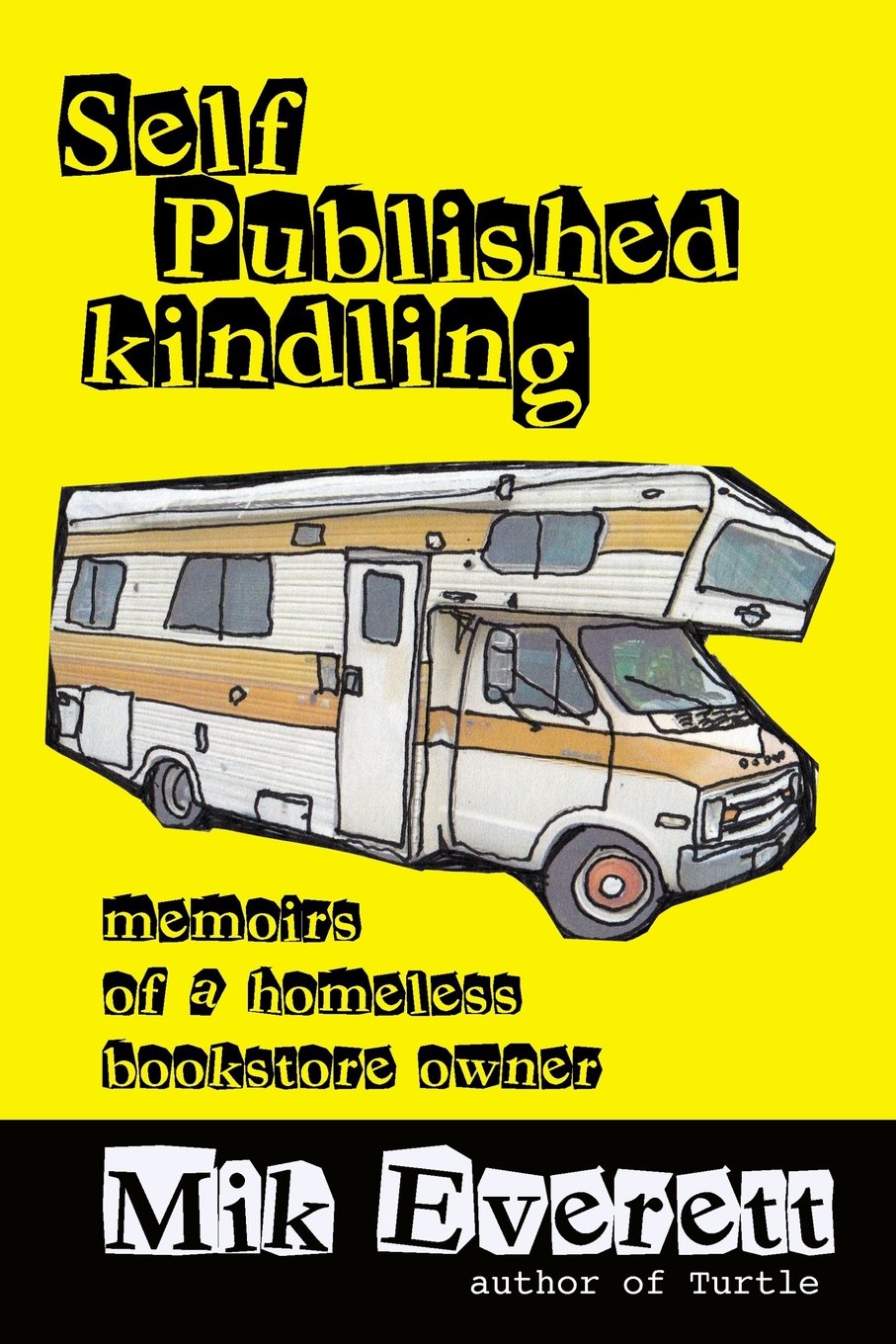
Self-Published Kindling: Memoirs of a Homeless Bookstore Owner by Mik Everett
I read plenty of books I don’t like, and this is one of them.
What I like most about disliking a book is how it reveals my unspoken expectations–what I depend on the author to provide to me, the reader.
And this, in turn (as in literally turning it around), informs and strengthens my perspective as a writer.
Audio version: Kate reads this article to you!
Book information and ratings:
Self-Published Kindling | by Mik Everett, 2013 | |
Genre: | Nonfiction, memoir |
|
Subject: | Homelessness | |
Rating: | Not my favorite | |
Read as: | Ebook | |
Readability: | Accessible | |
Subject Weight: | Moderate | |
How I found this book:
I read Laziness Does Not Exist by Devon Price.
He mentions a close friend and recommends her book Self-Published Kindling as an example of how homeless people aren’t lazy–there’s just more to the story that we aren’t understanding.
I was intrigued by an opportunity to deepen my understanding on this subject (and I love a good recommendation), so I found the ebook for a couple of dollars on Amazon and added it to my reading list.
About this book:
Devon Price says this is an "incredible book about [the author’s] experiences being homeless while running a bookstore" (Medium.com).
While the author does share a homeless experience, this book is nowhere near “incredible.”
****
I picked up this book with the intention and expectation of getting to know the author. I wanted to understand where she was coming from and what she went through–I wanted ALL of the context.
But, as I neared the end of this book, I was in a genuine state of confusion and frustration.
On the last page, the author proudly proclaims that she wrote all 171 pages in 2 weeks, typing an average of 7,000 words a day on her laptop.
Ah-ha! There it is.
This book was written in an extremely short amount of time (2 weeks), by a very young woman (22 years old), during an incredibly stressful experience: 2 months of homelessness with her partner and 2 children while dumping every resource into their floundering used bookstore. (That’s a lot of 2s…)
It is probably because she wrote it in the midst of the turmoil, and because it is self-published, that I found the quality lacking in the writing (both technically and stylistically) and in the depth of personal reflection.
****
This book has readability. Everett does lead the reader through a coherent series of events while providing some detail, crafting decent dialogue, and proclaiming her ideals.
I was following along the first half of the book just fine:
They (she, her daughter, her partner, and her partner’s son) get an eviction notice, and I’m interpreting the desperation and stress.
Before she leaves, on the apartment wall, she writes in Sharpie: “3.5 million homeless Americans. 1.6 million are children. Today, my children are 2 more. Thanks.” (p. 60) and I’m identifying with her sarcasm and anger.
They buy a motorhome that immediately breaks down, and I’m filled with despair.
They park in the homeless corner of the Walmart parking lot, and I’m relieved and very worried.
A woman is handing out cold lunches from H.O.P.E. (the Homeless Outreach Providing Encouragement organization), and I’m more grateful than embarassed.
She pays $1 for a shower with her little girl at the rec center, and I’m frustrated at the inconvenience but glad for the resource.
She steals a dress from Target to wear to her bookstore event, and I’m not totally sure about that–but I’m going with it. (She rationalizes this by saying she doesn’t want to look homeless and stealing from a big box store isn’t stealing from a person, although I’m not sure how long it’s been since they’ve been evicted?)
They are "Still, [showing] up to work every day, even though no customers did. We might go a week without a single browser, let alone a purchase" (p 50). And I’m not sure why?
Why pay rent at the bookstore and not an apartment for their kids?
Is there any way they can live at the bookstore?
Maybe they see the presently unsuccessful bookstore as an investment that will pay off eventually…
Maybe the rent on the store is that much lower or maybe they had paid in advance…
Why, why, why…?
Maybe, maybe, maybe…???
Wait.
Why am I filling in all the blanks here?
****
It took me a while to identify that this author fails to lead the reader through much of her mental and emotional landscape.
I was constantly filling in the gaps with my own reactions and rationalizations but trying to give her the benefit of the doubt at the same time.
As a reader, this isn’t my job, and it was tiresome. The burden of providing the basis of understanding lies with the author, and I had dozens and dozens of questions as I read.
****
This book was also littered with some things I could have done without, specifically several long, multi-page rants loosely disguised as dialogue.
Her anger and ideals were unmistakable–and, at times, contradictory.
As a reader, I felt duped over and over again into reading these dialogues; I was looking for the thing moving the story forward, but instead was dragged through on-going tirades.
Points can be made and ideas can be and shared in ways that are far more effective and interesting for the reader.
****
The bookstore they own focused specifically on serving the local authors of the Longmont, Colorado area–especially those who are self-published.
She shares this scenario:
“One book we have,” I said, “The author had just put an ad on Craigslist. John found it. ‘Free books. Self-published. Good for taking apart to use for crafts, or for kindling,’ That’s what is said. This guy just had a garage full of self-published books.” (p. 166)
This little story is the basis for the title of Everett's book.
While I think the author meant her title sarcastically, I find that it speaks more literally to her book.
This is NOT to say that I think it deserves to be thrown in the burn barrel–I mean to say this work is literally the kindling laid, but lacks the spark, the development, the fire.
****
She specifically misses out on developing the ending.
Everett ends the story before they find a place to live. So, instead of detailing the physical process of moving from homeless to “homed,” as well as her thoughts and feelings throughout, AND offering some interesting compare and contrast points–she intentionally leaves you hanging in her homeless mess.
What a gem of an opportunity missed.
****
The good news is that Devon Price was right: I did not see these homeless people as lazy.
The unfortunate news is that this book is not about getting to know an individual through reflection on a difficult experience or even a book about how a family becomes homeless, survives, and reclaims stability–but a platform for the writer to vent.
There is a lot of potential here–but it was immaturely and prematurely executed.
About the author:
MIK EVERETT is an American Regionalist novelist born in 1991 in Wichita, Kansas. She studied philosophy and English at Wichita State University, where she also worked as a logic clinician before moving to Boulder, Colorado to open a bookstore. She is the author of [several books]. Goodreads
Sources:
Everett, Mik. Self-Published Kindling: Memoirs of a Homeless Bookstore Owner. KindleUnlimited. 2013. Amazon, https://www.amazon.com/Self-Published-Kindling-Memoirs-Homeless-Bookstore/dp/0615852009.
*This is issue #4 of The Book Moth Newsletter

Add a comment: