
Issue #3: The Disease to Please
An unflinching look at people pleasing and how to recover your sense of self

Book Review
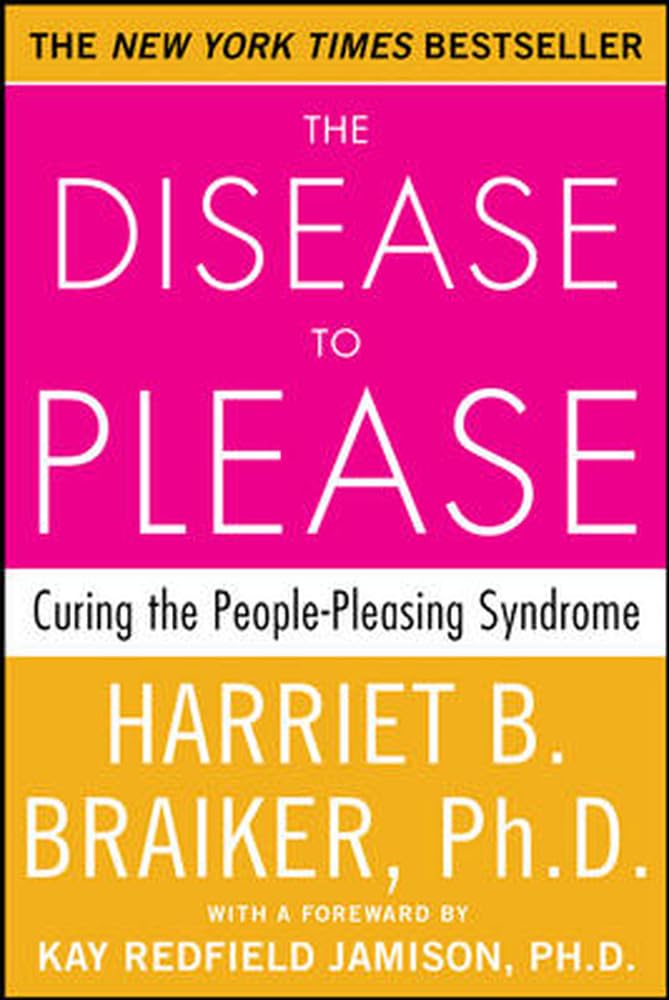
The Disease to Please: Curing the People-Pleasing Syndrome by Harriet B. Braiker
May we all better appreciate ourselves for who we are and not for what we do.
Audio version: Kate reads this article to you!
Book information & ratings:
The Disease to Please | by Harriet B. Braiker, 2001 | |
Genre: | Nonfiction, self-help |
|
Subject: | Mindset/stress management | |
Rating: | Worth the investment | |
Read as: | Print copy | |
Readability: | Accessible | |
Subject Weight: | Moderate | |
How I found this book:
My best friend Julie recommended this. The title alone made me want to eat the book whole! Add Julie’s stamp of approval, and it was a must-read for me.
About this book:
It’s disconcerting to have someone take an impeccably sharp knife in one hand, your carefully maintained belief system in the other, and adeptly filet the thing: cutting away the fleshy meat of everything you’ve been feeding and exercising, leaving bare boned messages flayed out in perfect symmetry on the other…
****
As a recovering Mormon woman, this book had me at the title! Good Mormons are great people-pleasers. Good Mormon women are excellent people-pleasers…and I was a really good Mormon woman. It was my training, my place in the world, my divine calling to be obedient, compliant, and nice–which would ensure my approval in this life and my place in eternity…
I’ve made a lot of progress since leaving the Mormon church 5 years ago, but this book brought some nasty foundational beliefs to light–things I wasn’t even aware of–especially as some of the same messages are delivered not only specifically through religion but more insidiously through our American culture, to both men and women.
And Braiker lays it all out–THEN dismantles it–AND THEN replaces it.
It is profound, comprehensive, helpful–and astounding.
****
She begins by outlining the toxic people-pleasing mindset in very concrete, memorable ways, mirroring both The Ten Commandments and The Seven Deadly Sins:
The Ten Commandments of People-Pleasing
I should always do what others want, expect, or need from me.
I should take care of everyone around me whether they ask for help or not.
I should always listen to everyone’s problems and try my best to solve them.
I should always be nice and never hurt anyone’s feelings.
I should always put other people first, before me.
I should never say “no” to anyone who needs or requests something of me.
I should never disappoint anyone or let others down in any way.
I should always be happy and upbeat and never show any negative feelings to others.
I should always try to please people and make them happy.
I should try never to burden others with my own needs or problems.
There is really a hidden eleventh commandment as well: I should fulfill all of these shoulds and shouldn’t expectations of myself completely and perfectly. (p 17)
****
If those are the commandments, these are the promised blessings:
The Seven Deadly Shoulds
Other people should appreciate and love me because of all the things I do for them.
Other people should always like and approve of me because of how hard I work to please them.
Other people should never reject or criticize me because I always try to live up to their desires and expectations.
Other people should be kind and caring to me in return because of how well I treat them.
Other people should never hurt me or treat me unfairly because I am so nice to them.
Other people should never leave or abandon me because of how much I make them need me.
Other people should never be angry with me because I would go to any length to avoid conflict, anger, or confrontation with them. (p 18)
I love that she points out the following:
These rules about how others should and should not behave reveal the defensive character of people-pleasing. There is little doubt that pleasing, helping, or fulfilling the needs of other people gives you pleasure and affords you gratification. However, the defensive people-pleasing formula that seems to deter negative responses from others in exchange for your niceness serves as an even stronger motivation. (p 18)
****
You might have noticed the greasy “shoulds” smearing through every statement. These “shoulds” are problematic.
My friends and I routinely call each other out on our shitty “shoulds”—especially when one of us is dangerously close to a freak-out or shame spiral. We like to put it into perspective by saying lovely things to each other like: “stop ‘shoulding’ on yourself” and “this is a giant ‘should’ storm,” and “that sounds should-y,” etc.
Using “should” as a warning signal actually helps a lot, because:
The bottom line is that the only thing you really should do is eliminate as many shoulds from your thinking as possible. When you replace the demanding shoulds with alternative statements about your requests, desires, or preferences, you will reap the benefits emotionally. (p 21)
****
If any of these lists or ideas seem overwhelming to you, Braiker makes it digestible with certain statements highlighted throughout the book and a section called “Attitude Adjustments” at the end of every chapter where she helps reconfigure the harmful messages.
She also includes several true/false quizzes to help you self-evaluate.
I took all of the quizzes and was so happy to recognize that I was able to answer “false” to something I would have answered “true” to in my earlier years…Yay, me! But, I still managed to score within the top tier on every single quiz. Oh, shit. I still have a lot of work to do. (!!!)
****
At the end of the book she includes “The 21-Day Action Plan for Curing the Disease to Please.” Leave it to this brilliant and compassionate woman to hand out not 1, but 21 lifelines as you move forward.
The magnitude of this mind-set problem is staggering–and the daily steps (though almost tedious) help a lot. I’m still working through them.
She provides exercises around: how to say "no"; rewriting “The Ten Commandments of People-Pleasing”; correcting “The Seven Deadly Shoulds”; solving a problem with a friend, not for a friend; and much, much more.
****
I’ll leave you with this underlying wish from Dr. Braiker:
May we all better appreciate ourselves for who we are and not for what we do.
Amen.
About the author:
HARRIET B. BRAIKER (1948-2004) [was a bestselling author and a] practicing clinical psychologist and management consultant in Los Angeles/Beverly Hills and Pasadena, California, for more than 25 years. [...] Dr. Braiker was an internationally recognized authority on stress and women's issues who was always in great demand as a public speaker. She was a contributing editor and columnist for Working Woman and Lear's, and also wrote for many other national women's magazines. Often featured in the media, Dr. Braiker appeared many times on national talk shows[...].
She is frequently quoted as having said, "Striving for excellence motivates you; striving for perfection is demoralizing." Harrietbraiker.com
(She passed away at 55. Her obituary by the Los Angeles Times is excellent.)
Sources:
Braiker, Harriet B. The Disease to Please: Curing the People-Pleasing Syndrome. McGraw-Hill, 2001, New York.
*This is issue #3 of The Book Moth Newsletter

Add a comment: