Power
Felt Notes
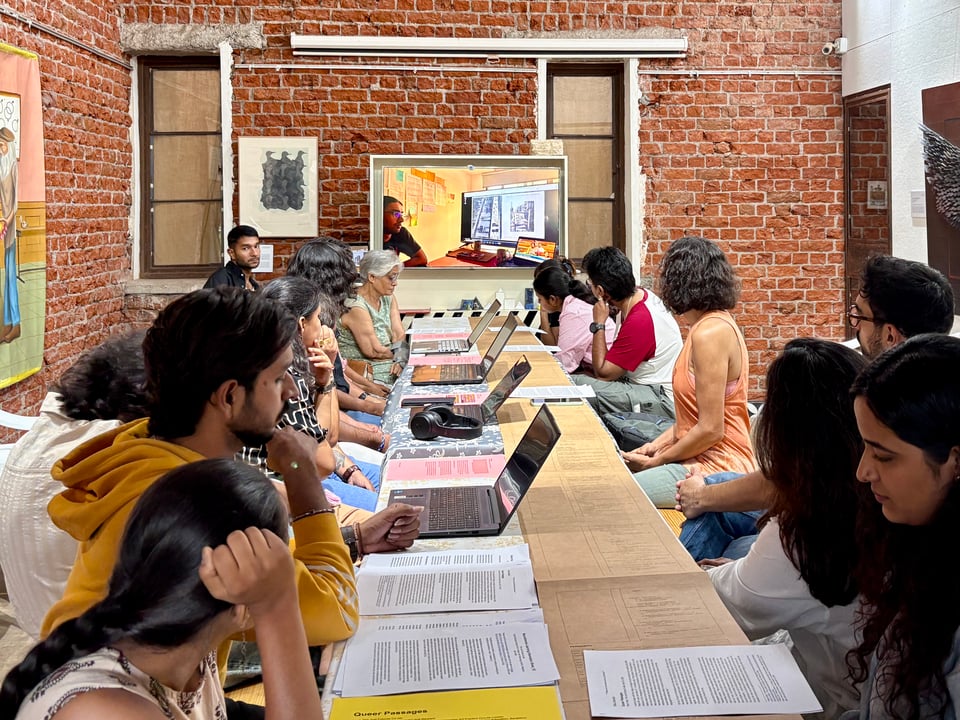
ID: The Just Futures Co-lab Pop-Up called “Queer Passages” for, with, and at Vikalp’s Art Exhibition on May 28, 2026. Queer Passages brought together interactive storytelling and writing studies as forms of digital humanities and contemporary art scholarship from the lab as rooted in anti-caste, anti-colonial, Queer- and Trans-feminist processes of collaborative knowledge production in and with the digital. As standalone HTML files, the interactive hypertexts illuminated a range of epistemic locations from citational to computational and media curation to dreamscapes. As an endless scroll of critical making index, the analog print laid bare forms such as texts, networks, public media, code, sounds, and songs as our expansive and intentional scholarly citations. This pop-up followed a form and focus drawing upon another exhibit at the Bangalore International Center (BIC) in December 2025. Image courtesy of Kush Patel (May 2026).
Last month marked the successful completion of postgraduate seminars and a corresponding public show of graduating lab works in Bengaluru (May 17-18, 2026), as well as a pop-up lab engagement in the context of Vikalp’s art exhibition in Vadodara (May 27, 2026). Both milestones were part of my ongoing embeddings in community, involving people with whom I build discourse and new worlds as an engaged academic—and through which I demonstrate how thinking-making-doing relations can come into being with critical pedagogy and research-creation work at the intersections art, technology, and social justice.
To my fellow queers and queens at the lab—aṇu, Devaki, eyeshaa, KP, Ruhani, Urja, and Vepa: hearty congratulations to you and to us! The curatorial note, “acts of knowing,” [1] held together your individual excellence, our trusting connections, the sites of knowing both named and deepened over the past two (and three) years, and the equally immersive works we aim to produce as Co-lab’ers moving forward.
To my fellow queers and queens at Vikalp—Bela, Deep, Indira, Hitwa, Maya, Minakshi, Palak, Prateek, Roshni, Shanta, Sourabh, Tanya, and Vaishali: congratulations to us! The exhibition frame and program, “Dialogues of Collective Solidarity,” [2] modeled what is possible when we come together to amplify lived histories, affective politics, and structural realities of queerness through textual, visual, and performative forms. Additionally for me, this art exhibition served as a node among many such nodes of an ever growing rhizome at and with Vikalp: grateful.
Last month, I also concluded a two-part archival bootcamp with lab members aṇu, Devaki, eyeshaa, Namitha, and Ruhani. At these sessions, we extended the principles and lessons of Queer- and Trans-Feminist Digital Humanities (DH) and Critical Making TDR from 2024 to work on the materials and exigencies of “the Bill” between its uninvited release and outrageous passing earlier this year. Such are the lab’s pedagogy intensives, where building and honing our individual and collective capacities to act with scholarly, creative, and publicly engaged expertise, even during our darkest nights, is paramount. My gratitude to Niruj and to everyone who was able to participate in these sessions as and alongside our essential work in community.
Last month, too, and in relation to my wider and ongoing DH scholarship, Susan and I, with Aiden, launched The Just Archives Collaboratory site on Knowledge Commons. Having been working on this project collaboratively as part of my 2025 SSSHARC Hunt-Simes Visiting Chair of Sexuality Studies fellowship at the University of Sydney [3], it’s been remarkable to study all things queer, trans, feminist, and archival—and to build and further this project with Susan as we look ahead and upward. The site outlines the project purpose; carries links to our queer and trans archives’ workshop resources; and makes accessible to the world the newly launched Dialogue series CFP. To those on our listserv and others connected with us via social media, stay tuned for a related announcement extending into next week’s International Archives Week #IAW2026, whose theme, “Archives For Justice,” aligns closely with the community, scholarly, and pedagogical orientations of this project.
And before I break for the summer, I want to share with you one more update (again, in the context of my broader scholarly practice). This month, the University of Minnesota Press released the online, open-access edition of Critical Infrastructure Studies and Digital Humanities volume, edited by Alan Liu, Urszula Pawlicka-Deger, and James Smithies—and one in which I have a co-written chapter (with Ashley Caranto Morford and Arun Jacob) on “Resisting BYOI (Bring Your Own Infrastructure) in Digital Humanities Learning Spaces” [4]. My earnest gratitude to Alan for demonstrating to me, and to each of the contributors, what might a scholarly-editorial brilliance look like at all scales from project conception, robust peer review, and care-filled correspondence to accessible post-publication media announcement [5] and helpful summary notes.
As I wrote elsewhere [6]: “In community, to know and to feel that knowing, is power.”
Notes
[1] Access the event poster (collaboratively led by Urja) and exhibition catalog (initiated by aṇu and Devaki and collectively written and edited)—and read the curatorial statement as follows: As students of the MA Contemporary Art Practice and M.Des Human Centered Design at Srishti Manipal, we present works from our 24-week capstone. Our inquiries have travelled with us through two years, as we were guided, mentored, and shaped by the values, orientations, and approaches of The Just Futures Co-Lab (TJFC-L). The exhibition title comes from TJFC-L’s two interconnected inquiries, namely, Intersectional Feminist Histories and Futures and Critical Digital Humanities Pedagogy—and specifically, the project spaces of Queer Futurities and Futures with the “Peripheries” located in their overlaps. All works at the lab share a commitment to anti-caste, anti-colonial, queer- and trans-feminist processes of research creation, where making in and with the digital is also about building critical relationships with tools and technologies of thinking, writing, and creative prototyping. Within this context, and furthermore, the exhibition title draws upon José Esteban Muñoz’s concept of “queer acts” to ask: if acts center attention to what we do rather than what we are, how do each of us within this collection of MA CAP and M.Des HCD students lay claims to acts of knowing? Throughout this capstone, we found ourselves knowing with biographies, pedagogies, and histories; forms that are not representational, performative or external to contemporary art, but rather constituting and amplifying its very research creation methodologies. As the lab positions these forms as artistic-cultural critiques, they show up in different configurations across each of our projects and creative expressions ranging from sonic-texual interfaces, poetry, learning practices, and surrealist album art to digital video games, fiber art, and portraiture on kitchenware.
[2] Access the exhibition poster and program (designed by Hitwa)—and follow along the curatorial statement as follows: In the face of everyday hostilities, rather than crumble and despair, Vikalp proposes a collective resolve to hold space for queer feelings and politics, for radical solidarity across difference, and for affirming ourselves and each other in community. Specifically, in “Dialogues of Collective Solidarity,” we invite artists to ask questions about the aesthetics of resistance, or what might it mean to build and navigate one’s voice and expression as itself a counternarrative of cis-hetropatriarchal silencing and exclusion, including values otherwise normativized within queer cultures of assimilation, caste coloniality, and nationalism. The exhibition brings together contemporary artists from the LGBTQIA+ community and allies with practices in visual, textual, and performance art to locate solidarity and freedom at the heart of queerness. Rather than an exceptional story, we foreground the many languages of queer existence and collectivizing—inviting us all into a space of reflection and reckoning, healing and repair, and an assertion of co-liberatory politics. Each artwork, whether single- or co-authored, functions as a response to this call: thoughtful, unapologetic, argumentative, and honest.
[3] To read more about this work, see this digital archive of queer scholarship at the University of Sydney Hunt-Simes Institute in Sexuality Studies (HISS), https://www.hiss.sydney/ (led with care by Lee Wallace, Vic Rawlings, and Huy Nguyen).
[4] See the editors’ introduction under “Part 3: (Re)evisioning Digital Humanities Infrastructure”: “In chapter 14, ‘Resisting BYOI (Bring Your Own Infrastructure) in Digital Humanities Learning Spaces,’ Kush Patel, Ashley Caranto Morford, and Arun Jacob of the Pedagogy of the Digitally Oppressed Collective present a fictitious narrative set in higher education institutions in India, the U.S., and Canada during the Covid-19 pandemic. Their story unfolds in a Twine narrative of fictional emails between campus administrators, department chairs, faculty members, students, and others. As the pandemic unfolds and remote-working takes over, ‘responsibilization’ (whereby neoliberal corporatization places pressure on individuals to use their own resources to keep things running) and differences in infrastructure across institutions and classes become more apparent. Ultimately, Patel, Caranto Morford, and Jacob argue in a powerful indictment, responsibilization—’a legacy and aspect of capitalist colonialism’—is ‘a supposed freedom that strips others of their agency and safety’” (pp. xxvii in the physical book).
[5] Consider, for example, Alan Liu’s alt-text for the book cover (access here, and which I would add is an expert class on how to write one): “Cover of new book in the U. Minnesota Press Debates in DH series: Critical Infrastructure Studies and Digital Humanities, eds. Alan Liu, Urszula Pawlicka-Deger, and James Smithies. The book cover shows the title of the book in large, upper-case-only, sans-serif block letters (colored yellow for ‘Critical Infrastructure Studies’ and red for ‘Digital Humanities’) against a diagonally tiled, grey background with a drawn, shaded texture suggesting concrete. The overall visual effect is of text stenciled on a concrete wall in an urban infrastructural environment whose brutalist modern style has been given nuance in two ways. First, the architect has qualified the heavy-handed systematicity of modernism through the decor of slightly irregular tessellation (the tiles are of several shapes in an overall geometry whose system is unclear and unpredictable). Then it is as if some street artist or street theater group has come along and stencil spray-painted a poster for their improv event over the building wall.” See: Alan Liu (@alanyliu.bsky.social), “I had fun writing alt-text for this image of the cover of the new Critical Infrastructure Studies & Digital Humanities book (in Debates in DH series) I co-edited,” BlueSky Social, December 5, 2025, https://bsky.app/profile/alanyliu.bsky.social/post/3m76zmiqx4c2c
[6] Kush Patel (@kshpatel.bsky.social), “Ending one of the most unkind and difficult weeks of this month with hope in the respective works of a forthcoming trans-feminist DH project review and my doctoral student’s successful pre-proposal defense. In community, to know and to feel that knowing, is power,” BlueSky Social, March 27, 2026, https://bsky.app/profile/kshpatel.bsky.social/post/3mhzodpd5ic2x
About
Felt Notes are monthly dispatches about the work of the Just Futures Co-lab, and the co-labouring worlds of research and teaching in art, design, and the digital humanities that it scaffolds, furthers, and amplifies. The letter writing translates the ever so negotiated nature of this space at Srishti Manipal Institute and the discourse and scholarship on equity and justice I produce with students and wider academic and non-academic community members through critical pedagogy; archival and database constructions; interactive digital storytelling; and inquiries into queer- and trans-feminist digital technologies and knowledge infrastructures.
I hope reading this letter and its upcoming segments are a meaningful experience for you. If you aren’t subscribed yet, you may do so here. If you are already subscribed, I would love for you to share the link with friends and trusted networks as we make sense of our relationships to technology as well as our relationships to each other via technology. If you would like to write or co-write a letter in the future or share any announcements, please feel free to get in touch with me, and whilst you’re here, please also check out the Felt Notes Archive.
Kush Patel