Exhibitions
Felt Notes
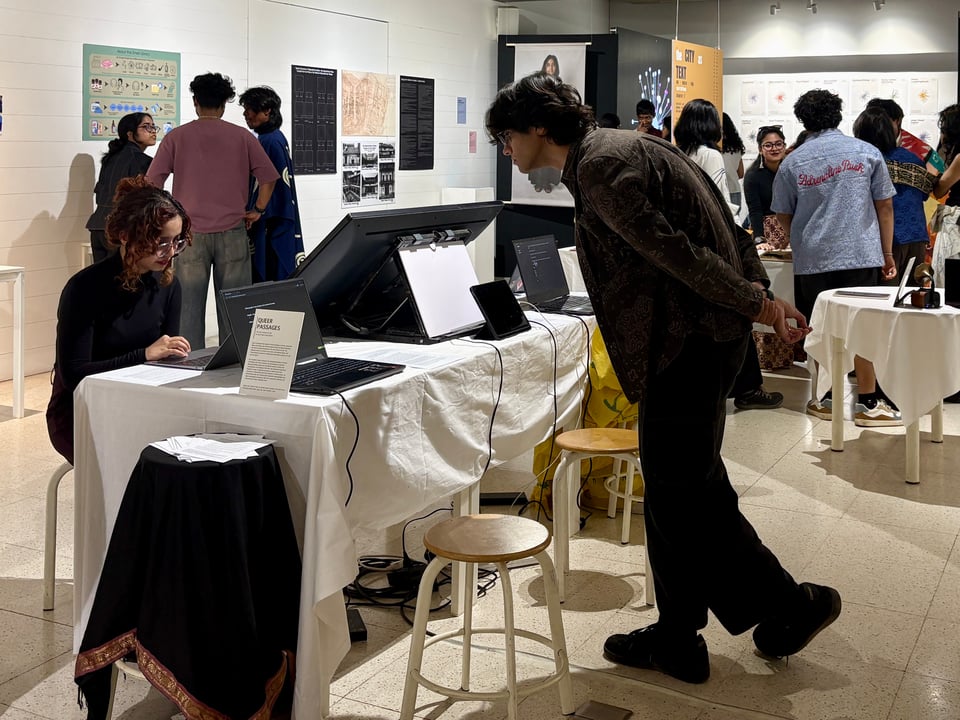
ID: An exhibition of selected projects from The Just Futures Co-lab entitled “Queer Passages” at the Bangalore International Center (BIC) this month. The projects comprise an annotated glossary of archival and records terminology as scrollable digital image composite (50 inches x 155 inches) on a TV; interactive hypertexts as standalone HTML files on laptops; and a statement against GenAI in writing on newsprint paper (A4 stack).
The past three months leading up to the end of 2025 have been brilliantly busy and publicly engaged at The Just Futures Co-lab. In name and form, my units on “Text and Textuality” covered two contemporaneous teaching experiences each on transdisciplinary research (TDR) project and academic writing. Whereas the TDR project had students of MA Contemporary Art Practice, MA Visual Communication, and MDes Human-Centered Design come together and work on hypertexts, the writing seminar for the second year cohort of MA CAP made space for different genres of reading and writing including, but not limited to, the biographical, poetic, historical-theoretical, (non)fictional, and speculative. Interconnecting these units, I asked:
If writing comprises everyday artifacts (ephemera, code, prints, bibliographies, databases, video, and sound media), practices (messaging, note-taking, scripting, threading, researching, essaying, cataloging, and archiving), and experiences (reading, listening, storytelling, citing, editing, and community organizing), when and how does writing become a hypertext (TDR project) and when and how does writing become a scholarly text (research paper). Furthermore, what textual forms, arguments, and interactivities emerge when we approach writing (and its attendant artifacts, practices, and experiences) with anti-colonial, anti-caste, queer- and trans-feminist epistemologies?
The publicness of this inquiry-based work also assumed distinct exhibitorial forms at the end of the semester. The first exhibition entitled, “drafting disorientations,” extended from the ten-week-long studio facilitated by Sandip Kuriakose in the context of 1ShanthiRoad, which is also where we held the actual show (November 28-29, 2025). The second exhibition called “Queer Passages” constituted a standalone installation of the lab within the larger curation and envisioning structure of the Interlude 2025 program at the Bangalore International Center (December 18-19, 2025).
underpinning drafting disorientation was a set of explicitly anti-colonial, anti-caste, and Queer- and Trans-feminist epistemologies that disoriented each student’s art form uniquely and to which the classroom remained critically oriented. In particular, if Sara Ahmed’s writings in Queer Phenomenology (2006) served as a guiding text for the studio, it was the “scholarly dis-/re-/orientation” opening to the seminar that amplified students’ individual forms of thinking—and the connections they re-made with their respective projects through methods of drafting, reworking, reviewing, and rewriting. The coming together of works—texts and objects—in this exhibition was a bringing together of the destabilized fields of power both as experienced within each student’s body and through relations of art and self-production that we are continually re-working.
Contributors: aṇu, Anjali, Devaki [and Priya], eyeshaan, Krishnapriya (KP), Kush, Sandip, Urja, Vaishali, Vepa
Queer Passages bring together critical pedagogy, archives, interactive digital storytelling, and writing studies as forms of digital humanities and critical making scholarship at The Just Futures Co-lab. The displayed works are rooted in anti-caste, anti-colonial, Queer- and Trans-feminist processes of collaborative knowledge production in and with the digital. As a scrollable image composite, the annotated glossary of archival terminology cites texts, projects, and technologies to structure discourse building around two interrelated themes of ethics and custodianship. As individual HTML files, the interactive hypertexts illuminate a range of epistemic locations in creative work from citational to computational and from caregiving to media curation. As distributable prints, the refusing GenAI statement acknowledges how digital technologies produced by Big Tech corporations dishonour our commitments to deep intellectual work.
Contributors: Akshya, amo, Anantha, Anjali, aṇu, Devaki, Devansh, eyeshaan, Joyce, Krishnapriya, Kush, Nandita, Ruhani, saguu, Urja, Vepa, Yasshvie.
Among several accomplishments this term, perhaps, the one that stands out to me the most is the statement on refusing GenAI use in writing that I collaboratively produced with lab members: amo, aṇu, Krishnapriya (KP), Ruhani, Urja, and Vepa. To access our handout and integrate this approach and form into your classroom and inclusion policies, please refer to the document here (PDF).
There is much to look forward to as I transition into the new year with each of my students and their continuing work in the lab. Onward—and with light and justice wishes for 2026!
About
Felt Notes are monthly dispatches about the work of the Just Futures Co-lab, and the co-labouring worlds of research and teaching in art, design, and the digital humanities that it scaffolds, furthers, and amplifies. The letter writing translates the ever so negotiated nature of this space at Srishti Manipal Institute and the discourse and scholarship on equity and justice I produce with students and wider academic and non-academic community members through critical pedagogy; archival and database constructions; interactive digital storytelling; and inquiries into queer- and trans-feminist digital technologies and knowledge infrastructures.
I hope reading this letter and its upcoming segments are a meaningful experience for you. If you aren’t subscribed yet, you may do so here. If you are already subscribed, I would love for you to share the link with friends and trusted networks as we make sense of our relationships to technology as well as our relationships to each other via technology. If you would like to write or co-write a letter in the future or share any announcements, please feel free to get in touch with me, and whilst you’re here, please also check out the Felt Notes Archive.
Kush Patel