Blue
Felt Notes
ID: The Feminist Solidarities Reading Circle at Prabhakar Kamble’s Vichitra Natak in Anand Warehouse, Mattancherry. (R-L) eyeshaa, KP, aṇu, Devaki, Vaishali, Vepa, and moi. Image courtesy of Kailash Khanjode (February 13, 2026).
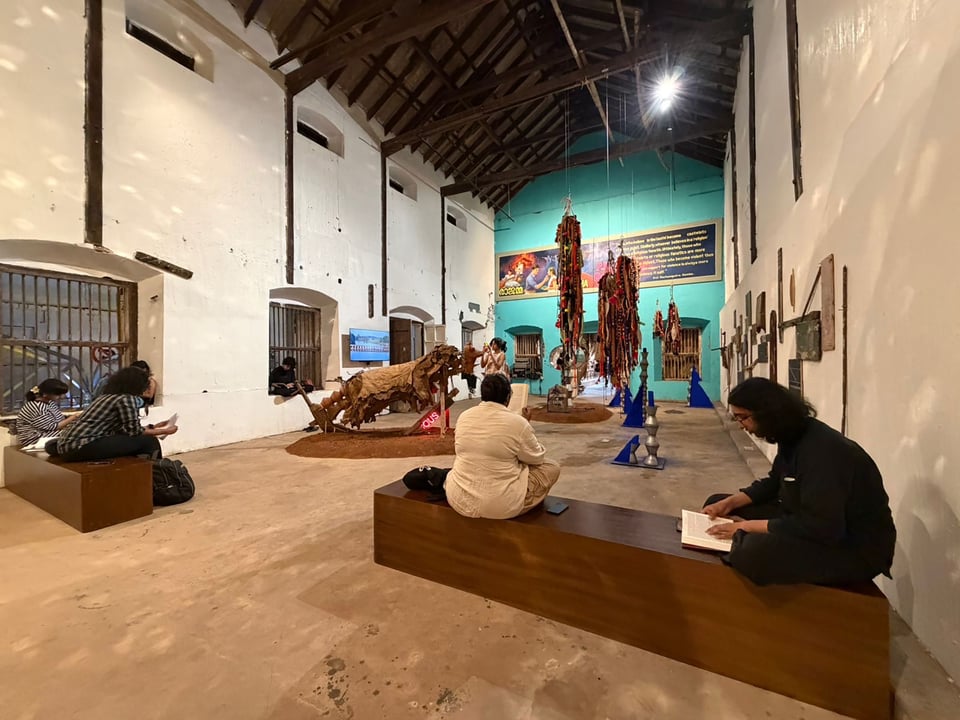
This month, the Feminist Solidarities Reading Circle [1] met at Kochi Biennale in the context of Prabhakar Kamble’s installation entitled Vichitra Natak. Held centrally by a gravestone in a pile of soil with Dr Babasaheb Ambedkar’s clarion call, “ANNIHILATION OF CASTE,” and framed by a wall-to-wall hand-painted film poster honouring the legacy of PK Rosy, born Rajamma, the circle brought nine of us together to simply read—and to read alongside the words of Professor Gautamiputra Kamble also on the wall poster as follows:
Those, Who believe in the ‘caste’ become casteists at some point. Similarly, whoever believes in a ‘religion’ becomes a religious fanatic. Ultimately, those who become casteists or religious fanatics are more likely to become violent. Those who become violent then support violence, and support for violence is always more dangerous than violence itself.
Vichitra Natak is a text that invites epistemic examinations of caste violence through one’s movement with and alongside forms and expressions outside dominant social and artistic references; forms that Mario D’Souza in their exhibition note co-interprets as “dismissed” in the name of “folk” within the Brahmanical worldview of art and aesthetics or as “decorative” through similar oppressor caste and white Euro-centric logics of “abstraction” and conceptual purity in the academy. Prabhakar calls this work “Arte Povera of the subcontinent” [2] in which “art is sourced not from found detritus but from the precarious afterlives of craft, survival, and faith” [3].
In these material “afterlives,” I found sculptural forms [embodying] structural critiques:
+ chandeliers made of “ropes, metal, brass, bells, cowry, leather, and [hidden] terracotta pots” used by farmers to decorate their cattle, but configured here to document “five tiers of the varnashrama dharma” [4];
+ rotating sound instruments [doubling as] horse sculptures, restaging perhaps the otherwise revered chariot horses—and another of the cow tied to an LED screen carrying the phrase “RELIGIOUS;”
+ a video [disrupting] the caste gaze by crossprogramming brass bands and sugarcane fields; and
+ gridded visuals and metal doors [doubling as] frames of carcerality.
The work of annihilating caste, which includes naming and destroying our implications in everyday casteist violence are ever so instructive here. In relation to this Natak, my only ask of each co-participant—Aanandha, aṇu, Devaki, eyeshaa, Kailash, KP, Vaishali, and Vepa—was to bring along a text and/or source materials locally or within the group; a text that is feminist in orientation and one, which is also embedded in anti-caste, queer-trans-intersex, and/or anti-colonial politics.
We will gather at Prabhakar Kamble’s work at Anand Warehouse by 10:45 on Friday and after a brief introduction to the circle, we will all find a place to sit or stand and read quietly for an hour. At the end of the hour, we will share one insight from each text that we’ve read and proceed to reading—and reading out loud—a common text: the last letter by Rohit Vemula to pause for the day.
We selected the following texts to read individually and as a collective:
Aanandha: The Prisons We Broke (2009) by Baby Kamble, translated from Marathi by Maya Pandit.
aṇu: Castes In India: Their Mechanisms, Genesis and Development (1916) by Dr Babasaheb Ambedkar.
Devaki: The Seekers (2025) by Gautamiputra Kamble, translated from Marathi by Sirus J. Libeiro.
eyeshaa: Women in the Worlds of Labour (2021) edited by Mary E. John Meena Gopal.
Kailash: बाबांची रामू (2014) by ज. वि. पवार
KP: Annihilation of Caste (1936) by Dr Babasaheb Ambedkar.
Kush: Caste: Pedagogic Philosophy of Our Ruins (2025) by Yogesh Maitreye.
Vaishali: Beef, Brahmins, and Broken Men: An Annotated Critical Selection from The Untouchables (2019) by Dr Babasaheb Ambedkar, with an introduction by Kancha Ilaiah Shepherd and as edited and annotated by Alex George and S. Anand.
Vepa: Sing, Slivered Tongue: An Anthology of South Asian Women’s Poetry of Trauma in English (2025) edited by Lopamudra Basu and Feroza Jussawala.
All: The Last Letter (January 17, 2016) by Rohit Vemula.
My utmost gratitude to Kailash who I met serendipitously with and via aṇu a few days before the scheduled circle in Mattancherry—and whose work at the Biennale entitled Ginning Justice (with Rohit Athawale and Sachine Banne) carries sculptural forms each of Dr. Rohit Vemula and Dr. Pochiram Kamble as part of his practice, informed by Phule-Ambedkarite thought, to recast individuals who died from caste oppression on university campuses.
My heartfelt thanks to Aanandha who was also present at that same serendipitous meeting with Kailash and who recommended that we print out and read Rohit Vemula’s last letter at the circle. That Aanandha is now my PhD advisee and an integral part of The Just Futures Co-lab is doubly meaningful for my learning and our collectivizing work ahead.
And my hearty thanks to KP for gifting me a copy of The Seekers by Gautamiputra Kamble in Kochi. It was equally brilliant—and wonderfully serendipitous—to also have Devaki read from her own copy of The Seekers at this circle or as Prabhakar shared: “Thank you for doing this performance at my venue, it’s our venue. Kailash sent me some videos and they are beautiful. I am so glad you included The Seeker too” [5].
Onward.
Notes
[1] This was the fifth Feminist Solidarities Reading Circle and the first to be held outside Bengaluru. Sonali and I co-led the inaugural circle in Cubbon Park in August 2023 where we invited people of the city to join us in reading and discussing two texts, namely, The Vulgarity of Caste: Dalits, Sexuality, and Humanity in Modern India (2022) by Shailaja Paik and Undrowned: Black Feminist Lessons from Marine Mammals (2020) by Alexis Pauline Gumbs. Since then, the reading circle has not only come to re-occupy the park lawns periodically, but also on-campus spaces such as the lab and studio to celebrate Dr Babasaheb Ambedkar's birth anniversary on April 14th last year.
[2] As quoted in Mario D’Souza’s description of “Vichitra Natak” in: for the time being, sixth edition of Kochi-Muziris Biennale curated by Nikhil Chopra with HH Art Spaces, p. 125.
[3] Mario D’Souza, p. 125.
[4] —., p. 125.
[5] Personal correspondence (February 14, 2026).
About
Felt Notes are monthly dispatches about the work of the Just Futures Co-lab, and the co-labouring worlds of research and teaching in art, design, and the digital humanities that it scaffolds, furthers, and amplifies. The letter writing translates the ever so negotiated nature of this space at Srishti Manipal Institute and the discourse and scholarship on equity and justice I produce with students and wider academic and non-academic community members through critical pedagogy; archival and database constructions; interactive digital storytelling; and inquiries into queer- and trans-feminist digital technologies and knowledge infrastructures.
I hope reading this letter and its upcoming segments are a meaningful experience for you. If you aren’t subscribed yet, you may do so here. If you are already subscribed, I would love for you to share the link with friends and trusted networks as we make sense of our relationships to technology as well as our relationships to each other via technology. If you would like to write or co-write a letter in the future or share any announcements, please feel free to get in touch with me, and whilst you’re here, please also check out the Felt Notes Archive.
Kush Patel