On Courage publication day!
Dear friends,
Today is publication day for On Courage: How to Be a Dissident in an Age of Fear – my book with co-author Ami Fields-Meyer on how to fight authoritarianism.
I wrote to all of you earlier this year about how writing the book felt like chasing hope. As Ami and I interviewed 100 plus dissidents, again and again we heard how they were motivated by their hope for a better world – even against seemingly insurmountable odds. It was an inspiring journey, and made me feel more optimistic about the future.
But the days leading up to book launch, to be honest, felt a bit more like dread. There is something so vulnerable about waiting for the world to read your words and anticipating the response.
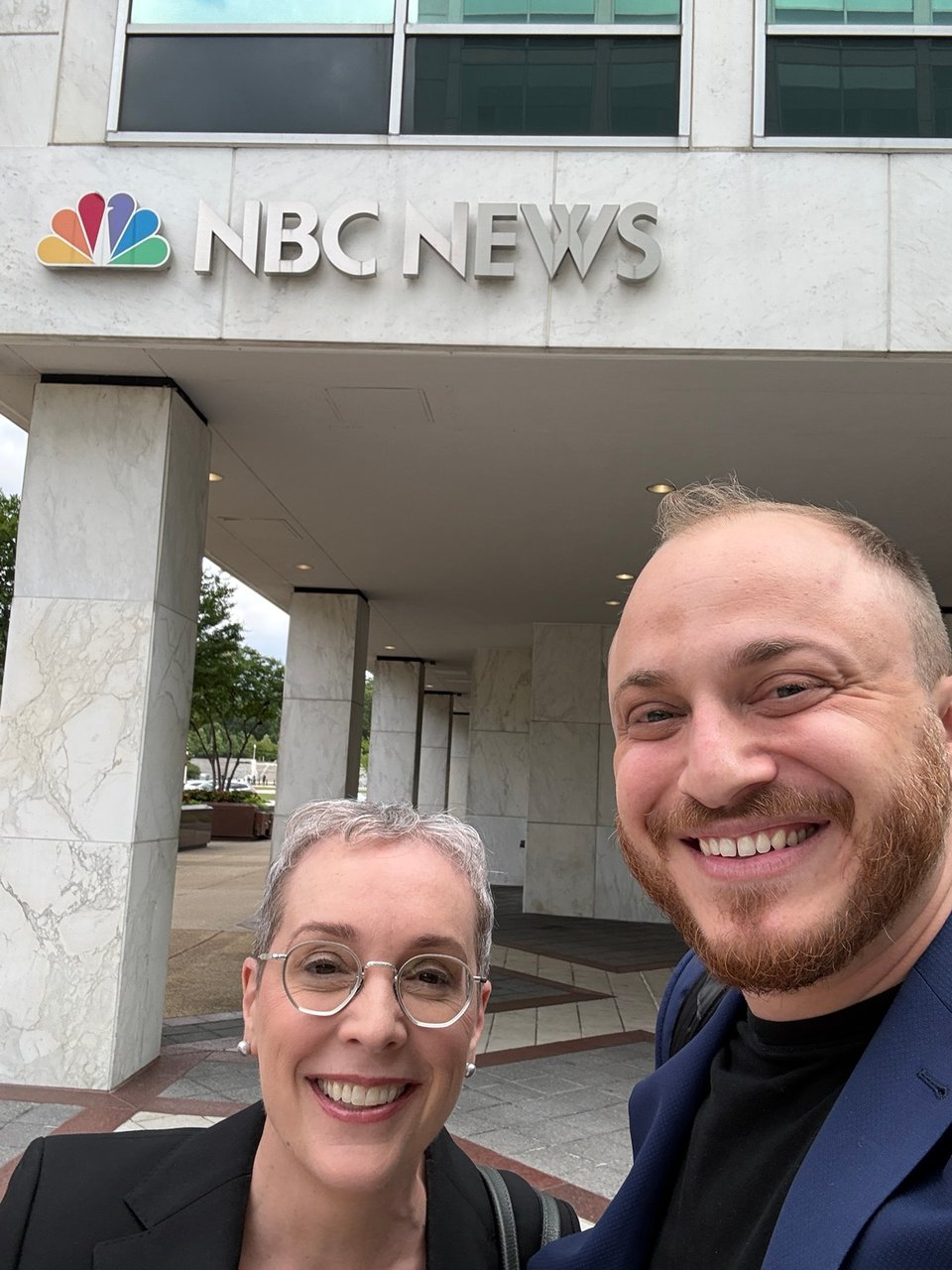
I was in that headspace when Ami and I stepped into the MS Now studio last week to record an interview with Rachel Maddow. We perched on high stools and stared into the black box where Maddow was piped in from another location. In our ear, the producer informed us that Maddow would speak for about 15 minutes, then we would be brought in after the break.
Maddow started by talking about the unexpected difficulty of narrating an audio book. Even short books take days and days of recording, she said. And at the end of each recording session, she said, “you are totally pancaked … you need to lie down and pant for a while and not speak.”
Teetering on my stool (I am too short for my feet to reach the rungs on most stools!), my heart sank. "Did she have us on to complain about taping our book?" I worried.
Maddow had, in fact, just spent days and days in the recording studio narrating the audio for On Courage. Was she regretting it?
But no, instead she talked about how narrating On Courage “was contrary to my own interests”— but worth it. Holding up a copy of our book, she went on to read excerpts about several of the brave dissidents we profiled and discussed how the stories made her re-examine some of her own beliefs.
“It’s a classic of our time” she concluded. “ I think everyone should read it. I’m honored to have done the audio book.” (You can watch the whole interview here).
“HOLY SHIT,” I scribbled in my notebook as the segment ended. We had achieved something profound and rare: we were heard. Our message resonated and it rang true to someone with deep expertise on the topic.
There is nothing better than the feeling of being truly seen, of being deeply understood by someone you respect. It is, in my humble opinion, the definition of love. And that gift, it turns out, was also what fueled so many of the dissidents we interviewed around the globe.
When we began reporting, we thought we would be gathering stories of heroic people throwing their bodies in front of soldiers and tanks—and sure, we did hear some of that. But more commonly, we heard stories like the one from Hong Kong dissident Nathan Law.
Law, who later gained fame as a leader in the Hong Kong democracy movement, started by simply passing out water bottles to fellow students protesting the Chinese occupation. But after he saw peaceful activists being pepper-sprayed and dragged away by officers, the once risk-averse student joined the protests himself.
“I witnessed more police brutality, more suppression, and more of my friends becoming more committed,” Law, who left Hong Kong in 2020, told us from his new home in exile in London. “I just had a gradual urge to just do more for my community.”
In other words, he saw unjust treatment and he cared enough to do something about it. Authoritarians work their dark magic by convincing us not to care about the groups they oppress. When you choose to see the humanity of people being targeted, you disrupt the authoritarian cycle.
In our New York Times Opinion essay (gift link) previewing the book, we describe this practice as redefining who we mean by “we.” Fighting authoritarianism is as much about insisting on seeing the humanity in each other as it is in any particular strategy or tactic.
As Maddow put it: "Most people whose stories get told in this book found themselves becoming dissidents simply because they insisted on paying attention to their own quiet internal moral compass. It didn’t mean they didn’t have fear or conflicting emotions, only that they trusted the personal, moral tug that guided them to say no, and then to take action."
I hope you find it inspiring to read the book, listen to Maddow narrate it, or just follow along as we publish a short video series with key lessons of the book. And if you can repost on social (our posts on YouTube, Instagram, Bluesky, LinkedIn, TikTok, or X) or review the book, that would boost us a lot.
As always, thanks for reading.
Best,
Julia
P.S. Book launch has distracted me from sending regular newsletters. So in case you want to keep up with my projects, here’s two things you might have missed.
My New York Times Opinion essay “Meta is Dying. It’s About Time” (gift link), was my most popular essay yet, the editors tell me. Meta was real mad – sending a spokesperson to Bluesky to fight with me and writing a letter to the editor.
My nonprofit newsroom Proof News has relaunched with a fantastic series of investigations into the ways that AI is infiltrating workplaces, from robots in hospitals to AI apps supervising hotel housekeepers. These stories require boots-on-the-ground reporting that few other outlets are doing. If you can afford to support Proof’s work, every dollar counts!