Three Cultures Walk Into the Desert
What an immersive-theater experiment at Burning Man taught me about AI, organizations, and the invisible rules inside every system
What an immersive-theater experiment at Burning Man taught me about AI, organizations, and the invisible rules inside every system
Jodi Schiller
It was an improbable collision of things I was fascinated by: virtual reality, theater, psychology, artificial intelligence, simulation theory, the technological Singularity, and the increasingly uncertain boundary between physical and virtual experience.
We had HTC Vive headsets. We had developers and artists. We had immersive theater and psychodrama.
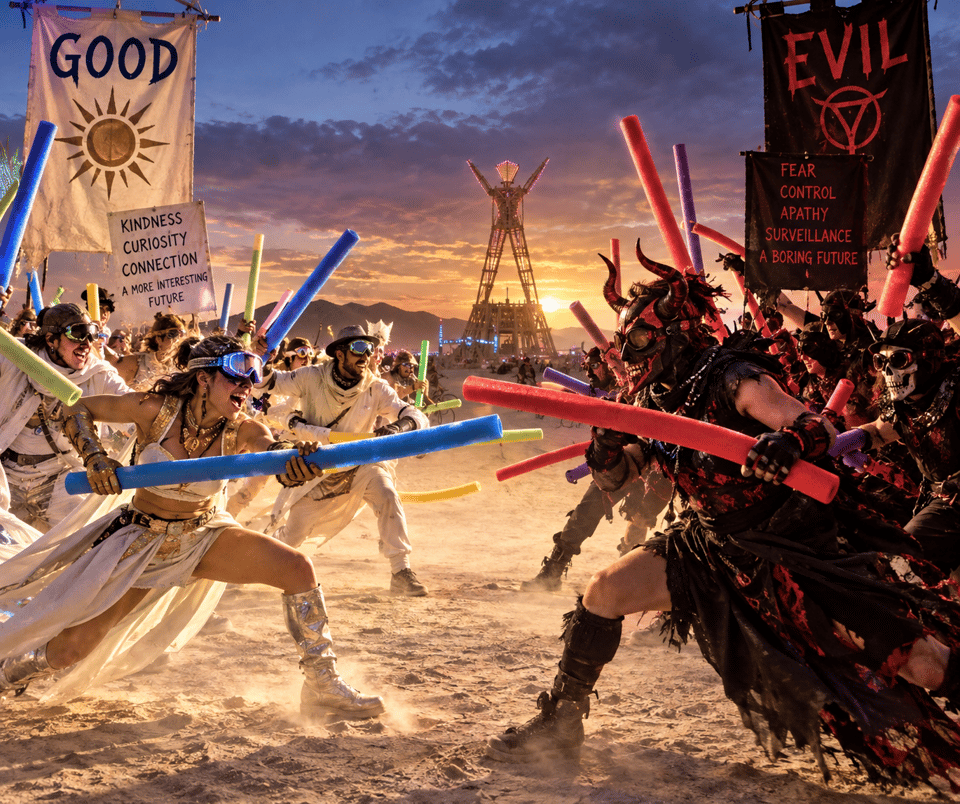
And because apparently I couldn't contemplate the future of humanity without staging a war, we also had a massive epic battle between good and evil.
The weapons were pool noodles.
Many of the people working on the project weren't performers. Some were understandably nervous.
During one rehearsal, I asked, “What word do we use in theater for the show?”
They looked at me blankly.
“A play,” I said. “It's a play. This is just playing. Don't be nervous. Just play.”
Then came the actual performance.
I was expecting approximately ten people.
Two showed up.
I remember looking around in disbelief. I had spent years working professionally in theater. Whether you appear for the performance is generally not negotiable.
IT'S A SHOW. YOU SHOW UP FOR A SHOW.
At the time, their absence seemed incomprehensible. Ten years later, I understand it differently.
Three Cultures Walk Into the Desert
We weren't merely combining technologies. We were combining cultures.
I came from professional theater, where the social contract is unusually clear: if you are in the show, you show up for the show. Everyone else's work depends on your presence.
Many of my collaborators came from technology. They understood experimentation, software, VR, and building things, but “performer” wasn't necessarily an identity they had ever inhabited.
And then there was Burning Man.
Burning Man has a deeply participatory culture. The distinction between performer and audience, creator and participant, giver and receiver is intentionally porous. You can spend one part of the day creating an experience for strangers and another wandering into experiences strangers created for you.
That's part of what makes it extraordinary. It is somewhat less convenient when you are trying to put on a scheduled show.
I thought we had established one kind of social contract: We are putting on a show. You are in the show. Therefore, you will be here when the show begins.
But we were operating inside a larger culture in which roles and commitments were much more fluid.
I had assumed the rules were obvious. They weren't.
I Was Part of the Collision
At the time, I was furious.
I was a producer. My staff had agreed to do a show, the show was happening, and most of them hadn’t shown up. From everything I knew professionally, this was outrageous.
But there was another problem: being furious about it wasn’t particularly Burning Man-esque either.
So I had to interrogate my own reaction. I wasn’t standing outside these three cultures observing their collision. I was inside it. I had brought the operating assumptions of professional theater with me, just as everyone else had brought theirs.
That changed the question from “Why didn’t these people do what they were supposed to do?” to “How did we construct a system in which different people had such different ideas about what they were supposed to do?”
When systems collide, it is tempting to locate the failure in the other person. The more useful question is often: What assumptions did each of us bring into the system that nobody thought to make explicit?
Every System Contains Invisible Rules
Organizations are full of assumptions nobody has written down because the people inside them think they're obvious.
Every profession develops its own invisible operating system: what counts as evidence, who has authority, when something is finished, what needs to be documented, what can be improvised, and what absolutely cannot be improvised.
Then you connect different systems, and suddenly those invisible rules matter enormously.
That's increasingly what we're doing with AI. A workflow designed by engineers may be operated by lawyers. A model developed by researchers becomes part of customer service. Humans and machines begin handing work back and forth.
And everybody assumes everybody else understands the rules.
They don't.
SYSTEMS OFTEN FAIL NOT BECAUSE A COMPONENT IS BROKEN, BUT BECAUSE TWO COMPONENTS ARE OPERATING ACCORDING TO DIFFERENT ASSUMPTIONS.
That's what happened in the desert.
The theater system wasn't broken. Burning Man culture wasn't broken. The technologists weren't broken.
The interface between them was underspecified.
The Technology Is Only Part of the System
We tend to describe technological projects by talking about the technology: the headset, software, model, platform, capability.
But Roko’s Basilica was never simply a VR application.
It was a system containing technology, performers, developers, physical space, narrative, psychology, schedules, audience members, expectations, and largely invisible agreements about how everybody was supposed to behave.
The headset was one component. So was I. So were the performers. So was Burning Man. So were the pool noodles.
Organizations make the same mistake with AI today. They acquire extraordinarily capable systems and wonder why transformation doesn't spontaneously occur.
But the model is only one component. You also need workflows, information architecture, defined roles, review mechanisms, escalation paths, accountability, and people who understand what they're responsible for.
The organization itself becomes part of the AI system.
Humans Need Permission to Play
There was another lesson hidden inside that production.
When people encounter an unfamiliar technology or role, our instinct is often to give them more instructions. Sometimes what they need is permission.
My nonprofessional performers were nervous because they thought they were being asked to perform. So I changed the frame.
Don't perform. Play.
I think we're making a similar mistake with AI. We give people extraordinarily powerful systems and surround them with anxiety: learn prompting, don't hallucinate, don't reveal confidential information, become more productive, transform your workflow, don't get replaced.
No wonder people freeze.
The people who become sophisticated AI users retain the capacity to play. They interrogate the systems, challenge them, try things, throw away bad results, change the question, compare models, and follow unexpected paths.
That doesn't eliminate the need for governance. Exploration still needs boundaries, verification, and human judgment. But people cannot discover what a new medium can do if they're terrified of touching it incorrectly.
Systems Fail at Their Seams
Looking back, the most interesting thing about the project may have been the collision.
Theater met virtual reality. Psychology met technology. Professional theatrical assumptions met technologists' assumptions. Both collided with Burning Man culture. Enormous philosophical questions about intelligence and reality met extremely inexpensive foam weaponry.
And the problems appeared at the boundaries.
That has become central to how I think about AI. The hardest problems aren't necessarily inside the model. They're often at the seams:
AI → human
Information → interpretation
Model → workflow
Workflow → organization
Decision → accountability
Every handoff contains assumptions. Every assumption that remains invisible is a potential failure point.
In 2016, one of those failures left me standing in the desert thinking: WHERE THE FUCK ARE THE OTHER EIGHT PEOPLE?
In consequential AI systems, an underspecified interface can have much greater consequences.
We aren't simply deploying software. We are designing human-machine systems, and the humans are part of the architecture.
Ten Years Later
The technological Singularity has not arrived. The pool noodles survived.
But the question underneath that strange experiment feels much less theoretical today: what happens when intelligent technologies change the environments in which humans perceive, decide, communicate, and act?
In 2016, we explored that question by putting people inside an experience. Today I approach it through AI workflow architecture, knowledge systems, governance, and human oversight.
The medium changed. The systems problem didn't.
The lesson I carried out of the desert is simple: make the rules that matter visible, make the commitments clear, and give people enough structure to know what they're doing and enough freedom to play.
And if the fate of humanity depends upon an epic battle between good and evil at seven o'clock, tell everyone explicitly that they need to show up.
And bring extra pool noodles.