The Real Skill in AI Is Building Systems That Work
The valuable skill in AI is no longer simply getting an AI to produce a clever answer. It is designing the AI system so that it can perform useful work, reliably: The New Full Stack Engineer.
By Jodi Schiller
There is a subtle shift happening in artificial intelligence, and it is easy to miss because so much of the conversation is still focused on the wrong thing.
We have spent the last few years learning how to make AI produce clever answers.
We learned prompting. We learned how to phrase questions. We learned how to coax better writing, better images, better code, better analysis out of increasingly capable models. We learned that the difference between a mediocre result and an astonishing one could sometimes be a few carefully chosen words.
That was useful.
But it is not the destination.
The valuable skill in AI is no longer simply getting an AI to produce a clever answer. It is designing the AI system so that it can perform useful work, reliably.
That is a much bigger problem.
A clever answer is an output. Useful work is a process.
And processes have to survive reality.
The difference between a demo and a system
Imagine an AI agent that reads an email, identifies what needs to be done, drafts a response, updates a database, and sends the appropriate notification.
In a demonstration, this can look magical.
You give the agent an email. It understands the request. It chooses the right tool. It produces the correct result. Everyone watches the screen and thinks: Wow.
But what happens on Tuesday?
What happens when the email contains an attachment the agent cannot parse?
What happens when the database is temporarily unavailable?
What happens when the email is ambiguous?
What happens when the agent misunderstands the user's intention?
What happens when the tool returns an unexpected result?
What happens when the agent performs ninety-nine steps correctly and makes a catastrophic mistake on step one hundred?
And perhaps most importantly: How do you know any of this happened?
That is where the interesting engineering begins.
The demo proves that an AI can do something.
The system has to prove that it can do it repeatedly, safely, observably and under real-world conditions.
Those are radically different accomplishments.
AI is becoming infrastructure
This changes what it means to be good at AI.
The old mental model was essentially:
Human → prompt → AI → answer
The emerging model looks more like:
Goal → context → reasoning → tools → actions → verification → memory → evaluation → human oversight
The model is still important. In many ways, it is extraordinarily important.
But the model is no longer the entire product.
It is a component inside a larger machine.
That machine needs an environment in which the model can operate. It needs access to appropriate information. It needs tools. It needs permissions. It needs memory. It needs boundaries. It needs mechanisms for detecting failure. It needs logs. It needs evaluation. It needs ways for humans to intervene.
In other words, it needs architecture.
And this is why the current explosion of "agentic AI" is so interesting. The difficult question is gradually moving away from What can the model say? and toward What can we responsibly allow the system to do?
That is a much more consequential question.
Reliability is the product
A model can be brilliant and still be a terrible employee.
Imagine hiring someone who is astonishingly intelligent but occasionally invents facts, forgets instructions, misunderstands ambiguous requests, loses track of what they were doing, and sometimes confidently takes an action they were never authorized to take.
You would not solve that problem by giving them a better motivational speech.
You would build a system around them.
You would define their responsibilities. Give them appropriate access. Create procedures. Require approvals for consequential decisions. Keep records. Monitor their work. Establish escalation paths. Review failures.
That is increasingly what AI engineering looks like.
The intelligence of the model matters, but the reliability of the surrounding system determines whether that intelligence can actually be used.
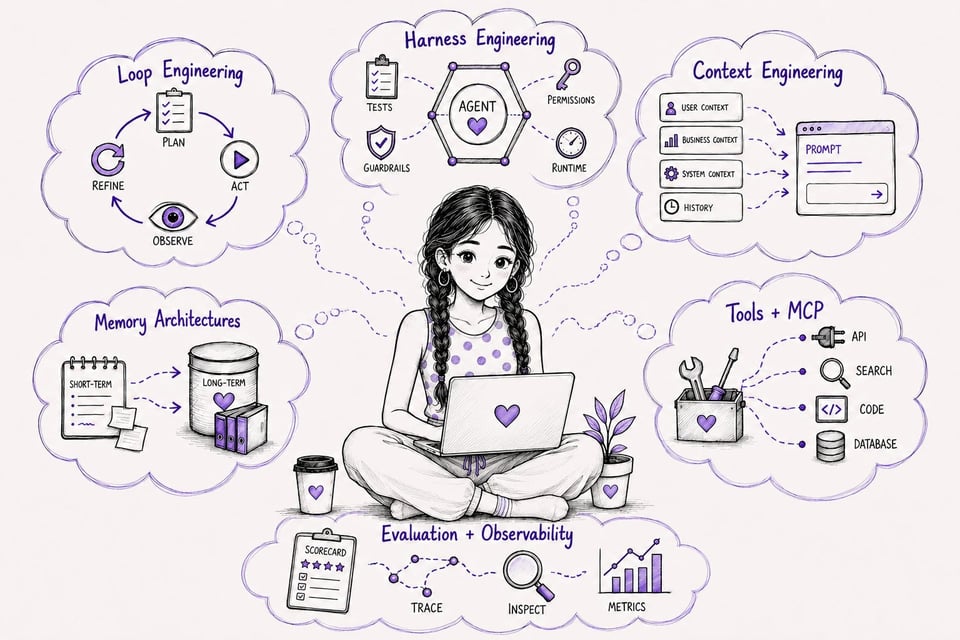
This is why concepts such as context engineering, memory architecture, tool use, evaluation, observability, orchestration and human-in-the-loop controls are becoming so important.
They are all answers to the same underlying question:
How do we turn intelligence into dependable work?
The forgotten problem of failure
There is another reason this matters.
When people demonstrate AI, they naturally show the successful path.
They show the beautiful answer.
They don't usually show the seventeen times the system failed before producing it.
But production systems don't get to live inside the successful path.
They encounter the weird email.
The missing document.
The contradictory instruction.
The unavailable API.
The malicious input.
The outdated information.
The user who changes their mind halfway through the process.
The task that takes three minutes in the demo and three hours in reality.
The most important AI engineers of the next few years may therefore be the people who become exceptionally good at thinking about failure.
Not because they are pessimists.
Because they understand that reliability is constructed out of failure handling. This is project management 101.
A mature AI system doesn't merely know how to succeed.
It knows what to do when it cannot.
The architecture around intelligence
This also changes the meaning of "AI automation."
Automation used to mean:
«If X happens, do Y.»
Agentic systems introduce something different. The system may have to determine what Y should be.
That is powerful, but it introduces uncertainty.
If an AI is allowed to make decisions, then the architecture around those decisions becomes critical.
What information did it have?
What assumptions did it make?
What tools did it use?
What actions did it take?
What did it believe the goal was?
What evidence supported its conclusion?
Who authorized the action?
Can we reconstruct what happened afterward?
Can another system review its work?
Can a human stop it?
These aren't merely technical questions.
They are questions of governance.
And that is why the next generation of AI work is likely to blur the boundaries between software engineering, workflow design, information architecture, security, compliance and organizational design.
The person who can build the model is valuable.
The person who can build the system in which the model can be trusted may be even more valuable.
From prompting to systems thinking
Prompt engineering will not disappear. Good instructions still matter.
But prompting is increasingly becoming one layer of a much larger discipline.
The real expertise is learning to see the entire environment in which intelligence operates.
What context should enter the system?
What should stay out?
What should be remembered?
What should be forgotten?
Which actions can happen automatically?
Which require confirmation?
What happens when two models disagree?
What happens when the evidence conflicts?
How should uncertainty be represented?
How do we evaluate performance over hundreds or thousands of executions rather than one impressive example?
And how do we preserve enough information about the system's behavior that someone can actually audit it afterward?
Those questions require something deeper than prompt cleverness.
They require systems thinking.
The new AI professional
This is where I think the most interesting career opportunity lies.
The future does not necessarily belong only to the people who know the most about machine learning algorithms.
It may increasingly belong to the people who can stand between powerful models and messy human organizations and figure out how to make the two work together.
Someone who understands workflows.
Someone who understands information.
Someone who understands automation.
Someone who understands how humans actually make decisions.
Someone who understands risk.
Someone who can design escalation paths.
Someone who can build evaluation into the process instead of bolting it on afterward.
Someone who understands that an AI system is not finished when it produces an impressive answer.
It is finished when the organization can depend on what happens next.