The AI Adoption Gap Isn't About Technology. It's About Design.
Discover why AI implementation fails when companies focus on tools instead of human-centered UX, workflow integration, and intuitive design.
Every week, another headline announces a faster model, a smarter assistant, or a revolutionary AI breakthrough. Organizations respond the same way they always have. They buy another tool.
Then...nothing changes.
Productivity barely moves. Employees become frustrated. Leaders wonder why the promised transformation never arrives.
The problem isn't artificial intelligence.
The problem is organizational design.
The Myth of the Better Tool
Most organizations assume that better technology automatically produces better outcomes. It doesn't.
Giving an employee the world's most advanced AI without redesigning how work flows is like installing a Formula One engine into a horse carriage. The engine may be extraordinary, but the vehicle was never designed to use it.
Technology amplifies existing systems. If those systems are fragmented, bureaucratic, or poorly designed, AI simply helps them fail faster.
The Invisible Work
Every organization has two workflows.
The first is the documented workflow: the official procedures, policies, organizational charts, and software.
The second is the invisible workflow: the shortcuts, workarounds, tribal knowledge, personal relationships, handwritten notes, and institutional memory that actually keep the organization functioning.
Most AI implementations ignore the invisible workflow.
As a result, organizations automate paperwork instead of improving work.
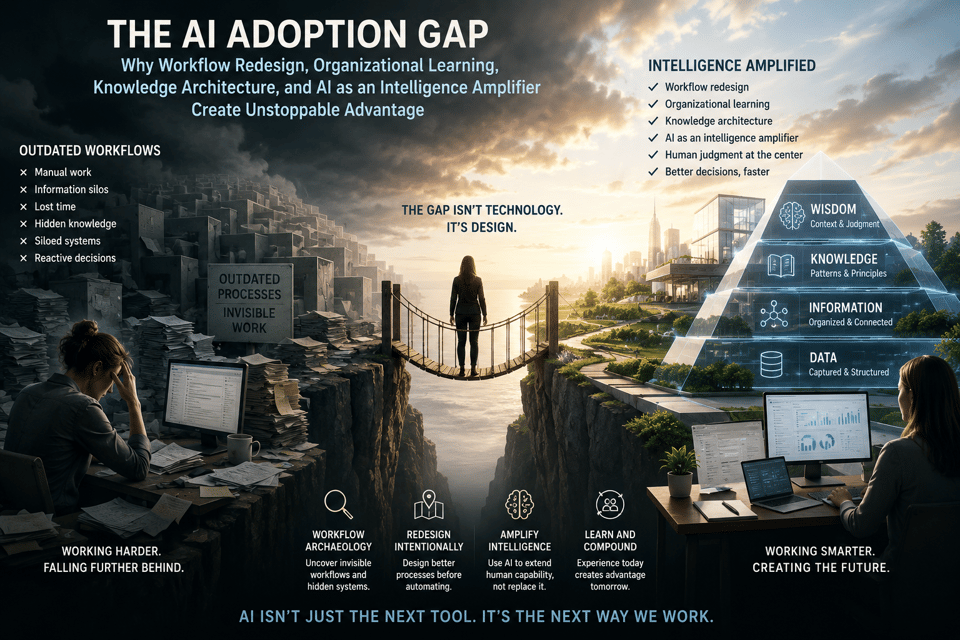
Before deploying AI, leaders should become workflow archaeologists. They need to uncover how decisions are actually made, where information becomes trapped, and where human expertise quietly compensates for broken systems.
Intelligence Amplification
The goal of AI should never be replacing human intelligence.
The goal is amplifying it.
When organizations focus exclusively on automation, they ask, "What can the AI do instead of people?"
A better question is, "What can people accomplish when AI handles the repetitive work?"
That shift changes everything.
AI becomes an instrument that extends human judgment rather than attempting to replace it.
Knowledge Before Automation
Organizations often possess enormous amounts of data while suffering from a shortage of usable knowledge.
Data are isolated facts.
Information organizes those facts.
Knowledge reveals patterns.
Wisdom applies judgment.
AI performs best when organizations intentionally move upward through that hierarchy. Without knowledge architecture, even sophisticated AI systems produce fragmented answers because they are learning from fragmented information.
The quality of intelligence is constrained by the quality of organizational knowledge.
The Real Adoption Gap
The adoption gap is often described as a technology gap.
It isn't.
It is the distance between organizations designed for industrial-era information management and technologies built for knowledge-era intelligence.
Bridging that gap requires redesigning workflows, connecting knowledge, improving governance, and placing human discernment at the center of decision-making.
Organizations that understand this will not simply adopt AI.
They will redesign themselves around intelligence.
The Future Belongs to Discernment
As artificial intelligence becomes increasingly accessible, technical capability will cease to be a competitive advantage. Every organization will have access to powerful models.
The differentiator will be discernment.
Which problems deserve automation?
Which decisions require human judgment?
How should knowledge flow?
How do we create systems that are not merely efficient, but accountable, transparent, and trustworthy?
These are design questions, not technology questions.
The organizations that answer them well will create enduring advantages. Those that continue chasing the newest tools without redesigning the systems those tools inhabit will find themselves owning extraordinary technology while achieving ordinary results.
The gap was never about AI.
The gap has always been about design.