GOAT Notes #7

Welcome to the newsletter for Grassroots Open Assistive Tech!
Please DONATE TO GOAT today!
Happy new year, GOAT friends!! We’ve been quiet for the past few months, but are doing a lot!
=====================================
Events
This year, GOAT is running a monthly series of “Tune Up Tuesday” mobility device maintenance workshops. Come and get your wheelchair, scooter, or other mobility gear inspected, get a free toolkit, learn some preventative maintenance, and add fun stuff to your gear.
For February, our Tune Up Tuesday will be at ILRCSF at 825 Howard St. in San Francisco (near 5th and Howard; the closest BART station is Powell).
In March, we are planning for Tune Up Tuesday at the Disability Cultural Center at 165 Grove St. in San Francisco. The date is not yet on their calendar, but we’ll send out another newsletter in early March to keep you informed!
As part of our longer term goal to foster a healthy repair ecosystems for assistive technology, we will be looking for ways to expand support for training more people professionally in wheelchair and powerchair repair.
=====================================
NEWS!
Toolkits
We had nice feedback from toolkit recipient from last year, J.T., who said our little emergency kit saved her from being stuck on the street because of a lost bolt. From her kit, she used heavy duty cable ties to keep her scooter together long enough for her to get to a hardware store and replace the missing bolt.
Together with our GOAT team we are assembling new “mini toolkits” with the very basics for repair and maintenance. It holds basic useful materials like zip ties, velcro straps, heavy duty rubber bands, and a small assortment of nuts and bolts, along with a mini double headed screw driver, a mini wrench, and reflective stickers for safety. Rather than a full workbook, the mini toolkit includes a much shorter resource guide for wheelchair repair and free gear within San Francisco. I carry some of these kits with me, along with a larger stash of extra tools, adaptive handles, and more fasteners and accessories, so the mini kits can be easily customized on the fly.
We are now working towards having a better system to track who received a toolkit, collecting contact info and following up where possible. That way, when people have more complex needs, I can either work with them to find what they need, or refer them personally to our partners in repair, refurbishing, and other services, that may be able to
Get Andrei Rolling project
GOAT’s project to help Andrei from Moldova with a wheelchair joystick more suited to his changing hand strength turned into a sprawling collaboration between multiple organizations and amazing people. This started out small and quickly snowballed. Everyone enjoyed talking with Andrei so much in our meetings, getting to know each other, and building some solutions for him. Olga is going to travel to Andrei’s country in March to set up the various improvements for him on his wheelchair. We are shipping some of the controls early so he can test them with gaming consoles and his computer, and will then be able to use the same kinds of controls to drive his chair.
Meanwhile, Andrei is doing very intense advocacy for himself, getting citizenship for himself in place in his father’s (neighboring) country so that he will have better access to disability resources and medication for his condition. It is also very interesting to all of us to learn how he is connecting with other disabled people in eastern European countries to share information and resources.
Andrei’s Reddit post from October asking for help with reprogramming a motor controller led to our collaboration, to us offering some extra controller parts, then more expertise from Easy Does it, the CIL, and ILRCSF, then this led to more advocacy to connect him with a respiratory therapist and refurbished breathing assist equipment as well as helping him get on a pathway for state of the art medication. I think the spirit of Disability Justice activism has leapt across the world to him.
Bruce from Easy Does It had a great comment in one of our group email threads the other day.
“Yes, here in America we also have our bureaucratic problems, which I am currently dealing with regarding our clients who need immediate help and cannot wait one-two months for the bureaucrats and institutional machinery to slowly complete the paperwork. We have an amazing team of individuals who care about human beings, and we are not afraid to step outside of our own procedures when it becomes necessary to help another human being. The world is full of wonderful, caring human beings, and there are many humanitarian service organizations who keep society and vulnerable individuals surviving. Our ability to serve you and your needs, even though you are on the other side of the planet, and we have never met you in person, satisfies our hearts and souls while living in a very difficult world.”
Yes Bruce!!! I felt that!!!!!
Collaboration with A11yhood and CREATE/ U Washington
We are continuing our meetings and planning with A11yhood, and are nearly ready to start adding data to their database of assistive technology! The work by our interns to process the contents of uploaded DIY works and tag them will be very helpful for adding useful structured data to A11yhood for the public and for academic researchers as well!
We’ll be helping A11yhood to staff their booth at the CSUN Assistive Technology Conference, as Olga and I will be driving down in her van to attend in mid-March!
Toddler Mobility Trainers with Make Good West
Make Good is a nonprofit in New Orleans that has developed many assistive tech designs and given these designs (as well as the actual products) to the world. (They are a DIFxTech grantee partner as well!! ) This year, with a new grant from Ability Connection and other funders, they have started Make Good West here in California! They are working with makers and hobbyists to DIY the “Toddler Mobility Trainer”, a low cost wheelchair for disabled kids.
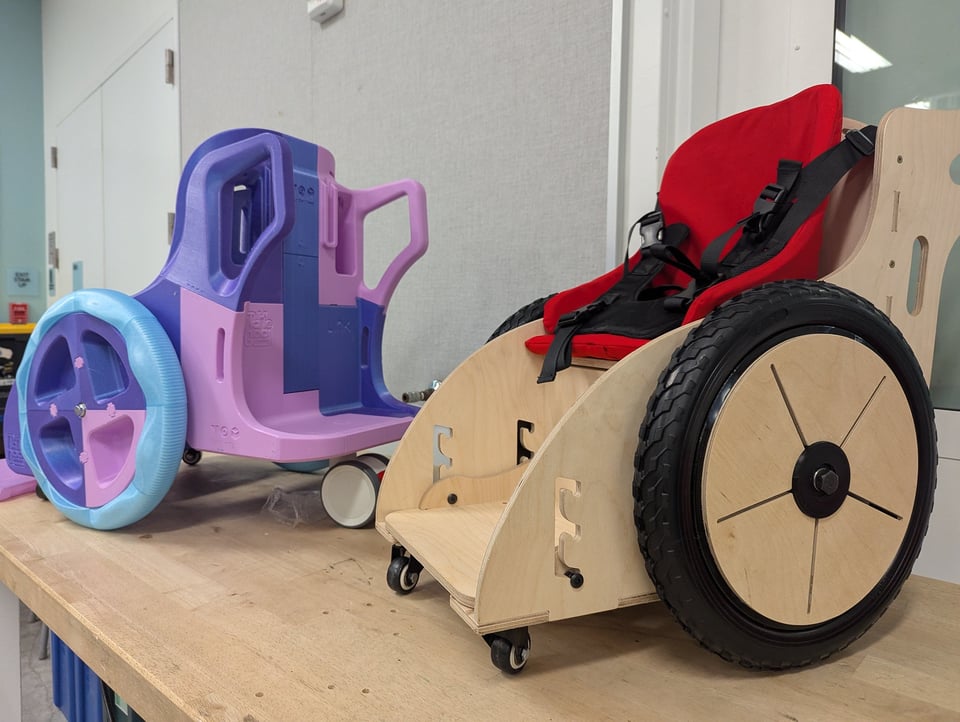
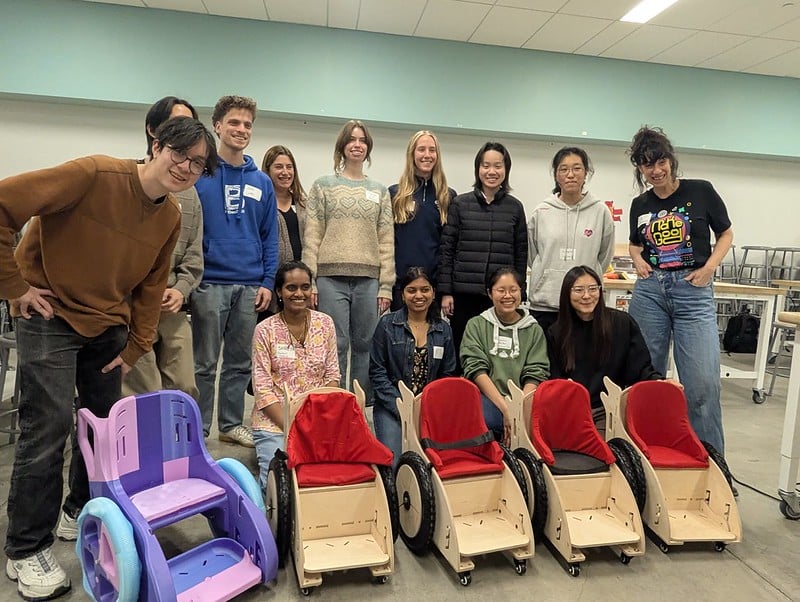
Dana Yichye Shwachman, the Director for Make Good West, organized her first west coast build party, yesterday in the Jacobs Design lab at UC Berkeley. I’ll write a more detailed blog post about this event soon!
GOAT volunteer and expert fabricator Emma Humphries showed up for the build party with me.
Several teams of Berkeley students spend 4 hours and in that time assembled 4 chairs. These were the TOM design made from plywood, with manufactured rubber wheels, foam, and handmade cloth cushion covers. Dana cut the parts for one chair, then got a fellow fabricator to cut parts for 10 more, and I believe she sewed the fabric covers and assembled the fasteners and tools needed. The basement of the Jacobs Lab was a great place for this with sturdy workbenches, plenty of space, and spare tools easily at hand.
As the students worked, Emma and I excitedly had a million ideas about how to modify these chairs (in safe ways) to make them a sort of hybrid of 3d print, wooden, and commercially available parts. I watched Emma go around the room talking with all the students and offering them tools, advice, and basically, mentorship and eliciting their thoughts on the build process.
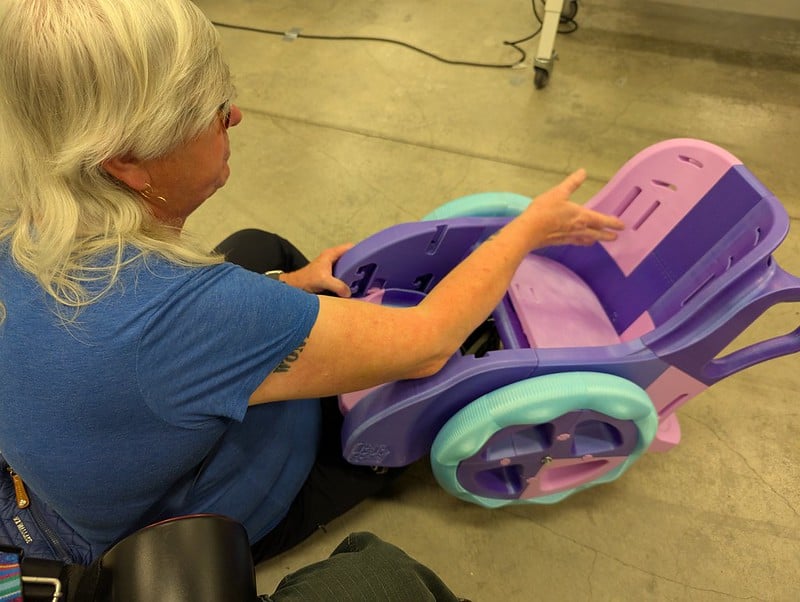
I also got to chat with a mom and her kid who showed up to pick up one of the new chairs. Me and the kid put stickers on each other (I was telling her about the classic kids’ book, “Put Me in the Zoo” as we exchanged little rainbow dot stickers) and had a “race” as she was guided in how to push her new chair. Dana and I also saw the need for a higher cushion and Dana just rolled up her sleeves and made it happen in about 10 minutes. I also think a custom positioning will be needed so I followed up in email to the mom.
I can’t wait to build one of these and make it extra delightful, and help some kid take their first roll towards free movement. I also felt like simply by being at this event, as a disabled adult rather than a child in need of help, did something to disrupt the everyday narrative people have about disability. It is hard to convey how much we need this, a shift in framework from “pity/ inspiration” to Independence and Interdependence, and Disability Justice!
Back to our build. Each chair takes a lot of preparation and fabrication, some sewing, (and some shopping!) to get the parts ready BEFORE the build party where volunteers assemble the chairs. I believe the cost per chair is somewhere around $250-$350, not counting the labor to make them.
Any modifications we might make will need lots of discussion and testing. So at first they may look more like the wooden TOM model, with small enhancements 3D printed for textured wheel covers. Potentially, also we would like to 3D print the handles and back of the chair. (and of course … add the option to add amazing blinky lights and other accessories!)
We are meeting soon with Dana and with Olga so that GOAT can start planning its first build party later this spring!
Wheelchair charging stations
Last fall I was one of the people interviewed by Mission Local in an article about wheelchair charging stations. This is not something I have been advocating for in any active way, but it is a big need in the community!
The article already had at least one positive result: the Lyon Martin health clinic in San Francisco added a charging station for its clients in their waiting room. It looks like one of these devices from Mobility Matters, which has several different kinds of adapters. I am sure their clients will appreciate it!
And for anyone considering adding this to your location, here are some wheelchair charging station best practices.
Paid staff
Your donations are making it possible for us to “scale up” our work. Beyond occasional volunteering for events, we are now paying our interns for a few hours per week. We are also able now to pay Olga for their incredible expertise and hard work!
I am still unpaid; I’m working as a short term consultant for Mozilla on the anti-fingerprinting team, and more long term, as a contractor for Borealis Philanthropy to run their Disability x Tech Initiative. So, being able to compensate people for their work on GOAT business means we keep momentum on all these fantastic projects while I am working two other contract jobs.
It has been a fascinating adventure to spin up Gusto and all the official forms with the CA EDD and so on, and submit our first payroll at the end of January! A first for me as an organization lead.
What we do
Grassroots Open Assistive Tech’s purpose is to document, curate, preserve, make accessible, and freely share assistive technology designs and information under open licenses, as well as providing coordination and education to affiliated communities.
We support disabled people in making their designs and builds available for public good, and in having free to use designs available to them for their own use.
Please donate!
GOAT is a 501(c)(3) organization and your donations are tax deductible. EIN: 93-3313503.
We are also registered with Benevity for employer-matched donations!
You can donate via PayPal or via check.
PayPal donation email: liz@openassistivetech.org.
To avoid our paying transaction fees, you can send a physical check made out to Grassroots Open Assistive Tech, to GOAT, PO Box 720011, San Francisco, CA 94172.
Another great way to contribute: If you have an employer hosted “guild” or internal group relating to disability, we would love to come speak with you and we definitely encourage you to donate!
Subscribe to GOAT Notes
Subscription is free, but optionally, you can pay to subscribe via Buttondown, as a way to support our organization and its activities! https://buttondown.com/GoatNotes#subscribe-form
Add a comment: