
The City and the City and the City and - The West Passage
We’ve already talked about consumption in the most literal of senses, but what about the great consumption so many of us find ourselves caught within? Our lives are built on thousands of others, a veritable stratification of people and history all buried upon the memories of one another. How do you capture that in a book? I have a fever and am deeply bored by my research paper, so let me draw you towards those that have tried.
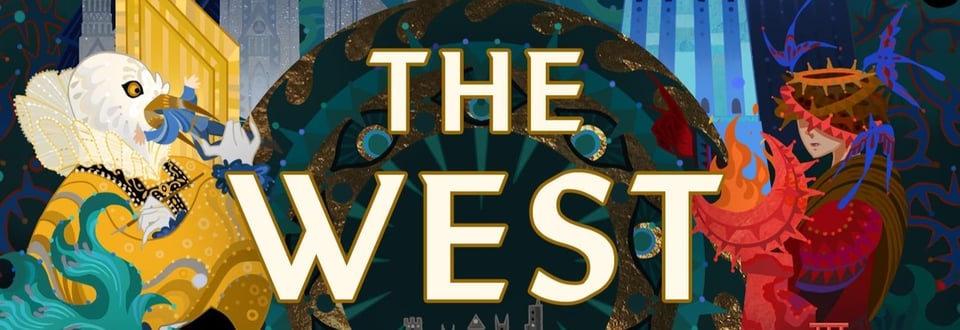
Today, for your entertainment and to satisfy my own messy thoughts on the topic, I want to try to describe a subgenre that I’ve been calling City Books. These books are almost always speculative fiction of some description—I would love to see an example that wasn’t speculative, simply for the novelty of it—and are, at their hearts, about strange and sprawling cities (or countries, or palaces, or houses, or or or. We don’t discriminate here). Their purpose is to draw us into the endless complexities of their cities and slowly pretend to peel back the layers, so that you may feel you know the city as well as any of its inhabitants, only to be struck by something so far beyond your comprehension as to remind you that it is you who is the interloper in this space.
More often than not, City Books seep gently into horror, even if they’re presented as fantasy or science fiction or something else entirely; is there not, after all, something innately horrifying in the great sprawling places we make our lives, full of so much history and so many stories we will never even know?
City of Saints and Madmen by Jeff VanderMeer will always be the first that comes to mind when I think about City Books, although as you may have noticed in the title of this newsletter, China Mieville takes that distinction in many people’s minds. Alas, I never got more than a chapter into Perdido Street Station, likely because I was about fourteen when my father handed me a copy and set me loose in the world of Bas-Lag. So, City of Saints and Madmen. Having read The Southern Reach trilogy (also when I was about 14. It was a weird year), I knew a little of what to expect from VanderMeer, and yet I still found myself surprised by City. It wasn’t structured like any of the novels I was so used to reading, instead set up as a series of—I struggle to call them short stories, as each played with different forms, from a textbook rife with footnotes, a series of woodcuts, or a story told entirely in a book code which had me scouring through page after page to find the correct word. The only thread connecting these individual stories was the way they explored some corner, some scrap of history or culture of the city of Ambergris, and one of the key points was—Ambergris was weird. Mushroom people disappear whole cities of people, an artist is invited to a beheading, people are transformed and haunted by the city’s previous inhabitants.
The important thing about a City Book is that you must be able to tell that the author cares far more for their worldbuilding than for their characters or plot. Both plot and characters are little more than a vehicle for you to peel apart and uncover the world they’ve crafted for you, bit by bit. This is not to say that their characters are unimportant, but perhaps rather that the city becomes a character all its own, and one we chase any modicum of understanding of. In many cases you’d see this critiqued by reviewers, who are used to narratives centring around their protagonists. I believe that, so long as you know what you’re getting into, there is immense joy to be taken from a City Book. They are such a rare treat, and what a true treat they are for those of us who want to learn to love a world.
That was a great deal of newsletter without even mentioning the book I’m claiming this entire entry is about, but I’m sure you’re all used to that by now. We love to ramble here, and quite frankly, if I cannot ramble in a newsletter about City Books, where else can I? I just finished a rather unintentional re-read of The West Passage. Despite the fact that I first read it back in May (how can that already be nearly six months ago? Time passes faster and faster every year, doesn’t it), and I claimed I wouldn’t reread it for a little while (sorry Trai) I dragged it off my shelf again in desperation yesterday to lose myself in a story.
The West Passage is a book that touched me deeply and left a lasting impression, though again, not in the way stories usually do, with their characters or plots or grand battles. Rather it was the world, strange and meandering and deeply alien, that lodged itself so fully in my brain. Though The West Passage does follow the journeys of two young people as they each set out on their own quest to save their rambling tower home, these travels are interspersed with old stories from Grey Tower, questions posed by tutors hundreds of years dead, and an entire chapter in which a group of giant frogs sing a lament for birth, life, and a death on the edge of the river. Yarrow is imprisoned in a schoolhouse full of apes who perform some strange ceremony of worship to an ancient fresco, meets the aforementioned frogs, and sings a being thousands of years old and utterly beyond our comprehension to sleep, whereupon the Yellow Lady turns into a flock of hundreds of birds. Hawthorn sees the horrors and excesses that make up the centre of their world, sees great Ladies caught in endless dances, the great wheel that turns the seasons over the palace, and has her memory rewritten multiple times.
The palace crumbles away beneath them, caught too long in stasis, unable to change or evolve so long as the Ladies cling desperately to their power and the promise of immortality. Ambergris is rotting from the inside out, built on the massacre of a people who never truly left. History is rewritten and retold and twisted by memory and power, and yet we are still told it, we still get to learn it. These books are marvels of invention, playful in their form, and often unique in their varying genres.
What I’m reading right now:
The City in Glass, by Nghi Vo on my quest to read the rest of the Ursula K LeGuin award nominees. Funnily enough, this is very nearly a City Book, in that it is focusing on the small elements of a city in great detail, but it’s not quite weird enough for all that and is definitely more character focused.
An album to listen to:
はじまりのおわり, by Babuchan, specifically I’m thinking of the song せかいのはじまりのさいごのうた (The Last Song of the World’s Beginning, if I’m translating that right). It feels rather fitting for the crumbling world of The West Passage.
What I’m working on:
As I mentioned over on Tumblr, I have a story idea rattling around my head about a group of girls in their final term at a boarding school, and the god they invent out of an old sheep skull. I only have scraps so far, but I hope it can become something more than just loosely connected scribbles.
One day, as we make our way to the edge of town, we’ll take a new path through the woods and find ourselves caught in the middle of a funeral, which will be an unpleasant surprise for all involved, and one we’ll giggle about for days to come. This will be before, of course. Before the beginning of the end.
For now, the bones. Polished and white in the afternoon sun, shadows growing yellow and purple like an old bruise across the eye sockets. Scavengers had picked the flesh clean, probably the work of the foxes that creep into town for scraps and the crows that prance across our lawns.
Add a comment: