
Tapestries, Quilts and Mosaics - North Continent Ribbon
Here, I’ve handed you a basket full of fragments and shards of bright glass. They will never piece back together the way that they were. What will you create with them? What story can you tell, held together by twine and wire and the blanket stitch you learned at your grandmother’s knee?
Phew! It’s been a while since I’ve done a proper writing craft newsletter! Er, I suppose this one falls somewhere between one of my examinations of the sci-fi genre and writing craft, so I suppose I should tell you to keep holding your breath. Don’t worry about our friend over there going blue in the face. This ain’t about him.

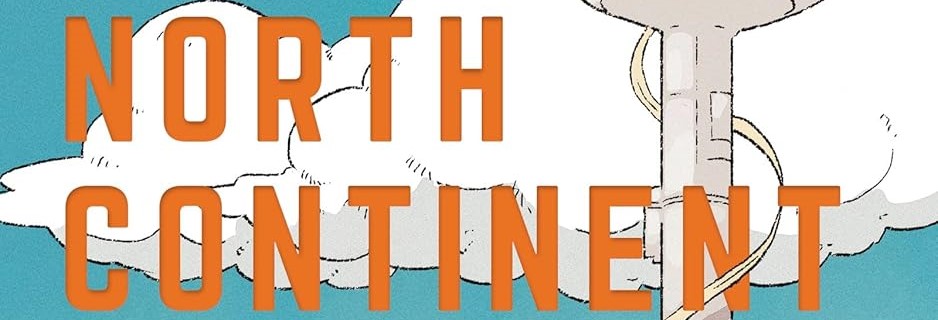
I’ve continued on my recent quest to read all of the 2025 Ursula K. Le Guin prize nominees; having read Rakesfall and The West Passage earlier in the year (and loved both, considering they made it onto my annual rec list), I tore through The City In Glass a couple weeks ago and just finished North Continent Ribbon last night. I knew that North Continent Ribbon was a particular type of book, though I couldn’t for the life of me remember what the style was called, until I ran across the term out of the blue, probably while whiling away my days on Tumblr: a mosaic novel.
Without even searching for the proper definition, I knew at once that that was what North Continent Ribbon was, and my sense was justified by Whitcher’s acknowledgements. Whenever I had tried to describe the book to my friends, I found myself repeating: “well, StoryGraph says it’s a short story collection, but I really don’t think it is.” Illuminating, I know. North Continent Ribbon is, yes, a collection of short stories by Ursula Whitcher, most having been previously published in various magazines. What sets North Continent Ribbon apart from most short story collections is that each story is set on the same world, the same distant planet, exploring and developing various parts of that world’s society. Where one story focuses on an assassin aboard a starship, another follows a judge who refuses to give up his artificially intelligent book in the face of anti-AI sentiments, to a person who has become a starship much like the one in the first story. Each story deepens our understanding of the world that Whitcher has carefully crafted over these stories.
Wikipedia defines a mosaic novel as “a novel in which individual …chapters or short stories share a common setting or set of characters with the aim of telling a linear story…with the individual chapters, however, refracting a plurality of viewpoints and styles” so you can perhaps see how I was getting stumped in attempting to describe something I did not yet know the word for. I have to say, even this definition leaves something to be desired, considering that the first example of a mosaic novel and the one that coined the term, La Bibliothèque Nomédienne, did not conform to the requirement of a ‘linear story’. Rather, La Bibliothèque Nomédienne, is something else entirely and, if you’ve been following me for a while, something rather familiar.
The mosaic novel, despite its seemingly ‘genre-blind’ definition, is inextricably tied to science fiction. La Bibliothèque Nomédienne is a series of documents, stories, and novellas all related to a fictional continent, all record of which was lost following the sudden loss of all electronic storage, and which has appeared to disappear from the face of the earth. The world of this fictional continent is slowly built up in an almost sidelong way, never explicitly describing itself to us, never dumping information or revealing its true focus. The stories circle around and around the key idea, that of the continent itself.
I’ve talked some about the ways that I love to see worldbuilding employed and explored to its fullest potential in my last newsletter, and in many ways that edition ties right into this one: City of Saints and Madmen is, after all, a mosaic novel. Interesting how our perspective on a thing can be changed so entirely. Rather than changing how I felt about the book itself, my awareness of City of Saints and Madmen as part of a larger canon of work made me feel as if I had lit a candle in a dark room, suddenly aware of how to seek out other novels that would fulfill the same need. Isn’t that what language should be for? (My book club just finished reading Babel-17, can you tell? Next up, ironically enough, is The Dispossessed, and not by my own hand.)
The mosaic novel, and its presence among the books nominated for the Le Guin award brought me back to the description of the award itself: being, as it is, for “realists of a larger reality, who can imagine real grounds for hope and see alternatives to how we live now” who reflect the themes and concepts present in Le Guin’s own work. While Le Guin did not explicitly write mosaic novels (though perhaps The Left Hand of Darkness gets closest, with its folk tales and historical records interspersed), I think that the Hainish cycle (and even, in some ways, Earthsea) functions as a kind of mosaic: individual novels, each self-contained and disconnected, but nevertheless exploring and developing the larger society and themes that each world is a part of. Le Guin was a master of crafting worlds that truly feel as if there were whole societies beneath the tiny fragments that we are gifted, whether that be the small hammers used to break the ice on beer on Gethen or the rituals of the Place in The Tombs of Atuan.
What I think is one of the strongest aspects of the mosaic novel is the way that it allows the focus of each story to centre on the lives of ordinary people, without losing the powers of social commentary and complex themes that can be so wonderfully explored in sci-fi. In North Continent Ribbon, a young person navigates life under a cruel and controlling mother as they experience their first crush on their tutor, a woman enters into ill-advised relationships, one of the Twelve-thousand Flowers seeks justice for her friend. At the same time, the peaceful facade of the world is peeled back one story at a time, injustices and parallels to our own reality revealed with each self-contained story. The mosaic novel allows that which may seem oxymoronic: character-focused stories nestled within a thematic and worldbuilding focused novel (or, novella, as the case may be).
This is something I’ve been thinking about recently while I write. While my story is definitely not a mosaic novel, being as it is very focused on one person’s personal journey, I’ve been trying to include small fragments, almost able to stand on their own, to flesh out the world. Stars Like Darting Fish is already a patchwork story, two narratives interwoven with memories, interludes written as poetry, and one section written entirely in Morse code. Admittedly, I’m not sure that one is staying in, but the idea remains. There is something about a story told in fragments that pull together into a whole which has always spoken to me. Now I just have a word for it.
What I’m reading right now:
As I said, I’m still working my way through the Le Guin prize nominees, and I’m about to start The Sapling Cage as a buddy read. In the mean time, I have to read 130-odd pages of The Dispossessed for book club next monday.
An album to listen to:
I’ve basically been looping You Forgot It In People, by Broken Social Scene for the past week while grinding through writing a series of papers. I have the taste of a Canadian teenager in 2002 (thanks Bev).
Add a comment: