
Robots, Guys with Other Guys in Their Brains, and Unreliable Narrators - The Archive Undying
Hello hello. Today I hope to lie to your face and pull the wool over your eyes. I’m not Lizard but rather a fragmented memory pretending to be a person. What is a narrator but a vessel—for story, for something else?
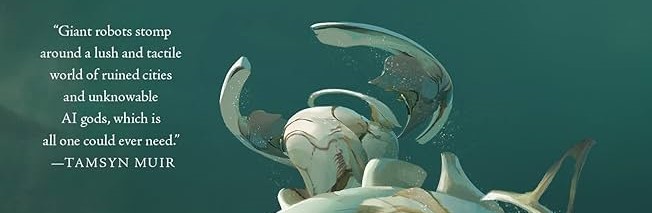
Narrators are something I think a lot about when I write, though that may be due to the fact that I am somewhat obsessed with non-traditional narrators. You can probably thank Tamsyn Muir for that if we're being quite honest. The Locked Tomb features some of the most remarkable unreliable narrators that I've encountered—one doesn't care, one literally [redacted], and one is six months old. All of those are perfectly valid reasons to be an unreliable narrator outside of the usual 'they're just lying to the audience. Or themself'. I mean, personally I think that 'she's not unreliable, she just really likes sports and doesn't actually give a damn about this obscure research field' is the objectively funnier option here. All that aside, it is really the narrator of Harrow the Ninth that I want to explore. Of course I refuse to do this head-on, so bear with my while we come at this all sideways.
In the wonderful book The Archive Undying by Emma Mieko Candon, different narrators interject and interweave, breaking apart and tying together the narrative in ways you might not expect going into what seems to be a relatively standard piece of genre fiction. First person, third, second, all are used to great effect throughout the book, and while the identity of each of these narrators is not necessarily secret, they are often not revealed explicitly to us, the reader. Candon is an absolute master of 'show don't tell', much to the chagrin of the reviewers bemoaning not understanding the worldbuilding. I assure you, the worldbuilding is there. This is book one of a series. Seriously guys. Anyway.
The thing about The Archive undying is that despite there being numerous narrators with their own perspectives, wants, goals, backgrounds, they are all limited to the same point of view. They are all sharing the same pair of eyes, the same space in the world.
I often joke that my favourite genre of character is 'guy with another guy in their brain', because I think explorations of identity and personhood through someone who is literally not just one person are incredibly interesting. Archive is a story about free will, and whether it’s worth it to preserve your autonomy and self, even if it may be easier to bow to some higher power. Even if choosing to stay your self could hurt innumerable others. A Memory Called Empire (and indeed Archive, though I’m sure we’ll see more of this in the next book, whenever it comes out) also extends this concept of personhood and autonomy beyond the narrator to become a discussion of literal and cultural imperialism.
Beyond the very interesting thematic interpretations of guys-with-other-guys-in-their-brains, in the case of The Archive Undying and others, This can give rise to my favourite phenomena when it comes to narrators: the person you thought was your narrator, your point of view character, your hero, is not the one telling this story.
In We're All Reaching for the Sun, (yes I’ll talk about my own stories as if anyone has actually read them) the only way that I could make sense of the structure of the story and the point I wanted to get across, was that I had to hold the knowledge in my mind that our main character is not the narrator. Instead, it was instead an AI slowly trying to take apart her brain and reliving a series of partially constructed memories. Does this come through in the text? Maybe, though certainly not in those words. I would always rather leave certain things up to interpretation than to come in upon a white horse, sword blazing, to announce my vision of the story. Meaning is a joint effort between the creator and the reader. If the writer creates something with the intention of a certain interpretation, but there is no material evidence to support that interpretation, then it is unfair to expect the reader to reach that conclusion. Art as collaboration is one of the most remarkable things about the entire process.
How much of a difference, then, does it make whether our narrator is a young woman or the AI riding her brainstem? They are experiencing the same events, the same neural impulses. It is then in the interpretation of that information that the views differ--does the thing in your head understand your grief? your regrets? your longing? Are we merely our memories, or is there something more to the human condition? As Charlie Jane Anders pointed out in here recent newsletter (hilariously timed, I wrote the bulk of this weeks ago), who gets a point of view in your story is inherently political, and thoughtfully selecting your narrators can be incredibly impactful.
I don't know. That's why I write, though. Writing is a conversation, even if it is with myself.
What I'm reading right now:
Interfaces, an anthology edited by Ursula K Le Guin and Virginia Kidd. Doing a buddy read with a friend whom I usually just complain about lab reports with. As always with anthologies the stories are rather…hit or miss. Luckily one of the hits involved being missed by high-speed titanium rods shot from atmosphere. Also greasy sci-fi women.
An album to listen to:
Alpinisms, by School of Seven Bells. When I was young I had an mp3 player with some of my parents’ random songs loaded on to it. Face to Face on high Places and Half Asleep were two of my favourites. Perspective shifts and the world changes around you, light up the room, see one another across a crevasse, pull away your mask.
What I'm working on:
Editing a piece of short fiction I’ve been working on for a while, about a woman who travels across the UK during a quarter-life crisis.
‘Did he send you?’ she asked.
The snake didn’t answer, since it was a snake. When it turned away to move along the side of the road, she pushed herself off the car and followed it.
Add a comment: