
Mecha-Narratives, Meta-Narratives, and the difference between description and analysis - Neon Genesis Evangelion
All lizards know is materials science, complain about media literacy, eat hot chip and lie. I am eternally drawn in by the siren song of mecha stories and end up shouting at my e-reader before falling into despair and disappointment. Of course, now I’ve talked about two stories that fall loosely under mecha but it is only through the subversion of the genre that I seem to enjoy it. Does this mean I do not like mecha? Oh well. Get in the robot, Shinji.
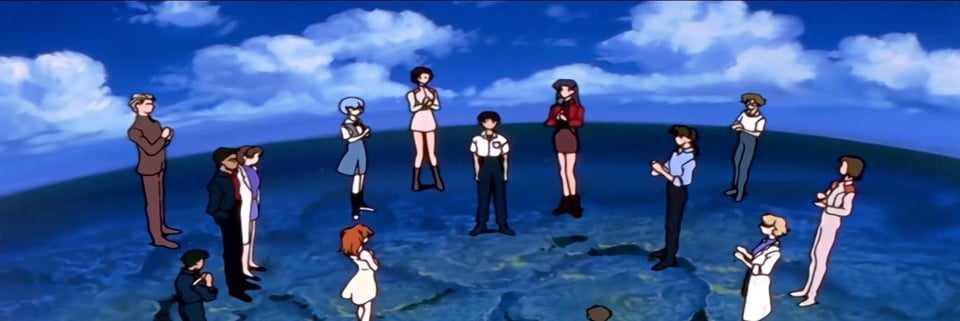
I know I usually centre these newsletters around a particular book, but damn it, it's my newsletter and I'll talk about the big fighty robot anime if I want to. Also, while I usually try to avoid major spoilers in these newsletters, this time I will be talking quite openly about NGE, so be warned.
I'm rewatching Neon Genesis Evangelion for the first time since I was...what, sixteen? Well, by the time this comes out, I will definitely have finished it since I've been completely tearing through the episodes. (Summer seems to be the season of revisiting thing’s I used to love. Combined power of having actual free time and the inherent nostalgia of the season). I mentioned to my roommate a while back that I was planning to rewatch at some point, and I noted that while I did understand what was going on during my first experience with NGE, I almost certainly missed things.
The thing is, I did understand the plot of NGE—or, as many people would say: 'what the fuck just happened'. I understood the general layers of Nerv and the Impacts, the EVAs as organic machines combining the angels and humans, the pilot's mothers recorded in the EVAs. What I actually missed at the time was how all of those things tie into the major themes and messaging of NGE.
Neon Genesis Evangelion is a story about connection, about knowing yourself well enough to make the decision to reach out and try to connect with others in whatever way you can[1]. It's a story about neglect, abusive home lives, and the ways that these things can severely limit your ability to make those connections with other people. Humanity lost itself long before the Second Impact, too focused on the individual without seeing the impact (hah) that we can all have on one another.
When writing about a piece of media, there is a difference between description and analysis. I could describe the plot of NGE to you exactly and you would not come away understanding the themes and the purpose of NGE as a text. Analysis, on the other hand, often relies on some level of shared knowledge between the writer and audience, but allows for an exploration of the text on a deeper level.
I think that it's wonderful to have complex plots with interlocking elements, obscured character motives, and layers and layers of background information. Games like Deltarune or Hello Charlotte which explore the medium of games through metanarrative often rely on complex hidden lore, and the fandoms that spring up around them (Deltarune more than Hello Charlotte, obviously, but I had to mention it) often obsess over trying to figure out what's going on behind the scenes of the stories. While I don't have any experience in the FNaF space, from what I can tell this kind of theorizing is a massive part of the game's popularity and longevity.
Sometimes, though, I think that the obsession with unravelling the plot of a story can get in the way of really picking apart the deeper meaning of a piece.
I suppose this really could have been a newsletter about Catherine House instead, but I wanted to be honest about my inspirations—that being watching NGE directly in front of my fan while trying to survive the heat. Catherine House is a 'dark academia' book about a young woman who agrees to attend an elite school on the condition that she remain totally ensconced in Catherine house for three years without contact with the outside world. I found that Catherine House really worked for me personally, but it has some rather...mixed reviews. A lot of the critiques that I've seen of it have centred around the pacing and the lack of plot in the book. There is a mystery at the heart of Catherine house, but while we are given glimpses in around the edges of that mystery, by the end of the book very little has been explained. Besides the open ending, Catherine House presents itself as an unknowable labyrinth (both as a book and a structure), largely beyond the comprehension of both the narrator and audience.
I didn't go into Catherine House expecting a great mystery or some other driving force, but rather as a sideways look at academia and the ways that certain people are left behind or kept eternally outside of the inner circle of these institutions. I think that may have been one of the reasons the book worked so well for me—it met my expectations, rather than leaving me dissatisfied with vague answers and mysteries that are never unravelled.
When a piece of literature is good, I'm willing to give it a lot more leeway with story elements that are not explained or that do not need to be explained. I often prefer stories, especially in the speculative fiction sphere, that leave many things up to the reader's interpretation. I don't need the origin of the Angels explained (again, I am not done rewatching the show, forgive me if it is explained), I don't particularly care whether End of Evangelion takes place in the same timeline or some alternate reality to the ending of the show, and getting caught up in these points can ultimately take away from the message of the show.
To paraphrase from the excellent video by Folding Ideas, the ambiguous endings of Catherine House and Hello Charlotte, of NGE and Annihilation make sense thematically, but when approached literally appear to fall apart. This does not make them bad endings, but rather ones that force the reader to engage with the themes and metaphoric language of the piece, rather than the surface-level literal plot.
I don’t want it to seem like I’m saying that people who enjoy theorizing about pieces of media don’t understand deeper themes—everything I’ve seen in the Deltarune scene on Tumblr in the past couple of weeks should disprove that. Theorizing is fun, picking at the fabric of a world is exciting, but if nothing else, having a strong understanding of the themes and larger intentions behind a piece of media can greatly improve your ability to construct accurate theories—I wouldn’t exactly trust the predictions of anyone who made it out of Deltarune without recognizing the themes of free will and the role and morality of the player in video games.
I just think that we (especially my own generation) should be more willing to accept that not everything has an explanation, that not everything should be explained, and that a piece of media is not lesser for it.
So long as it’s done well and isn’t just an absolute dumpster fire, of course, which is always possible too. We don’t discriminate in this household.
What I’m reading right now:
I have a couple books going right now, but I’ve been pretty busy this last week. I’m finishing up System Collapse as an audiobook in the lab, which means I’ll have finished all the full-length Murderbot stories. A surprise since, the first time I tried, I fell off after All Systems Red. I love me an Asshole Research Transport, what can I say.
An album to listen to:
COLONY, by BIN. It would feel weird to not have a J-pop album for this week. I’ve always loved the somewhat unusual combination of BIN’s vocal style with the backing music. I don’t have as much to say on the content of these songs because my Japanese is sketchy at best.
Add a comment: