
ElevatorBlueprint: The 2027 elevator deadline most NYC owners have never heard of

There is a hard code deadline coming January 1, 2027, and if you own a building with older traction elevators it can cost you $25,000 to $50,000 per car. Most owners have never heard of it. Here is what it is and how to keep it from turning into a scramble.
THE SIGNAL
NYC's Local Law 145 forces a UCM brake retrofit on every pre-2019 traction elevator by January 1, 2027.
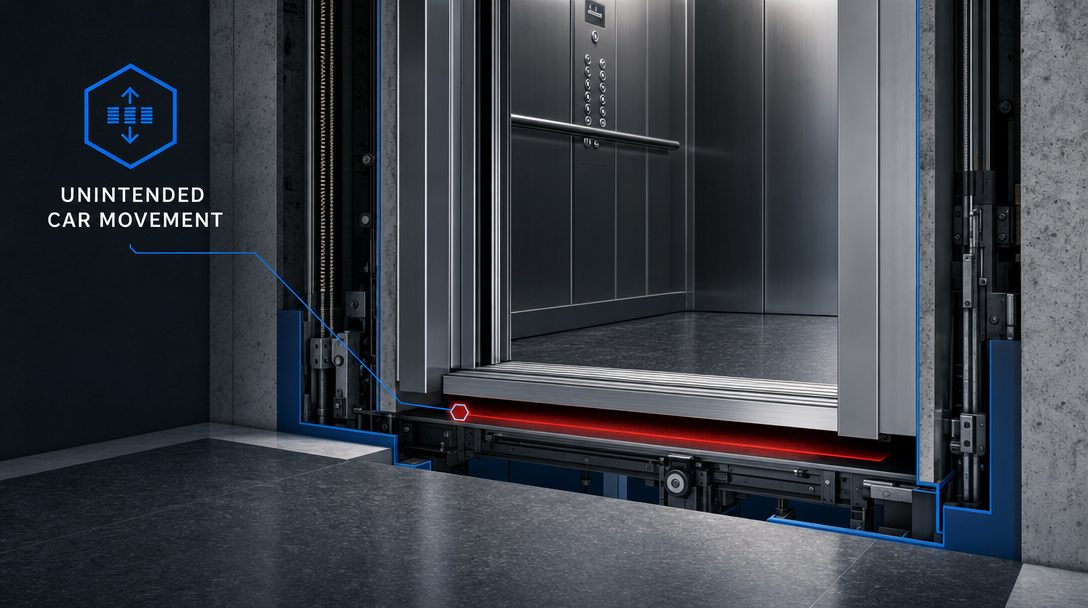
Unintended Car Movement (UCM) is when an elevator car drifts up or down while its doors are open, leaving a passenger stepping into a gap or, worse, a moving platform. To close that hazard, NYC's Local Law 145 of 2018 adopted the ASME A17.1 Section 2.19.2 UCM-protection standard and set a hard compliance date: January 1, 2027. Every existing traction elevator installed before 2019 must be retrofitted with UCM protection by then, typically a dual-plunger brake, a rope gripper that clamps the hoist ropes, or a machine replacement, plus the detection logic that keeps the doors shut until the car is verified stationary and aligned. Hydraulic elevators are exempt (no hoist ropes or counterweight to create the failure mode), and drum-machine units are not covered. The retrofit is a permitted alteration that ends in a DOB acceptance test. It runs roughly $25,000 to $50,000 per elevator, so an eight-car building is looking at $200,000 or more, and the industry consensus is that design plus installation can take up to a year, which means the window to start without paying a rush premium is already closing.
What this means for you: If your building has traction elevators older than 2019 and you are in NYC, this is a capital item you should be scoping in the next 60 days, not next fall. Three moves: (1) confirm what you actually have, hydraulic and drum-machine units are exempt, so the first thing to establish is whether the deadline even applies to your equipment before anyone quotes you a retrofit; (2) get competitive bids now while contractor calendars still have room, because once every NYC owner tries to comply in the last two quarters of 2026 the pricing and the lead times both move against you; and (3) treat any single-source or OEM-only quote with suspicion, UCM retrofit is exactly the kind of code-mandated scramble where captive pricing shows up. Outside NYC this is still worth reading: UCM and enhanced-brake requirements are moving through ASME A17.1 nationally, and a code deadline in the largest market is usually the leading edge of what your jurisdiction adopts next.
Source: Lerch Bates (independent elevator consultancy)
INDUSTRY WATCH

The real risk on the 2027 deadline is not the code, it is the calendar.
Independent consultants are warning that UCM retrofit design and installation can take up to a full year, and every affected NYC building is chasing the same finite pool of qualified contractors and the same rope-gripper and brake supply. Owners who wait until 2026 to start will be bidding into a seller's market with no leverage and real risk of missing the acceptance-test date. The practical takeaway: this is a plan-now item. Get your equipment classified, your budget approved, and at least two bids in hand this year, so you are scheduling the work rather than begging for a slot.
Source: Van Deusen & Associates (VDA)
Not every elevator is on the hook, and knowing which are is worth real money.
The rule bites existing traction elevators with single-plunger brakes; the fix is a dual-plunger brake, a UCM-protection device such as a rope gripper, or a main-machine replacement. Drum machines and hydraulic elevators are excluded. That distinction is the single most valuable thing to nail down before you take a quote, because a vendor who quotes a UCM retrofit on an exempt unit is either mistaken or padding the job. Ask your inspector or maintenance provider to classify every car in writing, then only bid the retrofit on the units that actually require it.
Source: KDA Elevator Consultants
THE DEEP CUT
How to scope a code-mandated retrofit so a deadline doesn't become a blank check
A compliance deadline is the most dangerous moment in the entire owner-vendor relationship, because it flips the leverage. Normally you can walk away from a bad quote. When the code says you must have the work done by a fixed date, walking away stops being an option, and every vendor in the market knows it. The owners who get gouged on the 2027 UCM deadline will not be the ones who paid for the work. They will be the ones who scoped it badly and bid it late. Here is how to do the opposite.
Start with classification, not quotes. Before you let a single company price a retrofit, get every elevator in the building classified in writing: traction or hydraulic, drum or non-drum, single-plunger or dual-plunger brake, install date. This one document decides which cars are even in scope, and it protects you from paying to retrofit a unit that was exempt all along. Your annual inspector or your maintenance provider can produce it. Do not accept a verbal answer, and do not let the company that wants the retrofit job be the only voice telling you which cars need it.
Then force every bid onto the same scope. A UCM retrofit is a menu, not a single part. One bidder may quote a rope gripper, another a dual-plunger brake conversion, another a full machine replacement, and the bottom-line numbers will be tens of thousands of dollars apart for reasons that have nothing to do with who is cheaper. Before you compare a single dollar figure, write out the exact deliverable, detection system, response mechanism, controller modifications, permits, engineering, and the DOB acceptance test, and require every bidder to price that identical list. A quote that leaves the acceptance test or the permit filing off the sheet is not cheaper, it is incomplete, and the difference lands on your invoice later.
Attack the two places compliance work hides money. First, proprietary lock-in: ask in plain words whether the proposed solution ties you to one manufacturer for every future adjustment and part, because a code retrofit is a chance for a vendor to deepen the lock-in under cover of a mandate. Second, the timeline: a bid promising an unrealistically fast install this late in the cycle is either padding the price or about to miss the date, and a missed acceptance test after January 1, 2027 is a violation, not a delay. Get the schedule and the acceptance-test date in writing.
The discipline is the same one that governs every good elevator decision, and a deadline is exactly when owners abandon it: classify first, normalize scope, get every exclusion in writing, and bid it early enough that you are choosing between real options instead of taking the only slot left. Do that and a code mandate is just a project. Skip it and it becomes a blank check.
The full NYC 2027 UCM deadline guide, costs and compliance steps
Free tool: the Contract Scanner

A code deadline is exactly when a vendor slips a lock-in clause or an aggressive escalator into the paperwork, betting you are too rushed to read it. Before you sign anything tied to a UCM retrofit or a service renewal, run the agreement through the Contract Scanner. Upload it and get a plain-English risk report in 60 seconds that flags lock-in clauses, escalation traps, and the exclusions buried in the fine print.