On land animals and oceanic friends
A late-night essay on water, wholeness, and what it means to dissolve, written from a couch, three pillows deep, by someone who is already two.
Hoi!
Here it is, another long overdue pudding. As I was filling endless boxes with tiny clothes, prepped food, and unread books, trying to create some order before the chaos arrives, I kept thinking about the other containers I’ve spent years building: the ones made of words, around the boundless things that resist them.
What follows is what spilled out when I stopped trying to keep the lid on. Not fully formed, some of it all too familiar, even a bit repetitive. But then again, that's life, baby. We’d better get on with it.

From my desk
Words that found their way onto the page.
I’m supposed to be in a swimming pool right now, surrounded by women whose growing bodies become seemingly weightless once the water starts to carry them. Unfortunately, swimming is a horizontal act. What was working for me, is now working against me. To stop the burning acid from flowing, I have to keep my head above my heart, fitness instructors tell me. Seated on my couch, laptop on top of my lap, I tell myself: soon, I’ll lie flat again, with my ears underwater. Soon, I’ll sleep with one pillow, instead of three. Soon, I’ll no longer be two, but one again. Or, I'll be no longer one, but split into two? Feeling the not so subtle kicks against my ribs, I can’t decide whether I’m facing a fracture or a juncture. ‘Soon again’, who knows what those words mean. The birth of a new life means the death of a unified self, the books on motherhood tell me. Or maybe it will, once and for all, shatter the illusion that there is such a thing as a unified self.
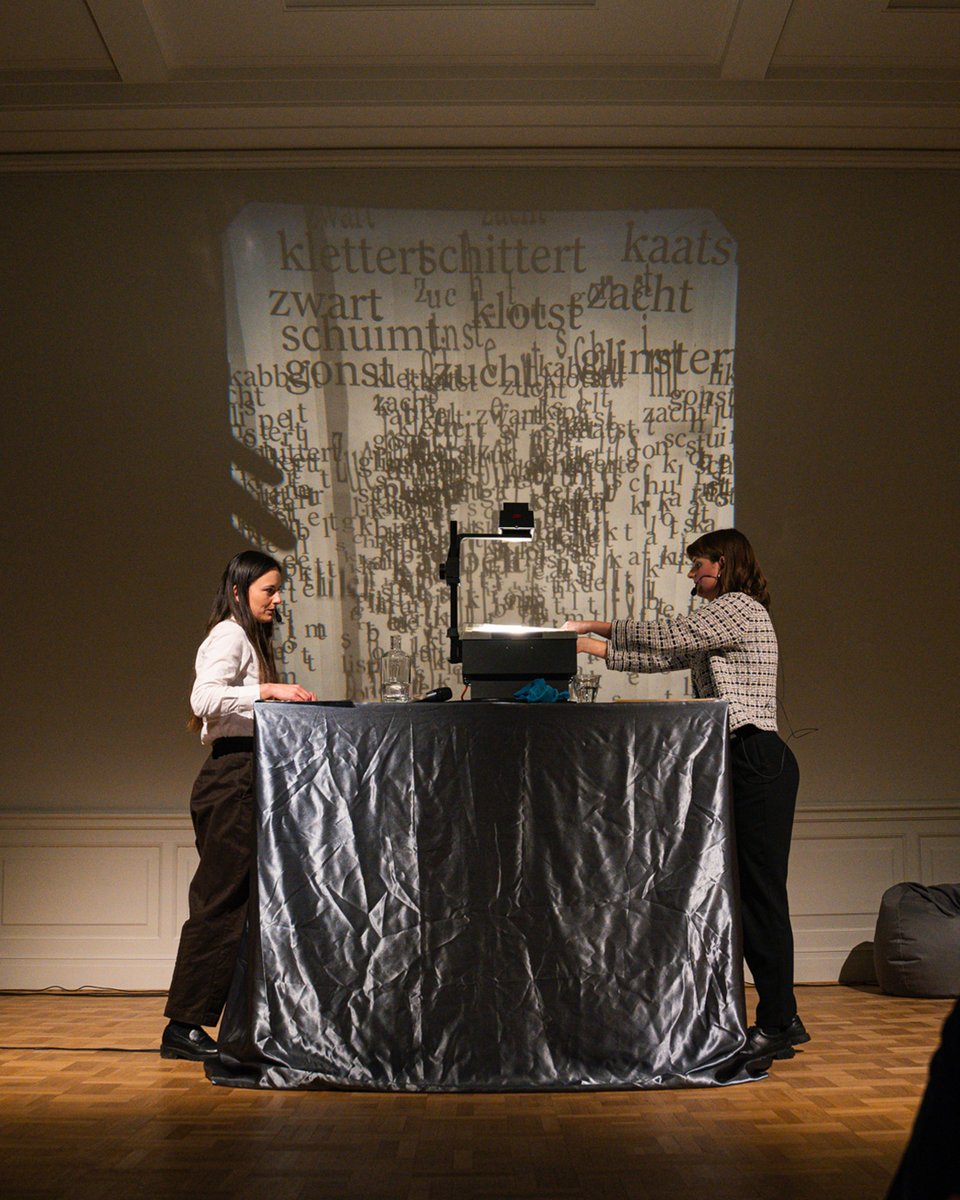
Last year, my friend Noortje and I worked together on a performative lecture we named ‘Niet Langer van Land’ (‘No Longer of Land’), in which we explored what it means to be in, or surrounded by, water. Noortje and I share a love of bathing in the broadest sense of the word, and both have attempted to channel this love into our work. While I try to encapsulate the experience of bathing in words, Noortje builds physical spaces that accommodate this same experience. When discussing our shared love, we danced around vague notions of ‘wholeness’, of feeling the world pouring itself out while we move with, not against, it. The yearning to, somehow, open the floodgates of our own selves, and become part of something bigger. We soon heard ourselves using the language of expensive wellness retreats and ayahuasca rituals, of the natural birthing blogs that now flood my feed. Big words that contain very little. While Noortje wisely accepted that some things are better left unsaid, exploring other ways to grasp or express, I turned to poetry instead.
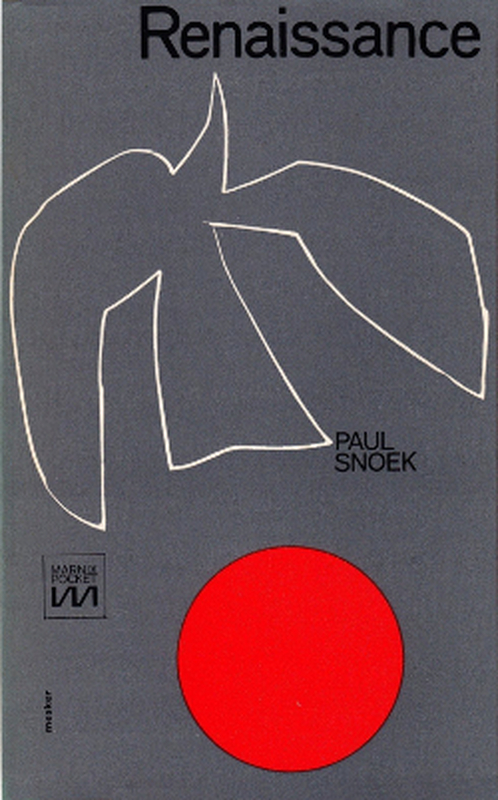
On dry land, I read Paul Snoek’s “Een zwemmer is een ruiter” (1960), translated as “A swimmer is a horseman” by Kendall Dunkelberg (2000).
It opens:
Zwemmen is losbandig slapen in spartelend water /
Swimming is licentiously sleeping in sprawling water.
It closes:
Zwemmen is een beetje bijna heilig zijn /
Swimming is being almost a little bit holy.
Losbandig, licentious: to be unrestrained, broken free from ties.
Heilig, holy: to be unimpaired, to form a whole.
Two adjectives that seem to be at odds with each other, and yet, they keep this poem together.
Two adjectives I keep coming back to in my current state.
I never thought of the word holy as a derivative of the Germanic adjective which produced the English ‘whole’. For some reason, it provides the word with a grounded undertone. Weighty, in the literal sense. Contained. Can we be almost a little bit holy, be part of a bigger whole, while still feeling unrestrained? What is it that holds us together, what breaks us open?
In 1927, Romain Rolland (French poet and mystic) wrote a letter to Sigmund Freud. In this letter, Rolland responds to Freud’s book The Future of an Illusion (1927), which Freud had sent him. In that book, Freud attempts to settle accounts with the idea of religion, a longing for sanctuary, by describing it as a kind of wish fulfillment, a childish desire to escape death.
According to Rolland, however, Freud had failed to properly appreciate the true source of religious feeling. In his letter, he describes a universal experience that reaches far beyond the walls of a church, or any holy book. He refers to an ‘oceanic feeling’ that precedes religion, a feeling in which we seem, for a moment, to become one with the external world. An experience of boundlessness, of eternity, which in institutionalised religions is often contained and curtailed. A direct, simple yet overwhelming, unbounded feeling, a feeling of universal interconnectedness, which according to Rolland we should not simply demarcate, but rather embrace.
In the famous Civilization and Its Discontents (1930), Freud responds to Rolland’s 'oceanic feeling' in a way that reveals his unease. He immediately admits that he cannot recognise in himself the feeling Rolland describes, but nonetheless attempts to account for it by attributing it to early childhood, when the boundaries between ourselves and the outside world have not yet taken solid shape: a Freudian explanation pur sang. He sketches the boundlessness of an infant, who does not yet know where its own body ends and the mother's breast begins. A feeling that exists at the edges of language, and that we are ultimately supposed to outgrow.
Freud continued his correspondence with Rolland for the rest of his life, though he remained skeptical about the oceanic feeling. In 1932 he would send him a copy of his book, The Ego and the Id, with the playful dedication: “From a land creature to his oceanic friend.” In a key passage in that book, he argues that the task of psychoanalysis is to strengthen the ego, and to arm it against the danger of self-loss. Not to become one with our instincts, but to keep drawing boundaries between ourselves and the endless, the boundless, the primitive. He adds, with a nod to Rolland, “this is the work of culture, comparable to the draining of the Zuiderzee.”
The oceanic feeling, which Rolland seeks and Freud fears, does not lie outside us, but hidden deep within. It lies dormant, and sometimes rises to the surface. A feeling that leads to the chaotic, undefined insight that precedes the word. According to Freud, we must deploy culture, or more specifically, language, to drain the wild ocean that dwells within us. Rolland chose the ocean, as a word, as a concept, because of all words it came closest to the wordless world he wanted to describe: that boundless body of water in which you can so easily lose yourself, in which we can literally and figuratively dissolve, and where words will not take you far.
In the middle of the night, unable to sleep, I read fragments of Julie Phillips‘ Baby on the Fire Escape, an exploration of the blank spot where mothering and creativity converge, told through artists who tried to be both. Instead of mourning the unified self, Phillips asks what artists can gain from a fractured consciousness, an interrupted life. A life I’m about to step into, in which I’ll be confronted with an ancient boundlessness, which I’ll probably try to encapsulate in words, against all odds. Noortje and I eventually gave shape to the oceanic feeling we’d been circling, blending words and sounds, the said and unsaid, and performed it at Museum de Lakenhal. We planned to turn this shared creation into a film, but got pulled into different directions. She is now moving across the world, unrestrained, making spaces for others to feel what we couldn’t name. I’m here, pillowed on my couch, trying to name it, again and again. A land animal, sending notes to my oceanic friend.
I think about the women in the pool. By now the class is long over, the pool empty, but I can clearly picture them: weightless, not trying to name what they're feeling, not trying to keep their heads above their hearts. Another kick reminds me that I am, whether I like it or not, already two, already dissolved. The oceanic feeling is no longer something I’m searching for, it’s something that found me, from the inside. A little bit holy, maybe. Losbandig, even. At least, for now.
From other desks
Words/images that reached me from other rooms.
Silent Friend, which I watched on a Tuesday morning in an empty cinema, unexpectedly reminded me of Rolland’s oceanic feeling. This slow film cuts among three stories, tied together by a massive tree: the only character old enough to appear across the three time periods. It starts with a lecture by one of the protagonists, a neuroscientist living through the pandemic, who draws a distinction between two modes of consciousness: the spotlight, narrow and directed, illuminating only what we choose to examine; and the lantern, diffuse and boundless, casting light on everything at once without preference or boundary. According to this theory, popularised by the philosopher and psychologist Alison Gopnik, the world of babies is shaped by the latter. Speech collapses their consciousness into the spotlight mode. Before that, babies are high all the time. The scientist, beautifully played by Tony Leung, aims to push beyond what can be strictly observed, to open oneself up again to this boundless consciousness, by shifting his focus from wordless babies to the silent ginkgo biloba. The film closes with a shot of the tree, a slow zoom out, which felt almost psychedelic. It made me cry.
From cinematic trees to dusty house plants. Jen Calleja’s Goblinhood: Goblin as a Mode reminded me “that you can be a writer and have a laugh, be a laugh. And have friends. Have your cake and eat it, too”. It also made me realise that house plants are, indeed,“the proliferation of goblins in the home”. Despite my effort to connect with them in profound ways, I often wonder what these creatures would have to say about how I treat them, and I’m silently grateful that they don’t possess the power of words. I hope they are high, like babies. I also wonder if motherhood will trigger my inner goblin. Fair chances it will, it already does.
Following Julie Philipps’ trail, I stumbled upon this excerpt by Jesse Klein called Epiphany in the Baby-Food Aisle. Turns out that one can discover the meaning of life in the grocery store, while buying cookies called Nom-Noms: that becoming a mother is, in essence, the perfect example of a hero’s journey, trailing a path of profound dream states, unimaginable torments and impossible delights. A journey not set against the backdrop of snow-peaked mountains, but sidewalk curbs. “A mother’s heroic journey is not about how she leaves but about how she stays”, she writes.
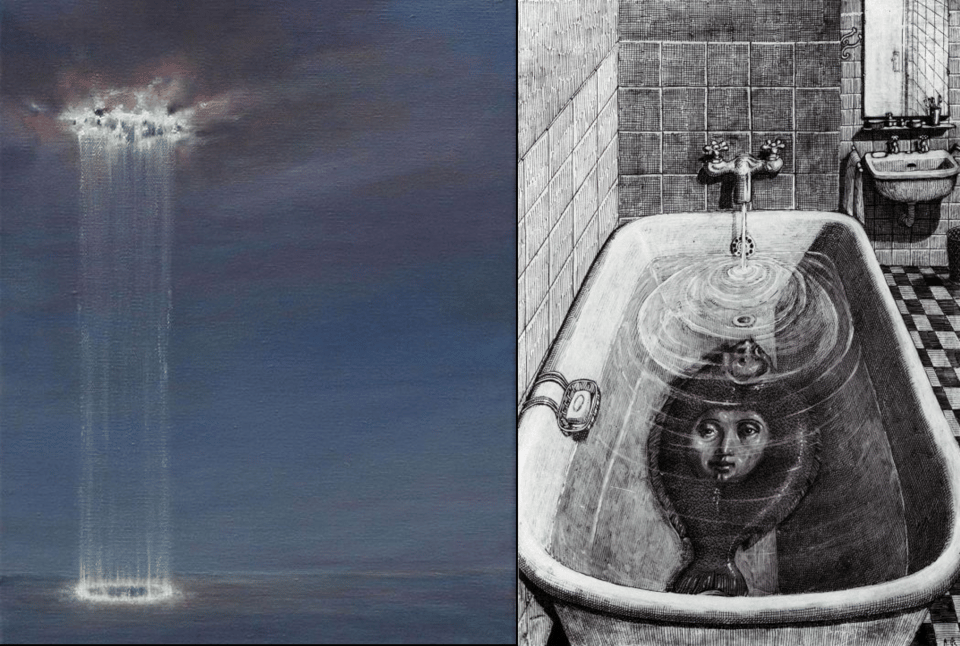
Diptych
Two images that found each other across my desktop.
That’s all, see you on the other side!
Happy Puddings,
Iris
Add a comment: