A Republic, Not a Throne
America rejected monarchy. The White House shouldn’t forget.
There’s a lazy reflex in American political culture right now: wave off anything egregious as just social media, as if the official voice of the government suddenly stops mattering the second it hits a platform with a character limit. That reflex is how standards erode—quietly, incrementally, and then all at once.
Because this isn’t nothing.
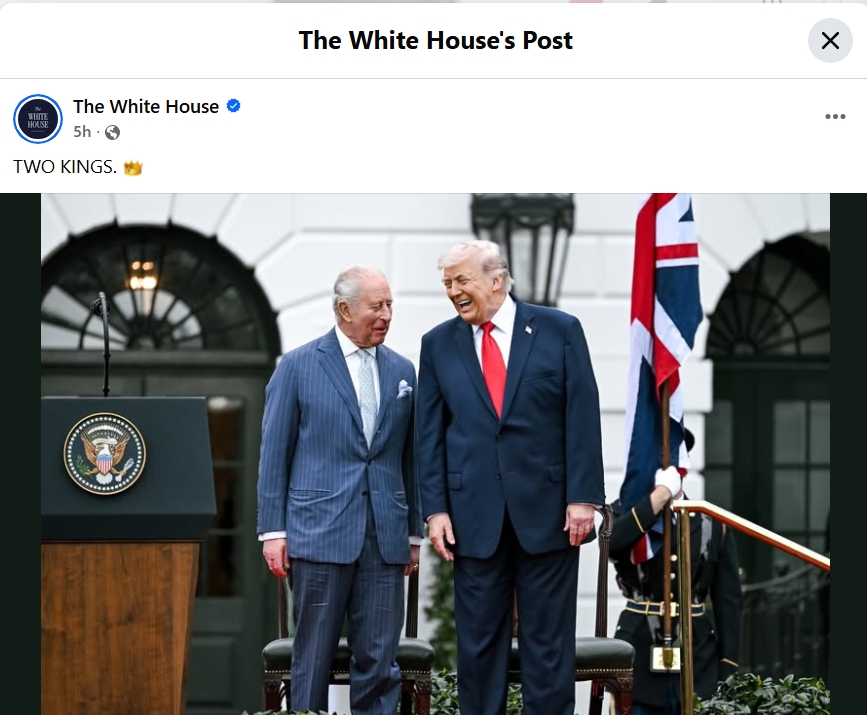
Upgrade nowThe White House posted an image of King Charles and Donald Trump on their social media pages and captioned it “TWO KINGS,” complete with a crown emoji. Not a parody account. Not a staffer’s burner. The official digital voice of the executive branch of the United States government.
Start with the baseline reality that should not need repeating: the United States does not have kings. It was not designed to have kings. It exists because it rejected kings. That is not decorative history—it is the point.
So when the White House casually borrows the language of monarchy to describe an American president, even as a joke, it is not harmless. It is a failure of institutional discipline. It is the government speaking about itself in terms that directly contradict the system it is supposed to represent.
And it’s not subtle.
Calling someone a king is not neutral slang when it comes from the White House. It is not the same as a fan account hyping a celebrity or a sports team. It is the state adopting the language of personal rule—language that collapses the distinction between elected office and inherited power into something interchangeable, aesthetic, and easy.
That should set off alarms. The fact that it hasn’t set off alarms is the problem. Has anyone seen any comment by Republican Party leaders? I haven’t. Not as of writing this column.
The defense in all likelihood, predictably, is that it’s just a joke. But that defense only works if you believe official communication has no cumulative effect—if you think tone, framing, and repetition don’t shape how power is understood. That’s not how politics works. It’s not how institutions work.
Language is how authority is explained to the public. And when the language gets sloppy, the understanding follows.
Look at what the post actually does. It takes King Charles—an actual monarch, whose role is bound by constitutional limits and centuries of tradition—and pairs him with an American political figure under a shared label of kingship. That is not clever. It is flattening. It erases the difference between symbolic monarchy and democratic leadership and replaces it with a single, glib image of dominance.
That erasure is doing work, whether the people who posted it realize it or not.
Because once you start treating the language of monarchy as interchangeable with the language of democracy, you make it easier to treat the underlying ideas as interchangeable too. You normalize the aesthetic of rule-by-personality. You make power look like something embodied in a person rather than constrained by a system.
And that’s how you end up with a government that sounds less like a republic and more like a fan club.
This is the downstream effect of a communications strategy that has completely lost the plot. Everything is optimized for engagement. Everything is flattened into content. If it travels, it’s good. If it provokes, it’s successful. Institutional coherence? Optional.
But the White House is not supposed to travel. It is supposed to communicate clearly, precisely, and with an awareness of the authority it represents. It is supposed to reinforce the difference between American governance and every system it was designed to reject—not blur it for the sake of a caption.
And yes, this is just a post. That’s the point. This is how it happens now—not through sweeping declarations, but through small, repeated choices that chip away at the boundaries until no one remembers where they were.
No one is arguing that Americans are about to wake up in a monarchy. The problem is more insidious than that. The problem is a slow drift in how power is described, where the language of democracy starts to sound indistinguishable from the language of personal rule, celebrity, and hierarchy.
When that drift becomes normalized, it becomes harder to push back on anything more serious—because the groundwork has already been laid in moments like this, dismissed as jokes.
So no, it’s not an overreaction to call this out. It’s the opposite. It’s recognizing that when the White House starts casually calling people “kings,” even in jest, it is signaling a comfort with the idea that should not exist in a republic.
And that’s not clever. It’s not funny. It’s not harmless.
It’s a tell.
