
The CritFail.Post - Issue 014
Free resources are the best
Hello and welcome to the official CritFail.Press Newsletter!
Checkout what’s been happening at CritFail.Press this week in the Map Monday and Weekly Article below!
If you have any suggestions or comments feel free to send them to mike@critfail.press.
D&D…for free?
Maybe you just played your first session of Dungeons & Dragons, maybe you’ve watched through Stranger Things (again), maybe you’re a huge Critical Role fan and love the idea of collaborative storytelling. Whatever the case, you are finally ready to make the leap to start playing, only you don’t know where to begin.
Or, maybe you’re an experienced Dungeon Master (DM) who has played for many years, purchased many source books and now enjoys designing adventures and campaigns with self-imposed limitations (like myself) because having ALL of the options available ALL of the time, is actually less helpful than you originally anticipated.
Whatever the case, playing D&D and any table top role-playing game (TTRPG) is such a rewarding hobby that of all the things that could potentially prohibit someone from playing these games, cost should never be one of them.
Fortunately, it is entirely possible to play exciting, complex, and deep adventures and campaigns without spending a single cent.
Come with me Adventurer, I will show you how.
Starting at the start
Why do this? Why create a roadmap for how to connect disparate resources strewn across the vast expanse of the Internet all to play a silly make-believe game about dwarves, elves, dragons, and goblins?
The answer is because after more than a decade of running games and shelling out literally hundreds (if not thousands) of dollars on this hobby, I’ve begun to realize what you actually need to run a game. What’s more, I’ve come to realize that there are a bunch of great free resources available on the open web that we can use today to do all of this. I want to share this with anyone who will listen because I believe truly great gameplay and stories can (and should) be told for free.
We’re going to set a few ground rules for this process as outlined below:
This is going to be a series of articles, we’re not going to cover everything today.
We are going to just focus on D&D for now. It is entirely possible to play other TTRPG’s for free as well, and we will cover them, but D&D has the broadest appeal and cultural recognition for fantasy RPG play. (That said, you can check out Issue 003 of the CritFail.Post for a free Dragon AGE RPG campaign, in the meantime).
We are assuming you, the reader, will be the Dungeon Master (DM) and will focus on providing resources DM’s need to organize and run a game, though player options will also be discussed.
We are assuming you have no access to any D&D first or third party material prior to reading this guide. If you do have some rulebooks or supplements already, or acquire some while we go through this process, you will have to decide if and how to implement them into the ideas we aim to show here.
We are going to assume you have access to the DMsGuild and the DriveThruRPG websites. They will form an integral part of this plan.
We will use a variety of products including but not limited to things like Creative Commons material and free preview PDF’s of otherwise paid products.
With “Free” being the focus of this tutorial, we may have to put in a little more legwork to compile and use our resources compared to just buying published books and using them as is. Certain technologies and programs will be suggested to help organize our information and make it easier. What’s offered in this series is just one way to do things.
Running a Game
Since our assumption is that you, Dear Reader, will be donning the weighty mantle of DM we are going to outline what you need to actually run a game. The truth is probably a lot less than you may actually think. But a game like D&D is known for its rules and its rule books so we’re going to start there. If we’re going to play the game we need rules to actually make it a game*.
1. 5.1 System Reference Document – D&D 5E Core Rules (2014 rules)
As the end result of some licensing chicanery that Wizards of the Coast (WotC) and their corporate overlord Hasbro tried to pull a few years ago (referred to online as the OGL crisis), we’ve been gifted the complete rules to 5E D&D in the form of the 5.1 SRD. This is all the rules you need to run and play the game with absolutely none of the fluff.
This compiles content from the three core rule books (Player’s Handbook, Monster Manual, Dungeon Master’s Guide) but strips out many things like a number of subclasses for Player Characters, optional character feats, character backgrounds, monsters that have strong Intellectual Property ties (mindflayers, beholders, etc.), DM advice and guidance, and more.
It’s certainly very playable, but is a bit lacking in some areas. It has been the basis for many forks of D&D 5E which have iterated on it successfully, so it’s a solid foundation to start from, but we can add to it.
2. Blackflag Reference Document – Tales of the Valiant
In the wake of the OGL crisis, Kobold Press, a long time D&D collaborator decided it best to spin off their own iteration of the 5E ruleset. The official line is known as Tales of the Valiant, but the free, Creative Commons ruleset is also available as the Black Flag Reference Document. This was a savy decision on their part to keep much of their back catalog relevant to fans who didn’t want to purchase anything else from Wizards. It also allowed them to make their own tweaks to the ruleset.
Although generally the same as the other rulesets on this list, Blackflag/Tales of the Valiant is notable for tougher monsters and characters than their D&D 5e counterparts. It also introduced the Luck System which in my humble opinion is far superior to the Inspiration mechanic of base 5E. You don’t need to know anything about this now, we’ll cover it more in future articles discussing modifying rulesets, but follow the links if you want to know more.
3. Level Up Advanced 5E
Another fork of 5E, this one occurred BEFORE the great OGL mess occurred. Created by EN Publishing, the game design arm of the ENWorld Forum website, Level Up sought to add more complexity to 5E. In that, they generally succeeded. Physical books and PDFs are available, but they also have a tidy SRD that is available for access online or download. A digital character builder exists as well.
4. 5.2 System Reference Document – D&D 5.5E (2024)
The second time D&D shows up on this list! The latest iteration of D&D is much like its predecessor but has enough small tweaks and changes to be distinct, but still considered “compatible” with what came before. These rules were also released in an SRD (the 5.2 SRD) and while the official support for this update to the D&D ruleset is minimal, it’s still relatively early in this editions life cycle and recent announcements provide a roadmap for what new products are coming soon. Also, just like the 5.1 SRD that came before it, it’s missing a number of character options and related content that can add to the enjoyment of the game, but this came rectified.
Verdict
Each of the four branches of 5E that we have covered have merit and utility in their own right, and each of them can provide us with amazing play opportunities for absolutely nothing. In fact it is even possible to mix-and-match bits from one 5E ruleset with another.
This is a tactic we will explore in greater detail throughout this series, but for now, keeping things simple is best.
As such, we will recommend using Option 4: 5.2 System Reference Document – D&D 5.5E
The reason being that this is the latest version of the rules, and it has been streamlined and tuned well, so will likely be the most approachable rules touchstone for new players and DMs. The hope is that it would provide the best play experience for $0.
In future articles in this series we’ll start to look at how to use these free rules and what other resources we may want to consider grafting on to our “Absolutely Everything Must Be Free” TTRPG framework.
I look forward to seeing you then.
-Mike
*You actually don’t need anything for really great collaborative storytelling, but having rules can impose some mutually agreed upon bounds and limitations that can “game-ify” the process. This is no bad thing, games are fun and creative. Just know all you truly need is your imagination and a willingness to collaborate!
Map Monday
Last week, we looked at an elevation view of the titular Dwarven mine from our adventure Depths of the Dwarven Mine.
This week, we take a look at the final map from that adventure. Next week we’ll move onto something else!
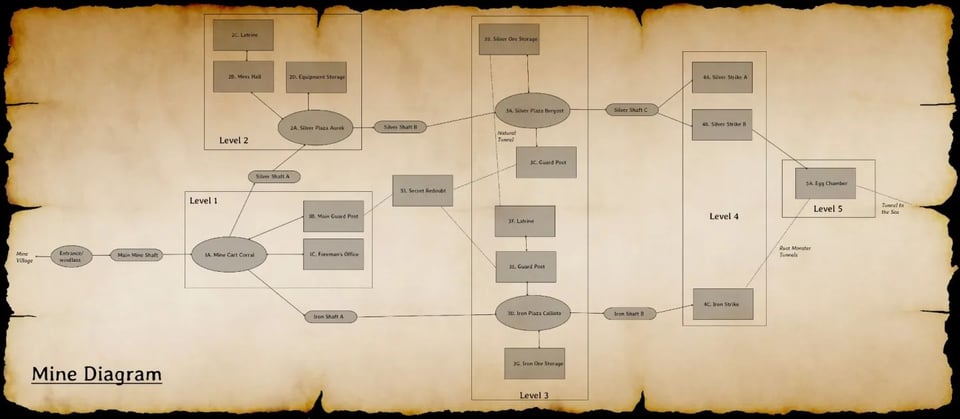
The conceptual map above was the original draft for the Dwarven mine. You can see it operates as more of a “node-and-path” map than a traditional dungeon map. Drawing things out schematically allowed me to arrange the rooms relative to one another and group them by floors. This approach helped me conceive the layout and refine it. With this schematic in-place, I was able to begin drawing the maps presented in the previous weeks.
You can download the map here.
-Mike