May 19, 1918: Mary Turner refused to stay silent
Today in True Crime by Case Bound
Source-backed daily true-crime history.
Non-graphic · Sensitive events discussed without explicit detail.
May 19, 1918: Mary Turner refused to stay silent
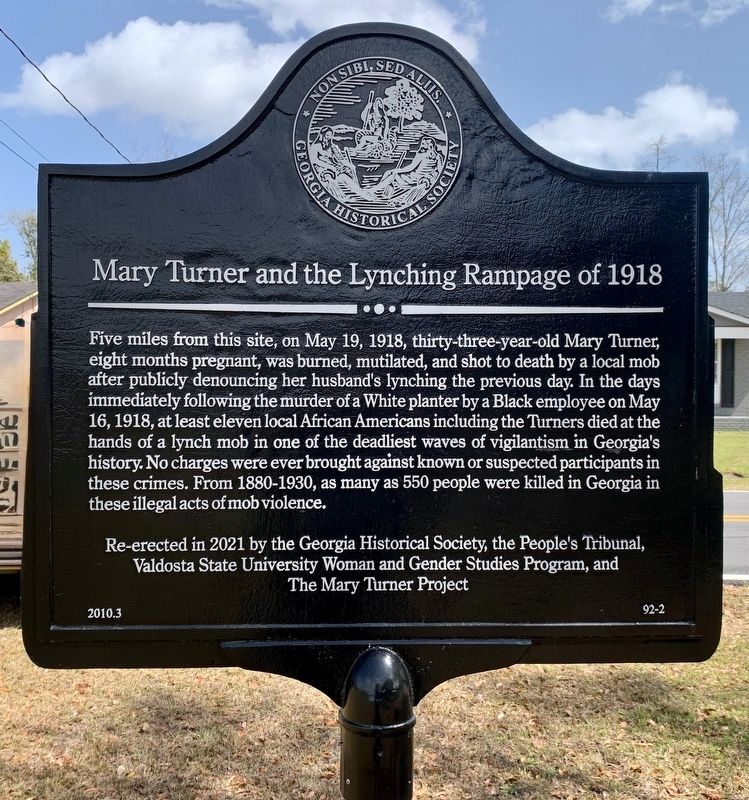
Mary Turner's name survives in the historical record because she refused to stay silent.
In the spring of 1918, Mary and her husband Hayes Turner were living and working in Brooks County, Georgia, near the plantation of a white landowner named Hampton Smith. The Turners were among hundreds of Black farm families in the area caught in a system of coercive labor that historians have characterized as "slavery by another name" — a web of debt peonage, convict leasing, and economic dependence that gave white landowners near-total control over Black workers.
When Hayes Turner threatened Smith in response to the severe beating his wife had received at Smith's hands, local authorities responded with the full weight of the all-white legal system. Hayes was arrested, convicted in a rapid proceeding, and sentenced to a chain gang. His wife, according to contemporaneous accounts, made clear she would seek accountability through the courts for his killing — an act of extraordinary courage in an era when such assertions by Black women were met with lethal retaliation.
On May 16, 1918, Hampton Smith was shot and killed by one of his workers. A white manhunt swept through Brooks and Lowndes counties. Over the following days, at least 13 Black residents were taken from their homes and killed by organized mobs. Some were seized directly from the county jail. More than 500 Black families fled the area out of fear for their lives.
On May 18, Hayes Turner was pulled from the chain gang by a mob and killed. The next day, May 19, Mary Turner was captured after learning of the threat against her own life. She was taken to Folsom Bridge, a crossing over the Little River approximately 16 miles north of Valdosta, and killed along with her unborn child.
The killings drew the attention of the NAACP, which dispatched investigator Walter F. White to Brooks and Lowndes counties. White's published findings — including his detailed accounting of the mob's participants and methods — brought national attention to the rampage. His report appeared in The Crisis, the NAACP's magazine, in September 1918. The case became a touchstone for the organization's campaign for federal anti-lynching legislation, which Congressman Leonidas Dyer of Missouri would introduce in what became known as the Dyer Anti-Lynching Bill of 1922. The bill passed the U.S. House of Representatives but was repeatedly blocked in the Senate by Southern Democratic opponents. Federal anti-lynching legislation would not become law until December 2018 — a century after Mary Turner's death.
No one was ever convicted for the murders of Mary Turner, Hayes Turner, or any of the at least 11 other victims of the May 1918 lynchings in Brooks and Lowndes counties.
Mary Turner's killing also underscored the particular vulnerability of Black women to racial terror. Historical research has documented that at least 120 Black women were known to have been lynched between 1865 and 1965, often for the same "offenses" — speaking out, resisting abuse, or being accused of crimes — that targeted Black men. The National Memorial for Peace and Justice, established by the Equal Justice Initiative in Montgomery, Alabama, includes Mary Turner's name among the thousands of racial terror lynching victims it documents.
A historical marker placed near the site of the lynching by the Georgia Historical Society in 2010 — and rededicated in 2021 as part of the Georgia Civil Rights Trail — acknowledges the events at Folsom Bridge. It reads, in part: "Mary Turner and the Lynching Rampage of 1918."
Mary Turner's story is not simply a record of horror. It is a record of a woman who, at 19 years old, in the most dangerous circumstances imaginable, refused to accept her husband's killing as unremarked upon. That refusal cost her everything. The historical record we have exists because she insisted, in the final days of her life, that it should exist.
Also on this day
-
Matewan Massacre (May 19, 1920) · WikipediaA shootout between Baldwin-Felts coal company detectives and local union miners in Matewan, West Virginia left 10 dead, including 7 detectives, 2 miners, and Mayor Cabell Testerman. The confrontation was a pivotal moment in the West Virginia Mine Wars.
-
Moscow, Idaho Mass Shooting (May 19, 2007) · WikipediaJohn Lee opened fire at three locations in Moscow, Idaho, killing three people and wounding three others. Lee was later convicted of three counts of murder and sentenced to life in prison.
-
NYC Chinatown Police Brutality Protests (May 19, 1975) · WikipediaAn estimated 10,000 to 20,000 people shut down Manhattan's Chinatown in the largest demonstration in the neighborhood's history, protesting the police beating of Peter Yew. Charges against Yew were eventually dropped and the precinct captain was transferred.
-
EgyptAir Flight 804 Crash (May 19, 2016) · WikipediaEgyptAir Flight 804 crashed into the Mediterranean Sea, killing all 66 people aboard. French investigators concluded smoke events were consistent with an intentional act, making this a possible criminal aviation disaster.
-
Brindisi School Bombing (May 19, 2012) · WikipediaThree gas cylinder bombs exploded in front of a vocational school in Brindisi, Italy, killing one 16-year-old student and injuring five others. The attack was treated as a possible domestic terrorism incident.
Sources used/checked for this issue
- Mary Turner (1899–1918), BlackPast — Euell A. Dixon, "Mary Turner (1899–1918)," BlackPast, September 22, 2015, accessed 2026-05-16.
- May 19, 1918: Mary Turner Lynching, Zinn Education Project — "May 19, 1918: Mary Turner Lynching," Zinn Education Project, accessed 2026-05-16.
- Mary Turner, Pregnant, Lynched in Georgia for Publicly Criticizing Husband's Lynching, Equal Justice Initiative — Mary Turner, Pregnant, Lynched in Georgia for Publicly Criticizing Husband's Lynching, EJI Calendar, accessed 2026-05-16.
- May 1918 lynchings, Wikipedia — "May 1918 lynchings," Wikipedia, accessed 2026-05-16.
- Mary Turner and the Lynching Rampage of 1918, Georgia Historical Society — "Mary Turner and the Lynching Rampage of 1918," Georgia Historical Society, accessed 2026-05-16.
- Battle of Matewan, Wikipedia — "Battle of Matewan," Wikipedia, accessed 2026-05-16.
- The Battle of Matewan: A Fight for Workers' Rights, WV Mine Wars Museum — "The Battle of Matewan: A Fight for Workers' Rights," WV Mine Wars Museum, accessed 2026-05-16.
- 2007 Moscow, Idaho, shooting, Wikipedia — "2007 Moscow, Idaho, shooting," Wikipedia, accessed 2026-05-16.
- John Lee pleads guilty to Moscow murders, KREM News — "John Lee pleads guilty to Moscow murders," KREM News, accessed 2026-05-16.
- Beating of Peter Yew, Wikipedia — "Beating of Peter Yew," Wikipedia, accessed 2026-05-16.
- May 19, 1975: Peter Yew/Police Brutality Protests, Zinn Education Project — "May 19, 1975: Peter Yew/Police Brutality Protests," Zinn Education Project, accessed 2026-05-16.
- EgyptAir Flight 804, Wikipedia — "EgyptAir Flight 804," Wikipedia, accessed 2026-05-16.
- 2012 Brindisi school bombing, Wikipedia — "2012 Brindisi school bombing," Wikipedia, accessed 2026-05-16.
Today in True Crime by Case Bound — 2026-05-19
