June 5, 1968: RFK shot in a hotel kitchen after winning California
Today in True Crime by Case Bound
Source-backed daily true-crime history.
June 5, 1968: RFK shot in a hotel kitchen after winning California
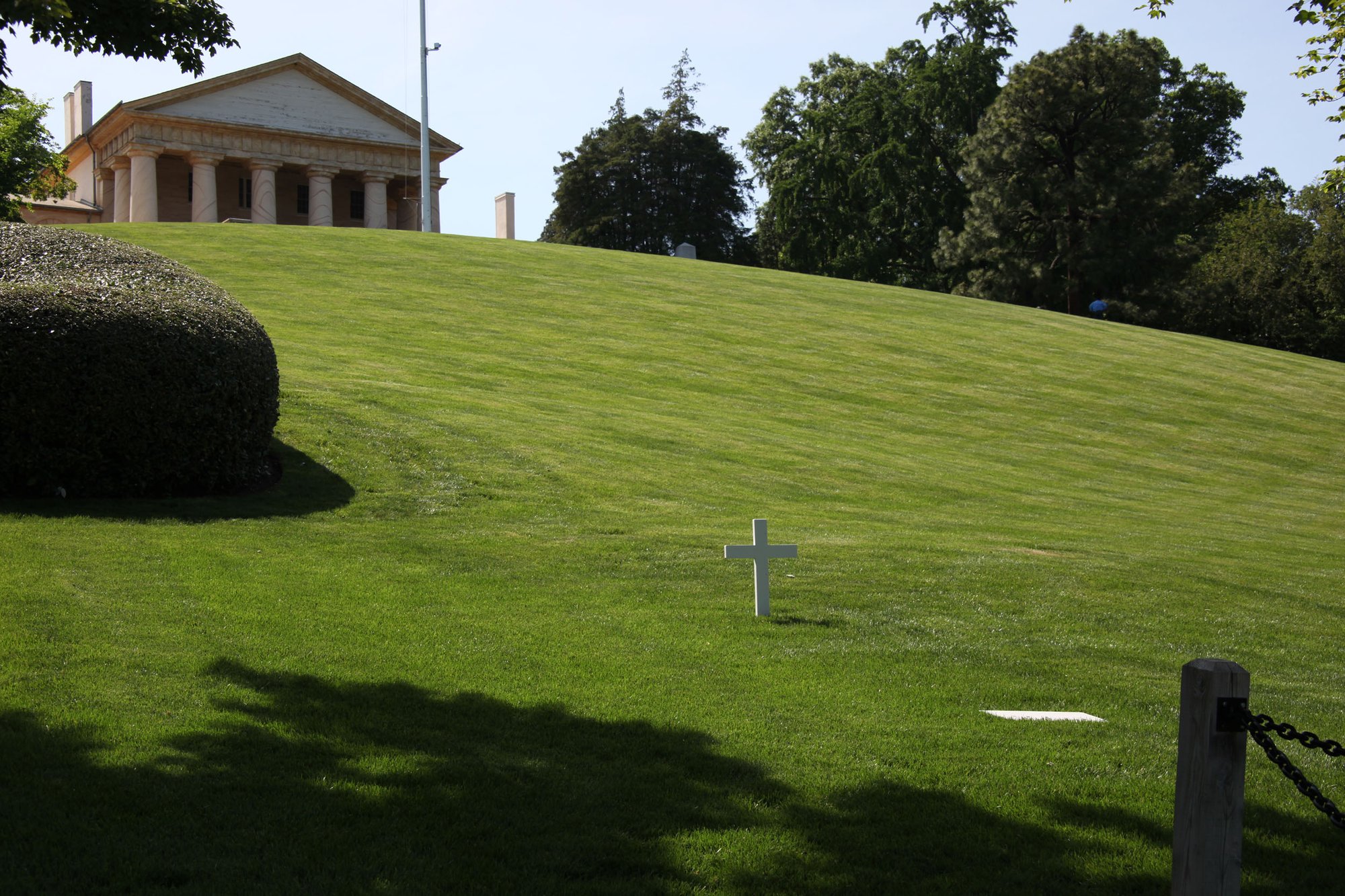
On the morning of June 6, 1968, at 8:44 a.m., Robert Francis Kennedy was pronounced dead at Good Samaritan Hospital in Los Angeles. He was 42 years old. The nation had spent the night in vigil, watching the wire reports, hoping against the news that was already all but written. Hours earlier, in the kitchen corridor of the Ambassador Hotel, a 24-year-old Palestinian-American named Sirhan Sirhan had raised a .22-caliber revolver and fired. Four others were wounded. Kennedy never regained consciousness. The thirty-six hours between that hallway and the hospital declaration compressed something enormous — the presidential campaign, the years of grief after Dallas, an entire season of national violence — into one more unbearable loss.
The night before had seemed like the beginning of something. Kennedy had spent June 4 watching the California Democratic primary returns. When the numbers came in and the crowds swelled in the Embassy Ballroom of the Ambassador Hotel, he stepped to the microphone and thanked his supporters — the farmworkers, the students, the civil-rights organizers who had made the California win possible. He spoke of closing the divisions that had split the country over Vietnam and poverty and race. Then the speech ended, the lights held, and Kennedy moved toward the kitchen to make his exit through the back of the hotel — an area that lacked the security presence of the main ballroom.
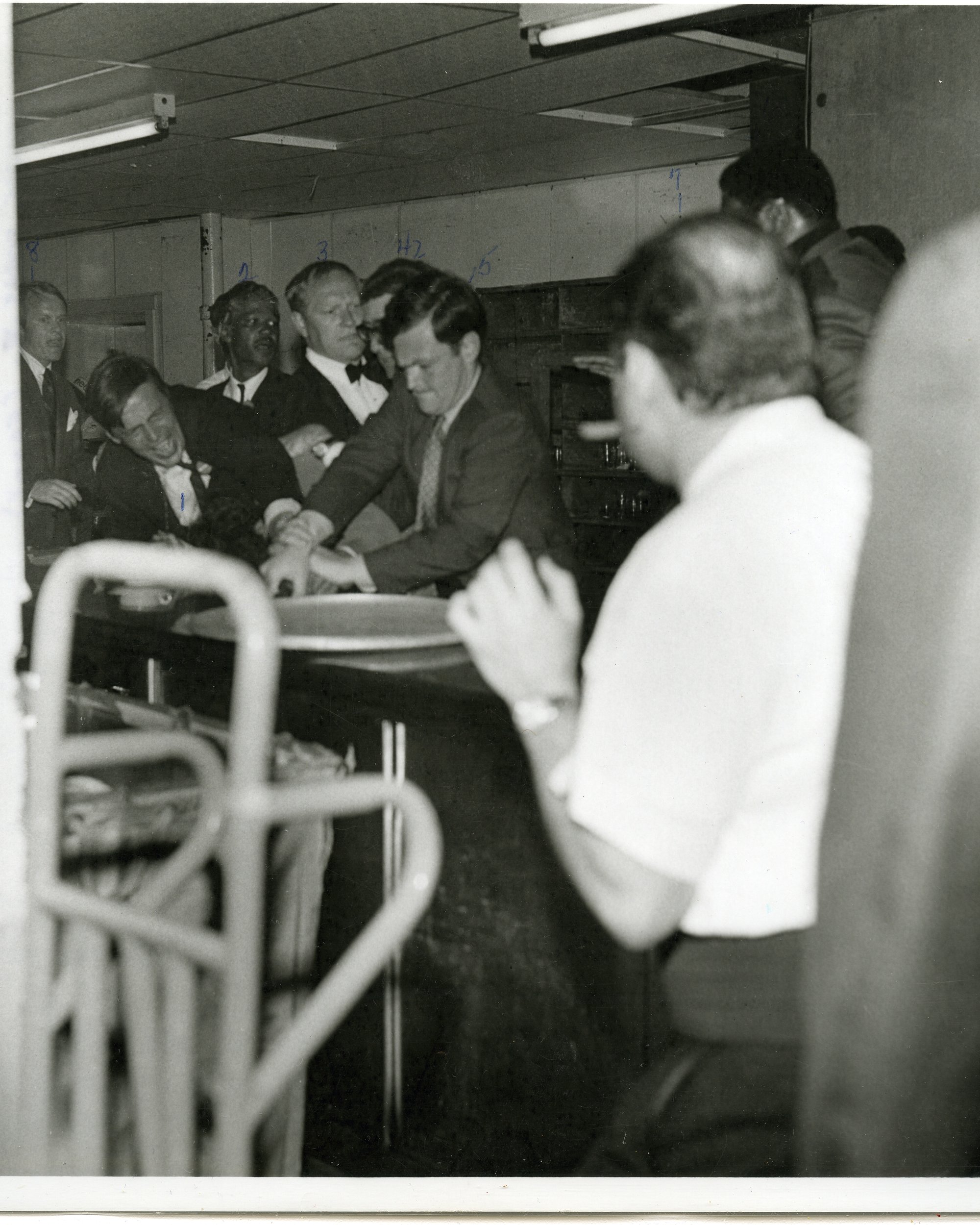
At 12:15 a.m. on June 5, Sirhan opened fire. Hotel staff and former NFL player Rosey Grier tackled Sirhan and pinned his gun arm, but the damage was done. Kennedy lay on the concrete floor of the pantry, his head cradled by a busboy. The crowd in the ballroom, seconds earlier jubilant, did not yet know what had happened.
Sirhan Sirhan had grown up in the Los Angeles area after immigrating from Mandatory Palestine with his family as a child. Investigators would later describe him as consumed by anger over Kennedy's stated support for Israel during the Six-Day War of 1967 — a position Sirhan had tracked in his journals. A handwritten notebook recovered from his home expressed hostility toward Kennedy in terms that prosecutors would cite as evidence of premeditation. Multiple psychiatric evaluations identified paranoid ideation, but the court ultimately found him fit to stand trial. The LAPD investigation concluded he had acted alone.
The trial that followed was a landmark in American legal spectacle. Artist Arnold Mesches attended the proceedings and produced courtroom sketches that were transmitted to newspapers and television stations across the country — one of the earliest cases in which courtroom illustration served as the nation's primary window into a proceeding no camera could enter. Those sketches now reside in the Library of Congress exhibition "Drawing Justice: The Art of Courtroom Illustration," a visual record of how the public watched justice unfold in an era before cameras were permitted inside courtrooms. On March 3, 1969, the jury found Sirhan guilty and sentenced him to death by lethal gas.
That sentence never carried out. In 1972, the California Supreme Court ruled in People v. Sirhan that the state's death-penalty statutes were unconstitutional, a decision that commuted not only Sirhan's sentence but those of every inmate then on California's death row. Sirhan became a lifer. The state reinstated capital punishment in 1978, but Sirhan's commuted sentence was not revisited. He has remained incarcerated ever since, transferred across several California facilities, most recently housed at the Richard J. Donovan Correctional Facility in San Diego County.
Over the following decades, parole hearings became a ritual of denial. The board has rejected his release fifteen times, with the most recent refusal recorded in 2016. At each hearing, the board weighed rehabilitation, mental-health treatment, and the nature of the original crime — and each time concluded that the deliberate assassination of a United States senator and presidential candidate placed his case beyond the threshold for release. Sirhan has now served more than 57 years.
The case has never stopped generating questions. In May 2018, as the 50th anniversary of the assassination approached, Robert F. Kennedy Jr. — the senator's son — traveled to the prison to meet Sirhan. He emerged describing the encounter in terms of reconciliation, speaking about forgiveness while making clear that the parole decision rested with the board, not the family. The meeting briefly reopened a long-running public debate about whether crimes committed by a young man can follow a person to the grave.
The Ambassador Hotel, where it all began, is gone. The Art Deco building that hosted Frank Sinatra and Marilyn Monroe and the Cocoanut Grove nightclub was demolished in 2005, replaced by a Los Angeles Unified School District campus. What remains is the record — the trial transcripts, the courtroom sketches, the footage of Kennedy surrounded by supporters in the seconds before he left the stage, and the date burned into the calendar: June 6, 1968, the morning that closed one of the most consequential campaigns in American political history.
Also on this day
-
Lake Bodom Murders — Espoo, Finland, 1960 · WikipediaThree teenage campers — Maila Irmeli Björklund (15), Anja Tuulikki Mäki (15), and Seppo Boisman (18) — were stabbed and bludgeoned to death while sleeping in a tent at Lake Bodom in Espoo, Finland, in the early hours of June 5, 1960. A fourth camper, Nils Gustafsson (18), survived with serious injuries. Despite decades of investigation and a 2004 arrest that ended in acquittal, the case has never been solved. It remains one of the most notorious unsolved crimes in Finnish history.
-
Ronald Clark O'Bryan Convicted of Capital Murder — Houston, Texas, 1975 · WikipediaRonald Clark O'Bryan — nicknamed 'The Candy Man' and 'The Man Who Killed Halloween' — was convicted of capital murder in Houston for poisoning his eight-year-old son Timothy with a potassium cyanide-laced Pixy Stix on Halloween night 1974. O'Bryan had taken out $30,000 life insurance policies on each of his children and gave the tainted candy to his son and four other children that night. He was convicted by a jury and sentenced to death. He was executed by lethal injection on March 31, 1984.
-
Sandra Hemme Convicted of Capital Murder — St. Joseph, Missouri, June 5, 1985 · The Marshall ProjectSandra Hemme was convicted of capital murder in connection with the 1980 death of Patricia Jeschke in St. Joseph, Missouri. Hemme maintained her innocence for decades. Her case was championed by the Innocence Project, and a Missouri circuit court eventually overturned her conviction. She was released in July 2024 after approximately 43 years in prison — making her the longest-known wrongfully convicted woman in the United States.
-
Richard Speck Dies in Prison — 1991 · WikipediaRichard Speck, who murdered eight student nurses in their Chicago dormitory in July 1966 in one of the most shocking mass killings in American history, died of a heart attack at Stateville Correctional Center on June 5, 1991. He was 49 years old. His case triggered widespread public debate over the death penalty after Illinois's capital punishment law was struck down in 1972, commuting his sentence to life. A video smuggled out of prison showing him in 1988 bragging about the murders and living comfortably caused national outrage.
-
James Earl Ray Extradited to U.S. for MLK Assassination — 1968 · WikipediaJames Earl Ray, the man who assassinated Dr. Martin Luther King Jr. in Memphis on April 4, 1968, was extradited from the United Kingdom to the United States on June 5, 1968 — the same day RFK was shot in Los Angeles. Ray had fled to Canada and then England after the killing. He was returned to face murder charges and eventually pleaded guilty, receiving a 99-year sentence. He died in prison in 1998.
-
Arthur Bremer Sentenced for Shooting Governor George Wallace — 1972 · WikipediaArthur Bremer was sentenced to 63 years in prison on June 5, 1972 for shooting Governor George Wallace of Alabama during a campaign rally in Laurel, Maryland on May 15, 1972. Wallace survived but was paralyzed from the waist down, ending his presidential campaign. Bremer's diary, published as 'An Assassin's Diary,' revealed he had initially stalked President Nixon before shifting his target to Wallace.
-
Marvin Gay Sr. Indicted for Manslaughter in Son's Death — 1984 · WikipediaMarvin Gay Sr., father of soul legend Marvin Gaye, was indicted on June 5, 1984 on charges of voluntary manslaughter for shooting his son on April 1, 1984 — one day before Marvin Gaye's 45th birthday. The elder Gay shot his son during an argument at the family's Los Angeles home. Prosecutors later discovered he had an inoperable brain tumor that was said to have affected his behavior. He pleaded no contest to voluntary manslaughter and received a suspended sentence.
-
Kenneth Bianchi Pleads Guilty — Hillside Strangler — 1979 · WikipediaKenneth Bianchi, one of the two Hillside Stranglers who terrorized Los Angeles in 1977–78, pleaded guilty on June 5, 1979 to five counts of murder in Washington State in a deal to avoid the death penalty. Bianchi and his cousin Angelo Buono abducted, raped, and murdered ten women and girls in the Los Angeles area before Bianchi moved to Bellingham, Washington, where he killed two more women. Bianchi's elaborate attempt to fake multiple personality disorder was exposed by psychiatrists and became a landmark case in forensic psychology.
Sources used/checked for this issue
- Robert F. Kennedy assassination, Wikipedia — "Robert F. Kennedy assassination," Wikipedia. https://en.wikipedia.org/wiki/Robert_F._Kennedy_assassination
- People v. Sirhan, 497 P.2d 1121 (Cal. 1972), CourtListener — People v. Sirhan, 497 P.2d 1121 (Cal. 1972). https://www.courtlistener.com/california/supreme-court/1972/people-v-sirhan/
- Sirhan Sirhan, Wikipedia — "Sirhan Sirhan," Wikipedia. https://en.wikipedia.org/wiki/Sirhan_Sirhan
- Robert Kennedy Jr meets father's killer Sirhan Sirhan, The Guardian — "Robert Kennedy Jr meets father's killer Sirhan Sirhan," The Guardian, June 7, 2018. https://www.theguardian.com/us-news/2018/jun/07/robert-kennedy-jr-sirhan-sirhan-meeting
- Ambassador Hotel demolished for school campus, Los Angeles Times — "Ambassador Hotel demolished for school campus," Los Angeles Times, June 25, 2005. https://www.latimes.com/archives/la-xpm-2005-jun-25-mn-ambassadorhotel25-story.html
- Drawing Justice: The Art of Courtroom Illustration, Library of Congress — "Drawing Justice: The Art of Courtroom Illustration," Library of Congress, 2024. https://www.loc.gov/exhibitions/drawing-justice-the-art-of-courtroom-illustration/
Today in True Crime by Case Bound — 2026-06-05
