In 1933: The Ambush That Changed the FBI Forever
Today in True Crime
by CaseBond · Source-backed daily true-crime history
June 17, 2026
Non-graphic · Sensitive events discussed without explicit detail.
In 1933: The Ambush That Changed the FBI Forever
June 17, 1933. Ninety-three years ago this morning, a group of law enforcement officers walked across Kansas City Union Station at approximately 9:30 a.m. with their prisoner, a notorious federal escapee named Frank "Jelly" Nash. They had every reason to think this was a routine transfer. Seconds later, gunfire erupted from multiple directions. When the shooting stopped — it lasted only moments — four law enforcement officers and the prisoner they were escorting lay dead. The Kansas City Massacre, also known as the Union Station Massacre, had just become one of the bloodiest ambushes in American law enforcement history.
Frank Nash had been a problem for the government since at least 1913, when he received a life sentence in Oklahoma for murder. He proved impossible to contain. On October 19, 1930, Nash escaped from the U.S. Penitentiary at Leavenworth, Kansas — a maximum-security federal facility — and spent the next three years evading capture while continuing a career that included bank robbery and other violent offenses. When federal agents finally ran him down and arrested him in the summer of 1933, they made arrangements to return him to Leavenworth. Special Agent in Charge Edgar C. Vetterli, the FBI's special agent in charge of the Kansas City office, personally coordinated the transfer. There was no sign anything had gone wrong.
The men waiting at Union Station had been busy since the day before. Vernon Miller, a career criminal with a personal stake in the outcome — he was a close friend of Nash's — had organized the rescue operation. He recruited Charles "Pretty Boy" Floyd, one of the most-wanted bank robbers of the Depression era, and Floyd's accomplice Adam Richetti. Their journey to Kansas City had not gone smoothly: their vehicle broke down on the morning of June 16, stranding them briefly before they pushed on. By the morning of June 17, they were in position.
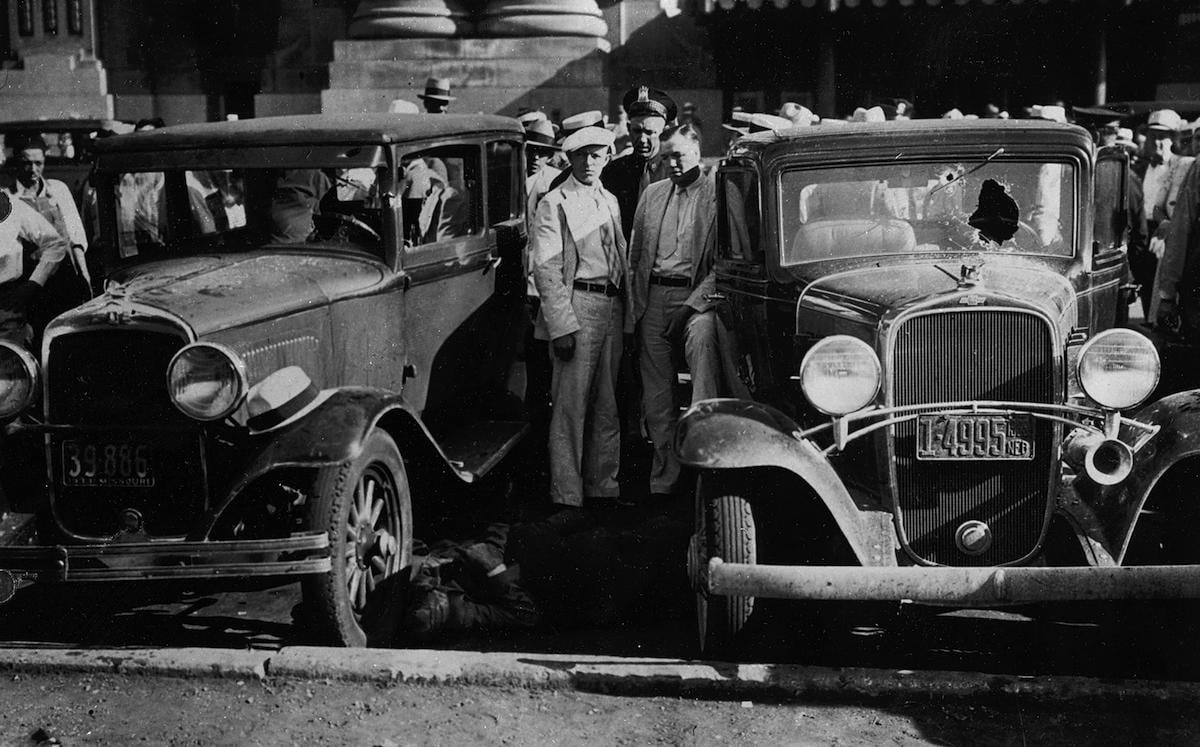
When Nash and his escort moved through the station, Miller, Floyd, and Richetti opened fire from their positions. The attack was over in seconds. Special Agent William F. Caffrey — among the earliest FBI agents killed in the line of duty — died at the scene. Kansas City police officer William J. Grooms was also killed, along with additional officers from other agencies who had participated in escorting Nash. Five people were dead in total: four law enforcement officers, and Frank Nash himself. Despite planning and executing a rescue operation on behalf of their friend, the gunmen had killed him in the crossfire.
The brazen slaughter of law enforcement officers in a crowded public station stunned the nation. The early 1930s had already produced a wave of Depression-era criminals who moved across state lines faster than jurisdictional boundaries allowed local police to track them. But the Union Station Massacre crystallized the stakes in a way that newspaper accounts of distant bank robberies had not. Law enforcement officers had died trying to move a prisoner through a train station on a Tuesday morning.
The investigation mobilized agencies across the country. All three orchestrators of the ambush met violent ends. Vernon Miller was killed in November 1933. Charles Floyd, elevated to Public Enemy Number One in the massacre's aftermath, was shot and killed by FBI agents in October 1934. Adam Richetti was convicted in connection with the attack and executed in 1939.
The Kansas City Massacre became a hinge point in the history of American law enforcement. In the months and years that followed, Congress expanded federal law enforcement authority, giving the Bureau new powers to pursue criminals across state lines and strengthening jurisdiction over crimes against federal officers. The attack at Union Station exposed precisely how lethal the gap between federal and local authority could be — and the political will to close that gap followed. The Bureau of Investigation was reshaped into the modern FBI partly in the wreckage of what happened on June 17, 1933. As recently as 2023, the FBI's Omaha Chapter laid a wreath at Agent Caffrey's grave to mark the ninetieth anniversary of the attack. The officers who fell on that platform have not been forgotten.
Also on this day
-
Henderson v. Morgan: Supreme Court Rules Guilty Plea Invalid Without Notice of Intent Element, June 17, 1976 · WikipediaOn June 17, 1976, the U.S. Supreme Court decided Henderson v. Morgan, ruling that a guilty plea is not constitutionally voluntary when a defendant was never informed that intent to cause death was an element of the murder charge he was pleading to. Robert Henderson had pleaded guilty to second-degree murder in New York without understanding that requirement. The decision set a foundational standard requiring courts to ensure defendants are actually informed of the nature of the charges before a guilty plea is accepted.
-
Gloria Sue Nix Green Disappears from Her Office in Kermit, Texas, June 17, 1985 · MediumOn June 17, 1985, Gloria Sue Nix Green vanished from her workplace in Kermit, Texas. Investigators working the West Texas region at the time believed her disappearance was connected to a pattern of killings targeting women in the area, later attributed to a serial offender known as the Odessa Lust Murderer.
-
Stein v. New York: Supreme Court Upholds Murder Convictions in Confession Admissibility Case, June 17, 1953 · ChanRobles Law LibraryThe U.S. Supreme Court issued its ruling in Stein v. New York, 346 U.S. 156 (1953), affirming the murder convictions of three defendants tried in a New York state court. The case examined the standards governing the admissibility of confessions as evidence in capital proceedings, producing a ruling that shaped criminal procedure law in the years before Miranda.
-
Eric Riddick Freed After 29 Years of Wrongful Imprisonment in Philadelphia, June 17, 2023 · Georgetown University Prison and Justice InitiativeEric Riddick walked out of a Philadelphia courthouse a free man after serving more than 29 years for a murder he did not commit. Convicted of a 1992 killing, his case was reopened by the Philadelphia District Attorney's Conviction Integrity Unit, which publicly accepted responsibility for the wrongful conviction at the time of his exoneration.
-
Oklahoma Court Grants Last-Minute Stay of Execution for Richard Glossip, June 17, 2008 · PBS NewsHourOklahoma's Court of Criminal Appeals granted an eleventh-hour stay of execution for death row inmate Richard Glossip, extending the timeline to allow consideration of new evidence. Glossip had been convicted of murder-for-hire in the 1997 death of his employer at an Oklahoma City motel, a case that became a prolonged subject of national controversy over questions of guilt and prosecutorial conduct.
-
Brooklyn Man Sentenced to 25 Years to Life for Execution-Style Killing, June 17, 2020 · Shore News NetworkCorey Townsend was sentenced to 25 years to life in prison for fatally shooting a seated man at point-blank range in a Brownsville, Brooklyn NYCHA courtyard. The killing was described as an execution-style shooting; the sentencing brought a close to a murder case out of New York City's public housing.
-
DNA Breakthrough Solves 1963 Wisconsin Gas Station Murder After 61 Years, June 17, 2024 · CBS NewsA DNA breakthrough led investigators to identify a suspect in the 1963 murder of Wayne Pratt, a 24-year-old gas station operator found dead at an Enco station along U.S. Highway 41 in Winnebago, Wisconsin. Pratt had been discovered by his wife in the back room of the station; the case had gone unsolved for more than six decades before advances in forensic genealogy produced a suspect identification.
-
Convicted Child Murderer Lewis Lent Continues to Be Questioned About Additional Victims, June 17, 2023 · WikipediaLewis Stephen Lent Jr., convicted of the 1993 abduction and murder of 12-year-old Sara Anne Wood and a 1990 child killing in Massachusetts, remained incarcerated and a continuing subject of inquiry into additional suspected victims across the Northeast. Lent pleaded guilty to both murders and received a mandatory life sentence for one count and 25 years to life for the other. Investigators continued efforts to account for other children believed to have been targeted.
Just hit reply. Tell me what grabbed you, what you'd want more of, or a case you can't stop thinking about. I read everything.
Sources used/checked for this issue
- Kansas City Massacre / Pretty Boy Floyd, Federal Bureau of Investigation — "Kansas City Massacre / Pretty Boy Floyd," Federal Bureau of Investigation History. https://www.fbi.gov/history/cases-and-criminals/kansas-city-massacre-pretty-boy-floyd
- Kansas City massacre, Wikipedia — "Kansas City massacre," Wikipedia. https://en.wikipedia.org/wiki/Kansas_City_massacre
- Kansas City Massacre involving Pretty Boy Floyd changed the course of the FBI, 90 years ago, Nebraska Examiner — "Kansas City Massacre involving Pretty Boy Floyd changed the course of the FBI, 90 years ago," Nebraska Examiner. https://nebraskaexaminer.com/briefs/kansas-city-massacre-involving-pretty-boy-floyd-changed-the-course-of-the-fbi-90-years-ago
- Union Station Massacre, KC Police Memorial — "Union Station Massacre," KC Police Memorial. https://kcpolicememorial.com/pages/unionstation
- Floyd, Charles (Pretty Boy), Pendergast KC — "Floyd, Charles (Pretty Boy)," Pendergast KC. https://pendergastkc.org/names/floyd-charles-pretty-boy?page=1
- Union Station Massacre — Kansas City History, Pendergast KC — "Union Station Massacre," Pendergast KC. https://pendergastkc.org/articles/union-station-massacre
- This Week in KC History — The Union Station Massacre, Kansas City Public Library / kchistory.org — "This Week in KC History: The Union Station Massacre," kchistory.org. https://kchistory.org/this-week-kc-history/mess-massacre
- Detective Frank E. Hermanson, Officer Down Memorial Page — "Detective Frank E. Hermanson," Officer Down Memorial Page. https://www.odmp.org/officer/6420-detective-frank-e-hermanson
- The Kansas City Massacre Prompted Legal Reforms That Bolstered Federal Law Enforcement, The Mob Museum (National Museum of Organized Crime and Law Enforcement) — "The Kansas City Massacre Prompted Legal Reforms That Bolstered Federal Law Enforcement," The Mob Museum. https://themobmuseum.org/blog/the-kansas-city-massacre-prompted-legal-reforms-that-bolstered-federal-law-enforcement
- William J. Grooms, Kansas City Law Enforcement Memorial Garden — "William J. Grooms," Kansas City Law Enforcement Memorial Garden. https://kclemg.org/william-j-grooms
Today in True Crime by CaseBond — 2026-06-17
