
Hey there,
Welcome to a new issue of Ninja Sparks. I’ve now been writing this newsletter for over a year, and it’s been a fun way to collect and share the things I’ve found along the way. I hope you’re enjoying it. As always, please let me know if you have any feedback or suggestions for future issues.
Over the last couple of weeks I’ve been doing some work on Brush Ninja, mostly tidying up user interactions to make it nicer to use. They’re all small changes that will hopefully go unnoticed, but together should make the experience feel smoother and more considered.
Away from the computer, something else has been quietly unfolding. My son has recently started getting into Lego. He’s 9 now, and although we introduced it years ago, it never really stuck until recently. A couple of weekends ago he adopted a “pet” pebble and decided it needed a house. What began as a single room has slowly grown into multiple rooms, a garden, and even a balcony.
I’ve always been sure he’s a creative person, but he’s never been particularly interested in showing it. That’s what’s been so nice to see. We actively limit his screen time, even though he’d happily have more. It’s a deliberate choice, partly because it’s hard enough for adults to manage screens without adding that weight to children who are still figuring the world out.
Lately, though, he’s been off building new additions to the pebble’s house, completely absorbed. Watching that kind of unprompted, playful creativity emerge has been genuinely lovely. It’s also been a good reminder that the right tools, and a bit of space, can go a long way.
Castle
Castle is a mobile app for iOS and Android that gives you simple tools and plenty of space to experiment. It lets you create and share interactive “toys”, sitting somewhere between a drawing app, a game maker, and a storytelling tool. The interface is intentionally straightforward, so you can make something playful in minutes rather than hours.
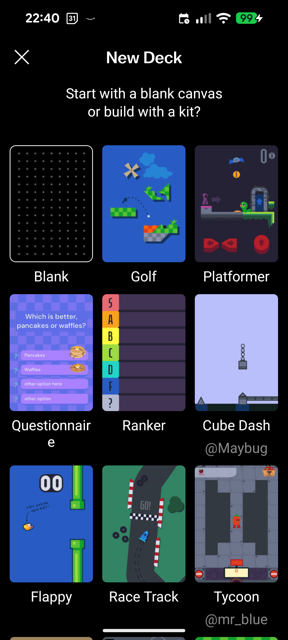
Rather than focusing on timelines or keyframes, Castle is built around interaction. Creations range from slideshow-style stories to small physics-based games. Everything is assembled from visual blocks and cards that you connect together to define behaviour. You can draw your own assets, remix built-in elements, or start from one of many templates.
What stands out most is how handmade everything feels. Creations are rough around the edges in a good way, full of personality and small surprises. That aligns closely with what I aim for with Brush Ninja, and it’s refreshing to see another tool leaning into creativity over polish.
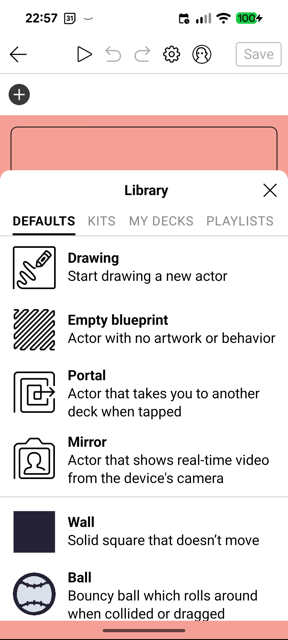
Castle also feels like a modern echo of early Flash. People making strange, playful things quickly, sharing them, and building on each other’s ideas. You don’t need to think of yourself as a game developer to enjoy it. Curiosity is enough.
The app is free to use, with optional purchases for extra features, and the community side is very much part of the appeal.
The Sad Story of Flash
One downside of creative tools tied to large platforms is what happens when they disappear. Flash was a multimedia platform used for animations, games, and interactive content across the web. It began as FutureSplash, was later acquired by Macromedia, and eventually became part of Adobe. For a long time, Flash was the easiest way to make expressive, interactive work online.
It was also where I started professionally, first as an animator and later moving into web design and development. Flash lowered the barrier to entry in a way few tools have managed since, and it enabled a huge amount of creative experimentation.
Over time, its problems became harder to ignore. Performance issues, security concerns, and poor support on mobile devices pushed the industry towards open web standards like HTML5. Adobe officially ended Flash support in 2020.
Adobe Animate, the rebranded successor, survived as a professional animation tool, and many cartoon studios still rely on it. Recently, Adobe announced plans to end active development and limit long-term access, which caused understandable concern. That decision has since been partially reversed, with Animate continuing in maintenance mode.
The episode is a useful reminder of the risks of closed creative tools. When access disappears, years of work can vanish with it. This is one of the reasons I continue to favour simpler, more open alternatives where possible, and why I built SwapCreate as a catalogue of options outside the Adobe ecosystem.
The Hyrule Fantasy
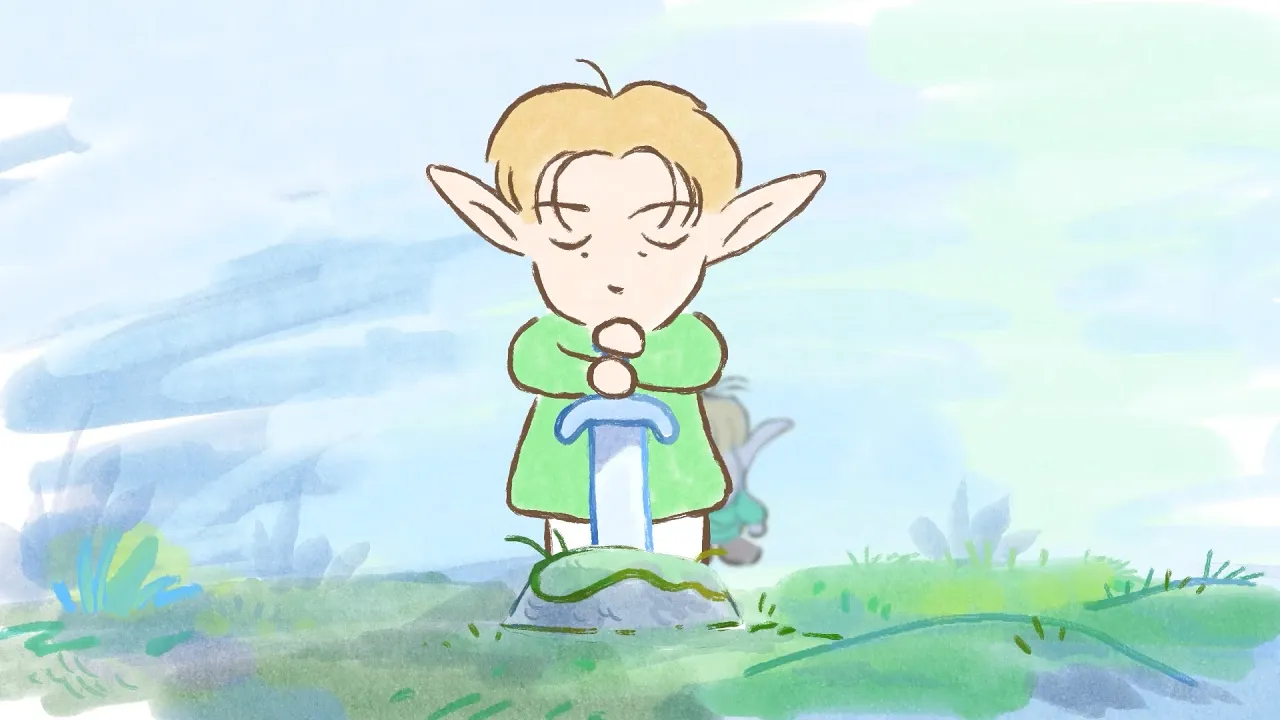
The Hyrule Fantasy is a short film by Ousmane Cissé, an animator from France. It’s a tribute to The Legend of Zelda, reimagined in a loose, expressive style that feels personal rather than referential.
It doesn’t try to replicate the games. Instead, it captures the feeling of exploration and quiet wonder that sits underneath them. The result feels thoughtful and sincere, and well worth a few minutes.
If you enjoy this, there’s also a shorter One Piece tribute on the same channel that’s worth a look.
Hacktivate

The Hacktivate game menu
Last issue I mentioned the game Hacktivate. I’m still playing through it and really enjoying it. I wanted to mention it again because there’s been a substantial update that adds solutions to all of the puzzles, allowing you to see how they were intended to be completed.
This was my biggest complaint previously. If you got stuck, or brute-forced a solution, there was no way to learn what you’d missed. Now there is, and it makes the experience much better. I’m planning to go through the game again to see what I got wrong, and how I could have approached things differently.
Fun Playground Equipment

An artistic piece of playground equipment from Japan
This is a fascinating selection of photos from Japan by photographer Fujio Kito, showing a wide array of playground equipment. In the UK, playgrounds tend to be fairly standardised: lots of wooden frames, metal poles, and slides.
These Japanese playgrounds are incredibly imaginative, with equipment designed to look like all sorts of things, often animals. Some are based on real creatures, while others are more fantastical. They add a lot of personality and fun to the spaces.
Of course, it’s not just animals. There are robots, buildings, and abstract shapes too. It’s a great reminder that playgrounds can be more than just functional spaces. They can be places that spark imagination and joy, exactly as they should.
Currently Watching
I’m currently on the last couple of episodes of The Afterparty, a cosy murder show on Apple TV+. I’ve really enjoyed how the characters are unreliable witnesses, each with their own motivations and perspectives, revealed as they tell their versions of events.
Each episode focuses on a different character recounting what led up to the murder from their own viewpoint, with their biases and framing nudging you in different directions. In the first season, one episode is largely animated, and you often notice details early on that are only explained or made clear much later. It’s a fun, thoughtful take on the Agatha Christie-style whodunnit, a genre currently enjoying a revival with films like Knives Out and books such as The Thursday Murder Club.
With my son, we’ve been watching Ronja, the Robber’s Daughter. It’s a nice story with beautiful animation, but it does feel very slow at times, and the voice acting comes across as stilted and over the top. Given that the English voice cast is made up of established names, I was surprised at how poorly it landed.
Have you found anything interesting lately? I’d love to hear about it, just reply to this email!
See you next time,
Ben
You just read issue #68 of Ninja Sparks. You can also browse the full archives of this newsletter.


