
Book Time #26: How I Read

Finding Books
My most reliable method for finding books is in the endnotes of other books I enjoy. I don’t flip to every endnote, but if I’m reading a passage that intrigues me, I’ll look up the sourcing. The downside of this method is I end up with a lot of books in the queue about similar subjects.
Many books end up on my list via personal recommendations. I love talking about books and I get a lot out of reading what people recommend. They are often not the types of books I would pick out myself, for better and worse. But even if it’s not a book I liked I am usually glad I read it.
Another way I find books is by paging through the seasonal catalogs for various university presses. Most of these books are written primarily for other researchers in the field. But sometimes I find gems in there on oddball subjects. Crap: A History of Cheap Stuff in America is one example. Two on my list I haven’t gotten to yet but found the same way are Whiskerology: The Culture of Hair in Nineteenth-Century America and The Things She Carried: A Cultural History of the Purse in America. I’m excited to read both.
Some books get added to my list because there is a subject I want to read more about. My go-to resources here are the Ask Historians subreddit and fivebooks.com. These are my first steps in an intellectual journey. I’ll pick one or two books from there, usually a work from the late 20th or early 21st Century if I can. To my mind the finest historical scholarship occurred from roughly 1960 to 2010. It is recent enough that the endnotes will be a valuable resource for further reading, but not so recent you end up getting a more faddish interpretation of the period that may not stand the test of time.
One place I do not get suggestions from is algorithms. This is both practical and principled. One practical reason is algorithmic recommendations are a worse version of the endnotes problem: You read this book about the Crusades, perhaps you’ll enjoy these 27 other books about the Crusades. The principled reason is I try and make my reading hobby as independent of digital technology as possible. Reading is my time away from computers. Sometimes this is avoidable, other times not. More on that later.
If I want something functionally similar to a recommendation algorithm but adds an element of curiosity and discovery, I go to the library. One of the many joys of living in New York City is the library system. The Performing Arts Library and Stavros Niarchos Foundation Library (on Fifth Ave across from the main branch) are both delightful places to spend a few hours in Manhattan, and in Brooklyn I spent more than my fair share of afternoons at the Grand Army Plaza main branch. I pick a section and walk the shelves until I get hungry, thirsty, or under-caffeinated.
And, when any of these methods result in finding a book that not only had a fascinating story but was researched and written particularly well, I will add all the author’s works to my queue.
Managing the Queue
I have tried physical notebooks, apps, and complicated pipelines in Notion to manage and track my reading. In the end, I have settled on the humble spreadsheet as the right balance of convenience, fuss and permanence. The spreadsheet is creatively titled “Books.” There is a “To Read” tab with my queue.
I prioritize using the library as much as I can. The most valuable service the library offers is taking the books back when I’m done. I live in an apartment in Manhattan. I don’t have space to acquire 50 new books every year, but I prefer physical copies for reasons I’ll explain in a bit.
However, it is important that I am always reading a book. I don’t know why, but I feel like something is missing if I’m not reading a book. When I finish a book, I immediately read the first 10 pages of a new one so I am never between books.
Therefore, I must always have books. My system is as follows. I request three physical books from the library at once. I check them out simultaneously. If any of them have a hold list and can’t be renewed, I read that one first. When I have about 500 pages left in the stack, I request more books. It takes a few days for them to get to the library branch, then I have a week to pick up the holds. I almost always finish those 500 pages by then.
Simultaneously, I periodically load as many digital library books onto my Kindle as I can. Yes, I have a Kindle. No, I don’t like reading on a Kindle. But many books are only available from the library via Kindle. And reading a book on a Kindle is better than not reading a book at all. The Kindle library also serves as a nice backup in case the library hold timing is off.
I prefer physical copies because I process what I’m reading as a journey through the space of the book. I can usually find any passage I want in a physical book because I remember the thickness of pages in each hand when I read it. On a Kindle, all of that is flattened, each page is identical to the one before it. For me it is much like the difference between going for a long bike ride along rolling country hills versus riding a stationary bike in a gym.
Every couple of months I take 20 minutes to borrow as many digital books as I can from my queue, then turn my device on Airplane Mode, and keep it there until I finish those books. The digital copy still gets “returned” to the library when the loan expires but I can read them at my leisure. Right now I have seven books on there. NYPL allows a maximum of three simultaneous digital loans, but the Brooklyn Public Library allows up to 20. This takes the pressure off managing my physical book queue.
If NYPL and BPL don’t have the book, I use the interlibrary loan system. It is much harder to predict when a book will come in via ILL and, unlike with its own catalog, there are late fees and restrictions on renewals that make it less flexible. So I use ILL sparingly.
That being said, ILL books are treats unto themselves. They are often old copies from some underused small university library, still with the old card catalog slip holders in the back, with that distinctive odor of aged paper. The first thing I do when I get an ILL book home is open to the middle and take a big whiff.
Occasionally I will purchase a book, either because the library doesn’t have it, I want to own a copy of a book I loved, or the book is extremely long and I don’t want to have to return it half-unread. I always like to have a few unread books I own on the shelf as the ultimate insurance policy just in case all else fails. First, I check Bookfinder, a used book site aggregator. If it is more than $10 or so used I will buy it new unless it is one of those stupidly expensive academic books.
I almost never buy new releases. The main exception is if someone I want to support wrote a book. Due to my line of work I am fortunate to call some authors friends of mine. I will, of course, preorder their books as a matter of course. If a podcaster, journalist, newsletter writer, etc. I follow is publishing a book, I will usually preorder that too, even if I am pretty sure I won’t like their book. I find very few people write quality books while also churning out newsletters and podcast episodes.
I haven’t found a good way to “follow” authors I like so I can be alerted to new releases. I understand why. If you write a new book every decade the method for getting the word out has changed with each new book you’ve released. Maybe Goodreads or Amazon or someone has a nifty tool for this. If so, that’s a convenience I can live without. That being said, can someone email me when the third volume of Kotkin’s Stalin biography finally comes out?
Reading Books (Or Not)
I read books while in a handstand propping the book in the crooks between my knees and thighs so as to achieve a state of total transcendent delight.
OK, I only wish I could do that. My preferred reading pose is this:
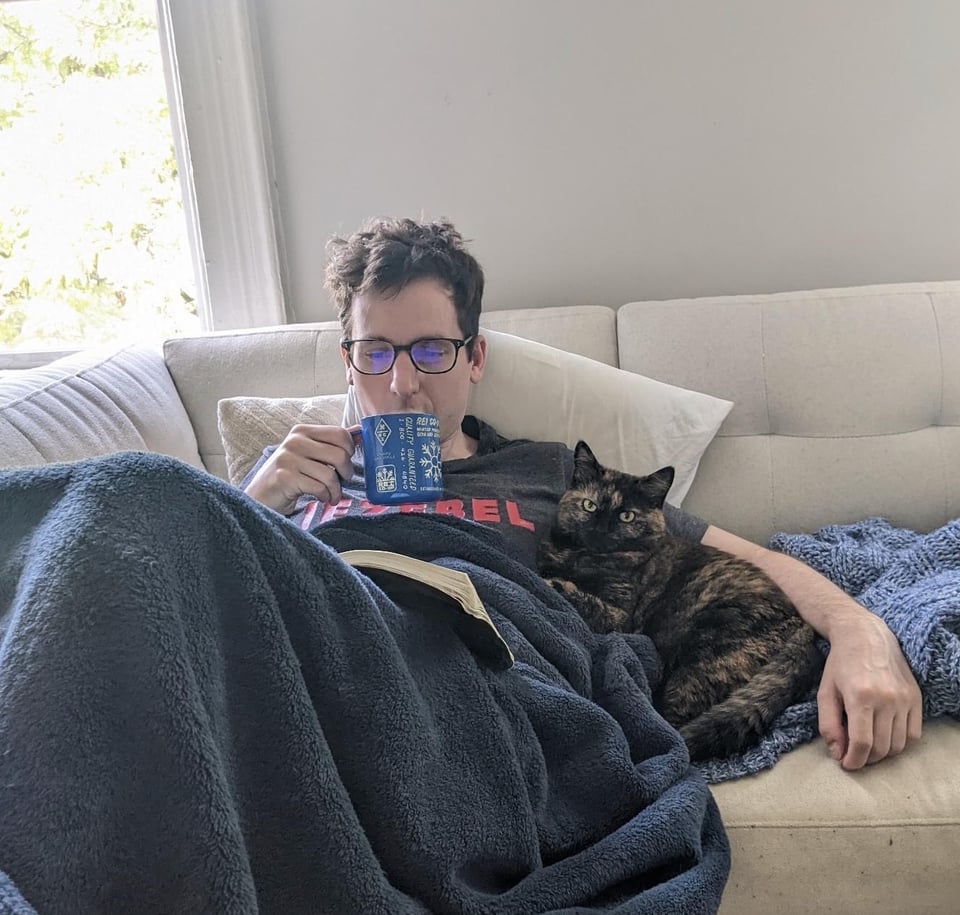
However, sometimes Harriet doesn’t like the book I’m reading which can present problems:
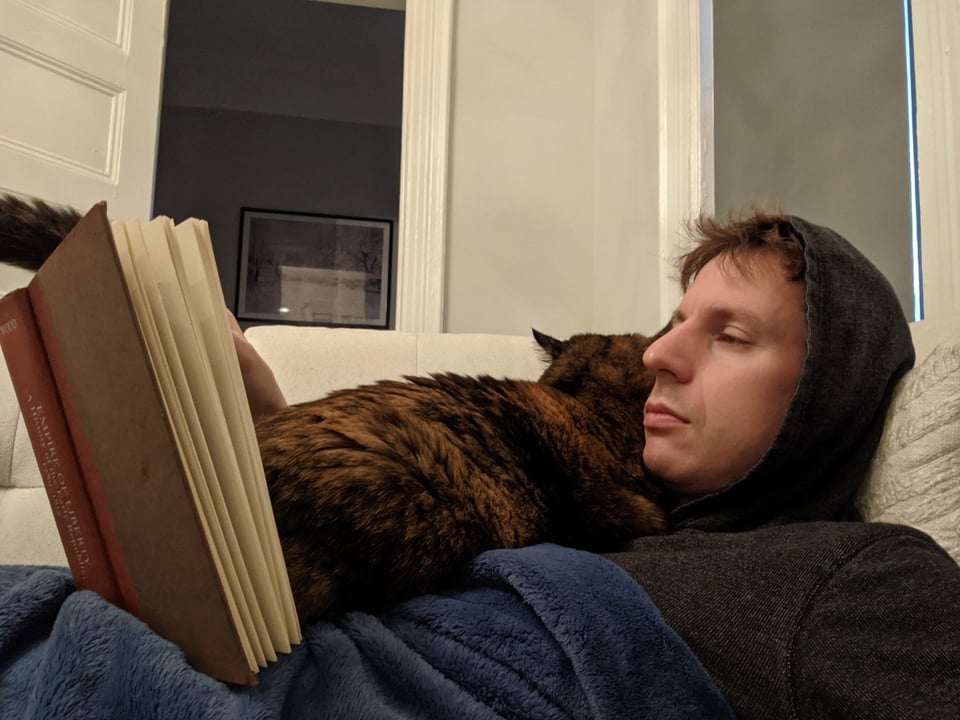
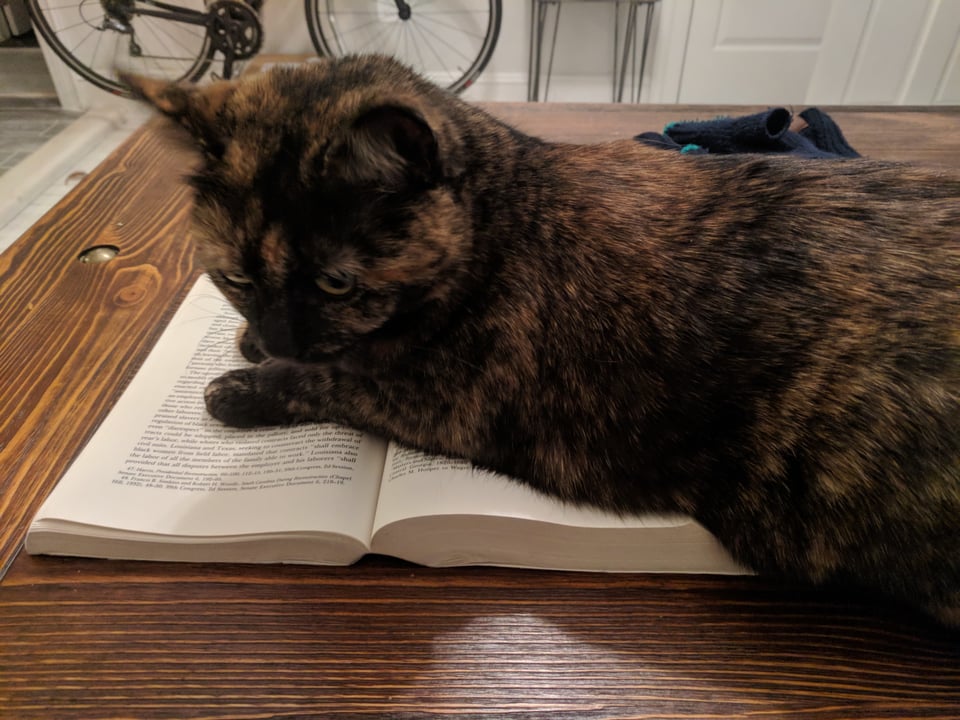
And in rare cases she really lets her opinions known:
When I want to feel like a king I read in the Rose Room of the New York Public Library main branch. The chairs there are uncomfortable. This only enhances the aura of royalty because I’ve seen old thrones and they look even more uncomfortable.
I also enjoy reading to classical music. I bought a radio during the pandemic and listen to WQXR. Ironically, the reception in Manhattan sucks so I have to plug an old phone with no SIM card into the radio to stream the WQXR app. Lately I have taken to turning my main phone off while reading on nights and weekends. All of a sudden I’m reading a lot more productively.
I currently have 43 books in my queue (actually this is an undercount because two of these “books” are series). This will take me about a year to get through, during which time I will add many more books. I will die before I read all the books I want to read. Which is to say, I subscribe to the philosophy that life is too short to read books you don’t like. I don’t believe there is any special virtue in finishing a book. I read all but the final 92 pages of Infinite Jest. My regret is not the 92 pages I didn’t read.
I absolutely do judge books by their titles, covers, endnote organizations, and first page contents. I will, if so moved, give up on a book within the first few pages. I will typically only do this when I can tell immediately the author and I won’t vibe. This happens once every couple of years. More often, I give books about a third of their length, or 100 pages—whichever is shorter—to convince me I should finish it. Most do. I finish about three quarters of the books I start. But I will give up on a book at any point. I will frequently conclude early on that a book isn’t working for me but can’t quite put my finger on why. I will keep reading to solve that mystery, whether it’s 20 pages later or 200. I have been known to do this all the way until the last page.
I finish books faster than I start them. The last 100 pages usually go by quite quickly, either because I am eating up what the author is serving or I’m trying to get it over with as quickly as possible so I can move on to the next course. No matter how good the current book I’m reading may be I am always more excited for the next one.
Finishing Books
When I finish a book, I log it in the spreadsheet. Each year gets a new tab. Each year tab has the same structure: Title, Author, Pages, DNF. The last, short for Did Not Finish, gets an X if I did not finish the book. The pages column denotes the number of pages I actually read.
Occasionally I will then visit the Totals tab of the spreadsheet, which has a breakdown of books, books finished, and pages read by year. I started tracking my reading using the spreadsheet method in 2020. This week, I read my 100,000th page. Here’s to the next 100,000.