
Expedition 63
The Bathysphere
Ahoy travellers! With the hot weather, it’s a short one this week. Florence tries to remember something about an angel and…an egg?
The Bathysphere crew
Christian Donlan
Florence Smith Nicholls
Keith Stuart
Contact us at [email protected]
Essay: A World Without Memory
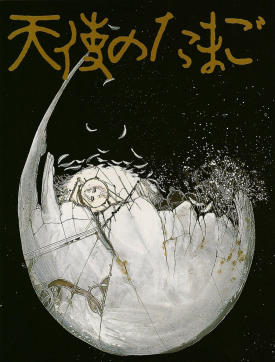
If you’ve heard of director Mamoru Oshii, it’s probably because of his 1995 film Ghost in the Shell. For me though, his greatest work is the cult classic Angel’s Egg. Like its name, it’s delightfully odd. A young girl carries an egg through a post-apocalyptic world, barely speaking any dialogue, except to a boy holding a cross-shaped weapon who follows her through the ruins.
Angel’s Egg came out in 1985 and it doesn’t look like other anime being produced at that time due to its extremely muted colour palette. The film’s distinctive ethereal style bears the fingerprint of Yoshitaka Amano, who came to be involved in a little known video game franchise called Final Fantasy. Though the work paints an intimate picture of its two protagonists, we barely know anything about them. They barely even know themselves, not remembering how they came to be in this strange decaying world. As the boy says:
“Maybe you and I and the fish exist only in the memory of a person who is gone.”
Angel’s Egg is not so much a character study of a person but of a place - the nameless ruined town which bears all the hallmarks of human life but with none of its essence. Some of my favourite moments in the film are shots from within these abandoned buildings, looking down on the girl through windows wreathed by everyday objects, as if they were gaping eyes judging her.
The uneasy sense of place in Angel’s Egg made me reflect on how important environmental storytelling is in video games for creating an initial impression of a place with fictional memories. Hopefully, over time a player will create their own memories of that fictional space through their own gameplay. Prior to this, though, the richness of the environmental design can implicitly convince you this a place that is remembered, and in turn that characters who don’t really exist have a sophisticated interior worlds in which it plays a starring role.
Speaking of memory, Oshii has compared the relationship between the two characters in Angel’s Egg to relationships in Tennessee William’s The Glass Menagerie. This is framed as a “memory play” in that it is told from the unreliable recollections of the protagonist. Perhaps that’s what the beautifully odd world of Angel’s Egg really is, a place half-remembered. An unreliable narration in monochrome.
I’ve made so many comparisons between pieces of media and FromSoftware games in the Bathysphere that I’d forgive you if you rolled your eyes at yet another one, but in this case the parallels are so obvious it would be odd not to mention them. You only have to consider the character of Filianore in Dark Souls III and the cracked egg she holds and you can see the ripples of Angel’s Egg influence. Its memory continues to be diffracted endlessly.
I’ll end with the opening soliloquy from The Glass Menagerie, which very much feels in conversation with fantastical memories and what they might belie:
"Yes, I have tricks in my pocket, I have things up my sleeve. But I am the opposite of a stage magician. He gives you an illusion that has the appearance of truth. I give you truth in the pleasant disguise of illusion." FSN
Add a comment: