
Expedition 61
The Bathysphere
Today we’re submerging in the depths a bit later than usual, and for a shorter trip. Please bring a map, but remember, it won’t help you.
The Bathysphere crew
Christian Donlan
Florence Smith Nicholls
Keith Stuart
Contact us at [email protected]
Essay: Ergodic Space
Games studies scholar Espen Aarseth is renowned for introducing the concept of ergodic literature, in which a “nontrivial effort is required to allow the reader to traverse the text.” House of Leaves, which I would personally describe as something like a haunted academic monograph, is a great example of this. The novel plays around with type-setting conventions, making the physical object literally quite difficult to parse unless you view it from various angles. The concept has often been applied to interactive fiction in which the reader must take an active role in order to progress through a narrative.
With Aarseth’s original definition, I’m not so much interested with the text part, or even the nontrivial effort part. I’m focused on the traversal. Indeed, the word implies travelling or navigating through a physical space. The aforementioned House of Leaves is essentially about an impossible dwelling. Having recently watched the Backrooms film I’ve been thinking a lot about the concept of ergodic space in media, including video games. A lot of ink has been spilled on the liminality of the Backrooms, but its confusing, labyrinthine logic is what most entices me.
“The maze has often been used as a space to trap and confuse players in their navigation of gameworlds,” says Alison Gazzard in the abstract for Mazes in Videogames: Meaning, Metaphor and Design. In a 2012 article for Game Developer by Martin Nerurkar, he writes: “The Maze is at it’s heart a spatially complex place. Finding one’s way around a Maze is not easy to do because the space is deliberately made hard to read and understand.” A ludic maze is designed to be an ergodic space, requiring a nontrivial traversal by its players.
But what’s the point of ergodic space? There’s an argument to be made that mazes must be at least moderately compelling if they have existed in some form for thousands of years. Indeed, while the more modern concept of a maze can be found in the ornate verdant spirals of Renaissance gardens, the most famous maze can be traced back to Bronze Age Crete. Well, technically a labyrinth is different from a maze, but in any case the myth of Theseus and the Minotaur is a story inspired by prehistoric Cretan culture. I specialised in the archaeology of that period for my BA and MA, so my love of weird spaces and the Minoans has been a long-standing special interest I’ve never found my way out of.
I’m not going to recount the myth of Theseus and the Minotaur (I’ll let you re-traverse that particular knot for yourself), but if I will pose my most deeply held and unhinged theory that all video games are essentially Minoan labyrinth-likes. In the terrible Bioshock Infinite a character refrains that “There’s always a lighthouse. There’s always a man. There’s always a city.” Well, I will tell you instead: There’s always a labyrinth. There’s always a hero. There’s always a minotaur.
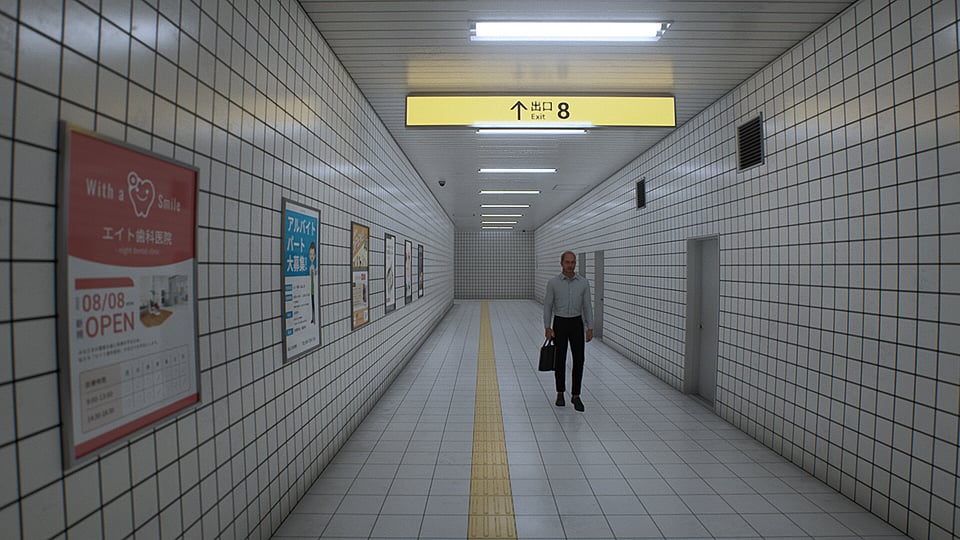
Here’s just one example: Exit 8. The game involves you walking a seemingly endless loop in a Japanese metro station passageway, desperately trying to find an exit. So, there’s the labyrinth (and it really does conform to the technical definition of only having one convoluted path instead of crossroads), and the hero is the player. The minotaur in this case isn’t one foe, but the game system itself which will manifest a series of anomalies in the environment randomly.
Still don’t believe me? Go back into the labyrinth, and see for yourself. FSN
Add a comment: