
Expedition 54
The Bathysphere
Oh, welcome back! Settle in. Mind all the switches and gauges! (What a tricky word to spell.) Let’s set out for the watery deep.
The Bathysphere crew
Christian Donlan
Florence Smith Nicholls
Keith Stuart
Contact us at [email protected]
Delightful games

It’s always a good day when there’s something new from LCB Game Studio to talk about. The literary tricksters behind the Pixel Pulps - which I utterly recommend; start with Mothmen - have a new game jam prototype up on Itch. It’s all about creativity via removal. It’s a game about editing! But it’s also about potions. And it has a truly wonderful start screen. CD
Interesting things

I must encourage you to go and see the film Exit 8, based on the ‘backrooms’ horror game. Director Genki Kawamura has done something extremely interesting with the source material, expanding a very short, oblique experience into a meditation on the guilt, alienation and loneliness of modern urban life. It also has good jump scares. KS
Tom Orry was my boss at Eurogamer, and like everyone who’s worked for him, I can tell you what a kind, considerate and generous mentor he is. I learned a lot from him! He’s a wonderful writer, and his email newsletter is already brilliant, and, crucially, like nothing else out there. Please do check it out. CD
I’ve started reading What Am I, A Deer? by Polly Barton, which is about a woman who takes up a job in localisation at a large games company in Frankfurt, and the all-encompassing obsession she develops with a man she meets on her morning commute. I actually love that the protagonist ends up working in games less out of a love for the medium than for the challenge of translation: “To do so, also, with the item description of a sword - as though she were being invited to step into the shoes of a clueless museum curator.” FSN
Essay: In the distance, something beautiful
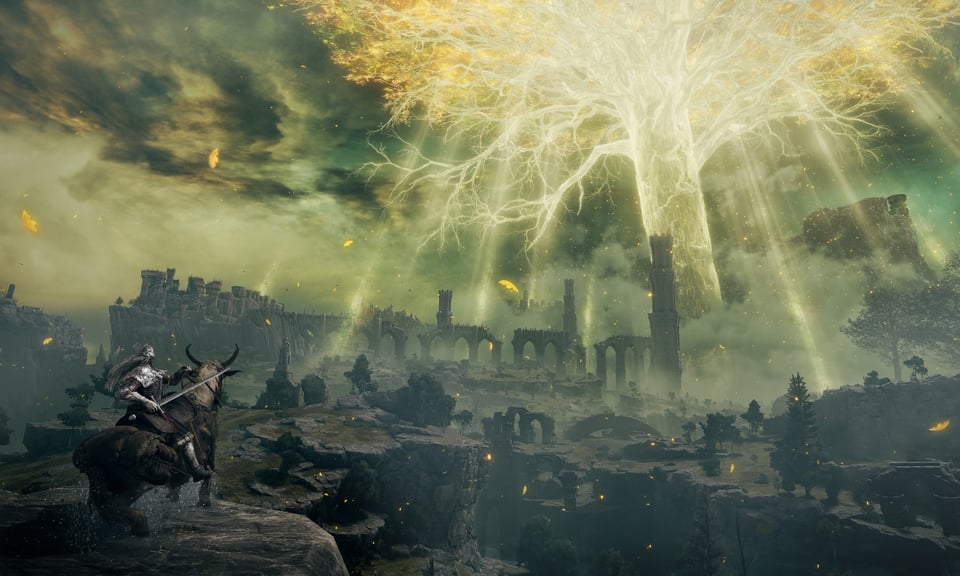
An interesting thing happened to video game marketing in the early 2000s. For the proceeding decade, it had all been about technological bullet points: the number of levels a game had, the amount of polygons in its cars or characters, the hours of video footage or CD quality sound. But as game environments broadened and became explorable, developers started to use variations on one highly seductive phrase: if you see something interesting in the distance, you can go there. Video game worlds moved from linear levels with painted backdrops to virtual domains offering players the freedom to be travellers and tourists.
It’s because of this, I think, that whenever I happen across an interesting view, whether it’s while walking our dog Betty in the fields near my house, or exploring somewhere new, I have to stop and wonder: if this were a video game where would I go? I spot things I perhaps wouldn’t have if I hadn’t spent so much time playing Minecraft and Elden Ring and Legend of Zelda. Why is there a worn pathway leading into those woods? What is that puff of smoke behind the hill? What is that tower? Almost all the walks in my area afford a view of the Westbury white horse, cut into a hillside on Bratton Downs possibly in the late 17th century. I imagine if I went there in a game, I would be offered a quest by some ancient tribe or equine god. If you do the Bath skyline walk in the summer, you get these little shimmering glimpses of the city in the distance; you walk out of the woods and spot Sham Castle in the haze. Surely there will be a warrior or merchant resting among the ruins, ready to impart some wisdom or lore?
Of course, video game worlds are designed as places of play – they are structured so that the player sees certain things at certain times. The towers in the Assassin’s Creed games, the stone monuments in Legend of Zelda: Breath of the Wild – they are put there to entice us toward narrative or ludological events. In this way, perhaps, open world games are more like 18th century landscape gardens or modern theme parks, in the way they control and direct attention. Walt Disney had a word for the elevated landmarks placed in Disneyland to keep visitors moving and engaged – he called them ‘weenies’ (the etymology is rather interesting), although now the company refers to them as visual magnets. They’re the castles and major rides that you can see from almost any area of the park, giving you something to head to, some delightful new experience in waiting. When Henry Hoare designed the lakeside gardens of his stately home Stourhead, he ensured that the many grottos and follies would always be partially hidden around wooded corners thereby ensuring the curiosity and surprise of his visitors.
But actually, most of the natural landscapes we encounter are, to some extent, authored. Woodland has been cleared for pasture, ancient quarries and barrows have cut away at hillsides, culverts redirect water. The tall navigational edifices of the Assassin’s Creed and Far Cry games have their precedent in church towers, which – as the highest points in any medieval town or village – were valuable aids to any wayfarers passing through. So I’m not completely mad when I look out at a new view and try to decide the story of the landscape. Indeed a whole genre of natural history book has emerged at roughly the same time as the open world game, with authors such as Tristan Gooley and Robert Macfarlane writing about rural environments as places filled with codes, symbols and lore.
Video games are sign systems – they teach us to obverse natural spaces, not as abstracted pastoral backdrops, but as machines of meaning, purpose and pleasure. Whether the view is across a valley, a city, a beach, it can be decoded. And when that is done, more often than not, something beautiful is revealed. KS
Add a comment: