
Expedition 36
The Bathysphere
Ahoy! This week, Florence discovers situationist football, Keith discovers trains and gothic horror, and Christian discovers a GTA-themed Tiktok travelogue.
As ever please consider taking out a paid subscription, which gives you access to the full essay as well as Keith’s regular retro treasure trove. You’ll also get access to our archive of essays.
Now please do come in, just watch your head on that pipe it… too late.
The Bathysphere crew
Christian Donlan
Florence Smith Nicholls
Keith Stuart
Contact us at [email protected]
Delightful games
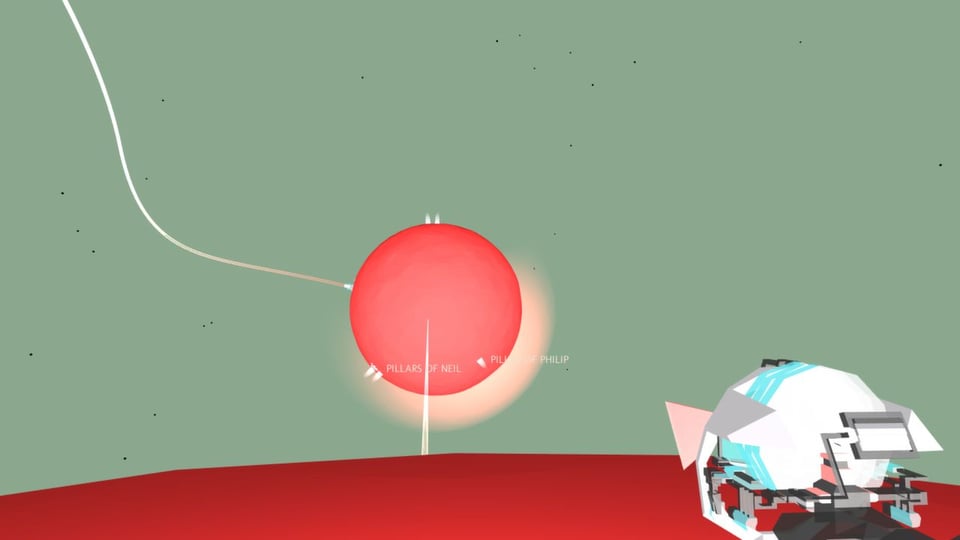
For absolutely no reason, I’ve been replaying MirrorMoon EP by Santa Ragione this week. I can’t think of many times I’ve been so captivated and so transported by a game, and so sure that the studio behind it was composed of people I was desperately keen to be friends with. Do play it if you haven’t, and check out all their other stuff too. (Wonderful reporting as ever by Matt Wales.) CD
Experimental game developer Michael Brough (responsible for the excellent 868-Hack) has made lots of his game jam entries and smaller games available on Itchio. It’s a fascinating collection, well worth digging through. KS
Last weekend I was at AdventureX, the narrative game convention, and I had the pleasure of trying out the demo for The Dark Queen of Mortholme. It flips the script by having you play as the final boss facing off against a hero who returns again and again to vanquish you. The devs also intriguingly describe it as an “anti-game.” FSN
Interesting things

If you’re extraordinarily quick, Professor Angela Wright is giving a talk at the University of Aberdeen on 3 December entitled ‘Lifting the Veil on Ann Radcliffe's The Mysteries of Udolpho’. It’s a look at the classic gothic novel in advance of a new edition that Wright is currently completing. This is basically a set text for horror fans and contains ideas, themes and images that still feed and inspire gothic-tinged video games. KS
@dryxio_gta is a TikTok account that is quietly going around LA and looking for locations that turned up in GTA San Andreas. And not just locations - often specific textures that Rockstar found in the world and put in the game. I would love to hear a proper interview about this - maybe on something like Post Games? CD
I’m really enjoying Pluribus, Vince Gilligan’s new TV show about a miserable romantasy author who is one of the few people left on Earth that hasn’t merged with a hive mind. How would you design a video game for a hive mind, I wonder? FSN
Essay: Situationist Football

Recently I was rifling through the zines at Housmans, the radical London bookshop, and came across something unexpected. It was a pamphlet with the title "Revolutionary Animism” on it, written by a group known as DAMTP (which stands for DAta Miners Travailleurs Psychique) in 2015. As if that wasn’t intriguing enough, the pamphlet opens with an essay on a sport I didn’t even know existed; three-sided football.
If, like me, you weren't acquainted with this asymmetrical version of the popular game, let me elaborate. Three-sided football (or 3sf) is a variation with three teams that play on a hexagonal court. A team wins not by scoring the most goals, but by conceding the fewest. It was originally designed by the Danish artist Asger Jorn in 1962 as a metaphor for his theory of triolectics, a challenge to the binary thinking of Marx’s dialectics. Apparently, Asger never intended for the game to actually be played, but since its inception it has been put to the field in multiple countries, and even as part of a political protest in Turkey.
Asger was part of the Situationist International movement that blossomed in the late 20th century, challenging capitalism’s elision of first-hand experiences and self-expression into the consumption of commodities. The movement’s name comes from their interest in creating “situations,” in order to have authentic experiences to liberate people from everyday life. You might raise an eyebrow at that last sentence (after all, what makes an authentic experience?), but I’ve found a lot of inspiration in ideas associated with the Situationists. Take Guy Dubord’s dérive, the practice of taking an unplanned journey through an urban environment, as a kind of balm against the predictability of everyday life. The dérive, like 3sf, is ultimately a playful experiment.
I’m not the first person to wonder what the Situationists would have made of contemporary 21st century video games, but it’s still worth asking the question. On the one hand, the video game industry could be characterised as the ultimate commodification of “second-hand” experience. On the other hand, digital games provide new opportunities for radical and subversive play. Is the emotional disorientation that Guy Debord sought in his dérive not totally dissimilar from the feeling you get clipping through a wall in a video game? What would it mean to play 3sf in Roblox? As it happens, a digital version of 3sf has indeed been made by Paolo Pedercini, as a three-player game.
In the pamphlet, writer Mark Dyson regards 3sf football from multiple angles; as art, critique of anarchism, and even as historical re-enactment. Apparently the Autonomous Association of Astronauts, a worldwide community of groups dedicated to building their own spaceships, has used the game as a way of training for life in outer space. To be clear, a lot of the AAA’s activities are meant to be pranks, although they have seriously protested the militarization of space. The AAA apparently disbanded in 2000, which is a shame, because in 2025 with Elon Musk’s continued colonisation of space we could definitely use it now more than ever. Similarly, the DAMTP website is no longer maintained. Still, their legacy lives on. As Dyson says “Like a hydra - three sided football has started growing exponentially with every iteration - each of which superimposes itself onto the original conception, enriching, complexifying, and diversifying.” FSN
Retrospective adventures

I am currently on a train so I wanted to share something train related, which obviously led me to Taito’s much-loved Densha de Go series of realistic train sims. The series started as a 1996 arcade game but home versions – on both consoles and the PC – became hugely popular throughout the late 90s and early 2000s. The games featured authentic Japanese train lines and trains – as the manual to the 1999 PlayStation instalment Densha De Go: Professional shows. There are actually several pages of train photos in the manual as well as a map – it’s a reminder of how much information video game inlay booklets used to contain, but also how much they contributed to the experience of playing. Sadly, this was very much a domestic series – there are no localised versions. One of my fondest memories of Japanese arcades was watching Tokyo salarymen play the coin-op cabinet with its elaborate controls and strict demands on time-keeping and station platform stopping. KS
Add a comment: