
Expedition 33
The Bathysphere
Fittingly, given the essay below, there’s a great submarine, if not quite a bathysphere, in Thomas Pynchon’s new novel. It cruises under the ice and it turns up where it shouldn’t. Welcome back to another descent!
The Bathysphere crew
Christian Donlan
Florence Smith Nicholls
Keith Stuart
Contact us at [email protected]
Delightful games
I mentioned Secret Maps at the British Library a few weeks back, I think, and I got to go visit the other day. It’s a fantastic thing, filled with opportunities to push your nose right up against the glass and enjoy tiny details.
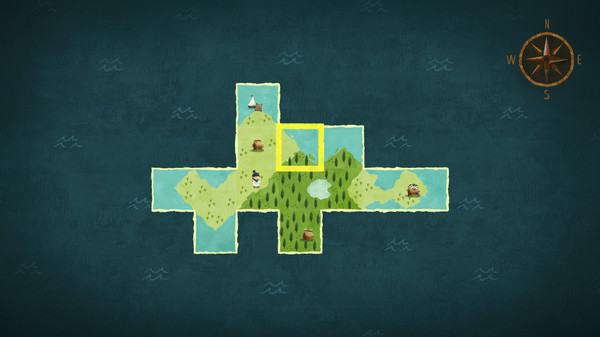
Since then, as a full-blown map sicko, I’ve been replaying Carto, which is an ingenious spin on exploring and map-making, and features at least one building that magically expands each time you return to it. CD
Last week I managed to find and rescue my old Nintendo DS while tidying my son’s room so I have been rediscovering some classic titles. Among them is KORG DS-10, a music creation app that simulates a range of classic Korg synths, allowing you to use the stylus and touchscreen in interesting, tactile ways. I love the way it turns electronic music into an audio toy and I’m sure it paved the way for Korg’s beloved Volca mini-synths. Anyway, I am enjoying making an unlistenable racket with it once again, and if you fancy a go, you can pick up a copy for around £25 on eBay. KS
Interesting things
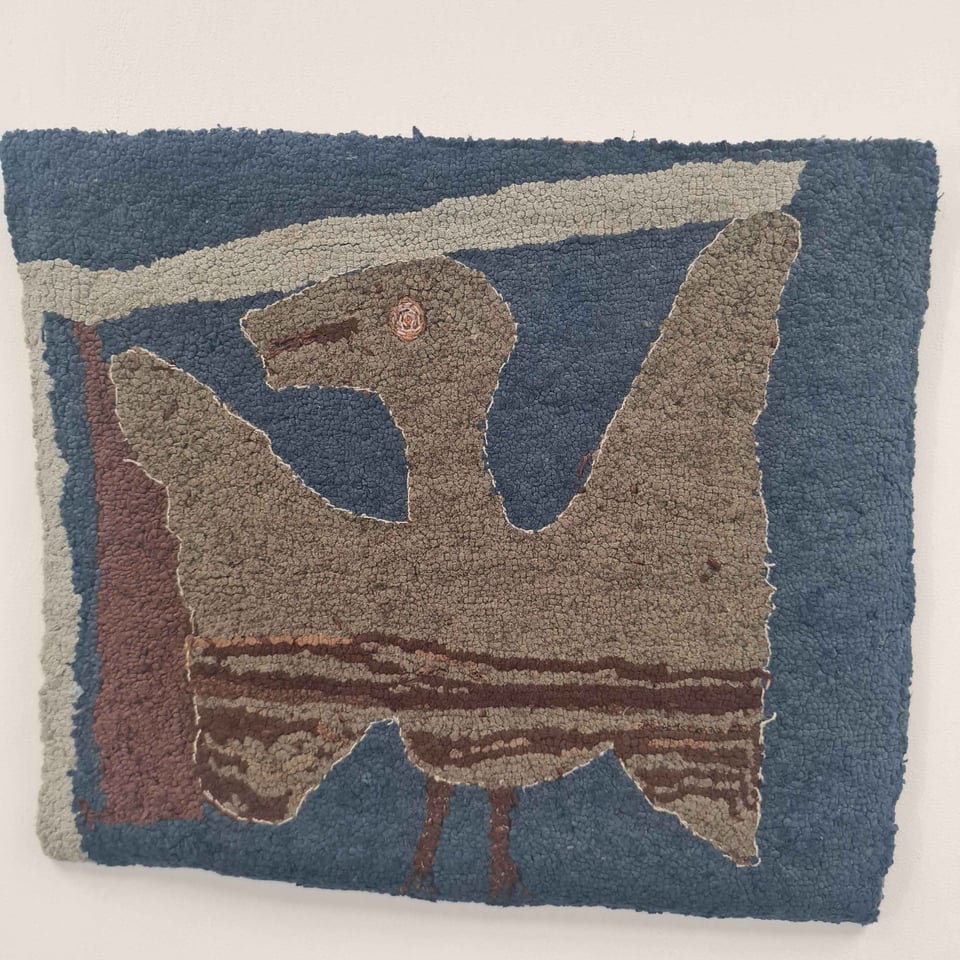
I recently learnt about the practice of making rag rugs out of scraps of old fabric during a visit to the Hub National Centre of Craft and Design in Sleaford. They have an exhibition on, fittingly called Cumbrian Rag Rugs that showcases 25 rugs made by the artist Winifred Nicholson, as well as other members of the farming community around Bankshead. I particularly liked the rug above which was designed by an unknown school child who was apparently told by his art teacher he had to draw an image unrelated to football. He drew a magpie, which is the emblem of Newcastle United FC. The teacher didn’t realise and his design was eventually realised by a woman called Florence Williams.
Rag rugs, much like mosaics, sort of remind me of pixel art in terms of their abstract designs and limited palettes. FSN
Unfortunately Roguelike Celebration 2025 has already passed. It’s an online event with talks about roguelikes and related topics. You’re in luck, though, because there’s a wonderful backlog of recordings on their YouTube channel. If you want a recommendation, check out Everest Pipkin’s talk “The Fortunate Isles-Fragment Worlds, Walled Gardens & the games that are played there.” FSN
Essay: Stalking Lot 49

First up, forgive me: I’ve reached that point in life where every time I write something there’s a vaporous worry that I’m properly repeating myself, that I’ve had this thought before and then written it up before, and I’m leaving a trail of self-plagiarism in my wake. I can at least promise that I did have this thought I’m about to talk about this week, so the thought itself is fresh, even if it’s also been fresh before.
Over the last few years, I’ve been slowly re-reading the earlier Thomas Pynchon novels. (Aside: rightly or wrongly, probably wrongly, I divide Pynchon into A and B tier these days. V., The Crying of Lot 49, Gravity’s Rainbow, Mason & Dixon - and, weirdly, Slow Learner - are A tier.) I’ve just finished The Crying of Lot 49, which remains a marvel.
I know Pynchon doesn’t like this book - God, I would kill to hear why - but I suspect it’s my favourite. Well, M&D and this. Well, V. and M&D and... Well... I think this is in part down to the SoCal setting - it always puts me in mind of one of my other favourite books, The Serial, by Cyra McFadden, which, if you haven’t read, I’m going to describe as being a kind of SoCal Cold Comfort Farm. But it’s in part down to the sheer amount of stuff in this short novel.
The Crying of Lot 49 is a dizzying book, with dozens of characters, hundreds of ideas and concepts, and a central narrative that both builds a conspiracy and then all but dismantles it. Even on my nth read, it’s astonishing and surprising. But I was struck this time more than ever by how clearly this confusing book is all organised. Oedipa, the main character, is asked to execute a will, and she heads off and investigates and that’s the narrative.
So basically, for all of these wild ideas and cameos and Jacobean plays and thermodynamics concepts, we’re just parked behind the main character and we follow them around. It struck me, more than anything, as being a kind of variation on the walking simulator. It reminded me of the richness of organising a story this way - there’s the sense of exploration, the tease of agency, the clarity of arranging things in an unbroken line - and it also made me think of other books that sort of work the same way.
I’ve always felt, for example, that the penultimate (? it’s been a while) chapter of Catch-22, when Yossarian walks around Rome, would be a perfect walking simulator. I guess you could throw in Ulysses, too. But what I also thought of, because I’d also only just read it, was The Real Life of Sebastian Knight, by Nabokov.
What a treat this book is. V., the narrator - yes, people think Pynchon read it, just as they’re pretty sure P took N’s classes at Cornell, one of which was so famous it was just known as “taking Nabokov” - anyway, yes, the narrator is trying to piece together a portrait of his half-brother, a famous novelist, and in doing so they keep running up against the shortcomings of language. Firstly, anyone who’s ever tried to write about games will have had that sense of the shortcomings of language, or rather, the sense of trying to unscrew a piece of furniture using an apple. Secondly, well, I forget what I had second, but my overall point is that this is wildly complex stuff, and yet where are we? Behind the narrator, following them as they move through the world.
Our lives, I sometimes sort of remember, are like one of those trick shots in a movie where the camera moves and moves without visibly cutting. It’s interesting to think that games and novels both approach this idea and get out of it a kind of thrilling immediacy, and an organising conceit that doesn’t overwhelm the audience. Pretty sure I haven’t written this before. But maybe I have. CD
Retrospective adventures
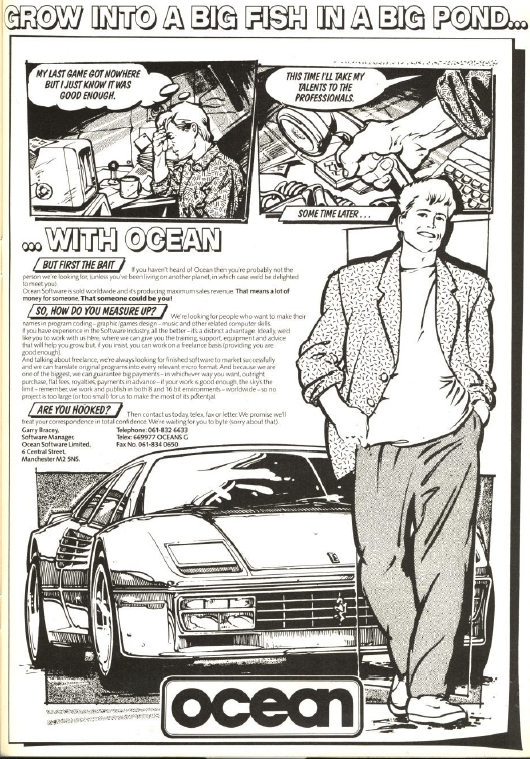
In the 1980s there were no widely circulated trade journals for the video games industry, so if a studio wanted to find new talent, they would often advertise in consumer video game magazines. This ad for legendary Mancunian publisher /developer Ocean appeared throughout the games press in 1987. I absolutely love its blatant 1980s aspirational vibe, a successful games creator standing in front of a Ferrari Testerosa (the most 80s sports car imaginable – as driven by Miami Vice’s Sonny Crockett) in his wide-shouldered blazer. As for the application details, I don’t know what I appreciate more: the fact that readers were invited to send their CVs directly to the company’s head of development Gary Bracey, or that they spelt his name wrong.
Also, while I’m on the subject, you should read this interview about the local newspaper ads posted by the makers of the infamous Cascade Cassette 50 compilation – and if you don’t know what I’m talking about, welcome to the rabbit hole, you’re gonna have a hell of a ride! KS
Add a comment: