
Expedition 28
The Bathysphere
It’s the 28th week of Bathysphere! This week, Chris is getting a little too excited about levers in videogames. Elsewhere, Floss attends the Queer Games Festival and Keith runs over some gremlins.
We’re sorry for the late delivery of the newsletter this week – we were trapped under an arctic ice shelf and couldn’t transmit the data until we surfaced.
The Bathysphere crew
Christian Donlan
Florence Smith Nicholls
Keith Stuart
Contact us at [email protected]
Delightful games

Last weekend, I was extremely lucky to be able to attend the Queer Games Conference in Montreal. I saw a lot of very interesting things and delightful games, but one particular highlight was the Indiepocalypse stall. Indiepocalypse is a monthly anthology of games, which can be bought online but also in physical form as USB sticks in custom cassette cases. As you can see from the picture above, the cover art is a feast for the eyes. Indiepocalypse curates games by emerging artists doing experimental work; each cassette is like a tiny terrarium filled with unexpected treasures.
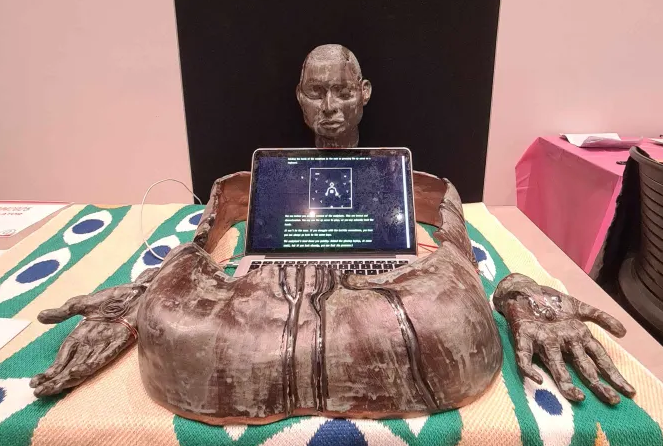
I also got to play Teddy Pozo’s Chest Simulator at QGCon. It’s an arcade game rendered not out of 80s nostalgia, but a ceramic figural cabinet with a hollow cavity and conductive elements. You have to squeeze the figure’s hands in order to advance. Absolutely gorgeous. FSN
Interesting things
Not really game-related, but the best restaurant in the world, St John, has joined up with the LRB to open a little cafe. It opens today and I can’t wait to go. If they do their Eccles cakes there, I’m probably never leaving. CD
Also not really game-related, but at least game-adjacent. There’s a skate ramp on the side of this skyscraper in Brazil. As someone who’s spent a lot of time playing the new Skate game, this made total sense. CD
Essay: Lever’s ball
I had an uncle, growing up, who worked for the railways. I have a strong early memory of visiting him at work on a very hot summer day, the sun almost blinding. He worked at the time in one of those signal boxes, which often look like a little house - fiercely domestic - sat on top of stilts. I remember sitting in the steps of the stilts as he had a cup of tea. And I remember that inside the little house there were these huge, rust-coloured levers with squeeze handles. They seemed huge and immobile, amongst the most adult things I had ever laid eyes on.
It’s funny to think that this was probably my one genuine run-in with levers in the real world. And it’s funny because, as a person who plays a lot of games, I encounter levers in the virtual world on a regular basis. They’re familiar objects, almost boringly so, and yet I don’t think I’ve ever actually used one. Real levers might be a bit like silencers. You have an idea of how they work, but it’s from fiction. Maybe the real thing is very different!
There’s lots to love about videogame levers, anyway. For one thing, a lever almost always means you’re on the right track. Levers tend to come in exploration and adventure games, and when you see a lever it means you’ve arrived at a place that you were meant to arrive at. Why? Because there are levers to pull! There’s something lovely and speculative about levers, too. You pull them, but you’re often not entirely sure what’s going to happen - you just know it will probably be some form or progress.
I love games where they play with this: where you’re ninety percent sure that a lever’s going to open a gate you can see behind you, but then you pull it and instead a set of stairs pop out of the wall. It’s always lovely to be wrongfooted like this.
Another great thing about videogame levers, perhaps the greatest thing? They’re a chance to see the developer’s handwriting, as it were.
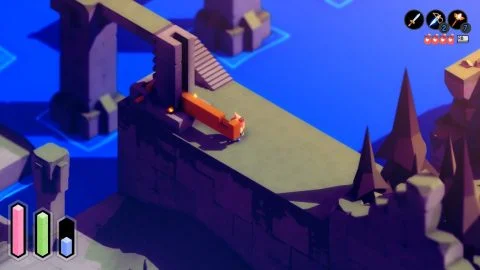
What I mean is that because so many games have levers in them, when you encounter a lever in a game you can tell a little about what the developer values, what they’re trying to do. I’m replaying Tunic at the moment, and the levers are something else. You’re very small in Tunic, and the leavers are really gigantic. This is because it was important to the creator, Andrew Shouldice, that the lever made practical sense. It had to have a store of energy in it that would be used to achieve whatever it was that the lever was attached to. And so you see that. The descending of the lever gives you a lovely sense of buried cogs turning, of work energy being transferred.
This lever is very different, say, from the levers I encountered recently in Silksong, which are often up high, brass Art Nouveau things. It’s very different to the levers in Tomb Raider, the old core games, in which all ancient civilisations seemed to have agreed on what kind of levers to use, but they were all allowed to decorate the lever face plate as they see fit.
A lot of games do this kind of thing: they put their own spin on levers. Sometimes you have to really put in the effort to get them moving. Sometimes they activate with a shot from a gun or a swipe from a sword. You sense their springloaded nature. Sometimes, I’ll have a memory, out of the blue, of activating a random lever in a random game. Then I’ll have to spend the next thirty minutes working out what the game was. A rusted lever - real effort to pull it. A sense that it’s rusted shut and then: pop. Oh, The Last Guardian. Great game. Great levers.
Morelli, the old art critic/historian fellow, used to say that you could spot a painter’s identity not in the way they did the big, fancy things in a painting, but the way they did the things that were so dull they did them on autopilot. He had books full of ears painted by various artists to help with attribution. There’s something of this to levers, I reckon. They’re everywhere. They’re functional and often a bit invisible through their endless recurrences. But that very invisibility carries with it a little message of its own, perhaps. CD
Retrospective adventures

As we’re stalking towards Halloween you can expect a lot of spooky retro stuff from me for the next few weeks. This is the marquee artwork for Exidy’s 1976 arcade driving game Death Race, which allowed one or two players to motor around a graveyard squashing gremlins. If you hit one of the little monsters, you could reverse over it as it screamed – a gory concept that would later be revived by Stainless Games in their controversial PC hit, Carmageddon. The game’s graphics were monochrome and extremely basic, so all the work was being done by the garish cabinet art, which resembles the spray-painted illustrations adorning funfair ghost trains and horror houses. Death Race was famously featured in a 1976 Associated Press article entitled “It Offers That Run-Down Feeling”, in which journalist Wendy Walker expressed concerns over the game’s gratuitous bloodshed. It would be one of the first examples of a moral panic over video game violence. KS
Add a comment: