
Expedition 21
The Bathysphere
Can you count to 21? as Cooper once asked. Somehow this is our 21st dive! Welcome aboard as ever. In our main essay Chris has returned from Greece where he had thoughts about getting stuck in games and why it can be great, and he also read a book about bathyspheres and had some other things to bang on about. Meanwhile, Florence played with liminal spaces and single-celled life, and Keith discovered a magazine ad for an almost forgotten 3D space sim by one of the original superstar game coders…
As ever, please consider taking out a paid annual or monthly subscription which gives you access to the essay and Keith’s retro section, as well as an archive of all previous essays. Running the Bathysphere is not cheap: there are a lot of pipes to maintain and we’re not entirely sure what they all do.
The Bathysphere crew
Christian Donlan
Florence Smith Nicholls
Keith Stuart
Contact us at [email protected]
Delightful games
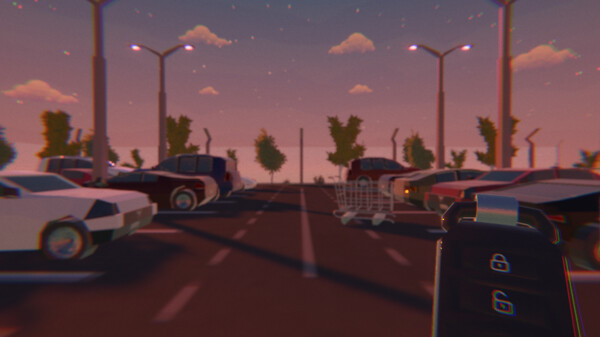
A Dream about Parking Lots stood out for me because I love liminal spaces like parking lots and we need more games about them. Also it sounds like it could have been on the B-side to Low or a mid-life Roxy Music record.
Anyway, in the game itself you’re wandering through a parking lot trying to find your car, while also having a conversation with a therapist about why you keep having this dream. It’s meant to be one of those shapeless dreams that takes a piece of mundane life and extends it in all directions, I think, but since I can’t drive, looking for my car actually felt kind of novel.
When I have these recurring dreams I’m always trying to dial a very long phone number or type a URL. What A Dream about Parking Lots really nails, though, is the parking lot vibe - this was essential I think - and the experience of a kind of dream where you wake up feeling more tired than when you went to sleep. I mean this in a good way. I do wonder whether the whole thing would be more satisfying without the narrative doing some of the work for you. CD
I’ve been thinking a lot about tamagotchis recently, how they both create and reinforce daily rituals. Nick Murray’s Tamagotchi Seance takes this even further, facilitating a ritual for speaking with a virtual pet that has passed through the veil. I can still distinctly remember the oval plastic shell and small coral-coloured buttons of my own childhood virtual friend. I hope they’re doing well, wherever they are. FSN
I was recently recommended the zero player role-playing game The Tragedy of GJ237b (thanks Matthew Guzdial!). An intelligent single-celled life form has thrived on the planet GJ237b, but unfortunately when humans arrived it caused environmental collapse. The game is played by re-enacting this process. You allocate that a room in your house or building represents GJ237b - if the room is entered at any point the game ends, humans have arrived and all life there is destroyed.
Have fun! FSN
Interesting things

Brad Fox’s luminously good book, The Bathysphere Book is all I can think about at the moment. It tells the story of a bathysphere and the people who used it to explore under the sea. As the bathysphere travels deeper and deeper the book fragments, a bit like Moby Dick or the second half of Gravity’s Rainbow. You get lots of short journeys and character snapshots and all sorts of beautiful, wayward, somehow crucial ephemera. All the while the notes taken over the radio from the dives themselves break through like T.S. Eliot poems.
I read this and thought, inevitably, about how I wanted this structure in a game. Going deeper and deeper and deeper and just…witnessing, and working out what to do with what I’d witnessed. Something a bit like Spelunky and a bit like Ridiculous Fishing perhaps, but also a bit like nothing. I would love a text adventure about bathyspheres, and now I’ve said that I bet a couple at least exist. Read this astonishing book. CD
Essay: Getting stuck in games and why it’s sometimes brilliant
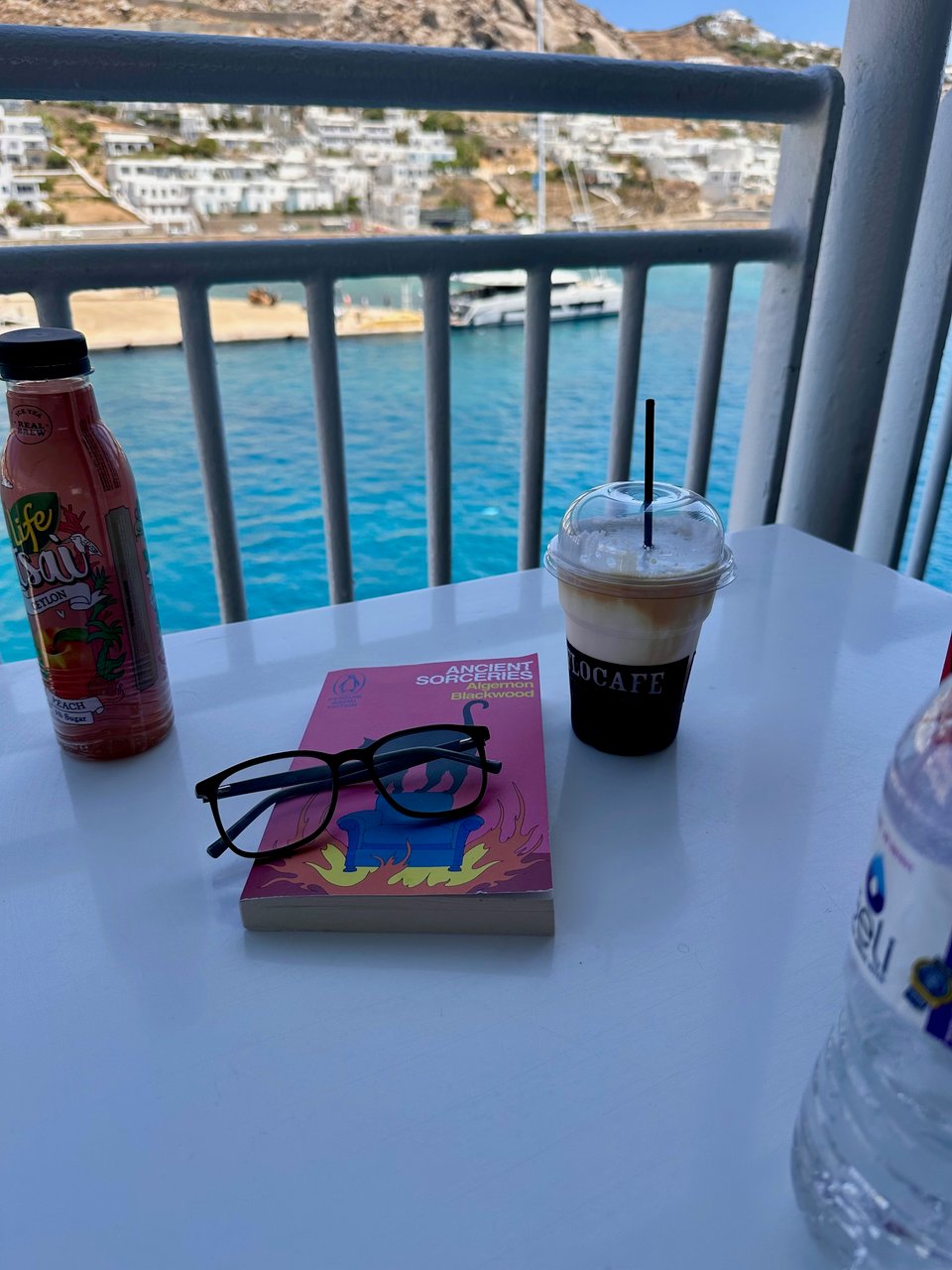
I’ve been on holiday in the Aegean, which means I spent most of the last few weeks wandering around a beautiful Greek island trying to think of rodents. This is because whenever I go on holiday I have a lot more time to ponder the Guardian Cryptic, and 23 Across on Monday the 28th was: Rodent is shy, backing up (5).
I knew how to do the last bit, for sure, but for the whole thing I needed a rodent, preferably a shy one. And I didn’t want to look online for a list of rodents. I wanted it just to come to me, because that’s the pleasure of cryptic crosswords - the moment when the right answer just falls out of the sky and gets you right in the brain and you feel...lighter? Almost giddy? Cryptics are the best.
As I was wandering around this island, taking pictures, walking up to the Venetian old town, drinking endless Freddo Cappuccinos, I started thinking about games and being stuck, and a thought I had almost had quite a lot suddenly emerged from the fog. Getting stuck in games is often terrible. But sometimes getting stuck in games is transformative. It opens games out.
I’m talking about a specific kind of getting stuck, obviously. Skill issues - horrible unbeatable bosses, endless gunfights with cruel save points and all that stuff - that is never fun or transformative for me. Also, in adventure games I never much liked what I would call programming puzzles, where you had a device like a drone, say - God, The Dig - and you had to control it so many places to the left, then down, then diagonal etc. I take no pleasure in these solutions so I take no pleasure in being stuck on these puzzles.
But that special kind of being stuck, which is a bit like being stuck on a cryptic? That’s wonderful. You’re in Maniac Mansion, and there’s a key in the chandelier and you can’t get to it. You can see it but you can’t reach it. Stuck! But now the fun begins.
The fun begins because you’re suddenly thinking about that key in the chandelier all day. This is a real example, BTW, and I remember sitting in Miss Clarke’s maths class and pondering that key. What had I collected that might allow me to get up there? What was nearby in the room? Could I use any of the verb interface to climb on a chair?
What I like about this is that it takes the game out of the bright glowing square of the computer screen (one must always play adventure games alone and at night, when the house is dark and dozing) and it thrusts it into the world. Suddenly I’m playing Maniac Mansion in maths class, on the walk to school, on the walk into town. Sometimes I’m playing games I’m stuck on in my sleep. They invade my dreams and in my dreams the solutions are beautiful but possessed by a vaporous logic that is hard to grasp upon waking.
Getting stuck, then, in the right kind of game, in the right kind of manner, can bring a game out into the world. No wonder I have such rich memories of those Lucasfilm games. They were great, of course, but they were also great in a way that encouraged me to carry them with me, to live inside their worlds when I was away from the screen. When I think of Maniac Mansion, I think of it as a place I have been, rooms I have walked through.
I feel the same way about Blue Prince today, and about games like Virginia. Virginia isn’t a puzzle game in the traditional sense, but the puzzle is putting the narrative together in your head afterwards. Ditto Hob’s Barrow, in which the narrative really transformed once I had finished it and once I was considering the limitations of my own initial interpretation. God, that is a good game.
Anyway, I got 23 Across in the end. I won’t spoil it. I want you to have the opportunity to live with it for a bit. CD
Retrospective adventures
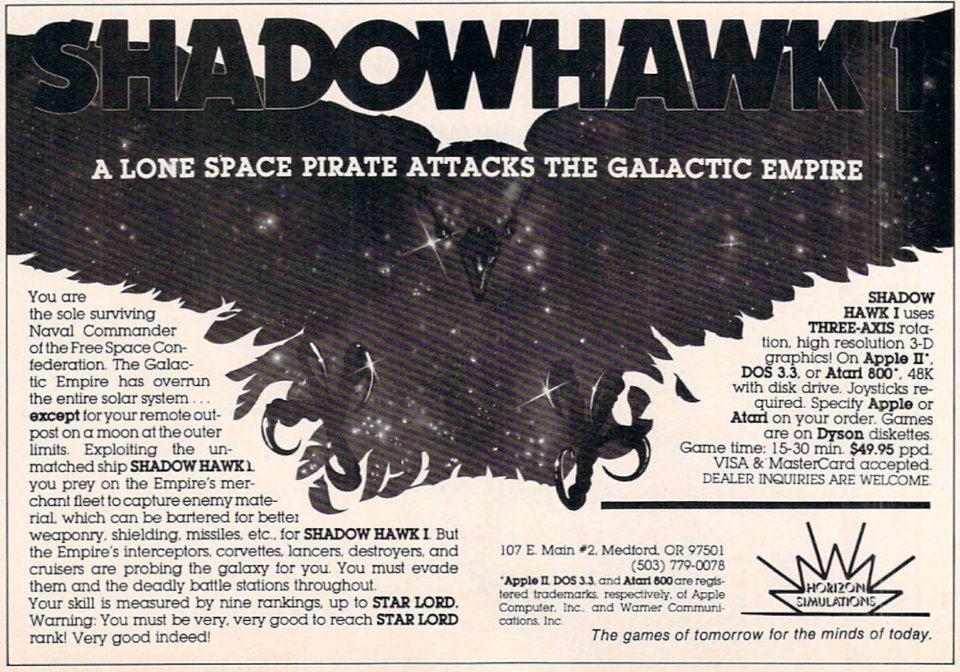
A lot of you may not have heard of ShadowHawk One a space adventure for the Apple II which used vector-based 3D visuals, like the BBC Micro classic, Elite. The 3D programming was by Bill Budge, one of the first superstar coders, later responsible for Raster Blaster and Pinball Construction Kit. There’s a video here that shows how impressive it was for the time.
This ad is from the December 1981 edition of Compute Magazine, subtitled ‘The Journal for Progressive Computing’. It’s a typical gaming advertisements of the era – no screenshots, just an illustration and several paragraphs of highly descriptive text. You never really knew what you were going to get until you sent your cheque or postal order, or phoned the company with your credit card details. In the case of ShadowHawk One, you were unlikely to have been disappointed.
Add a comment: