Talk listen to the animals
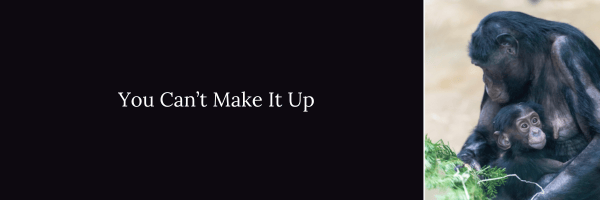
Over the years, I’ve written a lot about the animal language experiments that were done back in the 60s and 70s. I’ve always been fascinated by the idea of finding a way to speak with a member of another species. (In my younger days, I was a pen pal of Koko the gorilla.) It was all very exciting. Washoe, the first chimp to use sign language, learned at least 350 signs.
Thanks to these experiments we learned a lot about what it was like to be a chimp. And one of the things we learned was that we should not be doing these experiments. Mary Lee Jensvold is one of the scientists who worked with Washoe. She told me that as she grew to know Washoe and her family, as well as other chimps, she came to realize that these animals should not be kept in captivity, even in the enriched environments designed for them. “The behavioral research should never be replicated. Chimps should never be in captivity. It’s a miserable life. For all the enrichment, all we do to make their lives better, they still don’t have agency and freedom,” she said.
We’re now learning that the best way to learn to communicate with animals might be to learn their language rather than lock them up and force them to learn ours. So these days I’m writing a lot about efforts to decipher whale language. (If you’re interested in this, here’s an article I wrote for Discover.)
Scientists are still studying chimp communication; they’re just doing it in the wild instead of the lab. They’re going into chimp communities to learn how chimps communicate with each other. Recent research has found that chimps have conversational patterns — the back and forth between speakers — very similar to those of humans. Researchers have also learned that chimps use a variety of calls in various combinations when they want to communicate something more complex than “Look, food!” or “Watch out, predator behind you!”
This research also teaches us a lot about ourselves. It reveals our human arrogance, Jensvold said. “It forces us to say, ‘I’m not so special.’ It provides an avenue for humility, letting us see ourselves as a human animal and how we fit in nature.”
I’m still closely following animal communication. I just no longer send postcards to caged gorillas.
’til next time, stay curious.
Avery