The Pull, no. 2
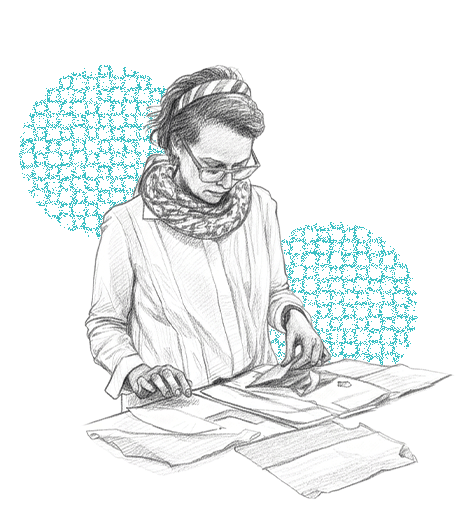
Valentine’s cards floated to mailboxes big and small this month, so we’re talking paper with:
Moyna Stanton, paper conservator
Cleveland Museum of Art
Archival Magic: Gloves or no gloves in your work?
MS: So typically, no gloves. For paper, we require clean, dry hands. One of the main reasons is that you lose tactile sensitivity and potentially can cause harm on fragile edges. We know if our hands are clean, we know if they’re sweaty, but if you’re wearing a glove, you’re potentially not aware of dirt building up on the glove. A material I like to wear gloves for are book bindings. Not necessarily for turning the page. In fact, we generally don’t wear gloves for turning the pages, but as a precaution, it’s pretty easy to handle a book with gloves on.
AM: What was the most recent archival object you showed to someone else?
MS: Just yesterday, I had two visitors. They were here de-installing a show for works that were returning to Italy. I showed them some prints I'm looking at for an upcoming exhibition on Renaissance engravings. And I knew I had an art historian with me, and I knew I had a metal conservator with me, but much to my delight, the art historian, this was her area, and so she was very familiar with the images and knew all about engraving. And the conservator is a conservator of copper plates. So she cares for a collection of 24,000 copper plates for etchings and engravings, intaglio prints, and she was also fascinated to look at these prints. These opportunities, they're not uncommon, but I don't take them for granted. It’s really, really wonderful when you can look at art with multiple pairs of eyes and related expertise. It's one of the joys of working in an institution like this.
AM: When did you first realize that you enjoyed working with archival materials?
MS: I don’t think it came about as a kind of realization. There was a very gradual development in my orientation in this direction. I mean, certainly my college experience, my foundation there with my coursework, was built on things that I had from childhood. I was someone who was attracted to craft. How are things made? What’s the materiality? And a natural inclination toward close observation. And then I honed these aptitudes through my coursework. I was a biology major, and I studied a lot of studio art. And my strengths in studio art were drawing and somewhat printmaking. Not because I was good at printmaking, but because I did a lot of it. My printmaking background most informed my early career as a paper conservator. And then my science curriculum was very robust and wonderful. There’s this exercise — I don't know if it’s still done today — where you look through the microscope, and you draw what you can see. And as you draw, it forces you to look more closely. And when you look more closely, it forces you to draw more carefully. And that exercise, I think, is so apt to describe what I still do today in my work, where you're observing closely. That’s how I got here. Not really with any cognizant, “Oh, I really like working with paper.” No, it just kind of happened very organically and made a lot of sense.
AM: What’s the most memorable item you’ve found or seen in any archive?
MS: Two things stand out in my mind as the most remarkable things I’ve ever worked on, and they’re both documents. One was a slave manifest from a ship. And the other was a medical discharge, a Confederate soldier’s medical discharge paper that he would have had to carry around in his pocket as a man of his age not at the front fighting. I had it in a lab where I could very carefully treat all the creases, realign all the folded back flaps, and restore all the legibility to the writing. The slave manifest was a series of pages that were lap-joined and had been rolled. So this means that pages were joined by overlapping, and then pasted together. That one I was able to wash. And it involved a lot of testing because it was written in iron gall ink, and we have to be careful with that ink. So we really wanted to wash it and then of course not alter any of the pale writing that was there, pale, but it was very legible. This is a blanket term — it can vary — but we use a conditioned deionized water. So that’s water that’s been highly purified by running it through deionization tanks and a charcoal filter. Then we get this, what we call, “ion-hungry water,” and we supplement it with something basic. A low-pH basic solution that will leave an alkaline reserve in the paper. Paper can live just fine at slightly acidic conditions, but it maintains its properties more ideally at slightly alkaline. So it was a list of slaves, and then some language at the beginning verifying that these were not new slaves, because it was already illegal to bring in new slaves. They were slaves that were being transported from Virginia to New Orleans. It was very awe-inspiring in a profoundly sobering way.
AM: What is one aspect of the archives that you wish the general public understood better?
MS: This kind of implies that maybe there’s a frustration in what they understand or don’t understand. I don’t really experience that. So I’ll share how I interact with the general public. And that would be in the gallery to give tours and talk about a specific show. Or behind the scenes in the paper lab where we can look much more closely at things and see things out of their frames. I can have people with a lot of experience and interesting backgrounds. And then I can have people who only think about paper as this ubiquitous mundane material, like paper and pencil — when in fact it’s a highly engineered material with a history of amazing innovation. Not everyone needs to think about this material the way I do. Everybody brings something of their own to it. And so what I kind of hope happens is that everybody takes something away that they can apply to their own interests and their own experiences.
AM: Archives are often portrayed as sterile or silent, but can you describe a specific sight, sound, smell, touch, or taste in your workspace?
MS: I think I will go back to that that sensation of working with water. That is a touch I associate with my job, a very strong sense I associate with my job. It's kind of poetic in a way. What is the substance that is the bane of paper collections? What can potentially do so much damage to paper collections? It’s water, right? There’s this beautiful stain we call tideline staining that I’m often trying to treat in paper. So the water put it in, and then we use water to get it out. The very element that does the damage is also the element that can restore and remove the damage. Well, oh, it gets even better. It’s even better. What do you need heaps of to make paper? Water. Yes. It’s so important to papermaking, whether it’s hand-made, machine-made, historic, modern. So, poetic, indeed.
AM: Can you tell me about a spreadsheet that was involved in a project you’ve worked on in your archival career, and what that project was about, and why it was great?
MS: I'm kind of averse to spreadsheets. That said, I rely on them all the time. Currently, I am working off a spreadsheet that was made by a visiting photo conservator in 2021. And I am so grateful to have this beautiful spreadsheet with all of her information, because now I am writing up a large document to summarize and prepare for the next step in this project, which will be to work on daguerreotypes and ambrotypes. These things take time. I'm preparing the report so that everybody can sign off and be on board to begin treating the photographs.
AM: What archives-related question should I ask the next person?
MS: I'm always interested in hearing about what kinds of projects people find most challenging. It can also be “most enjoyable.” Often more challenging is more enjoyable. So it doesn't have to be, you know, what-made-you-pull-your-hair-out challenging, but what was really challenging and rewarding? It could be a treatment, it could be a rehousing, it could be preparing something for display, it could involve working with another specialist to problem-solve. I always want to hear about things like that, because I love the how — how are things done.
—
This newsletter was written on the traditional lands of the Piscataway and Nacotchtank.