Wednesday, November 26, 2025. Annette’s Roundup for Democracy.
Jews, Trump and the Republicans.
When Trump attacked America’s elite colleges and Universities, he did so with rallying cries of antisemitism.
One year later, many no longer see Trump and the Republicans as friends of Jews, if they were foolish enough to ever believe that.
Jewish groups at Penn sound alarm over federal lawsuit seeking information on Jewish employees - Jewish Telegraphic Agency
“Across history, the compelled cataloging of Jews has been a source of profound danger,” said a letter criticizing the lawsuit.
The Trump administration is facing sharp criticism from Jewish groups at the University of Pennsylvania over its lawsuit demanding personal information on Jewish staff members.
The complaint, filed last week by the Equal Employment Opportunity Commission in Pennsylvania federal court, claims that the school “refused to comply” with a subpoena from the commission as it investigated allegations of antisemitism on its campus.
The subpoena sought contact information for Jewish employees who had filed a discrimination complaint, belonged to Jewish groups on campus, or were part of the school’s Jewish studies program.
“Identification of those who have witnessed and/or been subjected to the environment is essential for determining whether the work environment was both objectively and subjectively hostile,” the complaint read.
The EEOC first began investigating the university in December 2023, the same month that the school’s then-president, Liz Magill, resigned amid scrutiny over her refusal to say that calls for the genocide of Jews violated the school’s code of conduct.
Penn is not the first school hit by a probe for Jewish contacts. In April, professors at Barnard College received texts from the federal government asking if they were Jewish as part of the EEOC’s review. In September, the University of California, Berkeley said it had provided the names of 160 individuals involved in cases of antisemitism.
While Penn remained largely unscathed by the Trump administration’s sweeping federal funding cuts to elite universities over allegations of antisemitism, the school had $175 million in federal funding suspended in April over an investigation into a transgender athlete on its swim team.
In response to the Trump administration’s lawsuit, a Penn spokesperson told the Jewish Telegraphic Agency that the school had “cooperated extensively” with the EEOC but said the school would not provide “the personal information and confidential information of Jewish employees without their consent, and over employees’ objections.”
“Violating their privacy and trust is antithetical to ensuring Penn’s Jewish community feels protected and safe,” the spokesperson said.
In a joint statement on Friday, the school’s Hillel and MEOR chapters said that while they “recognize and appreciate the EEOC’s concern for civil rights,” they were “deeply concerned that the EEOC is now seeking lists of individuals identified as Jewish.”
Hundreds of Penn affiliates also signed onto an online petition voicing their support for the school’s refusal to turn over employee’s personal information.
“Across history, the compelled cataloging of Jews has been a source of profound danger, and the collection of Jews’ private information carries echoes of the very patterns that made Jewish communities vulnerable for centuries,” said the statement, which was posted on Instagram.
Why Republicans Are Fighting About the Nazis
Tensions over right-wing antisemitism have burst to the forefront of Republican politics, and show signs of becoming a fierce point of contention in the midterms and beyond.
For years, Jewish Republicans often denied that the right had a serious problem with antisemitism, pointing instead to anti-Jewish bigotry on the left and celebrating President Trump’s support for Israel.
But now that problem is staring them directly in the face.
Tensions over antisemitism in the party, free speech and Israel have burst to the forefront of G.O.P. politics, and show signs of becoming a fierce point of contention in 2026 primary races and beyond.
The furor has reached the highest levels of government, with President Trump this past week defending Tucker Carlson for conducting a friendly interview with the white nationalist Nick Fuentes, who has expressed admiration for Hitler and Stalin.
Some Republicans are now finding themselves in the extraordinary position of clarifying what long seemed obvious: Nazis are evil.
“It’s something that we all should know, but the fact of the matter is, it had to be said,” said Representative David Kustoff of Tennessee, explaining why he felt the need to denounce Nazis and antisemitism at a recent gathering of the Republican Jewish Coalition.
He was joined there by Senator Lindsey Graham of South Carolina, who declared, “I’m in the ‘Hitler sucks’ wing of the Republican Party.”
And even Laura Loomer, the far-right activist, who is Jewish, has argued on social media that “the GOP has a Nazi problem.”
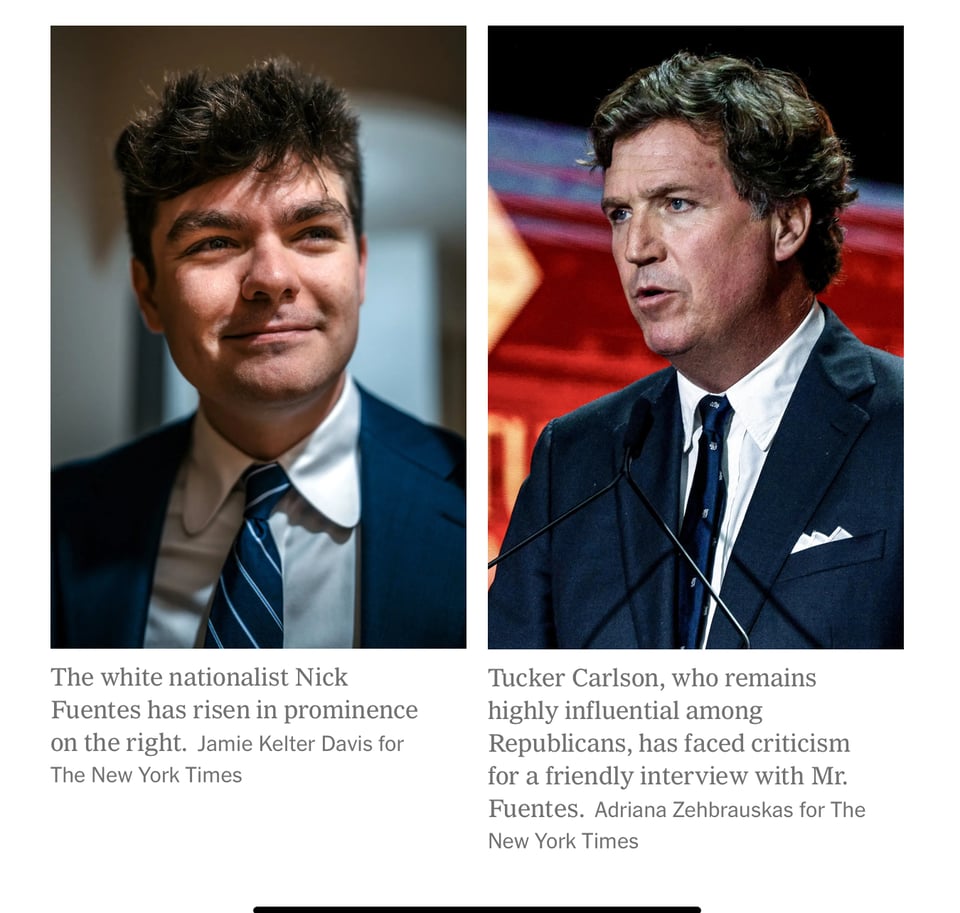
As the fallout from Mr. Carlson’s interview has consumed the right, some Republicans, including Speaker Mike Johnson, have condemned the amplification of antisemitic views. And to Jewish Republicans like Mr. Kustoff, Mr. Trump’s strong military support for Israel has cemented their backing, regardless of how he approaches people like Mr. Fuentes or Mr. Carlson. Mr. Trump has also pushed far-reaching campus crackdowns in the name of combating antisemitism, an approach some conservative Jews have welcomed.
Republicans have aggressively courted Jewish voters alienated by the left, and appeared to make some gains in the 2024 election.
But polling and interviews with Republican activists and strategists show that there are real and growing divides in their party, both over America’s support for Israel and how to address antisemitism on the right.
“You can’t have a political party that hates everyone except white people who like Hitler and think you’re going to win elections,” said Nachama Soloveichik, a Republican strategist who was the communications director on Nikki Haley’s 2024 presidential campaign.
“I don’t think we’re at that point,” she added, but “there is a battle.”
A flare-up of controversies
The Republican Party has grappled with antisemitism within its ranks on and off for decades. William F. Buckley Jr. sought to stamp it out of the conservative movement, and debates raged in the party over the candidacies of David Duke and Pat Buchanan.
Mr. Trump was widely criticized in 2017 after saying there were “very fine people on both sides” of a deadly white nationalist rally in Charlottesville, Va. (Mr. Fuentes was there.) The president again drew backlash in 2022 for having dinner with Mr. Fuentes at Mar-a-Lago.
But social media is making the current surge of antisemitic messaging more difficult to confront, some Republican activists say, as outlandish statements and conspiracy theories flourish online. People who question the Holocaust and offer revisionist histories of World War II have found platforms on popular podcasts, including Mr. Carlson’s.
The Heritage Foundation, the conservative think tank that wields broad influence in the Republican Party, has been plunged into turmoil after the release of a video by the organization’s president, Kevin D. Roberts, defending Mr. Carlson. A board member resigned this past week over Mr. Roberts’s refusal to retract the video.
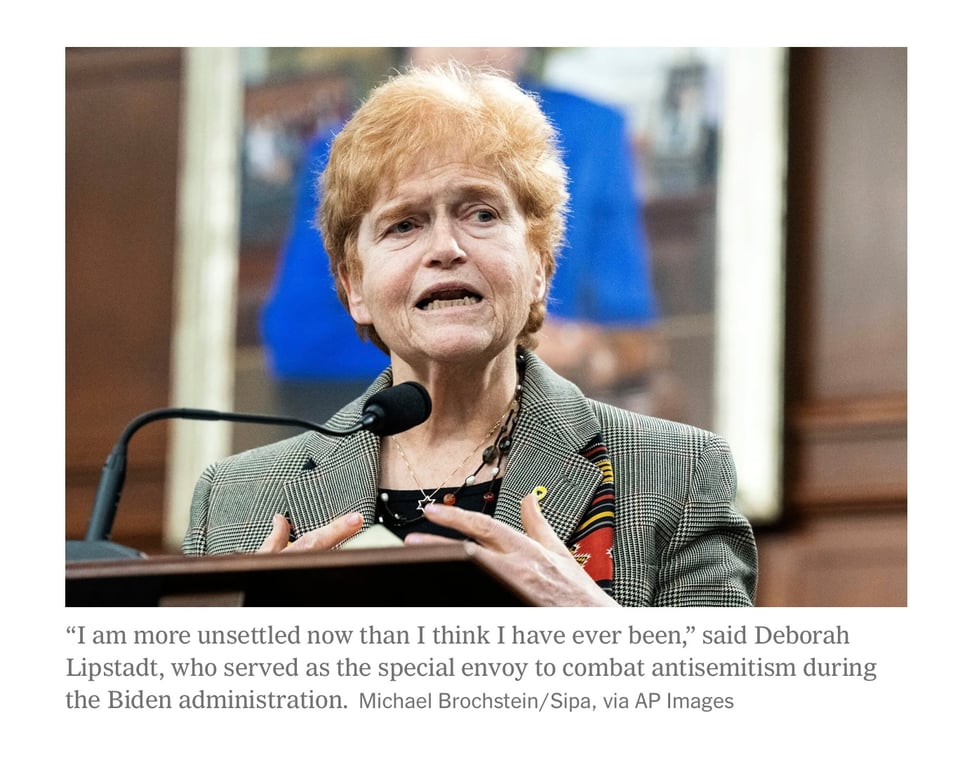
“I am more unsettled now than I think I have ever been,” said Deborah Lipstadt, who served as the special envoy to combat antisemitism during the Biden administration and has frequently criticized antisemitism on the left.
Dr. Lipstadt, a Holocaust scholar, has described the spread of antisemitism as a horseshoe, with the far right and far left closer to each other than to the center.
“This is how it moves, it begins at the periphery,” she said, but having the influential Mr. Carlson elevate Mr. Fuentes “makes it OK, and it begins to move toward the middle.”
Last month, Politico broke the news of a Telegram chat in which young Republican activists glibly invoked Hitler and the Holocaust. A Trump nominee for the Office of Special Counsel was withdrawn before his Senate confirmation after news surfaced of him declaring that he had a “Nazi streak.”
Mr. Carlson, who did not respond to a request for comment for this article, says he abhors antisemitism. He recently told The New York Times that much of the “institutional Republican Party” seems to “hate free speech.” Some of his defenders, including Representative Marjorie Taylor Greene of Georgia, the hard-right Republican who on Friday announced her plans to resign, have dismissed the backlash to the Fuentes interview as cancel culture or virtue signaling.
“There’s definitely a faction of the conservative right, that’s the more neo-con-y fashion, the more pro-Israel faction, that is turning into BLM 2020,” the conservative commentator Megyn Kelly recently said on her show, alluding to the Black Lives Matter movement. “It’s very alienating.”
Others on the right, including outspoken critics of left-wing antisemitism like Representative Elise Stefanik, who is running for governor of New York, have avoided commenting on the clash.
Mr. Trump and Vice President JD Vance “did not get elected to play podcast police,” said Alex Bruesewitz, an adviser to the Trump political operation. “This topic’s exhausted, and I don’t think the American people care about it.”
Generational disagreements over Israel
Beyond his hosting of Mr. Fuentes, Mr. Carlson has sparked controversy within the Republican Party over his pointed criticism of Israel.
While polls show that Republicans are more supportive of Israel than Democrats are, support for Israel drops sharply among younger Republicans. A Times poll this fall found that while 79 percent of Republicans over 65 sympathized with Israelis more than Palestinians, just 40 percent of Republicans under 44 agreed.
This issue has torn apart Democrats in primary races, and similar tensions could play out on the right.
One test comes next year in Kentucky. Representative Thomas Massie, a defender of Mr. Carlson who is one of the sharpest Republican critics of Israel in Congress and has broken with Mr. Trump on key issues, has attracted a Trump-backed primary challenger named Ed Gallrein.

Matt Brooks, who leads the Republican Jewish Coalition, said that defeating Mr. Massie was a “top priority” for the group, and that Mr. Gallrein had addressed a private dinner with R.J.C. leaders and received a warm welcome. A representative for Mr. Massie did not respond to requests for comment.
‘The fight is very much on’
These issues are already beginning to shape the earliest stages of the 2028 presidential race.
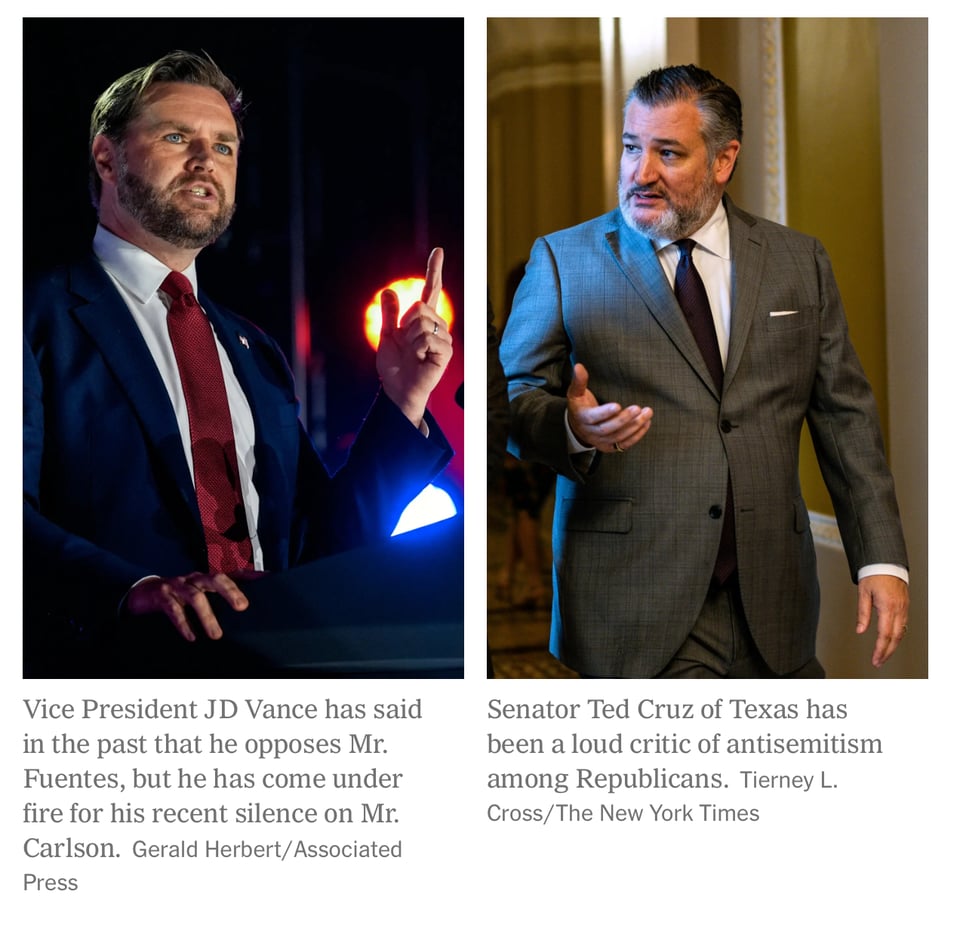
Mr. Vance, a likely presidential candidate, has said in the past that he opposes Mr. Fuentes, but he has come under fire for his recent silence on Mr. Carlson. (Mr. Vance has aggressively defended Mr. Carlson’s son, an aide in the vice president’s office, against online attacks, saying he has “zero tolerance for scumbags attacking my staff.”)
At a Turning Point USA event last month, Mr. Vance did not push back when an attendee, who described himself as a “Christian man,” falsely suggested that Judaism “openly supports the prosecution” of Christianity. His office declined to comment.
By contrast, Senator Ted Cruz of Texas, a former presidential candidate who could run again, has been one of his party’s loudest critics of Mr. Carlson and what he sees as growing strains of antisemitism in the party, sparking backlash in turn.
David Brog, a longtime Republican operative and a founder of Christians United for Israel, called right-wing antisemitism “a serious problem.”
He and other critics said some Republicans were reluctant to challenge Mr. Carlson for fear of alienating the isolationist, populist wing of the party. But, Mr. Brog said, he was heartened that more Republican officials had been speaking out recently.
“The fight is very much on,” he said. “It’s still to be determined which side will really prevail.” (New York Times).
Elise Stefanik, one of Trump’s nastiest allies, was expect to run on charges of antisemitism against Democratic Governor of New York, Kathy Hochul, but then Donald Trump embraced the Muslim Mayor Elect of New York City, Zohran Mamdani.
Trump’s Mamdani embrace complicates Elise Stefanik’s path to governor
ALBANY, New York — President Donald Trump’s astonishingly chummy Oval Office meeting with New York City mayor-elect Zohran Mamdani could not have come at a worse time for Rep. Elise Stefanik.
The New York Republican is mounting an uphill gubernatorial bid in a deep blue state, building her campaign on the argument that Democratic Gov. Kathy Hochul is the nation’s worst chief executive — and tying Hochul to the 34-year-old democratic socialist who will soon lead New York City.
Trump blew up that message in minutes. In the Oval Office, he said he wouldn’t worry about living in New York under Mamdani, noted how many voters they share and even complimented the mayor-elect’s looks. And in a rare bit of daylight with Stefanik, he declined to repeat her claim that Mamdani is “a jihadist.” In a statement, Stefanik said they would “agree to disagree.”
There was little doubt within the MAGA movement that the meeting at least temporarily undercut Stefanik’s central campaign premise.
“Dems just need to run clips of the presser today to defeat Elise,” Trump whisperer Laura Loomer wrote on X in the meeting’s aftermath.
The surreal lovefest underscored the limitations and hazards for a Trump ally like Stefanik as she runs to lead a state where Democrats have a massive enrollment advantage, the president is unpopular and a GOP candidate has not won statewide office in a generation. This, however, potentially cuts both ways for Democrats, who have otherwise relished the photos of a giddy Trump smiling at Mamdani.
Stefanik in an interview with News 12 Monday said the exchange doesn’t complicate her campaign’s message.
“I stand by my statement,” she said. “He is a jihadist. This is an area where President Trump and I disagree. But what we all want to work toward is making New York more affordable and safe, and that’s where I have a very strong record and working relationship with the administration.”
Yet Stefanik acknowledged there are areas where she and Mamdani can potentially work together, like addressing utility costs.
In a statement, her campaign knocked Mamdani as a “dangerous threat to New Yorkers” and argued “his policies will further Hochul’s affordability and crime crises.”
A future blow up with Mamdani — who told Meet the Press on Sunday he still believes the president is a fascist and despot — is anticipated by Democrats, despite the recent bonhomie. Such a rupture — and its timing — stands to impact not only the governor’s race, but the state’s battleground House races as well. Republicans in New York and around the country have signaled they will make Mamdani a Democratic boogeyman in the 2026 midterm elections.
Empire State GOP candidates are especially counting on a strong top of the ticket to aid their bids in swing seats on Long Island and in the Hudson Valley. Those elections will play a big role in determining control of the House in the final two years of Trump’s term. Stefanik’s campaign is expected to continue using Mamdani as a foil against Hochul, who endorsed his mayoral bid in September. The mayor-elect’s anti-Israel views haven’t changed following
the Trump meeting, a Stefanik campaign official noted, and polling shows Mamdani is deeply polarizing among voters statewide.
Trump has been a gift and a burden to Stefanik after she set her sights on Albany earlier this year following the decision to yank her nomination as United Nations ambassador. The president helped clear the Republican field in the spring, endorsing moderate Rep. Mike Lawler to remain in his swing House district. Lawler, long considered a potentially competitive statewide candidate, endorsed Stefanik’s gubernatorial bid Monday.
The unpredictable Trump has complicated Stefanik’s political calculus in other ways as well. The president has not discouraged Nassau County Executive Bruce Blakeman from also seeking the Republican nomination for governor. Trump is deeply unpopular in his native state, and Democrats have already signaled they will make him an anchor around her campaign. The Mamdani embrace highlighted that a mercurial president with an ardent following cannot always be counted on to deliver politically for his allies.
Stefanik is walking a delicate line and must remain in the president’s good graces as she seeks to lock down the GOP nomination. Georgia Rep. Marjorie Taylor Greene, who will resign her House seat early next year, is a cautionary tale of how quickly Trump can turn on a friend — and the political ramifications of getting crosswise with him.
“The thing with Donald Trump is he’s your friend until he’s not, and he’s your enemy until he’s not,” said Republican consultant Susan Del Percio, who has opposed Trump’s presidential campaigns. “If you look at it through that prism, pick your timing. It’s just the way he works. He’s that transactional.”
Trump has threatened to deploy the National Guard to police New York City streets and cut federal aid in response to Mamdani’s victory. Hochul’s administration has spent weeks gaming out scenarios in which Trump sends in federal troops. That planning is still in the works.
“We’re still going to be fully prepared and have the same planning underway,” said a Hochul administration official, who was granted anonymity to discuss the internal conversations. “We all know who Donald Trump is and can be.”
Stefanik, who has represented a blood-red House district for a decade, was not initially an enthusiastic Trump supporter. But the 41-year-old’s rise through the Republican ranks came, in part, through her ardent backing of the president.
She came to MAGA prominence during Trump’s first impeachment, and he praised her at the time as a rising star. Stefanik was on a shortlist to become Trump’s second-term running mate, and her nomination to become his United Nations ambassador was considered a shoo-in.
But a fraught process to select her House successor and the razor-thin majority held by Republicans in the chamber doomed her nomination. Now as a candidate for governor, Stefanik is banking on Hochul’s low favorability with voters and the governor’s support for Mamdani as being politically fatal in a state once accustomed to electing moderate Republicans like former Gov. George Pataki.
Since launching three weeks ago, Stefanik’s campaign has centered around Hochul being the “worst governor in America” — a catchphrase repeated three times in her announcement video. That same announcement video accused Hochul, who endorsed Mamdani in September, of having “cozied up to a defund the police, tax-hiking, antisemitic communist.”
Her allies do not expect there will be significant fallout from Trump’s surprising Mamdani enthusiasm.
“My view is there’s a lot of fluidity in this situation based on Mamdani’s actions going forward,” said Conservative Party Chair Gerard Kassar, a Stefanik ally. “The president is running a nation, Mamdani has a city to run. I think what the president said is ‘Let’s give this guy a chance.’”
Few Republicans believe Trump made his final judgment on the incoming mayor — or that his comments from late last week are set in stone.
“I don’t see any long-term consequence at all,” said New York GOP strategist Bill O’Reilly. “Trump is idiosyncratic and having a love fest with Mamdani is pure him. The next week he’ll be back to criticizing him.”
There are ample pitfalls for Democrats ahead of Mamdani taking office.
The backbench state assemblymember has never run anything larger than his legislative office and he will soon be leading a city government composed of some 300,000 workers. He is pressing Hochul to raise taxes on rich people and large corporations — a prospect she initially opposed, but has since hedged on citing uncertainty created by Trump and Congressional Republicans.
Mamdani’s candidacy created a rupture within the Democratic Party, with stalwarts like Senate Minority Leader Chuck Schumer refusing to endorse him. He is also polarizing in the vote-rich New York City suburbs: A Siena College poll found 49 percent of those voters hold an unfavorable view of him. Sixty-seven percent of Jewish voters have a similarly negative view, the poll found.
Republicans expect to make Mamdani the face of their 2026 midterm effort — an example of how the Democratic Party has strayed too far to the left and alienated moderate voters as a result.
That strategy has shown no sign of changing. The New York Republican Committee three days after Trump praised Mamdani at the White House released a fundraising appeal blasting the new mayor with the subject line “NYC has fallen.”
“New York City has been taken over by a radical socialist, Zohran Mamdani,” the email stated. “However, the fight is only beginning.” (Politico)
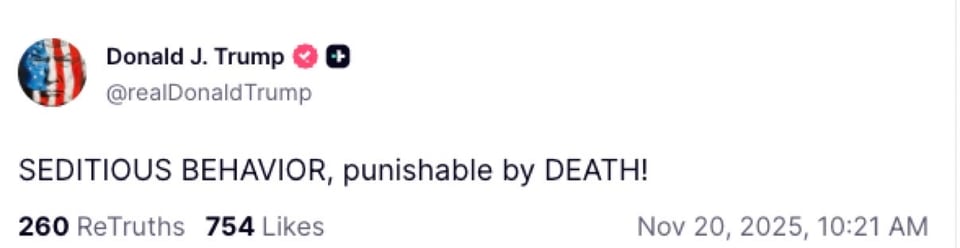
Pete Hegseth, Secretary of Defense, who calls himself Secretary of War, and Trump threaten Democratic Senator and military hero, Mark Kelly.
Leavitt: "The White House is supportive of the Dept of War's investigation into Sen. Mark Kelly, and I think what Sen. Mark Kelly was actually trying to do is intimidate the 1.3 million active service members." pic.twitter.com/HlLtf0dRif
— Aaron Rupar (@atrupar) November 24, 2025
We must not be silenced. Thank you Mark Kelly for continuing to use your voice. It’s an honor to stand with you. pic.twitter.com/0qU2hZUOhZ
— Cory Booker (@CoryBooker) November 25, 2025
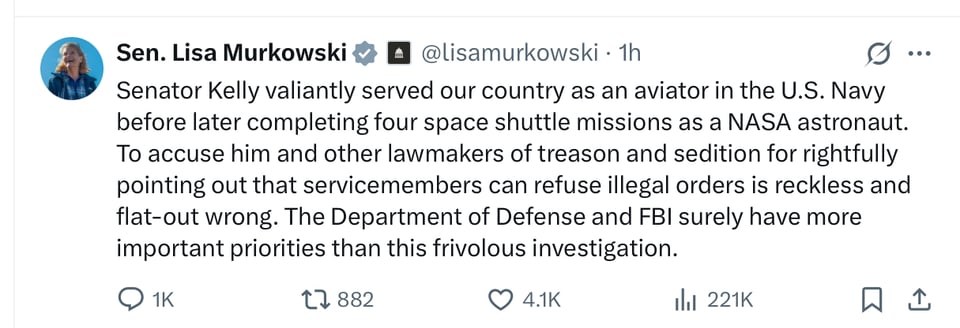
It’s simple. As a member of the military, you have a right to disagree with illegal orders. pic.twitter.com/8zzMVvFqlD
— Ruben Gallego (@RubenGallego) November 25, 2025
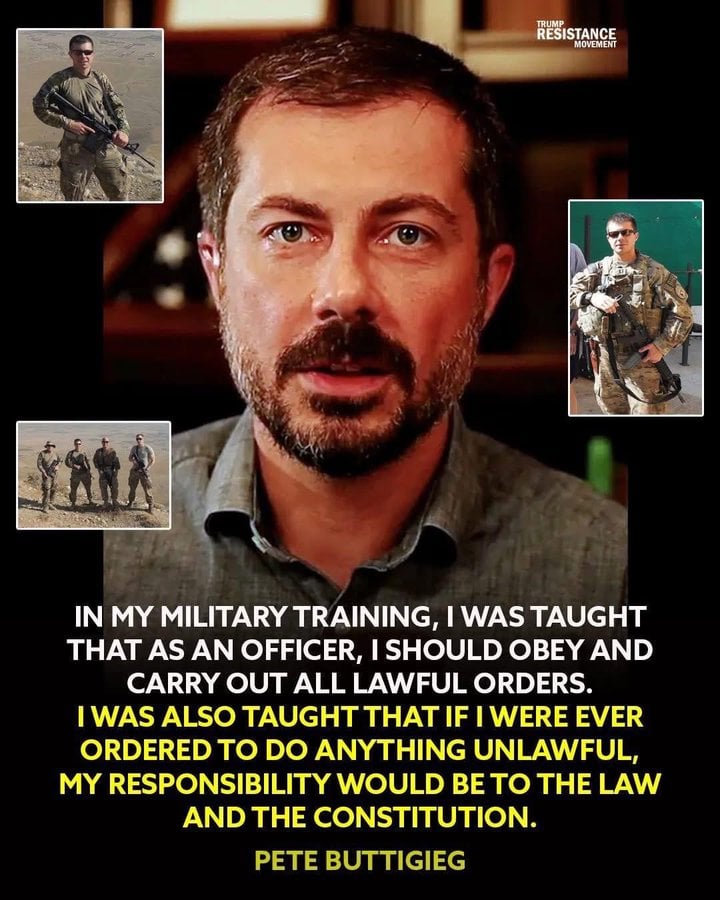

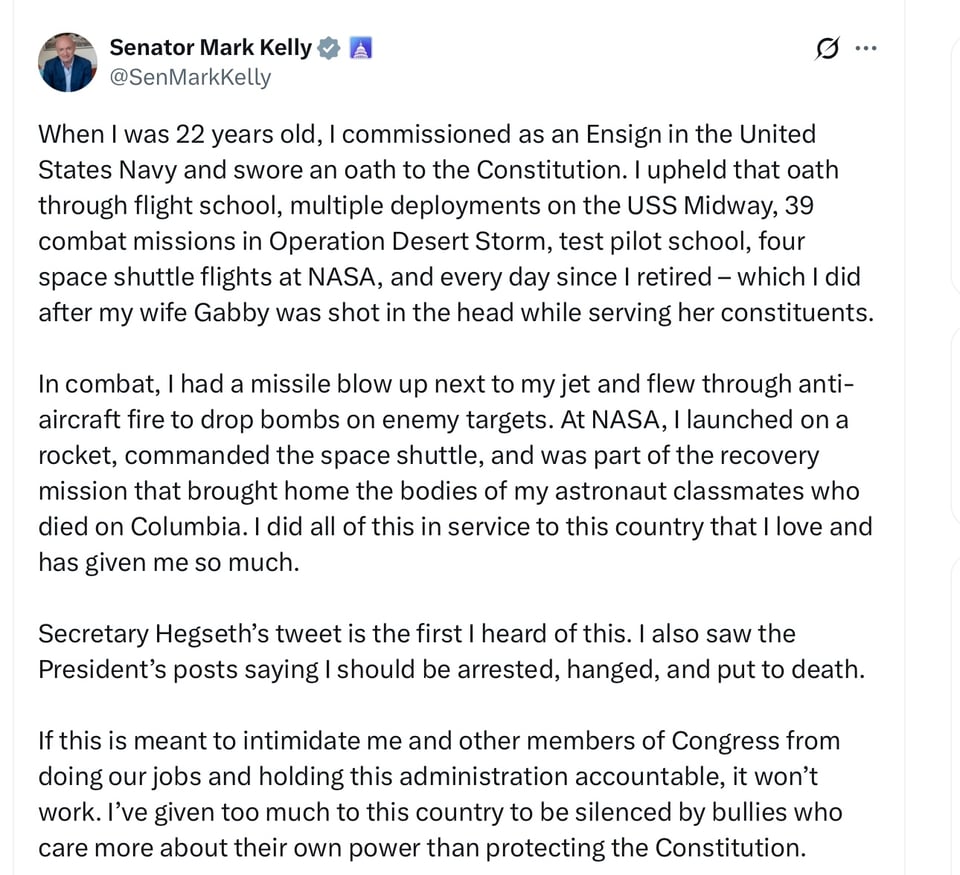
🚨NEW: The FBI plans to schedule an interview with Senator Mark Kelly and possibly open an investigation after he and other veteran lawmakers urged the military to not follow unconstitutional orders from Donald Trump.
— Protect Kamala Harris ✊ (@DisavowTrump20) November 25, 2025
RETWEET if you stand with @SenMarkKelly against the GOP! pic.twitter.com/m38nIqdI5r
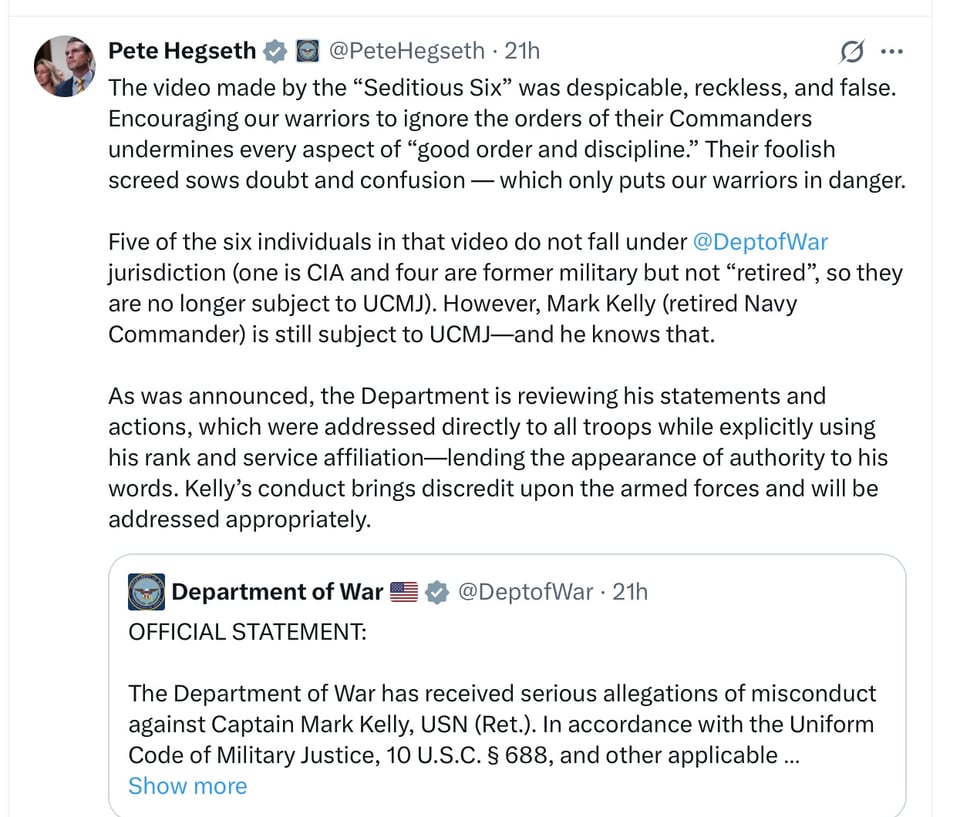
The "Department of War" has no jurisdiction to enforce, because there is no such thing as the "Department of War." The department was titled by Act of Congress in 1949. The title can only be changed by Congress. To assert otherwise is to issue an illegal order. https://t.co/SHNZfZ1ojY
— David Frum (@davidfrum) November 24, 2025
Justice increases in the EU.
Top court rules EU nations must mutually recognize same-sex marriages
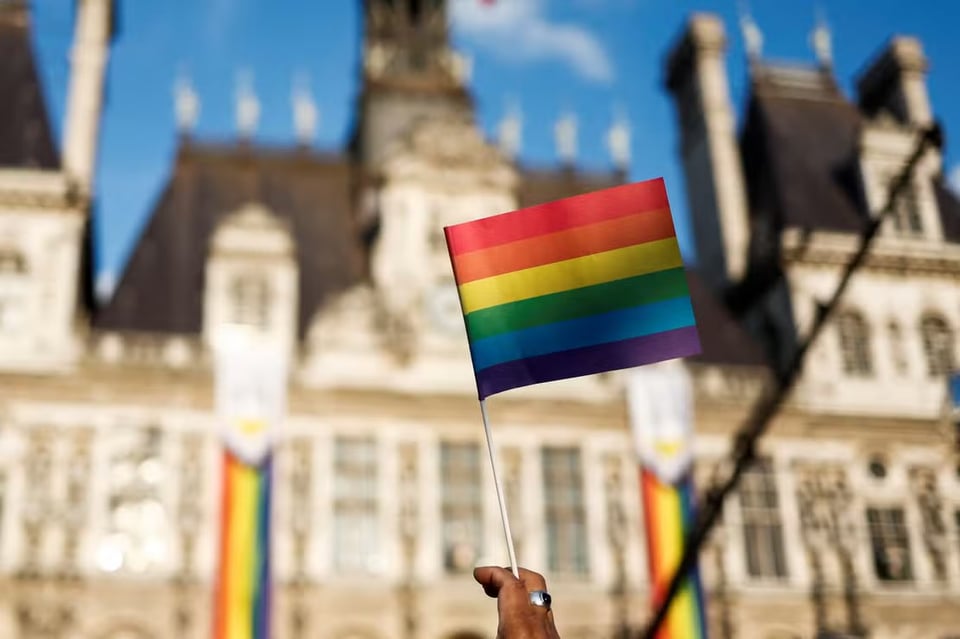
The Court of Justice of the European Union said in a statement on Tuesday that any refusal to do this 'is contrary to EU law' and 'infringes not only the freedom to move and reside, but also the fundamental right to respect for private and family life.'
A top European court on Tuesday, November 25, ruled that an EU nation had to recognise a gay marriage recorded in another member state, following a complaint by two Poles married in Germany.
The couple, one of whom also has German nationality, were living there and married in Berlin in 2018. But when they tried to move to Poland and requested their marriage certificate be registered there, they were "refused on the ground that Polish law does not allow marriage between persons of the same sex," the Court of Justice of the European Union said in a statement.
"The spouses in question, as EU citizens, enjoy the freedom to move and reside within the territory of the Member States and the right to lead a normal family life when exercising that freedom and upon returning to their Member State of origin," the court said. It said "such a refusal is contrary to EU law" and "infringes not only the freedom to move and reside, but also the fundamental right to respect for private and family life."
Contacted by AFP, the Polish NGO Campaign Against Homophobia (KPH) welcomed what it termed a "very positive" decision. In advance of Poland establishing its own legislation, "the transcription of a foreign marriage certificate into Polish and its registration in Polish records already represents a significant step forward," said Przemyslaw Walas, a KPH official.
Polish associations estimate that between 30,000 and 40,000 Polish citizens have contracted marriages abroad. They now anticipate a surge of couples bringing their cases to city halls in Poland following the ECJ ruling.
Traditionally, Catholic Poland has yet to undertake the social and secular reforms implemented since the early 2000s in many other European countries. In Poland, only marriage formalizes the union between two people – and exclusively people of opposite sexes – while its 2021 abortion legislation is one of the most restrictive in Europe.
Women can only undergo abortions in hospitals if their pregnancy is the result of sexual assault or incest, or else poses a direct threat to the life or health of the mother. Aiding an abortion is punishable by three years in jail. According to official data, fewer than 900 abortions were performed in hospitals last year in a country of 38 million.
Blocked reforms
The centrist coalition ruling Poland under Prime Minister Donald Tusk has recently embarked upon reform initiatives. Poland's education minister, Barbara Nowacka, on Tuesday welcomed the court's decision as "an important victory for the respect of rights and dignity," while leftist senator Magda Biejat called it a "historic decision."
But on the political right, several figures blasted what they saw as an assault on Polish sovereignty, with some going as far as to demand a "Polexit" – Poland's withdrawal from the EU. Conservative former justice minister Zbigniew Ziobro – currently in Hungary amid allegations of misappropriation of public funds – the ruling "wholly subjects member states to the leftist agenda."
The executive now has to negotiate political cohabitation since the election in June of nationalist conservative Karol Nawrocki as president. At the instigation of leftist parties, the coalition introduced a civil unions bill in October, including for same-sex couples, which Tusk described as a "small step forward."
Nawrocki, a devout Catholic backed by the Law and Justice party (PiS), which has been behind numerous conservative laws passed since 2015, has warned he will not sign any legislation that would turn civil unions into "quasi-marriages" and would also veto any measure to liberalise abortion laws. In its statement Tuesday, the Court of Justice noted the inclusion of a union between two people of the same sex enshrined in national law remains the responsibility of each member state.
The conditions for recognizing such unions concluded in another country also remain the prerogative of each individual EU member, but recognition must grant the same rights as those provided for in acts of union for which transcription is requested. Poland, along with Bulgaria, Romania and Slovakia, is one of the last remaining European countries still to legalize either marriage or civil unions for same-sex couples, according to the International Lesbian, Gay, Bisexual, Trans and Intersex Association (ILGA). (Le Monde. Fr.)

