Wednesday, March 4, 2026. Annette’s Roundup for Democracy.
Do we have candidates for you!
Texas.
No candidate chosen.
The Texas Democratic candidate for the Senate can’t be decided.

There is chaos in Dallas County. The count can’t be concluded.
The Republican Party in Dallas County changed the election rule which normally allowed voters to vote at any poll in the county. Instead, voters had to vote in the precinct nearest their homes.
The state election website did not post the current precincts. Voters didn’t know where to go,
This caused chaos. As a result, a Dallas County judge extended the time to vote until 9 pm.
The Texas Supreme Court, sprung into action by Texas Republican Attorney General Ken Paxton, stopped the Dallas judge’s extension of the vote to 9 pm. Instead the Court paused votes cast between 7 pm and 9 pm, which are to be “kept.” Will they be counted?
Dallas is Jasmine Crockett’s home area.
The ballot board will decide which votes count on Monday.
Jasmine Crockett vs. James Talarico. As Ali Velshi of MSNow said, this is a jump ball.
In this contest, Republicans would like to see Crockett and Talarico at each other’s throats all Spring long so neither can concentrate on running a campaign against the Republican Senate candidate.
We have now had a sample of what we can expect from the Republicans in November. Create chaos. Frustrate and discourage voters.
—-————
North Carolina.
Roy Cooper, the former governor of North Carolina, is the Democratic candidate for the Senate with 92% of the vote.
Roy Cooper has never lost a race.

His opponent will be Michael Whatley, the former head of the RNC.
The Republican Senator who believes in the 3 branches of the Federal government.
Tillis threatens to hijack Senate business amid frustrations with Noem
The retiring North Carolina Republican lashed the embattled DHS chief during her testimony before the Senate Judiciary Committee.
w
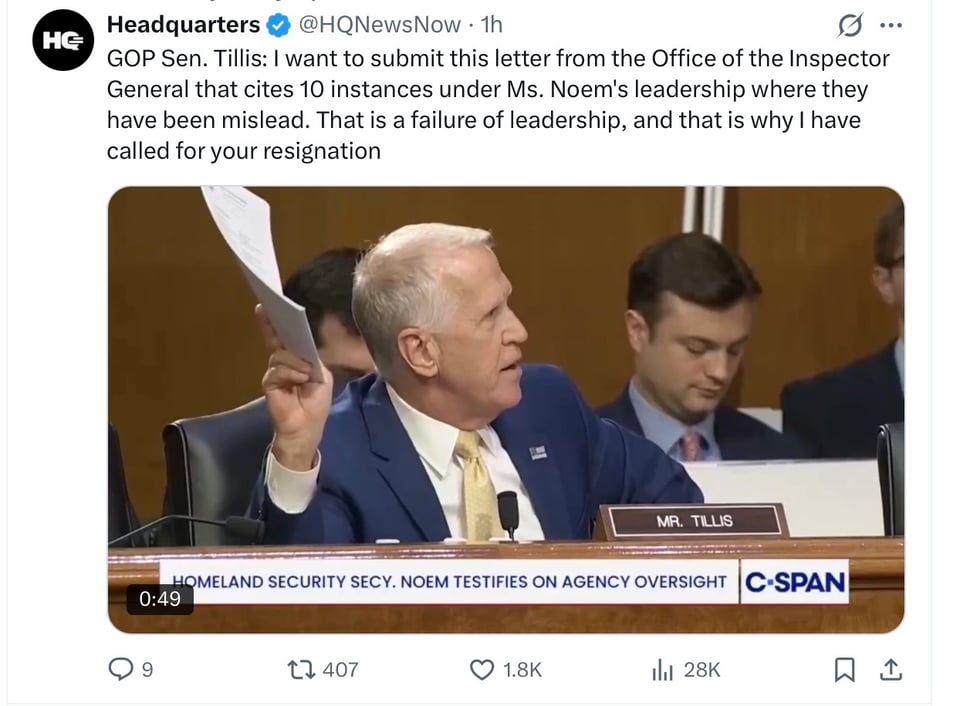
Thom Tillis ripped into Kristi Noem during her testimony before the Senate Judiciary Committee on Tuesday.
Sen. Thom Tillis (R-N.C.) threatened Tuesday to use aggressive procedural measures to bring Senate work to a standstill if Homeland Security Secretary Kristi Noem fails to respond to his offices’ inquiries about an immigration crackdown in Charlotte, North Carolina.
An irate Tillis, who is retiring this year from the Senate, ripped into Noem during her testimony before the Senate Judiciary Committee on Tuesday, saying that he would use his power as a senator to hold nominations and prevent bills from getting to the Senate floor.
“If I don’t get an answer that you’ve had a month to respond to, and the remaining ones … as of today, I’ll be informing leadership that I’m putting a hold on any en bloc nominations until I get a response, and in two weeks, if I don’t get a response, I’m going to deny quorum and markup in as many committees as I can until I get a response,” Tillis said.
The announcement from Tillis, who has called repeatedly for Noem to leave her post, would represent a rare escalation from any senator — in particular one from the president’s party — in the face of frustrations with a member of the Cabinet. Such a move, if he follows through with his threat, would hijack much of the Senate’s standard operating procedure.
Since 2025, the Senate has voted on some administration nominees en bloc — or as a group — to overcome tight margins. Meanwhile, denying quorum and markup in committee limits how legislation — and individual nominations — can advance in the Senate to the floor.
Tillis is a member of the Judiciary committee, as well as the Finance, Banking and Veterans’ Affairs committees. Disruptions to the latter three’s work could prove especially disruptive for the Senate.
Tillis’ anger reflects bubbling frustrations with Trump’s embattled DHS chief among Republicans, who have called for some changes to the tone and tenor of the administration’s immigration crackdown after immigration officers shot and killed two American citizens in Minneapolis in January.
In November 2025, ICE launched a crackdown in Charlotte similar to what it implemented in Minneapolis and other major cities across the country. While DHS claimed the operation was successful in apprehending hundreds of unauthorized immigrants with criminal records, concerns have been raised that ICE accidentally detained U.S. citizens. (Politico).

One more thing about Kristi Noem at the Senate.
Cory Booker challenged her too.

Our Turn next. Heed Heather Cox Richardson’s suggestion.
Call your Senators and Congresspeople and tell them Kristi Noem should be fired.
Trump may not know why he attacked Iran, but others think they do.
This report from Tulsi Gabbard makes clear that nuclear weapons were not the reason for the attack on Iran .👇

Trump has been moving from excuse to excuse, hoping one will satisfy the public.
Here is the latest - March 3, 2026 / JNS-
U.S. President Donald Trump denied claims on Tuesday that Israel forced him into taking preemptive action against Iran.
Speaking to reporters in the Oval Office alongside German Chancellor Friedrich Merz, Trump said that he believed that Iran was going to launch a first strike during talks between Tehran and Washington.
“We were having negotiations with these lunatics, and it was my opinion that they were going to attack first,” Trump said. “They were going to attack if we didn’t do it. They were going to attack first. I felt strongly about that.”
“If anything, I might have forced Israel’s hand, but Israel was ready, and we were ready,” he added. (Source. Jewish News Service).
Trump puppets, Rubio and Hegseth are now mouthing the same words, but some Trump worshipers went even further as to Why.
This happened at one military base. 👇


Oh, wait! It happened at many military bases.

One more thing.
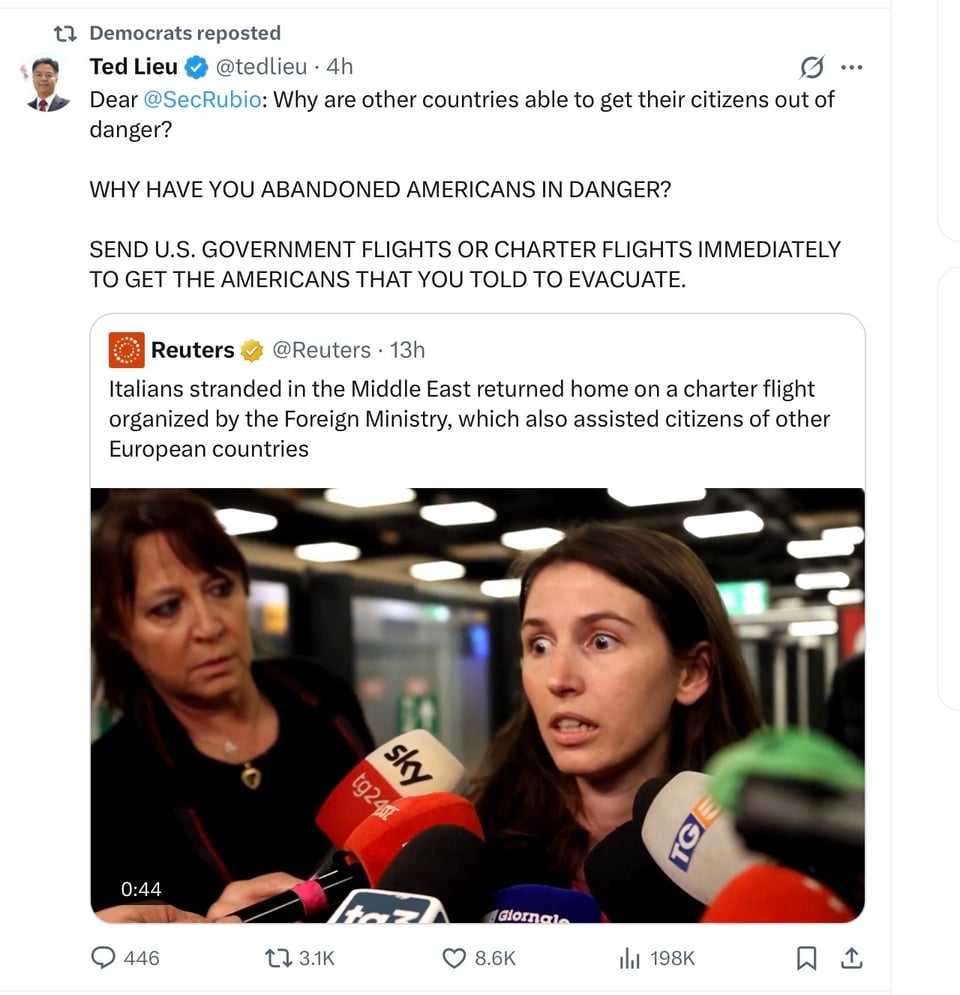
Whatever the reason, they didn’t prepare well.

Representative Ted Lieu, Democrat of CA, makes clear how a government is supposed to act toward its endangered citizens.
This ‘n That.
Because you should know.

John Fetterman says he is considering running for President.

A powerful post about how child molesters see their victims.
Epstein, ‘Lolita’ and a Culture of Disembodiment.

Disturbing images released in the Epstein files showing passages from Nabokov’s infamous novel written on bodies exemplify a world where women and girls are treated as objects for consumption.
Amid the cascading horrors of the Epstein files, we should not overlook several photographs of female bodies with lines from Vladimir Nabokov’s novel “Lolita” written on their flesh.
There are no faces in these photos, just anonymous flesh bearing excerpts from the famous opening passage, in which the protagonist, Humbert Humbert — a grown man who molests his young stepdaughter for years — muses with delectation on the girl’s various nicknames. (He prefers these to her real first name, Dolores, which means “pain” or “sorrow.” )
The disturbing photos remind us of Jeffrey Epstein’s pedophilic tendencies, of course, but they also communicate more than that. They rely on motifs that are entirely familiar — motifs underlying much of fashion and beauty culture. Like the legend at the bottom of a map, they provide a key to grasping vast swaths of a ghastly world.
In one of the photos, a young female throat and upper chest (with a hint of chin and mouth visible) bear the inscription “Lo-lee-ta: the tip of the tongue taking a trip of three steps down the palate to tap, at three, on the teeth.” Another photo shows an expanse of waist and lower hip (pants pushed down), with the phrase: “She was Lola in slacks.” Scrolling down an exposed spine, we read, “She was Dolly at school.” A fourth photo shows a bare, extended lower leg and (pedicured) foot reading: “She was Lo, plain Lo in the morning, standing four feet ten in one sock.” In the background of that photo, we see a well-worn copy of the novel.
These are staged images, the words carefully handwritten, perhaps in indelible marker. And the quotations seem deliberately placed, several referring to the body part where they appear: The line about “slacks” covers the waist; the one about a “sock” is written on a foot. Is this an inside joke? And if so, who is the presumed audience? Or could this be an attempt to elevate a crime into an act of literary appreciation — trying to soft-pedal abuse by lending it the patina of a secret book club?
The photos feel like messages passed between co-conspirators. It seems unlikely that the girl (or girls, it’s impossible to tell) on the bed is reading Nabokov. No, she is more text than reader. That book, we infer, is a winking missive between abusers, much as the young women were, their bodies the intermediaries, no more worthy of consideration than a blank sheet of paper, a product to label, an animal to brand. Unsettling as these images are, their basic concept is hardly new: What are models if not young women being used as blank slates, living billboards on which to write messages?
We gaze constantly upon pictures of anonymous female facial features, midriffs, breasts and feet as we contemplate how to enhance, reduce or embellish them. And, always, how to make those myriad, disjointed parts look younger and prettier, like those of the models in the pictures — a perfectly circular system.
Girls and women cannot help internalizing such messages. Lolita herself, Nabokov tells us, was an “avid reader of movie magazines,” tearing out ads to decorate her bedroom wall and dreaming of “Broadway and Hollywood,” the classic escapist fantasy of pretty girls. And Mr. Epstein and Ghislaine Maxwell capitalized on their own young victims’ similar dreams, enticing them with promises of modeling opportunities, new clothes or trips to the kinds of glamorous places seen in movies and on TV.
To further coax young girls into her lair, Ms. Maxwell apparently even described Mr. Epstein to them as a “Ralph Lauren type,” trying to connect him in their minds with the mogul of a great fashion empire. She was tapping into the very desires stoked by beauty culture, making those she preyed upon feel chosen and special, elevated and prized for their youth and good looks — the reward promoted by every fairy-tale-style movie, beauty pageant, modeling competition and makeover story. The dream of rising above your circumstances by dint of your youthful beauty is drilled into women by a society that teaches us to regard ourselves from the outside in, not as thinking subjects but as objects to polish and perfect for the approving gaze of discerning men.
The issue of men’s discernment also comes into play in those “Lolita” photos. The pictures suggest the participants are engaged in a kind of acting-out of the book’s premise, priding themselves on their highbrow, literary tastes.
But “Lolita” is not an instruction manual for pedophiles. It is the fictional memoir of a delusional criminal, written (as we are told in the also fictional foreword) from a jail cell where he ultimately dies. So, the reader knows how this character meets his end. Yet throughout the book, Humbert convinces himself that he is not a rapist, but a refined connoisseur of feminine allure, and that Lolita, the child he abducts, actually belongs to a special category of girls — “nymphets,” whose presumed sexual precocity absolves him of guilt.
The novel satirizes Humbert’s preening vanity about his education and superior taste. But Nabokov is also skewering American society: Humbert’s facade of European charm and erudition easily bamboozles those around him. Sycophantic teachers and neighbors are all too excited to be in his glamorous company to notice all the red flags of an abuser. How could such a refined, elegant man be a rapist? Similarly, Mr. Epstein’s pose as a serious thinker, an intellectual and an art collector, along with his curated coterie of international socialites and famous professors, all seem to have convinced a shocking number of people to overlook or ignore his criminality.
And so, Mr. Epstein was, in fact, living a version of “Lolita,” but not perhaps in the way he imagined. Thinking about these photos, we realize too just how much that novel (published in 1955) explains — about how easily vast segments of society could allow such abuse to happen, how easily men still coast on the presumptions of their “expertise” or advanced intellect and how easily young girls and women can be swept up into a world that turns them into objects of connoisseurship (as a precursor to far worse), luring them in with the very promises they’re taught to hope for.(Rhonda Garelick writes the Face Forward column for The New York Times’s Style section.)