Wednesday, January 14, 2026. Annette’s Roundup for Democracy.
Midterms and Pennsylvania on my mind.
Democrats’ hopes for taking the House begin in Pennsylvania by Chris Matthews.

Donald Trump didn’t wait for 2026 to begin the fight for control of Congress. In December, the president showed up at a ski resort in the Poconos, and he wasn’t there for the lovely Pennsylvania mountain scenery. He knows what’s headed his way. Trump and his people are well aware that Democrats’ hopes for a big victory in the midterms start with seats they lost narrowly in 2024. Three Pennsylvania Republicans appear high on the list.
In 2024, Rob Bresnahan won his Scranton seat, just up Interstate 380 from where Trump spoke, with only 50.8 percent of the vote.
Ryan Mackenzie won his seat in the Lehigh Valley, which includes Allentown and Bethlehem, with 50.5 percent of the vote.
In the Harrisburg area, Scott Perry is another 50 percenter; he eked out reelection in 2024 at 50.6 percent. Victories in those districts could set the Democrats up for the 30-plus-seat nationwide sweep that some watchers — me included — are betting is coming this coming fall.
And with it, a turnaround in the trajectory of Trump’s chaotic and damaging presidency.
There are three solid reasons to expect 2026 to bring a big win for the Democratic opposition. The first is the narrow Republican advantage heading into the campaign.
It takes 218 seats for a party to secure a majority of the 435-seat House of Representatives. After recent vacancies, the GOP holds exactly that number.
At 213 seats, Democrats need to add just five to win control. (Special elections before November will change those totals, but the majority will be razor-thin on Election Day no matter what.)
Second, there’s the history of midterm “change” elections in favor of the party that’s not in the White House. In 2018, during Trump’s first term, Democrats gained 41 seats. In 2010, Republicans flipped 64 seats in the “shellacking” they gave to Democrats, as President Barack Obama memorably described it.
George W. Bush and the GOP lost 31 seats in 2006. Bill Clinton and the Democrats lost 54 in 1994.
The third reason for Democratic optimism is the party’s recent string of electoral successes. Start with Mikie Sherrill’s big victory in the New Jersey governor’s race in November. While many observers expected a squeaker, she swamped her hard-running Republican rival, Jack Ciattarelli, with 57 percent of the vote.
In Virginia, gubernatorial candidate Abigail Spanberger won an even bigger victory for Democrats.
In Pennsylvania, Democrats pulled off a remarkable streak of wins of local offices in hotly contested Bucks County. They also won two statewide races in Georgia.
Then a December special election brought surprise in Tennessee. In a ruby-red congressional district that a Republican won by 22 points in 2024, the Democratic candidate came within just nine percentage points of an upset. Translated nationally, that shift of 13 percentage points could spell a 2024 Democratic House victory of 30 seats.
A week after that, Miami elected its first Democratic mayor in nearly 30 years.
All that explains why the Democratic Congressional Campaign Committee is salivating over vulnerable Republicans — Bresnahan, Mackenzie and Perry, along with Brian Fitzpatrick of Bucks County — in purple Pennsylvania.
It also explains why three of them — Bresnahan, Mackenzie and Fitzpatrick — just backed a leadership-defying House vote on extending expiring Obamacare subsidies.
And, of course, why Trump was in the Poconos.
To avoid its own shellacking, the GOP needs to find a way for the president to awaken the full MAGA base. The problem with that? The more the party works to put the fate of Trump’s presidency on the ballot, the more the Democrat base will tune in and turn out, too.
That leaves the persuadable middle. Are those who decided on Trump in 2024 happy with what he’s given them? Or are they coming to believe, like many of those long-ago investors in Trump casinos and enrollees in Trump University, that they’ve been taken for a ride? (Chris Matthew, opinion, Washington Pist).
Chris Matthews is a political commentator and host of the show “Hardball” on Substack. His most recent book is “Lessons From Bobby: Ten Reasons Robert F. Kennedy Still Matters.
WHYY Election 2026 - PA races may determine U.S. House control

With control of the U.S. House again expected to come down to a razor-thin margin next year, several congressional districts in Pennsylvania are emerging as some of the nation’s most competitive. As a result, control of the U.S. House may once again run through Pennsylvania.
Democrats have identified four districts they believe they can flip next year in Pennsylvania, more than any state: the 1st congressional district representing Bucks County; the 7th in the Lehigh Valley; the 8th in the Scranton area; and the 10th representing Harrisburg and York.
There are four highly competitive U.S. House races in Pennsylvania, more than any other state. Democrats hope to flip them all.
Three major, nonpartisan election forecasters — The Cook Political Report, Sabato’s Crystal Ball and Inside Elections have placed PA-7 and PA-10 among the most competitive House seats nationwide. PA-8 is commonly rated as “lean” or “tilt” Republican across the three major forecasters. And PA-1 remains “likely” Republican, but analysts say the district could become vulnerable under the right conditions.
Brian Fitzpatrick: The ‘moderate’
In the northern Philadelphia suburbs, Republican Rep. Brian Fitzpatrick is again preparing for a tough re-election fight in Pennsylvania’s 1st Congressional District, which includes all of Bucks County and part of Montgomery County. Fitzpatrick, a former special assistant U.S. attorney and FBI agent, first ran for Congress in 2016, replacing his brother Mike Fitzpatrick, who held the seat for four terms.
In 2018, the self-described moderate eked out a re-election victory despite being outraised and outspent 4 to 1. In 2020, he was one of only nine House Republicans to win a district carried by President Joe Biden. He went on to win by more than 10 points in 2024 in a district that Trump only narrowly won.
In the early years when Fitzpatrick represented the area, Democrats gained a majority advantage and a majority on the Bucks County Board of Commissioners, ending 40 years of Republican control. Republicans have since reclaimed a voter advantage, but in November, a high off-year election turnout led to a “blue wave” that saw Democrats win more local seats.
The Cook Political Report currently rates the seat “likely Republican,” while Sabato’s Crystal Ball and other prognosticators also see Fitzpatrick favored but not entirely safe.
Democrats appear to believe that the 2025 off-year elections show that dissatisfaction with Republican leadership in Washington is giving them a greater edge and that fights over the economy, abortion and “attacks on democracy” will help flip the seat. Several candidates have already stepped forward, including Bucks County Commission Chair Bob Harvie, Delaware Valley University professor Tracy Hunt, eyewear company manager Robert Strickler and attorney Lucia Dora Simonelli.
Ryan Mackenzie: The toss-up
The Lehigh Valley-based 7th District — encompassing Lehigh, Northampton and Carbon counties — is widely seen as one of the purest swing seats in the country. Republican Ryan Mackenzie flipped the seat in 2024 with just over 50% of the vote, ousting Democratic Rep. Susan Wild, who served two terms.
Cook, Inside Elections and Sabato’s Crystal Ball rate PA-7 a “toss-up.” The combination of a freshman Republican incumbent, a closely divided partisan history and a relatively inexpensive media market has made the Lehigh Valley a top target for both parties.
Mackenzie faces no serious Republican opposition so far, but the Democratic field is crowded. According to Ballotpedia and state election filings, declared Democratic contenders include firefighter and president of the Pennsylvania Professional Firefighters Association Bob Brooks, Ryan Crosswell, Northampton County Executive Lamont McClure, former PPL executive Carol Obando-Derstine and Lehigh County Controller Mark Pinsley.
Fundraising reports show all six PA-7 candidates together raised more than $1.5 million in a recent quarter, much of it from outside the region, suggesting how vulnerable Democrats believe Mackenzie to be — and how much attention voters there can expect in the coming year.
Rob Bresnahan: The stock trader
Further north and west, Pennsylvania’s 8th District — anchored in the Scranton/Wilkes-Barre region and the Poconos — is another GOP pickup from 2024 that Democrats are trying to claw back. Republican Rob Bresnahan, a businessman with a moderate image, flipped the longtime Democratic seat last cycle with just under 51% of the vote.
Cook lists PA-8 as “lean Republican,” while Inside Elections calls it “tilt Republican,” reflecting a slight GOP advantage. The district itself leans right — Donald Trump carried it by nearly double digits in 2024 — but Democrats see an opening given recent criticism over stock trading Bresnahan engaged in as a member of Congress with access to insider information.
Their preferred recruit is Scranton Mayor Paige Cognetti, who launched a campaign this fall and immediately positioned herself as a watchdog on ethics, criticizing Bresnahan over the trading. Another Democrat, Francis McHale, an attorney who served in the state Department of Labor and Industry, has also entered the race.
Scott Perry and Republicans Against Perry
Perhaps no Pennsylvania race is drawing more national attention than the 10th District, centered on Harrisburg, much of Dauphin County, parts of Cumberland County and the northern half of York County.
Republican Rep. Scott Perry, a former chair of the House Freedom Caucus, won re-election in 2024 by just over a point. Cook, Sabato and Inside Elections now rate PA-10 a “toss-up,” with some analysts describing it as one of the most vulnerable GOP seats in the country heading into 2026.
Democrats already have their preferred candidate in Janelle Stelson, the former TV news anchor who ran against Perry last time and is running again, having lost by about 1%. She is expected to be the best-known Democrat in a large primary field, and already received an endorsement from Gov. Josh Shapiro.
Perry is also facing dissent inside his own party. Last year, a group formed Republicans Against Perry and criticized the incumbent for his right-wing views that RAP says do not represent the district. That effort may have helped Stelson to come within a point of winning. Now, Perry has primary competition. Karen Dalton, a former staff attorney for Republicans in the state House, has launched a primary challenge, joined by Joshua Hall, who was sentenced to prison for threatening the life of U.S. Rep. Eric Swallwell.
Pennsylvania will hold primary elections May 19, for which Pennsylvania voters have until May 4 to register, if necessary. The general election will be held Nov. 3.
One more thing.
Plan your fall now.
Get ready to contribute, as you can, money and time to the Pennsylvania House races.
One thing that will help Pennsylvanian Democratic turn out in November is that the very popular Pennsylvania Democratic Governor Josh Shapiro is up for re-election. Shapiro will be on the top of our ticket and Trump won’t be on the top of theirs as he was in 2024.
Stay tuned for candidates by House district after the May 19th primaries. We can beat Rob Bresnahan, Ryan McKenzie and Scott Perry for sure, plus that one more - Brian Fitzpatrick - too.
NEW: The DNC is launching When We Count, our largest-ever voter registration effort aimed at closing the voter registration gap by training young Democrats to register new voters in districts across the country. pic.twitter.com/4sa9dpHgbN
— Democrats (@TheDemocrats) January 13, 2026
This happened too.
New: Florida Republican Neal Dunn announces he’ll retire from Congress.
— Samantha Handler (@sn_handler) January 13, 2026
Dunn is a senior member of the E&C committee. Yet another House member saying this term is their last. pic.twitter.com/jXmUUqWBCs
The Supreme Court may leave alone the Voting Rights Act just long enough to keep the GOP from House control in 2026.
Republicans want a big Supreme Court redistricting win. They’re losing hope it will help them in the 2026 midterms.
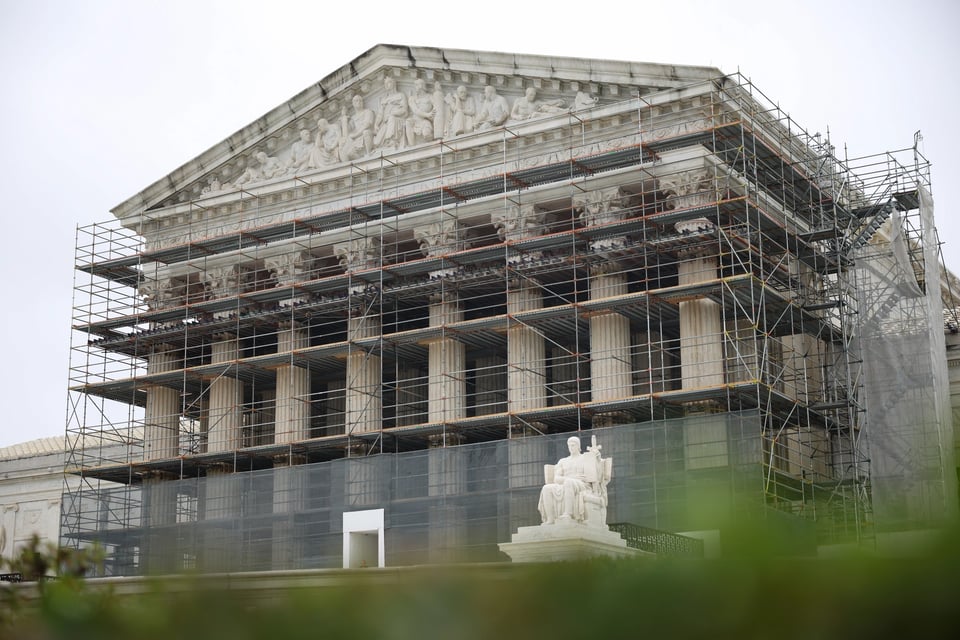
The Supreme Court’s decision in Louisiana v. Callais could weaken the Voting Rights Act and open the door to redrawing congressional maps, particularly across the South. Court watchers expect at least a partial win for conservatives that could let the GOP draw more seats for themselves by erasing Black- and Hispanic-majority districts.
But while that decision could theoretically come as soon as when the court returns on Friday, many experts think the case is more likely to be resolved with the flurry of decisions the court typically releases in late June.
The window of opportunity for new maps going into place before this November’s elections is rapidly closing, as states would need ample time to change deadlines, shift election calendars, vet signatures and print and distribute ballots. And the longer it takes for the Supreme Court to issue a ruling, the harder it will be for state-level Republicans to throw their maps out and draw new ones before this fall’s elections.
“It can get very complicated and very sticky, and that is not fast work,” said Tammy Patrick, the chief programs officer for The Election Center, a nonpartisan consulting firm that works with state and local election officials. “That is time-consuming, very methodical and detail-oriented work that needs to have sufficient time.”
Some state-level Republicans have already given up hope. In Louisiana, the plaintiff in the Supreme Court case, some state officials believe it’s already too late and that the state will have to use its current map in its 2026 elections regardless of the Court’s decision, as the candidate qualifying period opens next month. Louisiana Republicans pushed back its 2026 primary election dates from April to May during a special session late last year, in hopes the Court would rule by the end of 2025 and give them time to install a new map. But the shift still wouldn’t be late enough for a late-term SCOTUS ruling.
Some national Republicans, however, say there’s plenty of time to take on a redraw before November, arguing the Legislature can move the deadlines in order to redraw before elections are underway.
At the center of the Supreme Court case is Section 2 of the VRA, a provision that broadly outlaws discrimination in elections on the basis of race and has led to the creation of majority-minority districts, where Black, Latino or Asian voters make up a majority of the population.
Republicans have long argued such districts violate the Constitution and benefit Democrats. Democrats warn that the elimination of seats drawn to satisfy Section 2 could decimate minority representation in Congress and allow lawmakers to redraw lines in such a way to eliminate as many as 19 Democrat-held, majority-minority districts, many in the South.
Democrats in Blue states could also take advantage of a Section 2 change and redraw, but the party’s options are more limited, both because of geographic limitations and pressure from civil rights and minority groups.
But even as many legal experts expect the court to rule in a way that weakens the VRA, the case’s prominence has led many watchers to predict an end of term ruling in June. At that point, many states across the country will have already held primary contests and there will be no room to undertake redistricting.
“If it’s in any way a big deal, we’re not going to get that decision before June,” said Justin Levitt, a professor of law at Loyola Law School who worked in the Biden White House as an adviser on democracy and voting rights. “It’s really hard for me to see a decision that does anything significant that wouldn’t occasion a major dissent, and it’s really hard for me to see that dissent not taking a fairly long time in the back-and-forth.”
Many southern states where Republicans stand the most to gain have early primaries — seven of the 11 states that belonged to the Confederacy have primaries scheduled before or on May 19 — making the timing even tougher for the GOP.
That doesn’t mean that lawmakers are done gerrymandering before the 2026 election.
At least three southern states — Florida, Kentucky and Virginia — are eyeing redistricting ahead of the 2026 midterms, and lawmakers seem emboldened to attempt it with or without a Supreme Court ruling. In Florida, state House Republicans hope to tackle the issue during the legislative session that started this month, while Gov. Ron DeSantis called a special session in late April, in an effort to wait as “long as feasible” for a Supreme Court decision. And in Kentucky, some Republican lawmakers are weighing a redraw, even though the map would likely be vetoed by Democratic Gov. Andy Beshear.
In Virginia, the Democratic-controlled legislature is considering a move independent of a Supreme Court decision that will put redistricting before voters akin to the move in California last year.
But other southern states reliant on a weakened VRA to redraw, like South Carolina and Alabama, may be out of luck. Republicans in the Palmetto State — including Rep. Ralph Norman, who is running for governor — are pushing the legislature to draw out the state’s lone Democrat, Rep. Jim Clyburn. But the state’s candidate filing deadline looms in late March.
Pushing back the filing deadline further in hopes for a Supreme Court decision would scramble the primary calendar and put elections officials in a bind.
“Anytime a state decides to redistrict, it creates a domino effect of administrative issues that need to be addressed,” said David Becker, the executive director and founder of the nonpartisan Center for Election Innovation & Research. “Election officials and voters are able to manage that when it’s once every 10 years. When it becomes once every two years, it might get very, very difficult for that to be managed.”
Utah got a taste of the challenge of shuffling deadlines late last year after a district judge installed a new congressional map in November. The state’s top election official, Republican Lt. Gov. Deidre Henderson,
immediately announced her office would move forward with the new map, even as Republican lawmakers fumed and vowed to fight it. “There will likely be an emergency appeal,” she noted on X, “but the process of finalizing new boundary details will take weeks of meticulous work on the part of state and county officials.”
The state’s Republican-controlled legislature went forward with an appeal — which is unrelated to the VRA — after it pushed back the candidate filing deadline by two months for congressional hopefuls during a special session last month, offering itself a window for potential judicial action. Should the legislature — which meets for its scheduled session this month — again adjust the electoral calendar, it would send elections officials statewide into a scramble.
“The questions we would be asking are, you know, how much time do we have to program our ballot? What are the new dates? What would we communicate with voters?” said Nikila Venugopal, the Salt Lake County chief deputy clerk. “We haven’t heard any plans to do so at this point, and we’re moving forward with the assumption that the elections will be held as planned.” (Politico)
Many people are not obeying illegal orders.
ALERT: At least six career prosecutors in the Minneapolis U.S. Attorney's office — including Assistant U.S. Attorney Joe Thompson — have resigned after the office was tasked with investigating the shooting of Renee Goodhttps://t.co/d7ckXr9JfR
— Scott MacFarlane (@MacFarlaneNews) January 13, 2026
One more thing.
ICE shot and killed Renee Good, then called her a “fuckin’ bitch.”
— Democrats (@TheDemocrats) January 13, 2026
Now, instead of investigating the shooting, the Trump administration is trying to investigate the victim’s widow.
These people are sick.
As to the Senate.
I’ll be the first to tell you this race won’t be easy, but it is winnable if we all do our part.
— Mary Peltola (@MaryPeltola) January 12, 2026
I was the first Democrat to win Alaska’s statewide House seat in 50 years because I reject Lower 48 partisanship and always put Alaska first. pic.twitter.com/nnS7c74U9D
Some surprising good news.
Lawsuit dismissed after Trump admin quietly restored tens of millions to Planned Parenthood
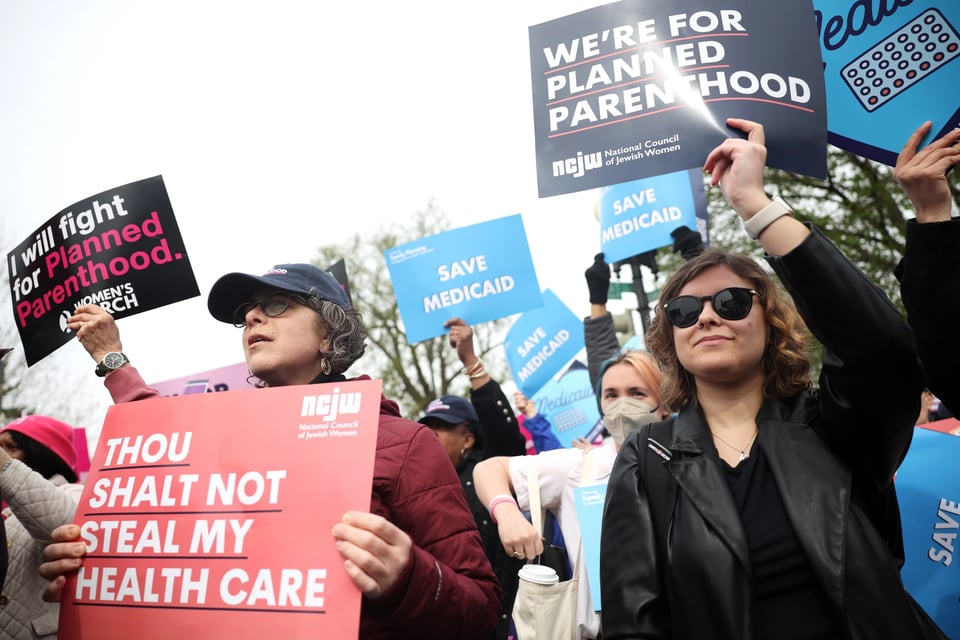
The American Civil Liberties Union on Monday dropped its lawsuit against the Trump administration over tens of millions in Title X family planning funds that federal officials had withheld from Planned Parenthood and some other health clinics since last spring, after HHS quietly released the money in December.
Though the Trump administration is still defending in court far bigger federal cuts to Planned Parenthood that Congress approved last summer, the release of the Title X funds gives the clinics a crucial lifeline. It is also likely to inflame existing tensions between the administration and anti-abortion conservatives who will rally in Washington later this month for the annual March for Life.
The clinics and the groups representing them argue, however, that the restored funds will not undo all of the harm done over the many months the money was withheld. Though many clinics had been saving their receipts from low-income patients who came in for birth control, testing for sexually transmitted infections and other Title X services and can submit them now for federal reimbursement, dozens of clinics have since shut down and are unlikely to reopen.
“More than 800 service sites were unable to provide Title X services. Hundreds of thousands of patients were unable to get Title X services. So the impact was tremendous,” said Brigitte Amiri, the deputy director at the ACLU’s Reproductive Freedom Project who represented the clinics in the case. “So damage certainly was done as a result of their unlawful withholding of the funds.”
Trump administration health officials did not respond to questions about why the funding was restored.
Last March, the administration informed more than a dozen health care providers in the half-century-old Title X family planning program, including nine Planned Parenthood state affiliates, that their funding would be “temporarily withheld” due to “possible violations” of federal civil rights law and President Donald Trump’s executive orders.
One Mississippi provider was cited, for example, for posting a statement in 2020, that it later deleted, saying: “Race, income, geography and/or identity should not determine whether a patient has access to high quality family planning care.”
HHS vowed to investigate whether the 16 grantees that collectively ran more than 800 clinics deployed “widespread practices across hiring, operations, and patient treatment that unavoidably employ race in a negative manner,” or ran programs in a way that “overtly encourages illegal aliens to receive care,” which they deemed “taxpayer subsidization of open borders.”
Over the following months, the impacted clinics provided materials and responses to the Trump administration arguing that they were not in violation of any federal rules, including around so-called diversity, equity and inclusion practices the administration has condemned.
Some had their funding restored over the summer, but others remained under investigation until December, when HHS official Amy Margolis said in a letter to Planned Parenthood affiliates in the Carolinas, the Dakotas, Ohio, Utah, Virginia, and other states where funding had been frozen that they would receive their promised funds dating back to last April, with no explanation given other than a nod to unspecified “clarifications made by, and actions taken by, the grantees.”
The federal district court in Washington heard arguments in the case in August, but was delayed in ruling by the fall’s record-long government shutdown. The court did, however, order the government to put the contested funds in escrow so they didn’t disappear at the end of the fiscal year on Oct. 1.
Then, in a court filing on Dec. 19, shared with POLITICO, U.S. Attorney Jeanine Pirro told the court “the review is completed, and all grants at issue for Plaintiff’s members have been restored.” She provided no further details, but asked the challengers to consider whether “this matter can be voluntarily dismissed in light of the restoration of the remaining grants.”
On Monday, the challengers agreed.
Clare Coleman, the CEO of the National Family Planning and Reproductive Health Association, which represents most Title X providers and led the lawsuit, said the abrupt turnaround suggested to her that the government “did not have a legitimate case for withholding this money.”
“There was no basis for HHS withholding the grants. They didn’t have anything to stand on,” she said. “We feel like without litigation, the money would be gone.”
The now-dismissed lawsuit is the latest round of legal and political fights over the Title X program. President Donald Trump imposed anti-abortion restrictions on the program during his first term that prompted an exodus of providers. Those rules were rescinded by President Joe Biden, but Coleman and other family planning leaders expect the current Trump administration to reintroduce them at some point during his term.
Additionally, while Congress voted last summer to strip Planned Parenthood of hundreds of millions in federal Medicaid funds, lawmakers would need to pass another law to extend that cut beyond this summer. A top demand of the anti-abortion activists gathering in Washington for the March for Life later this month is permanent defunding.(Politico)
Want to learn how to fight back?

The letter from the Clintons to Trump ally, Congressman James Comer of Kentucky, is a must read.
Bill and Hillary wrote a letter to the Republican chairman of the House Oversight Committee, refusing to testify in Congress. It outlines where we are as a nation and why and how we must fight back.
Read the Clintons’ Personal Letter to Comer
New York’s leaders are united.
Echoing Mamdani, Hochul Offers Plan for a More Affordable New York.
In her State of the State address, Gov. Kathy Hochul adopted some of the affordability message of Mayor Zohran Mamdani. She also took aim at federal immigration officials.
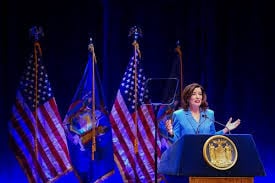
Portraying New York as a bulwark against the chaos and militancy of the Trump administration, Gov. Kathy Hochul used her State of the State address on Tuesday to convey her vision of making the state more affordable and safer for all as she entered a pivotal re-election year.
She cited “reckless federal actions” that threatened jobs and critical investments, as well as “efforts to divide, exclude and roll back hard-won rights,” according to a briefing book distributed before her speech.
The governor earned some of the loudest applause of the afternoon when she took aim at federal immigration officials, invoking Renee Good, the Minneapolis mother who was shot in the face by immigration officials last week.
“Protecting New Yorkers also means this: standing up to ICE agents who abuse their power,” she said, bringing the crowd to its feet.
At its core, this agenda reflects a choice about who we want to be,” Ms. Hochul said, laying out proposals that included investments in nuclear energy, lifting taxes on tips of up to $25,000 and building more protective barriers on subway platforms.
The address came at a critical time for Ms. Hochul, who must navigate shifting and complex political winds in New York. The state just saw a progressive Democrat, Zohran Mamdani, elected as mayor of New York City, but it also contains vast rural areas, where many voters support President Trump.
Ms. Hochul seemed willing to ride on Mr. Mamdani’s popularity. Last week, she stood alongside the new mayor to announce that she would spend $1.7 billion in new funds to make child care available to 100,000 additional children in the coming year, for a total of $4.5 billion.
The investment, which makes New York the second state (after New Mexico) to chart a path to universal child care, will be put to use in New York City as it helps to shore up existing prekindergarten and 3-K programs and expand care to children as young as 2. The governor has also proposed bolstering funds for pre-K outside the city, as part of an effort to guarantee access for 4-year olds across the state within four years.
On Tuesday, Ms. Hochul noted the exorbitant cost of child care in the city, saying it cost close to $30,000 a year. “For that price, your toddler should be fluent in three languages and doing your taxes,” she joked.
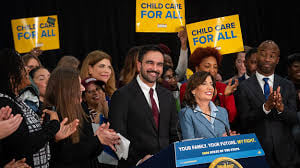
Mr. Mamdani, seated in the third row, was the first to stand and applaud as Ms. Hochul dug into the details of expanding child care over the next several years.
Other elements of her speech dovetailed with the affordability messaging that dominated last year’s New York City mayoral race. But unlike Mr. Mamdani, Ms. Hochul did not point the finger at wealthy New Yorkers, or call for additional income taxes. Indeed, she said little about how she would pay for her expansive vision, preferring to leave the nuts and bolts for the state budget presentation next week.
The governor’s synergy with Mr. Mamdani on affordability emanated throughout the entire address, representing a shift from Ms. Hochul’s previous State of the State addresses, which typically devoted substantial time to New York’s efforts to crack down on violent crime.
The atmosphere at the Egg, the iconic Albany auditorium where Ms. Hochul spoke, seemed suited to a basketball game rather than a political speech. A public address announcer gave sports-style introductions of the mayors of the state’s biggest cities, saving for last Mr. Mamdani, who graciously stood and waved back at his fans.
Ms. Hochul will need the support of Mr. Mamdani’s energized, progressive coalition as she seeks re-election. She is facing a primary challenge from her own lieutenant governor, Antonio Delgado, and a general election fight with the Nassau County executive, Bruce Blakeman, whose pro-abortion-rights, pro-Trump stance defies easy categorization.
Mr. Blakeman criticized the governor’s address, saying Ms. Hochul had not done enough to improve affordability for New Yorkers during her first term. “She created these problems, and now she blames Washington for all the problems in New York State,” he said.
Ms. Hochul has long aimed to avoid giving Republicans anything they might use to their political advantage. Her alliance is particularly delicate with Mr. Mamdani, who has already been the target of Republicans upstate and on Long Island. In her speech, Ms. Hochul attempted to portray her agenda as representing all New Yorkers, creating a bit of distance between herself and the mayor.
Mr. Delgado, who is seeking to run to the left of the governor, criticized Ms. Hochul for not offering a concrete tax plan strategy, among other things.
“It’s just a bunch of status quo half measures,” he said.
Aside from expanding child care, Ms. Hochul offered a series of proposals to streamline and supercharge the development of housing, reduce the cost of auto insurance and confront the pitfalls of fast-growing vices, like online gaming.
After struggling in recent years to expand the supply of housing, Ms. Hochul wants to ease stringent environmental reviews for housing and infrastructure. The rules, meant to protect air and water quality, have increasingly been used to slow or block housing, according to pro-development advocates, and hamstring the ability of local officials to tackle ambitious infrastructure projects.
Ms. Hochul has also proposed spending $3.75 billion over the next five years so communities can construct water infrastructure like sewers. The money will augment housing construction in places like Long Island, a voter-rich region, where Ms. Hochul is hoping to make inroads in November.
But the governor left little doubt about her origins, peppering her speech with references of her upbringing in Buffalo: a shared attic bedroom, an after-school job making pizza and her loyalty to the Buffalo Bills. She closed the speech by donning a Bills cap and walking off to a rally song for the team.
In a rebuke to the Trump administration, Ms. Hochul said she would support legislation to allow citizens to sue federal immigration officials who they believe have trampled on their constitutional rights. State and local law enforcement agencies are already subject to such lawsuits.
And she said she would push for legislation that would force immigration agents to obtain warrants to search “sensitive locations” such as hospitals, religious institutions and schools.
“We will not allow masked ICE agents to storm our schools, our day care centers, our hospitals, our houses of worship for civil immigration raids unless they have a judicial warrant,” Ms. Hochul said.
These items are expected to be popular among Democrats in the State Legislature. This week, the leader of the State Senate said that the body considered protecting immigrants among its top priorities for the session, and that it planned to pass a bill that would bar local officials from cooperating with immigration agents.
She also hopes to make virtual spaces safer for children. Last week, Ms. Hochul announced that she wanted to extend age verification requirements across social media and online gaming platforms, which would allow the state to restrict who can contact minors online.
Ms. Hochul also introduced what she said would form the “backbone” of the state’s zero-emissions energy portfolio: nuclear energy. She has directed state agencies to develop five gigawatts of nuclear energy, she said, with the goal of producing a total of 8.4 gigawatts, enough to power over one million homes.
Nuclear is attractive for policymakers because of its reliability and because it does not release carbon. But it also produces radioactive waste, can be difficult to manage and poses catastrophic risks. Protesters decrying the plan had already begun to assemble on Tuesday at the Egg auditorium.
In her address, Ms. Hochul proposed allocating $50 million to help residents seeking to make their homes more efficient. She also proposed modernizing the energy grid to make it more flexible and resilient.
But climate change — what to do about it and how to prepare for it — was mentioned just once.
As in years past, the State of the State contained a grab bag of proposals and priorities. One plan to lower the cost of auto insurance by capping payouts for drivers engaging in criminal behavior had been attacked by the powerful trial attorney lobby even before the governor started speaking.
A proposal to establish New York State as “the nation’s hard cider capital” was not expected to generate similar controversy. (New York Times)
At the same time, there are some who just don’t get it.
Tone deaf Trump may well sink the GOP ship.

