Wednesday, December 31, 2025. 🎉💥🥳 Annette’s Roundup for Democracy.
Both of these posts are in honor of Tatiana Schlossberg, who died yesterday at the age of 35.
# Tatiana Schlossberg, Kennedy Daughter Who Wrote of Her Cancer, Dies at 35
An environmental journalist and child of Caroline Kennedy, she recently wrote of her battle with leukemia in The New Yorker, drawing worldwide sympathy.
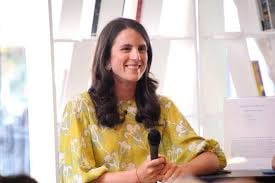
Tatiana Schlossberg, an environmental journalist and a daughter of Caroline Kennedy — and granddaughter of President John F. Kennedy — whose harrowing essay about her rare and aggressive blood cancer, published in The New Yorker magazine in November, drew worldwide sympathy and praise for Ms. Schlossberg’s courage and raw honesty, died on Tuesday. She was 35.
Her death was announced in an Instagram post by the John F. Kennedy Library Foundation in Boston, signed by her family. It did not say where she died.
Titled “A Battle With My Blood,” the essay appeared online on Nov. 22, the 62nd anniversary of her grandfather’s assassination. (It appeared in print in the Dec. 8 issue of the magazine with a different headline, “A Further Shore.”) In it, Ms. Schlossberg wrote of how she learned of her cancer after the birth of her daughter in May 2024. There was something off about her blood count, her doctor noticed, telling her, “It could just be something related to pregnancy and delivery, or it could be leukemia.”
It was leukemia, with a rare mutation. Ms. Schlossberg had a new baby, and a 2-year-old son.
“I did not — could not — believe that they were talking about me,” she wrote. “I had swum a mile in the pool the day before, nine months pregnant. I wasn’t sick. I didn’t feel sick. I was actually one of the healthiest people I knew. I regularly ran five to ten miles in Central Park. I once swam three miles across the Hudson River — eerily, to raise money for the Leukemia and Lymphoma Society.”
She added, “This could not possibly be my life.”
She wrote of months of chemotherapy and a postpartum hemorrhage, from which she almost bled to death, followed by more chemo and then a stem cell transplant — a Hail Mary pass that might cure her. Her older sister, Rose Schlossberg, was a match and would donate her cells. Her brother, Jack Schlossberg, now running for Congress in New York’s 12th district, was a half-match; nonetheless he pressed the doctors, asking if a half-match might be good enough. Could he donate, too? (He could not.)
After the transplant, when Ms. Schlossberg’s hair fell out, Jack shaved his head in solidarity. She wore scarves to cover her bare scalp; when her son came to visit her in the hospital, he did, too.
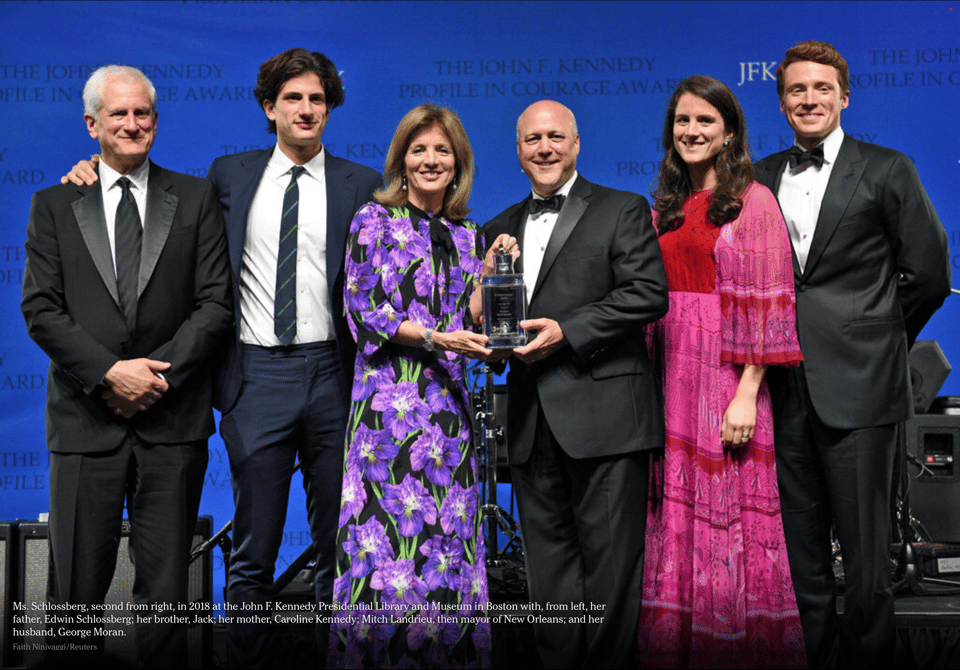
Ms. Schlossberg, second from right, in 2018 at the John F. Kennedy Presidential Library and Museum in Boston with, from left, her father, Edwin Schlossberg; her brother, Jack; her mother, Caroline Kennedy; Mitch Landrieu, then mayor of New Orleans; and her husband, George
She was never able to fully care for her daughter — to feed, diaper or bathe her — because of the risk of infection, and her treatments had kept her away from home for nearly half of her daughter’s first year of life.
“I don’t know who, really, she thinks I am,” Ms. Schlossberg wrote, “and whether she will feel or remember, when I am gone, that I am her mother.”
She went into remission, had more chemo, relapsed and joined a clinical trial. There were blood transfusions, another stem cell transplant, from an unrelated donor, more chemo, more setbacks. She went into remission again, relapsed, joined another clinical trial and contracted a form of the Epstein-Barr virus. The donated cells attacked her own, a condition called graft-versus-host disease. When she came home after a stint in the hospital in October, she was too weak to pick up her children.
Her oncologist told her that he thought he could, maybe, keep her alive for another year.
“For my whole life, I have tried to be good,” she wrote, “to be a good student and a good sister and a good daughter, and to protect my mother and never make her upset or angry. Now I have added a new tragedy to her life, to our family’s life, and there’s nothing I can do to stop it.”
Tragedy, of course, has trailed the Kennedy family for decades. Caroline Kennedy, a former ambassador to Australia and Japan, was just 5 when her father was assassinated on Nov. 22, 1963; she was 10 when her uncle Robert F. Kennedy, a presidential candidate in the Democratic primary of 1968, was murdered. Her brother, John F. Kennedy Jr., died in 1999, when the plane he was piloting crashed off Martha’s Vineyard, killing him, his wife, Carolyn Bessette Kennedy, and her sister, Lauren Bessette. He was 38 years old, and Tatiana had been a flower girl at his wedding three years earlier.
Having grown up in the glare of her parents’ glamour, and her family’s tragedies, Ms. Kennedy largely succeeded in giving her own children a life out of the spotlight — a relatively normal, if privileged, upbringing, along with a call to public service that was the Kennedy legacy.
Tatiana Celia Kennedy Schlossberg was born on May 5, 1990, in Manhattan, the middle child of Ms. Kennedy and Edwin Schlossberg, an interactive digital designer. She attended the Brearley School and then Trinity School, private schools in Manhattan. She studied history at Yale University, graduating in 2012, and earned a master’s degree in history from Oxford University in 2014.
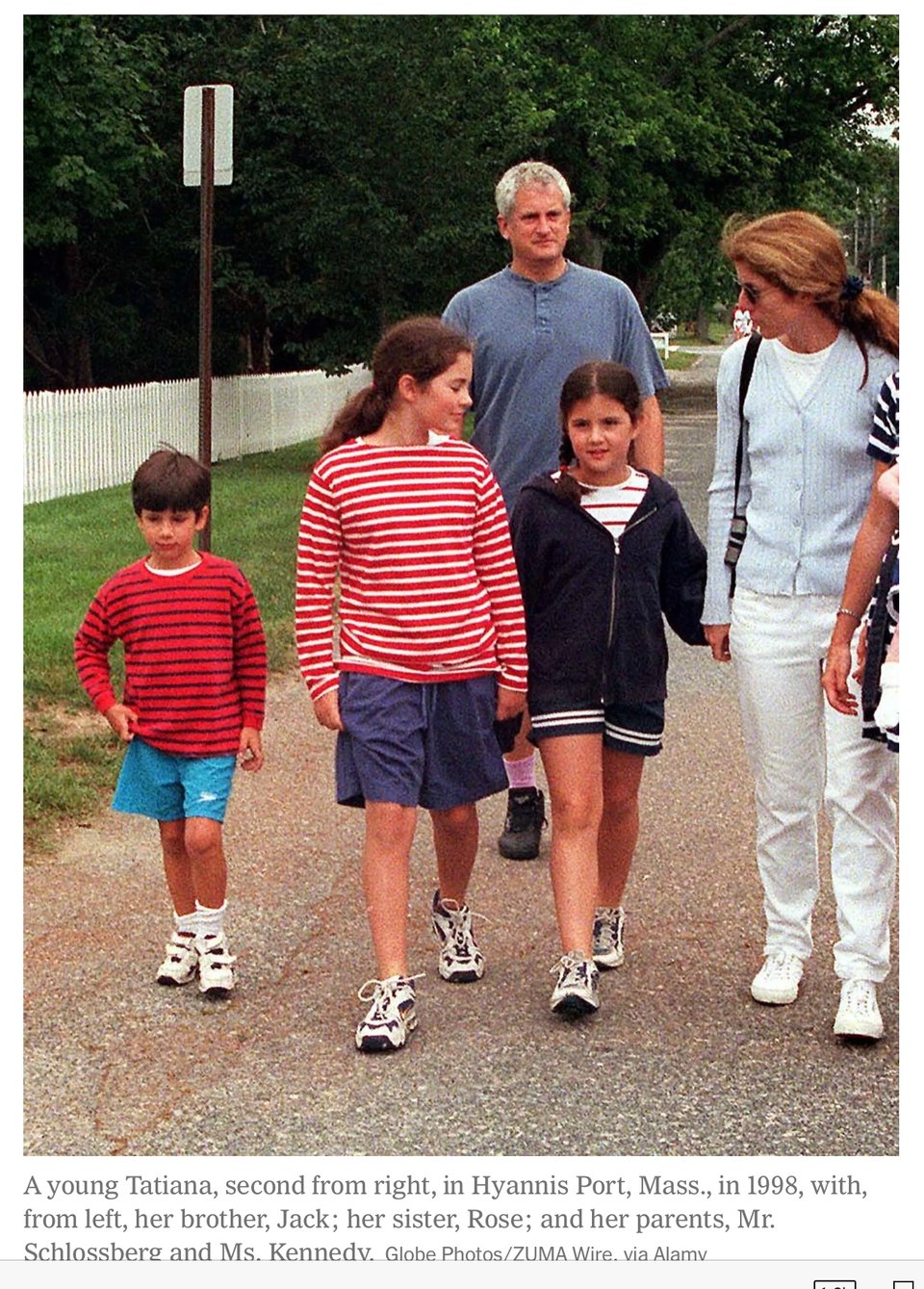
In between, Ms. Schlossberg, who had been the editor of The Yale Herald, was a reporter for The Record of northern New Jersey. In 2012, she was named Rookie of the Year by the New Jersey Society of Professional Journalists. She joined The New York Times in 2014, working first on the metropolitan desk and then as a science and climate reporter.
Over the years, in both New York and New Jersey, she covered a range of subjects, from doughnut wars (a squabble between shops over accusations of stolen recipes) to gun violence and Hurricane Sandy.
In a first-person essay in The Times in 2015, she described herself as a bit of a nerd. She had been covering a rash of overdoses at Wesleyan University that year when her editors sent her back to the Middletown, Conn., campus to investigate the drug scene there. She was 24, and they thought she might blend in.
“Even when I was in college, I had never really wanted to go to parties,” she wrote, “and now I was going to have to spend a Friday night trying to find out where parties were at a school where I didn’t go and didn’t know anyone? Nightmarish.”
She continued, “Also, no one had ever really offered me drugs in college, so I had no idea how I was supposed to find them. I told my younger and much cooler brother I had to go to Wesleyan to report on drugs. He answered: ‘Why are they sending you? You’re practically a narc.’”
On the metro desk, Ms. Schlossberg covered grisly murders as well as lighter fare, including a nun on a path to sainthood, the ice-breaking boats of New York Harbor, the decline of the bodega and the mysterious discovery of a dead black bear cub in Central Park in 2014. Ten years later, The New Yorker reported that the carcass had been left there by her cousin Robert F. Kennedy Jr. as a peculiar prank.
“Like law enforcement,” she told The Times then, “I had no idea who was responsible for this when I wrote the story.”
In her essay in The New Yorker, she called out her cousin for his actions as secretary of Health and Human Services, describing him as “an embarrassment to me and my immediate family.”
Under his tenure, she noted, funding for medical research was being cut at institutions like Columbia University, where her husband, George Moran, a urologist, is an assistant professor, and she feared that his job, and those of his colleagues, were at risk. She wrote of the horror she felt when Mr. Kennedy cut a half-billion dollars for research on mRNA vaccines, a technology that is also deployed against some cancers. After her postpartum hemorrhage, she was given misoprostol, a drug used for medical abortions; she pointed out that her cousin had directed the Food and Drug Administration to review the drug after decades of safe use.
She continued, “Also, no one had ever really offered me drugs in college, so I had no idea how I was supposed to find them. I told my younger and much cooler brother I had to go to Wesleyan to report on drugs. He answered: ‘Why are they sending you? You’re practically a narc.’”
On the metro desk, Ms. Schlossberg covered grisly murders as well as lighter fare, including a nun on a path to sainthood, the ice-breaking boats of New York Harbor, the decline of the bodega and the mysterious discovery of a dead black bear cub in Central Park in 2014. Ten years later, The New Yorker reported that the carcass had been left there by her cousin Robert F. Kennedy Jr. as a peculiar prank.
“Like law enforcement,” she told The Times then, “I had no idea who was responsible for this when I wrote the story.”
In her essay in The New Yorker, she called out her cousin for his actions as secretary of Health and Human Services, describing him as “an embarrassment to me and my immediate family.”
Under his tenure, she noted, funding for medical research was being cut at institutions like Columbia University, where her husband, George Moran, a urologist, is an assistant professor, and she feared that his job, and those of his colleagues, were at risk. She wrote of the horror she felt when Mr. Kennedy cut a half-billion dollars for research on mRNA vaccines, a technology that is also deployed against some cancers. After her postpartum hemorrhage, she was given misoprostol, a drug used for medical abortions; she pointed out that her cousin had directed the Food and Drug Administration to review the drug after decades of safe use.
“Suddenly,” she wrote, “the health-care system on which I relied felt strained, shaky.”

Ms. Schlossberg was the author of “Inconspicuous Consumption: The Environmental Impact You Don’t Know You Have” (2019), a kind of consumer’s guide to the ways in which human behavior adversely affects the climate. In 2020, the Society of Environmental Journalists honored the book with the Rachel Carson Environment Book Award. Ms. Schlossberg hoped her book would help people make changes in their behavior and buying habits, rather than being overwhelmed by climate anxiety and fatalism.
“We don’t have to keep living like this, in fear of the future and with guilt about the past, because change is possible,” she wrote.
Ms. Schlossberg is survived by her parents, her siblings and her husband, whom she met at Yale and married in 2017, along with their two young children.
Before her illness, she had been preparing to begin reporting for her second book, focused on climate change and the world’s oceans. She learned that one of her chemotherapy drugs, cytarabine, was derived from a type of sea sponge first synthesized by scientists at the University of California, Berkeley, in 1959. Those scientists, she wrote, “almost certainly relied on government funding” — the very thing, she added, that her cousin had cut.
“At its heart, climate change is a justice issue,” Ms. Schlossberg wrote in the preface to a 2022 edition of “Inconspicuous Consumption.” “It exacerbates inequality within and between countries. We need to save the polar bears, sure, but we also need to save the people. Actually, we can’t save the polar bears if we don’t save the people.” (New York Times)
This Is the Damage Kennedy Has Done in Less Than a Year.
In the days before Christmas, as measles, whooping cough and influenza continued to spread and surge across the country, the Department of Health and Human Services came perilously close to scrapping the nation’s longstanding list of recommended childhood vaccines.
As CNN reported, the agency’s plan was to go with a shorter list, along the lines of what Denmark recommends. As Politico reported soon after, that plan was jettisoned at the last minute over legal and political concerns.
Sources in and around the department have since suggested that something far worse may still be in the offing. “They could still move to align us with a country like Denmark,” said Dr. Demetre Daskalakis, a former director of the Centers for Disease Control and Prevention’s respiratory disease division. He resigned in August in protest of the agency’s politicization of vaccine policy. “But they could also just scrap the list altogether, so that there are no official recommendations, only vague suggestions.”
Either of those changes would be unconscionable. Among other things, the C.D.C. list, also known as the childhood vaccine schedule, helps determine which vaccines are covered by insurance, which are included in the Vaccines for Children Program that supplies crucial shots to the un- and underinsured, and which are protected from certain liabilities that might otherwise drive vaccine makers from the U.S. market. Altering those recommendations, or downgrading them to “shared clinical decision making,” would upend those protocols, and could make it nearly impossible for millions of families to receive certain lifesaving vaccines, even if they still want them.
However, neither move would be surprising.
In the 11 months since he was confirmed as health secretary, Robert F. Kennedy Jr. has wreaked steady havoc on the nation’s vaccination policies and programs. He canceled hundreds of millions of dollars in federal investment for mRNA vaccines, including ones that would have improved our ability to fight the next flu pandemic. He chased away doctors and scientists at the Food and Drug Administration and the C.D.C. who oversaw federal vaccine policy for decades.
Perhaps worst of all, he fired the entire 17-member Advisory Committee on Immunization Practices, known as ACIP. The group is responsible for advising the C.D.C. on which vaccines to recommend for whom. It now consists of a mix of ideologues and incompetents handpicked by Mr. Kennedy himself.
Already, this new Potemkin group has:
Rescinded recommendations for any flu shots containing thimerosal, a preservative that keeps multidose vaccine bottles free of bacteria and other contamination. It has been in use for nearly a century and has decades’ worth of data validating its safety.
Revoked a longstanding recommendation of the measles, mumps, rubella and chickenpox, or M.M.R.V., combination vaccine for children younger than 4. The policy change is not based on any valid medical or scientific concern.
Stopped recommending Covid-19 vaccines for healthy people younger than 65 unless they talk to a health care provider, a move that makes it harder for people who want or need those shots to get them.
Changed the recommendations for hepatitis B vaccination from saying that all newborns should have this shot to one that might as well be a shrug emoji: new mothers who test negative should decide for themselves whether to have their babies vaccinated at birth, but might consider waiting.
None of these changes are evidence-based. All of them run counter to what the C.D.C.’s own experts (and most of the nation’s leading medical groups) have advised. And all are likely to sow confusion, undermine public trust and ultimately drive the nation’s vaccination rates down. “We are already hearing about pregnant women who test positive for Hep B deciding not to get the shot,” said Dr. Paul Offit, director of the Vaccine Education Center at the Children’s Hospital of Philadelphia. “Because the message they’re getting from that recommendation is that the vaccine itself is dangerous.”
Proponents of the push to align U.S. recommendations with those of so-called peer nations such as Denmark, Japan and Germany — all of which recommend fewer shots than the United States — have billed it as a common-sense corrective. But, as innumerable doctors and scientists have explained, when it comes to public health, countries with fewer shots on their must-have list are not actually our peers.
In Denmark, to take the administration’s favorite example, prenatal care is free and universal. More than 95 percent of pregnant women are screened for hepatitis B, and those who test positive are promptly treated and duly monitored. In Japan and in most European nations, primary care systems have the capacity to find and vaccinate children who face a higher risk for vaccine-preventable diseases — and in many of those countries, paid sick leave also helps minimize the spread of contagions through schools and offices.
None of this is true in the United States.
Here, nearly a quarter of pregnant women lack adequate prenatal care, and those who face the highest risk of contracting and spreading vaccine-preventable diseases are often the least likely to have access to doctors or pharmacies. When U.S. health officials tried to stamp out hepatitis B through vaccination programs aimed at high-risk groups, they failed miserably. It was not until they carried out a universal, at-birth vaccination policy in 1991 that hepatitis B infections finally plummeted — by about 99 percent.
In fact, if the U.S. public health system has one thing going for it relative to other nations, it’s probably vaccines. As the C.D.C.’s own data indicates, routine childhood vaccination has prevented hundreds of millions of illnesses and tens of millions of hospitalizations here. It has also saved half a trillion dollars in medical costs, a figure that jumps into the multitrillions once you factor in indirect, societal costs like lost productivity and lost wages.
The United States tends to have higher rates of measles vaccination than Europe, and fewer measles cases as a result. Compared with Denmark, we also tend to have lower hospitalization rates for rotavirus (which causes diarrhea and can be fatal in infants and children) and respiratory syncytial virus, or R.S.V. (which is a leading cause of hospitalization among children). The reason for those disparities is not in dispute: We vaccinate routinely against both viruses. Denmark does not.
Mr. Kennedy and his supporters have said repeatedly that parents should be able to decide for themselves whether to vaccinate their children. But the Trump administration’s actions have put the nation on course for a future where even those who want vaccines may not be able to get them.
“Anytime you move away from a clear, universal recommendation, implementation becomes more difficult,” said Dr. Fiona Havers, a vaccine expert who resigned from the C.D.C. in protest in June. Does insurance still have to cover a shot that falls under shared clinical decision making? Maybe. Can you still get it at the pharmacy? Not necessarily.
For now, health insurers have promised to continue covering vaccines, regardless of what the C.D.C. does or says, presumably because they understand that vaccinating people is far cheaper than letting them get sick. But consumers would have no obvious recourse if those insurers eventually changed their minds — and, in any case, that promise applies only to families that have commercial health insurance to begin with. About half of all American children rely instead on the federally funded Vaccines for Children Program — and that program falls squarely within the jurisdiction of Mr. Kennedy, our anti-vaxxer in chief.
If the C.D.C. does change the childhood schedule to resemble Denmark’s, or scraps that schedule altogether, and if the health secretary decides to adjust the Vaccines for Children Program accordingly, about half of all American families could suddenly find themselves with no clear way to get essential vaccines — their best possible protection against a roster of devastating diseases, including rotavirus, R.S.V. and hepatitis B.
In the meantime, the Food and Drug Administration is angling to make an even bigger and more enduring impact on Americans’ access to vaccines. After claiming, without presenting a shred of proof, that Covid vaccines played a role in the death of 10 children, top officials at the agency have proposed a roster of new requirements for the shots, including several that critics say would be logistically impossible and could leave us with no F.D.A.-approved Covid or flu vaccines.
That loss of approval would be disastrous, Dr. Daskalakis, Dr. Havers and others say.
Changes to the federal Vaccine Injury Compensation Program could also seriously undermine vaccine access. The program, which compensates people who suffer rare side effects from certain vaccines, was established in 1988 after a tidal wave of lawsuits threatened to drive vaccine makers from the American market. If Mr. Kennedy decides to exempt any shot that falls under the fuzzy rubric of “shared clinical decision making” from this program — and if nobody stops him — vaccine makers may once again threaten to leave the U.S. market.
Mr. Kennedy could also drive those companies away by adding autism to the list of conditions for which they are potentially liable. (Decades of research has debunked the assertion that vaccines cause autism. But Mr. Kennedy and his supporters have proved astoundingly impervious to that evidence.) “They will stop selling vaccines here,” Dr. Havers said. “And regardless of what ACIP says, regardless of what F.D.A. says, regardless of what your doctor says, and regardless of what you actually want, if companies don’t sell them, people can’t get them.”
We don’t have to wonder what that future will look like. We can glimpse it already in communities across the country where measles and whooping cough are resurgent and where infants and young children have already died from both. We can also see it foretold in the current flu season: This year’s flu vaccine has proved an imperfect match to the currently circulating strains. New shots, based on mRNA technology, would have one day enabled us to avoid this kind of misfire. But the nation’s leaders have imperiled that future with the decisions they made this year.
It should not surprise anyone that 2025 — when the nation’s most prominent anti-vaxxer rose to the highest health office in the land — is ending with our vaccine policies in disarray and our access to vaccines increasingly imperiled.
Mr. Kennedy has brought us to this precipice by aggressively subverting nearly every process and protocol that previously governed our public health institutions. He has granted political appointees enormous sway over agency scientists. He has excluded people with meaningful expertise from his planning and deliberations. And he has fired dissenters all the way up to the C.D.C. director and replaced them with lackeys, sycophants and wellness grifters.
The relentless norm-shattering is not just a byproduct of Mr. Kennedy’s larger plans; it is a central feature. Bureaucratic changes to arcane and acronym-laden programs are easy to overlook or forget after a brief flash of indignation, especially in a world saturated with bleak, worrisome headlines. But it’s through that overlooking that we may eventually lose vaccines altogether.
Vaccines are a triumph of human ingenuity, modern medicine and public health. With them, we have beaten back smallpox, chickenpox, yellow fever, polio, measles, mumps, rubella, hepatitis B, Covid, meningitis and more. If Mr. Kennedy continues to force the nation down the course he’s now set, we will be left to explain to future generations how we came to abandon them. (Jeneen Interlandi, option writer, NY Times).
One more thing.
Trump weighed in on Kennedys, after Tatiana's death was announced.
From People magazine.

In the meantime, there will be no New Year’s Eve concert at the Kennedy Center, nor will there be entertainment for most nights in 2026.
🚨NEW: Legendary jazz saxophonist Billy Harper has cancelled his planned New Years Eve performance at the Kennedy Center: "I would never even consider performing in a venue bearing a name that represents overt racism"
— Protect Kamala Harris ✊ (@DisavowTrump20) December 30, 2025
RETWEET if you stand with Harper against Trump! pic.twitter.com/m9EgWFbHZZ
Another Big Blue Win.Iowa.
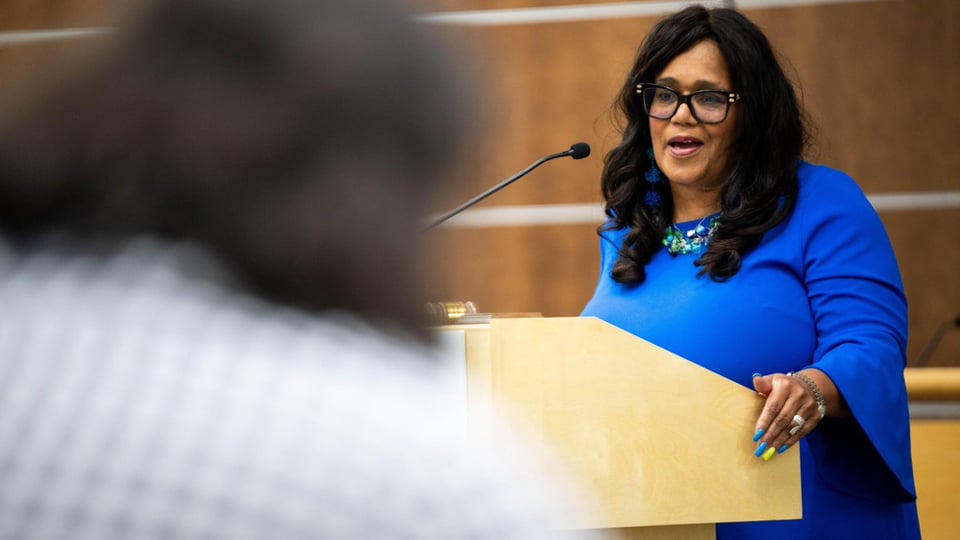
Breaking News: Renee Hardman, a Democrat, won a special election for the Iowa Senate, blocking Republicans from reclaiming a supermajority. https://t.co/jZUlURG7aQ
— The New York Times (@nytimes) December 31, 2025
Tomorrow New York City will have a new mayor.
Rep. Alexandria Ocasio-Cortez will deliver opening remarks and introduce Zohran Mamdani at his inauguration ceremony at City Hall on Jan. 1.
— Jacob N. Kornbluh (@jacobkornbluh) December 30, 2025
Senator Bernie Sanders will administer Mamdani’s oath of office. pic.twitter.com/dZB96p5PNx
I'm honored to swear in @ZohranKMamdani at the Old City Hall subway station at the turn of the new year.
— NY AG James (@NewYorkStateAG) December 29, 2025
Our subways connect us all, and they represent exactly what our next mayor is fighting for: a city every New Yorker can thrive in.https://t.co/8vIvchysMm
To a happy, healthy, Democratic New Year.
💥🎉🥳🙏
Happy New Year!! ❤️🌟#snoopy #snoopywoodspeanutt#peanuts pic.twitter.com/K65L7jIQIX
— snoopy (@realsnoopys) December 30, 2025
See you on January 5th.

