Wednesday, December 3, 2025. Annette’s Roundup for Democracy.
Trump in action. December 2025.
Bullies often get more and more outrageous - and shout louder and louder - as they increase their demands.
There he goes.
Trump Calls Somalis ‘Garbage’ He Doesn’t Want in the Country
President Trump unleashed a xenophobic tirade against Somali immigrants on Tuesday, calling them “garbage” he does not want in the United States in an outburst that captured the raw nativism that has animated his approach to immigration.
Even for Mr. Trump — who has a long history of insulting Black people, particularly those from African countries — his outburst was shocking in its unapologetic bigotry. And it comes as he started a new ICE operation targeting Somalis in the Minneapolis-St. Paul region.
“These are people that do nothing but complain,” Mr. Trump said at the tail end of a cabinet meeting at the White House, during which he sometimes appeared to be fighting sleep. But when the subject turned to immigration, Mr. Trump made a point of lashing out.
“When they come from hell and they complain and do nothing but bitch, we don’t want them in our country. Let them go back to where they came from and fix it,” Mr. Trump added as Vice President JD Vance banged the table in encouragement.
He said Somalia “stinks and we don’t want them in our country.” He described Representative Ilhan Omar, Democrat of Minnesota, who came to the United States from Somalia as a refugee and became a citizen 25 years ago, as “garbage.”
“We could go one way or the other, and we’re going to go the wrong way if we keep taking in garbage into our country,” Mr. Trump said. “She’s garbage. Her friends are garbage. These aren’t people who work. These aren’t people who say, ‘Let’s go, come on, let’s make this place great.’”
Mr. Trump has used this kind of rhetoric throughout his rise in politics, including in his first term as president, when he demanded to know why the United States would accept immigrants from Haiti and African nations, which he described as “shithole countries,” rather than, say, Norway.
But he has long been especially fixated on Somalis in the United States, and on Ms. Omar in particular.
“His obsession with me is creepy,” Ms. Omar wrote in a post shortly after the cabinet meeting. “I hope he gets the help he desperately needs.”
Mr. Trump has seized on immigration as a potent political weapon, demonizing immigrants and equating them with crime and disease. He often returns most furiously to the topic when he is on the defensive, as he is now, over issues like the economy and the Epstein files.
On Tuesday, when asked about Mr. Trump appearing to doze off in the cabinet meeting, his press secretary, Karoline Leavitt, pointed to his remarks about the Somalis, which she described as an “epic moment.”
Mr. Trump significantly stepped up his anti-migrant stance after the shooting of two National Guard members in Washington last week, by a gunman identified by the authorities as an Afghan national.
Since Mr. Trump took office for a second time, his administration has sealed the country to refugees around the world, including to Somalis, reserving a limited number of slots for mostly white South African Afrikaners.
The mayors of Minneapolis and St. Paul said on Monday that they found Mr. Trump’s remarks about Somali immigrants to be reckless and dangerous.
“The words that founded this country start with the words ‘We the People,’” said Mayor Melvin Carter of St. Paul. “The sacred moments in American history are the moments when we have to decide who the ‘we’ is. Who gets to be included in the ‘we.’ Do we mean Black people? Do we mean women? Do we mean immigrants?”
Mr. Trump began his cabinet meeting on Tuesday by complaining about the coverage of his schedule and questions about his physical stamina after he appeared to doze off in the Oval Office last month.
As cabinet officials took turns mixing a summary of their agency’s work with flattery for the president, Mr. Trump appeared restless, tired and at times uninterested. He occasionally leaned back in his chair and repeatedly narrowed and closed his eyes.
But then, when a reporter asked Mr. Trump about how Gov. Tim Walz of Minnesota handled a fraud scheme in his state, Mr. Trump used the opportunity to reset the conversation.
“Walz is a grossly incompetent man,” Mr. Trump said. “There’s something wrong with him. There’s something wrong with him. And when you look at what he’s done with Somalia, with Somalia, which is barely a country.”
Mr. Trump and his aides have in recent days focused on an investigation into fraud that had taken place in pockets of the Somali diaspora in Minnesota to make broad assertions about the community. Federal prosecutors charged dozens of people with felonies, accusing them of stealing hundreds of millions of dollars from a government program meant to keep children fed during the Covid-19 pandemic.
On Thursday, Mr. Trump said that Somalis were “taking over” Minnesota and that Somali gangs were “roving the streets looking for ‘prey.’”
Mr. Trump added that Ms. Omar was “always wrapped in her swaddling hijab” and that Mr. Walz was “seriously retarded” for welcoming immigrants from Somalia.
His top officials have also used dehumanizing language against immigrants. On Monday, Kristi Noem, the homeland security secretary, said she recommended that Mr. Trump enact “a full travel ban on every damn country that’s been flooding our nation with killers, leeches, and entitlement junkies.”
Robert Pape, a professor at University of Chicago who has studied political violence for 30 years, said such language from the Trump administration was dangerous.
“They’re not just like nasty metaphors — they’re especially dehumanizing metaphors,” Mr. Pape said. “‘Garbage.’ You’re not thinking of something that is human, you’re thinking of it as something that can be easily thrown away, so that is exactly the kind of metaphor we have just found for really decades is likely to increase support for violence.” (New York Times)

It gets clearer each day.
Pete Hegseth, Trump’s self-proclaimed Secretary of War, is a war criminal.
George Will, once the acknowledged articulate leader of Conservatives, makes the case.
A sickening moral slum of an administration.
Regarding Venezuela, Ukraine and much more, Trump and his acolytes are worse than simply incompetent. Opinion by George F. Will.
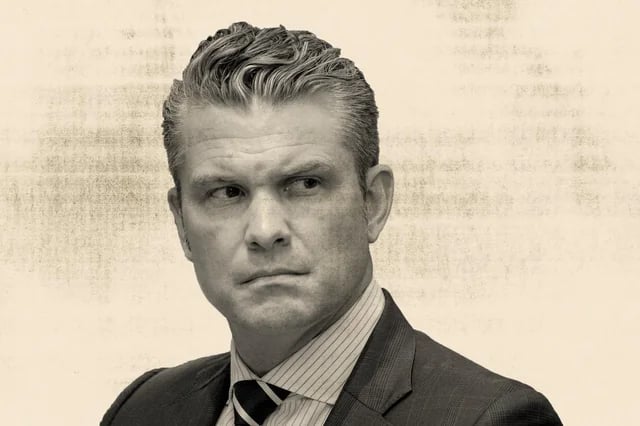
Defense Secretary Pete Hegseth seems to be a war criminal. Without a war. An interesting achievement.
In 1967, novelist Gwyn Griffin published a World War II novel, “An Operational Necessity,” that 58 years later is again pertinent. According to the laws of war, survivors of a sunken ship cannot be attacked. But a German submarine captain, after sinking a French ship, orders the machine-gunning of the ship’s crew, lest their survival endanger his men by revealing where his boat is operating.
In the book’s dramatic climax, a postwar tribunal examines the German commander’s moral calculus.
No operational necessity justified Hegseth’s de facto order to kill two survivors clinging to the wreckage of one of the supposed drug boats obliterated by U.S. forces near Venezuela. His order was reported by The Post from two sources (“The order was to kill everybody,” one said) and has not been explicitly denied by Hegseth. President Donald Trump says Hegseth told him that he (Hegseth) “said he did not say that.” If Trump is telling the truth about Hegseth, and Hegseth is telling the truth to Trump, it is strange that (per the Post report) the commander of the boat-destroying operation said he ordered the attack on the survivors to comply with Hegseth’s order.
Forty-four days after the survivors were killed, the four-star admiral who headed the U.S. Southern Command announced he would be leaving that position just a year into what is usually a three-year stint. He did not say why. Inferences are, however, permitted.
No operational necessity justified Hegseth’s de facto order to kill two survivors clinging to the wreckage of one of the supposed drug boats obliterated by U.S. forces near Venezuela. His order was reported by The Post from two sources (“The order was to kill everybody,” one said) and has not been explicitly denied by Hegseth. President Donald Trump says Hegseth told him that he (Hegseth) “said he did not say that.” If Trump is telling the truth about Hegseth, and Hegseth is telling the truth to Trump, it is strange that (per the Post report) the commander of the boat-destroying operation said he ordered the attack on the survivors to comply with Hegseth’s order.
Forty-four days after the survivors were killed, the four-star admiral who headed the U.S. Southern Command announced he would be leaving that position just a year into what is usually a three-year stint. He did not say why. Inferences are, however, permitted.
The killing of the survivors by this moral slum of an administration should nauseate Americans. A nation incapable of shame is dangerous, not least to itself. As the recent “peace plan” for Ukraine demonstrated.
Marco Rubio, who is secretary of state and Trump’s national security adviser, seemed to be neither when the president released his 28-point plan for Ukraine’s dismemberment. The plan was cobbled together by Trump administration and Russian officials, with no Ukrainians participating. It reads like a wish-list letter from Vladimir Putin to Santa Claus: Ukraine to cede land that Russia has failed to capture in almost four years of aggression; Russia to have a veto over NATO’s composition, peacekeeping forces in Ukraine and the size of Ukraine’s armed forces. And more.
Rubio, whose well-known versatility of convictions is perhaps not infinite, told some of his alarmed former Senate colleagues that the plan was just an opening gambit from Russia — although Trump demanded that Ukraine accept it within days. South Dakota Republican Sen. Mike Rounds, a precise and measured speaker, reported that, in a conference call with a bipartisan group of senators, Rubio said the plan was a Russian proposal: “He made it very clear to us that we are the recipients of a proposal that was delivered to one of our representatives. It is not our recommendation. It is not our peace plan.” Hours later, however, Rubio reversed himself, saying on social media that the United States “authored” the plan.
The administration’s floundering might reflect more than its characteristic incompetence. In a darkening world, systemic weaknesses of prosperous democracies are becoming clearer.
Harvard sociologist Daniel Bell’s 1976 book, “The Cultural Contradictions of Capitalism,” argued that capitalism’s success undermines capitalism’s moral and behavioral prerequisites. Affluence produces a culture of present-mindedness and laxity; this undermines thrift, industriousness, discipline and the deferral of gratification.
Today’s cultural contradictions of democracy are: Majorities vote themselves government benefits funded by deficits, which conscript the wealth of future generations who will inherit the national debt. Entitlements crowd out provisions for national security. And an anesthetizing dependency on government produces an inward-turning obliviousness to external dangers, and a flinching from hard truths.
Two weeks ago, the chief of staff of the French army said: “We have the know-how, and we have the economic and demographic strength to dissuade the regime in Moscow. What we are lacking … is the spirit which accepts that we will have to suffer if we are to protect what we are. If our country wavers because it is not ready to lose its children … or to suffer economically because the priority has to be military production, then we are indeed at risk.”
Putin has surely savored the French recoil from these words. And he has noticed that, concerning Ukraine and the attacks on boats near Venezuela, the Trump administration cannot keep its stories straight. This probably is for reasons Sir Walter Scott understood: “Oh, what a tangled web we weave,/ when first we practise to deceive!” Americans are the deceived. (Washington Post)
Newsmax Legal Analyst Andrew Napolitano Destroys Pete Hegseth in Stunning Commentary: ‘Should Be Prosecuted for a War Crime!’
Maybe it would be better if Trump slept even more.
Touch to watch.👇
That clip had an audio problem. Here is the fixed version. pic.twitter.com/qWrrEMvx7z
— NIK VENTURE (@NIK_VENTURE) December 2, 2025
Sleepy Don the con is too damn old to be president. pic.twitter.com/qrImSvyJ1p
— Pam Hurd (@1_love22) December 3, 2025
I, GAVIN C. NEWSOM, JUST HAD AN AMAZING 3-DAY MEETING WITH NO NAPS. (DIDN'T EVEN BLINK!) I ONLY NEED FIVE HOURS OF SLEEP. PER YEAR. I WAS WOKE BEFORE THERE WAS WOKE! UNLIKE THE KING OF SNOOZOPIA. NOBODY KNOWS IF HE'S NAPPING OR IN A COMA. WHO KNEW THAT PIGGIES HIBERNATE. NOT I. pic.twitter.com/xtAWPavuV5
— Governor Newsom Press Office (parody) (@AwesomeNewsom) December 2, 2025
I guess most of us would fall asleep during the day if we spent our night writing 150 delusional social media posts the previous night.
These are just some of the over 150 posts Trump put out on Truth Social last night in the span of an hour. Completely insane conspiracy theories. He was clearly having a mental decline episode and was posting whatever came to mind. It’s going to get worse. pic.twitter.com/3t8AQNnHLG
— Harry Sisson (@harryjsisson) December 2, 2025
BREAKING: No one in government should obey this order by Donald Trump. It’s illegal. pic.twitter.com/9obUMw3Kqe
— Ed Krassenstein (@EdKrassen) December 2, 2025
Touch to watch.👇
Trump: But right now, I think I'm sharper than I was 25 years ago. I took my physical. I got all A's, everything. But they said to me, would you like to take a cognitive test? I said, is it hard? They said, yes. I said, well, I'm a very smart person. pic.twitter.com/tv11xvziQB
— Acyn (@Acyn) December 2, 2025
Tennessee. We won while losing.
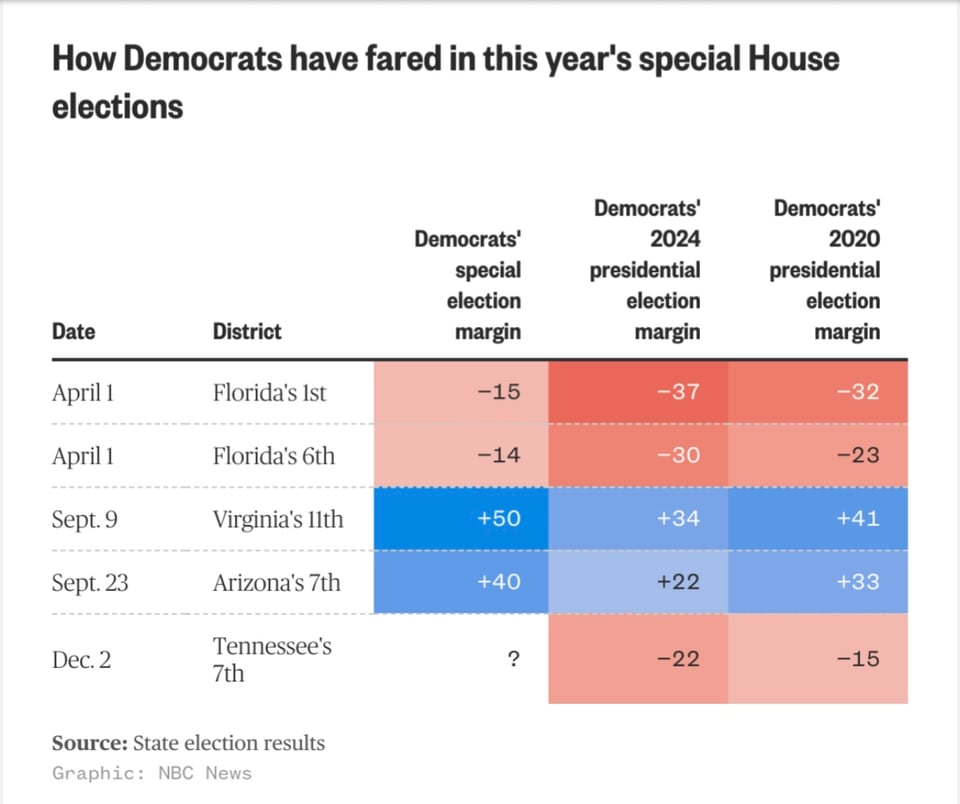
We would have preferred to win that House Seat but this was a district that the Evil Orange Guy won by 22% in 2024.
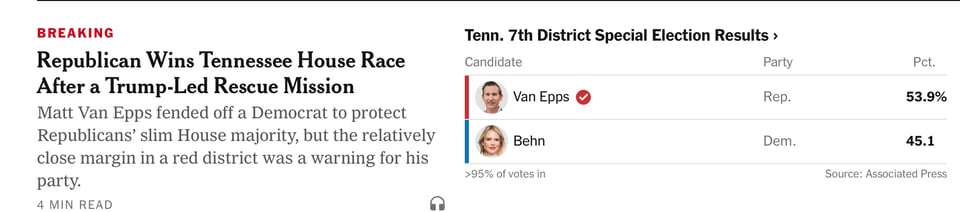
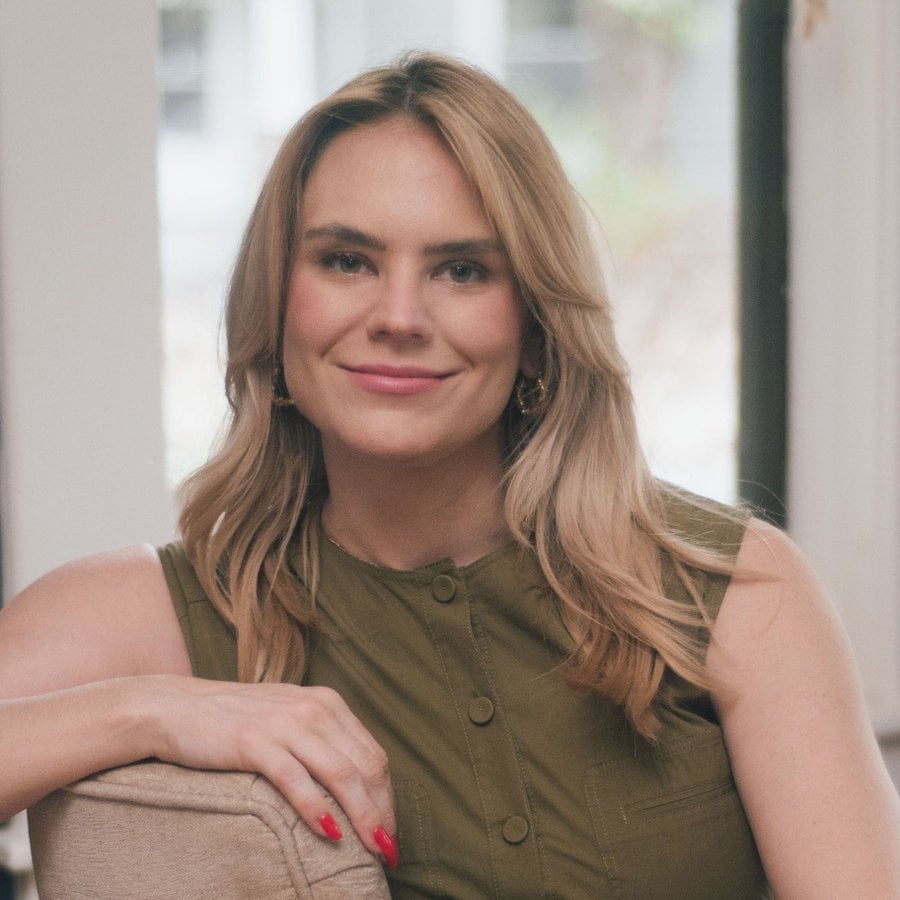
Democrat Aftyn Behn cut the Republican margin of victory down to 9 points from Trump’s 22 in Red State Tennessee.
What’s next.
Artificial Intelligence.
Former Google CEO Eric Schmidt Warns AI Could Think For Itself In Four Years at Harvard Talk.
Former Google CEO Eric E. Schmidt predicted that artificial intelligence will be able to learn from itself within four years at a forum hosted by the Harvard Kennedy School on Monday, where he issued a stark warning about the need for limits on autonomous learning.
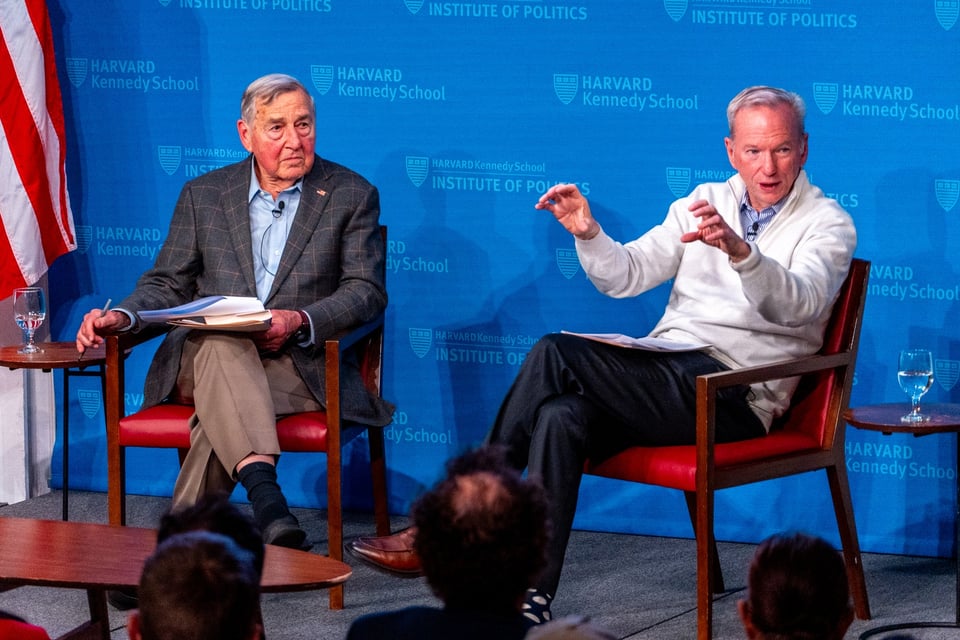
Former Harvard Kennedy School Dean Graham T. Allison '62 and former Google CEO Eric E. Schmidt discussed artificial intelligence at a forum on Monday evening
Schmidt, who led Google from 2001 until 2011, argued in April that the technology will fundamentally change every aspect of human life within a matter of years, labeling his theory the “San Francisco Consensus.” On Monday, he set the timeline at four years.
“Recursive self improvement is when it’s learning on its own. This is not true today. Today, when you set up one of these huge data centers, you know what they look like, you have to tell it to learn. But the belief is that this is coming,” Schmidt said.
“The ability for computers to provide programs to generate medical conjectures and to discover new facts looks like it’s very close,” he added. “Many people believe that there will be AI mathematicians in the next year.”
Despite his optimism, Schmidt warned that as AI develops closer to autonomous learning, there will have to be new conversations about placing limits on the technology.
“Somebody’s going to have to raise their hand and say, ‘We just went too far. There’s too much danger here,’” he said. “We don’t want to give that agency to the computer. We want humans to be in charge of it. It is not agreed to where that point is.”
“I think there’s no higher duty than to preserve human agency and human freedom,” Schmidt said. “That’s going to be a central challenge for all of you.”
Schmidt has been extensively involved in AI endeavors since leaving Google. He currently serves on the board of Sandbox AQ, the Broad Institute, and the Mayo Clinic.
Both Schmidt and the forum’s moderator, HKS professor and former dean Graham T. Allison ’62, published work on AI with former Secretary of State Henry A. Kissinger ’50.
We are today grappling with the question that he foresaw 20 years ago when we started working on this,” Schmidt said. “What does it mean to be human in the age of AI?”
At the Monday forum, he also voiced concern about the rate of U.S. open-source development in comparison to China, the country’s main rival in the AI sector. He warned that Chinese companies that have embraced open-source AI will be more quickly adapted internationally over closed-source AI models from the U.S., where code is not publicly accessible.
According to an MIT study published earlier this year, Chinese companies and independent open-source developers make up an increasing share of the global open-source AI market, while the market share of U.S. models has declined over time.
Schmidt said that the U.S. government and nonprofit organizations should increase funding for open source AI development with “American values and human values” to compete against Chinese models.
“I don’t see the open-source leadership in America, and I see nothing but open-source leadership in China,” he said. “I think those are the facts.”
He added that China has been better at implementing AI in the production of everyday products, but has focused less on advancing AI to the point of “super intelligence.”
“It appears that the two are pursuing different paths,” Schmidt said.
But he said on the more immediate horizon, AI is naturally on the path toward thinking on its own.
“The scaling law basically says that if you put more data and more electricity and more chips, you get this emergent behavior, one after the other,” Schmidt said.
This eventually leads to reasoning, he argued, granting AI “language, agency, and reasoning.”
“So it’s happening,” Schmidt said. “It’s happening very quickly.” (Harvard Crimson)
More on Self-Driving cars.
The Data on Self-Driving Cars Is Clear. We Have to Change Course.
By Jonathan Slotkin
Dr. Slotkin is a neurosurgeon.

I recently got called to see a teenager ejected in a rollover car crash. The trauma team rushed him into surgery to stop major abdominal bleeding, but we all knew. When that much energy enters a skull, no operation can turn it back. He was declared brain dead. His death was a reminder of the staggering amount of suffering and loss of human life we accept from car accidents every single day.
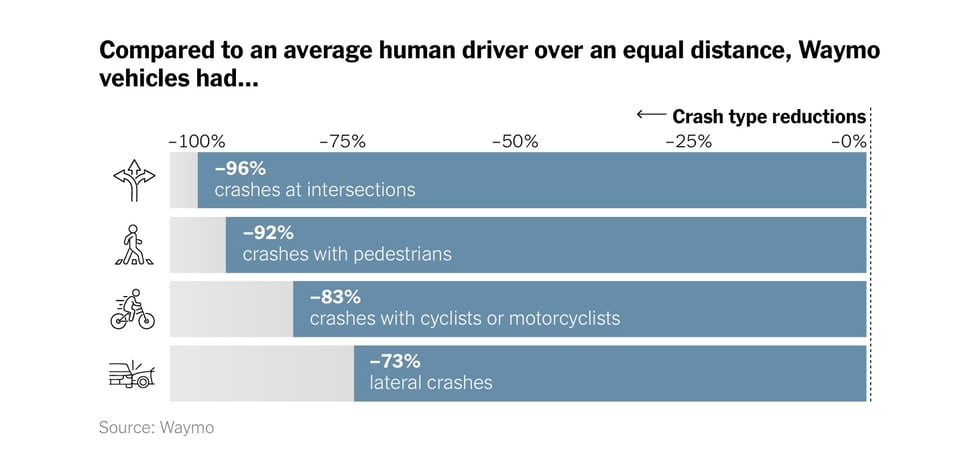
Self-driving car company Waymo recently released data covering nearly 100 million driverless miles in four American cities through June 2025, the biggest trove of information released so far about safety. I spent weeks analyzing the data. The results were impressive. When compared to human drivers on the same roads, Waymo’s self-driving cars were involved in 91 percent fewer serious-injury-or-worse crashes and 80 percent fewer crashes causing any injury. It showed a 96 percent lower rate of injury-causing crashes at intersections, which are some of the deadliest I encounter in the trauma bay.
So far, other autonomous vehicle companies don’t report or report incomplete data. Waymo, by contrast, published everything I needed to analyze the data: crash statistics with miles driven that allow accurate comparison to human drivers in the same locations.
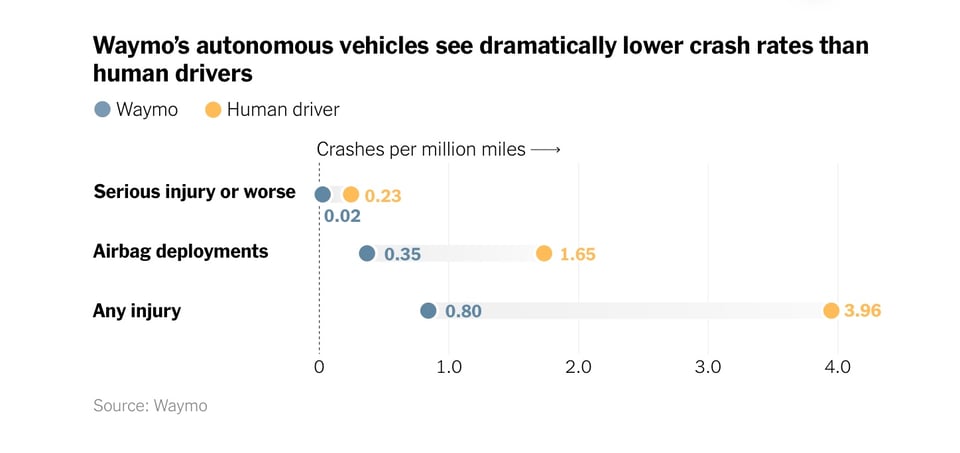
If Waymo’s results are indicative of the broader future of autonomous vehicles, we may be on the path to eliminating traffic deaths as a leading cause of mortality in the United States. While many see this as a tech story, I view it as a public health breakthrough.
The reasons autonomous vehicles are safer are straightforward. A system that follows rules, avoids distraction, sees in all directions and prevents high-speed conflicts will avert deadly collisions much more often.
These vehicles aren’t perfect. A passenger heading to the airport was recently stuck inside a Waymo that looped a parking lot roundabout for five minutes. Waymo issued a recall last year to update the software on its vehicles after one hit a utility pole at low speed while pulling over.
And there have been two fatalities and one serious injury in crashes involving a Waymo vehicle. In all three cases, however, human-driven vehicles caused the collision: a high-speed crash that pushed another car into a stopped Waymo, a red-light runner hitting a Waymo and other vehicles before striking and injuring a pedestrian, and a Waymo rear-ended by a motorcyclist, who was then fatally struck by a hit-and-run driver.
This last instance may give some skeptical readers pause. There’s a common misconception that these cars brake erratically and get rear-ended. But they are involved in far fewer rear-end injury crashes than human drivers are. And Waymo has never rear-ended another vehicle at injury level. Autonomous vehicle companies have to report every contact resulting in injury or property damage over $1,000, while studies show that humans don’t report the majority of accidents, even many with injuries.
In medical research, there’s a practice of ending a study early when the results are too striking to ignore. We stop when there is unexpected harm. We also stop for overwhelming benefit, when a treatment is working so well that it would be unethical to continue giving anyone a placebo. When an intervention works this clearly, you change what you do.
There’s a public health imperative to quickly expand the adoption of autonomous vehicles. More than 39,000 Americans died in motor vehicle crashes last year, more than homicide, plane crashes and natural disasters combined. Crashes are the No. 2 cause of death for children and young adults. But death is only part of the story. These crashes are also the leading cause of spinal cord injury. We surgeons see the aftermath of the 10,000 crash victims that come to emergency rooms every day. The combined economic and quality-of-life toll exceeds $1 trillion annually, more than the entire U.S. military or Medicare budget.
This is not a call to replace every vehicle tomorrow. For one thing, self-driving technology is still expensive. Each car’s equipment costs $100,000 beyond the base price, and Waymo doesn’t yet sell cars for personal use. Even once that changes, many Americans love driving; some will resist any change that seems to alter that freedom.
Not all autonomous vehicles are created equal. Many of the devastating crashes that capture headlines involve “driver assistance” systems — the kind found in millions of Teslas and other modern cars — where humans need to remain vigilant behind the wheel. Tesla recently released results suggesting that what it calls “full self-driving (supervised)” decreases the frequency of crashes, but we will still need more independent analysis of that data before we can draw firm conclusions. And research on other partial automation vehicles have yielded mixed results. A study from the Insurance Institute for Highway Safety found “no convincing evidence” that partial automation reduces crash rates.
Waymo operates cars with no human driver. Their vehicles use cameras, radar and specialized sensors, known as LiDAR, that create detailed 3-D maps. They operate only in cities where they’ve studied every intersection.
We don’t yet know if other autonomous vehicles will have a similar safety record. Tesla recently launched a driverless pilot program (with a person supervising from the front passenger seat) in Austin, Texas, but has not released performance data yet. Other companies operate fully self-driving ride-hail services, but so far without comparable data transparency.
There is likely to be some initial public trepidation. We do not need everyone to use self-driving cars to realize profound safety gains, however. If 30 percent of cars were fully automated, it might prevent 40 percent of crashes, as autonomous vehicles both avoid causing crashes and respond better when human drivers err. Insurance markets will accelerate this transition, as premiums start to favor autonomous vehicles.
Researchers predict that the shift to autonomous vehicles will take more than a decade. We should use that time to plan wisely. Autonomous vehicles improve safety remarkably when they replace humans driving personal vehicles, but if they end up primarily pulling riders from trains and buses, which are already exceedingly safe, there will be far less of a benefit. It makes sense to deploy these vehicles through commercial robotaxis, which is the current approach, but we need deliberate work force planning to address the way that this will threaten the livelihoods of America’s millions of commercial drivers.
Rather than grapple with these challenges, many cities are erecting roadblocks. In Washington, D.C., local politicians have long postponed a key report that would facilitate the broader use of these vehicles despite 18 months of successful vehicle testing. In Boston, the City Council is considering mandating a “human safety operator” in every vehicle, effectively stalling meaningful deployment. Policymakers need to stop fighting this transformation and start planning for it.
Federal leadership is essential. Current regulations require companies to report crashes, but not miles driven or where those miles occurred. We need the denominator, not just the numerator. Data reporting requirements should include crash rates, miles driven and where, and safety performance. Independent auditors should verify this data against police reports, insurance claims and privacy-protected medical records.
This transformation will happen. We can guide it toward a safer, more equitable future or let it unfold haphazardly around us. There’s a future where manual driving becomes uncommon, perhaps even quaint, like riding horses is today. It’s a future where we no longer accept thousands of deaths and tens of thousands of broken spines as the price of mobility. It’s time to stop treating this like a tech moonshot and start treating it like a public health intervention. (New York Times, Op-Ed)
What’s the same.

Overview
Rockefeller Christmas tree lighting 2025.
The 2025 Rockefeller Center Christmas Tree will be lit on Wednesday, December 3, 2025, at 10 p.m.
The ceremony will be broadcast on NBC and simulcast on Peacock. The broadcast will stream live on NBC television and Peacock nationally starting at 8 p.m., and a Spanish-language broadcast will be available at 9 p.m. on Telemundo.
Coverage of the Rockefeller Center Tree Lighting on television will begin at 7 p.m. on NBC New York and continue until 10 p.m. The Rockefeller Center Christmas Tree Lighting pre-show coverage will start at 6:30 p.m. on the NBC New York streaming channel in the NBC NY app, on Peacock or wherever you stream.
After the lighting, the tree will be illuminated daily from 5 a.m. to midnight.
Key details
Date: Wednesday, December 3, 2025
Time: 10 p.m.
Location: 30 Rockefeller Plaza, between West 49th and 50th Streets
The performers for the tree lighting include: Marc Anthony, Michael Bublé, Kristin Chenoweth, and Laufey. The Radio City Rockettes will also perform.
Here's a list of the performers for the tree lighting:
Marc Anthony
Halle Bailey
Michael Bublé
Kristin Chenoweth
Laufey
New Edition
Brad Paisley
Carly Pearce
Gwen Stefani
The Radio City Rockettes
How to watch:
Attend in person (check nyc.gov for details)
Tune in to the live televised special on NBC
Watch the live simulcast on Peacock
Daily lighting schedule: 5 a.m. to midnight
Special lighting hours: 24 hours on Christmas Eve and off at 9 p.m. on New Year's Eve.

