Tuesday, March 17, 2026. ☘️ Annette’s Roundup for Democracy.
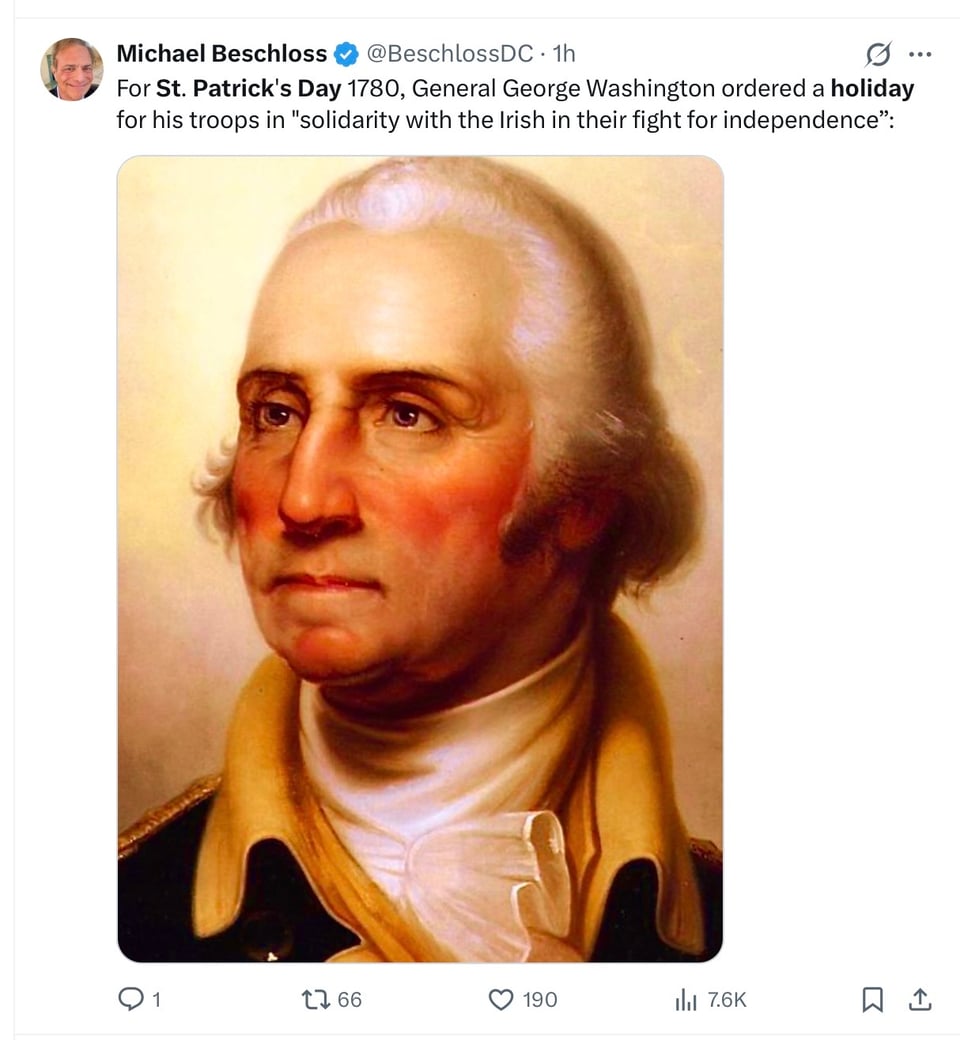
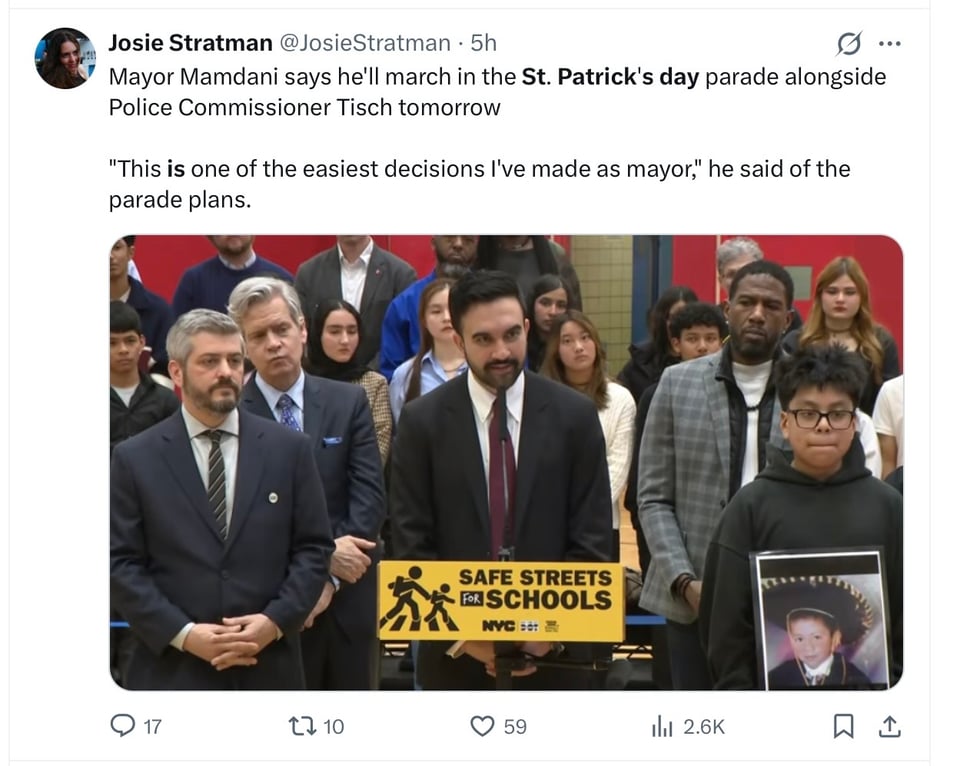
Happy St. Patrick’s Day.☘️☘️☘️
A holiday of one of America’s immigrant groups that the whole country celebrates.

Two weeks into war with Iran, Trump has been knocked back on his political heels.
ABOARD AIR FORCE ONE (AP) — In the two weeks since the U.S. and Israel launched strikes on Iran, President Donald Trump increasingly has been knocked on his political heels.
He’s grown more agitated with news coverage and has failed to find a way to explain why he started the war — or how he will end it — that resonates with a public concerned by American deaths in the conflict, surging oil prices and dropping financial markets. Even some of his supporters are questioning his plan and his overall poll numbers are declining.
Meanwhile, Moscow is getting a boost from the war’s early days after Trump eased sanctions on some Russian oil shipments. That, combined with rising oil prices, undercut the yearslong push to crimp President Vladimir Putin’s ability to wage war in Ukraine.
Then there are Democrats, who were left reeling after Trump won the 2024 election. With control of Congress at stake in November’s midterms, the party has come together to oppose Trump’s Iran policy and point to the economic turmoil as proof that Republicans haven’t kept their promises to bring down everyday costs.
“I think Democrats are well-positioned for this November and the midterms,” said Kelly Dietrich, CEO of the National Democratic Training Committee, which trains party backers to run for office and staff campaigns.
Dietrich said the past two weeks show the Trump administration has failed at long-term planning. “They’re flying by the seat of their pants, and the rest of us are paying the price,” he said.
Trump let some of his frustrations show on Air Force One as he flew back from a weekend at his Mar-a-Lago estate in Florida, lashing out at allies and other countries dependent on Middle Eastern oil for not doing more to counter Iran and specifically name-checking British Prime Minister Keir Starmer, who he said initially declined to put British aircraft carriers “into harm’s way.”
“Whether we get support or not,” Trump said, “I can say this, and I said to them: We will remember.”
Trump seeks help securing the Strait of Hormuz
The president spent much of his weekend at his golf club in West Palm Beach, Florida. He also attended a closed-door fundraiser for his MAGA Inc. super PAC at Mar-a-Lago on Saturday night.
Last weekend, Trump played golf at another of his South Florida properties a day after witnessing the dignified transfer for six U.S. soldiers killed in the Iran war. A political action committee used a photo of the solemn event in a fundraising email, but Trump brushed off a question about whether it was appropriate, saying “there’s nobody that’s better to the military than me.”
Trump and his White House have increasingly complained about media coverage of the conflict. On Saturday, he cheered on his broadcast regulator for threatening to pull broadcast licenses unless they “correct course.”
He angrily told reporters flying with him on Air Force One that coverage of the war had been influenced by Iranian propaganda, which exaggerated the military and political strength of Iran’s leaders and their support among the country’s people.
The president — who kept allies other than Israel in the dark about his war plans for Iran — this weekend began suggesting the U.S. would need to lean on the international community to help oil tankers move through the Strait of Hormuz, where transportation has been severely disrupted, throwing global energy markets into a tailspin.
Iran has said it plans to keep up attacks on energy infrastructure and use its effective closure of the strait as leverage against the United States and Israel. A fifth of the world’s traded oil flows through the waterway.
Trump said the U.S. was talking to “about seven” countries about providing military support to help reopen the strait. But he wouldn’t say which ones and gave no indication of when such a coalition might be formed.
“It’s something that we don’t need and these countries do need,” the president said, adding “I think it’s a good thing for other countries to come in.”
Singling out allies in Europe, Trump also said, “We’re always there for NATO” and “It’d be interesting to see what country wouldn’t help us with a very small endeavor.”
“Really I’m demanding that these countries come in and protect their own territory,” Trump said.
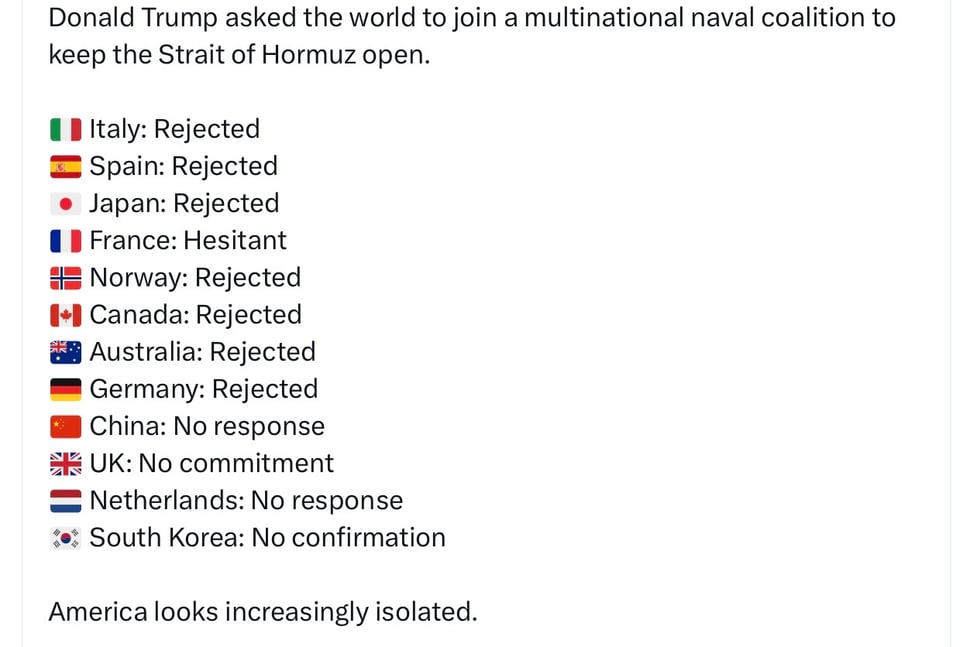
But other countries have reacted to that call only cautiously so far.
South Korea plans to “closely coordinate and carefully review” Trump’s comments, while Japan is closely watching developments. Britain’s defense ministry said it was “discussing with our allies and partners a range of options to ensure the security of shipping in the region.”
A spokesperson for the Chinese Embassy in Washington said keeping the strait “safe and stable serves the common interests of the international community” and that’s “as a sincere friend and strategic partner of Middle Eastern countries, China will continue to strengthen communication with relevant parties.” Trump — who is slated to visit Beijing later this month — declined to say whether China would join the effort.
Trump had pledged at the beginning of the war that U.S. naval ships would escort tankers through the waterway. But that hasn’t happened yet.
In the meantime, questions about the strait continue to undermine Trump’s recent pronouncement during a Kentucky rally that, “We’ve won.”
“You know, you never like to say too early you won. We won,” he said. “We won the, in the first hour, it was over.”
The war has far-reaching political implications
The U.S. Treasury Department announced this past week a 30-day waiver on Russian sanctions, aiming to free up Russian oil cargoes stranded at sea to help ease supply shortages caused by the Iran war.
That’s despite analysts saying that spiraling oil prices due to Persian Gulf production blockages are benefiting the Russian economy. Moscow relies heavily on oil revenue to finance its war on Ukraine, and sanctions were a growing handicap.
Some of Washington’s key allies have decried the move as empowering Putin. Ukrainian President Volodymyr Zelenskyy called easing sanctions “not the right decision” and said it “certainly does not help peace” because it leads to a “strengthening of Russia’s position.”
With midterm races now starting to heat up, Trump was asked about the potential political impact of voters seeing gas prices jump.
“Politically, sure, everybody has concern — I have to do what’s right,” Trump said Sunday night. “I can’t say that ‘Gee, I don’t want to have any impact on oil prices for three or four weeks, or two months, and we’re going to let Iran have a nuclear weapon.’”
Energy Secretary Chris Wright said of higher energy prices on NBC’s “Meet the Press” that “Americans are feeling it right now” and would “for a few more weeks.”
Iran also has even divided Trump’s “Make America Great Again” base, between those who support the action and others who say that Trump expressly campaigned on ending wars.
The political turbulence has some Democrats predicting their party could see midterm gains rivaling 2018’s “blue wave” election during Trump’s first term.
“Democrats just have to keep reminding people that he made a promise to bring prices down, and they’re still going up,” Democratic strategist Brad Bannon said of Trump. “And now they’re going to go up even more because prices in gasoline can increase prices of everything else, including at the grocery store.” (Associated Press)
No country but Israel supports Trump in the Mideast.
One more thing.
Trump is hardly more popular at home than abroad.
Looking at the polling numbers which predict an ever growing defeat for MAGA in the Midterms, the predictable fascistic Senator from begs to win the SAVE Act.
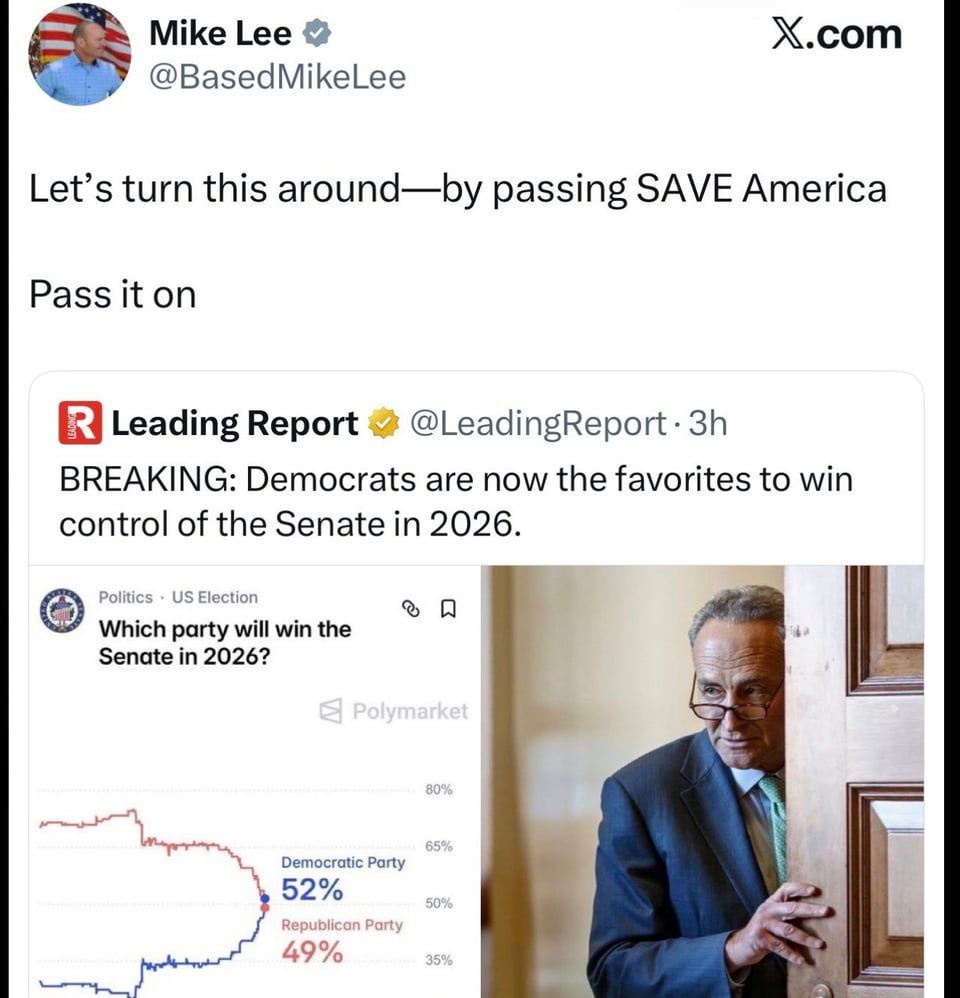
Keep calling your Senators to stop SAVE! A U.S. Capitol Switchboard operator can connect you directly with the specific Senate office. (202) 224-3121.
Feet stamping continues.
Fascists don’t like to be thwarted.
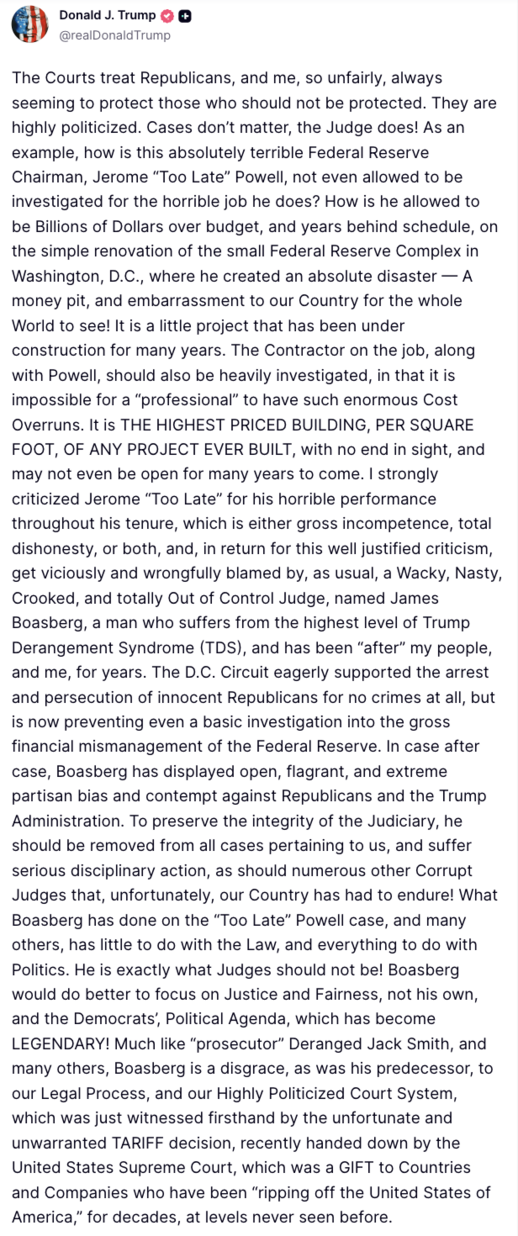
Trump Lashes Out at Supreme Court and District Judge Boasberg
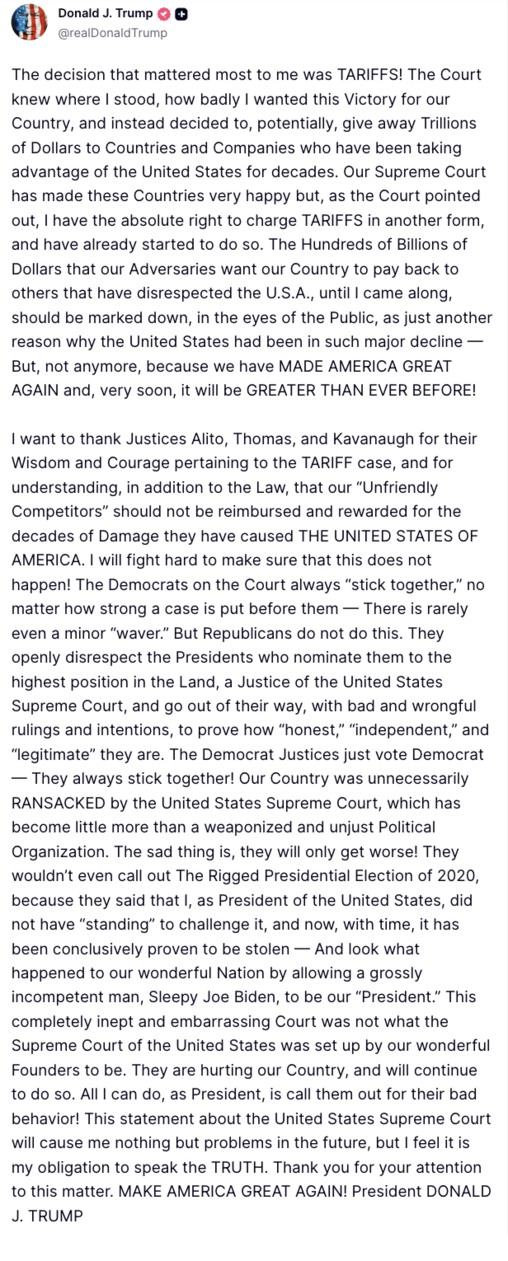
President Donald Trump lashed out at “the courts,” which he said treat him “so unfairly,” in a two-part social media missive Sunday night full of falsehoods and pointed criticisms. He noted that his posts “will cause me nothing but problems in the future, but I feel it is my obligation to speak the TRUTH.”
“Trump just posted a lot of words about the Supreme Court and other courts — many of which were not true,” Politico senior legal affairs reporter Kyle Cheney posted on X, after the President’s Truth Social posts. “The rest is one of the most incendiary attacks on the court in memory.”
The first post started with Trump blasting the Supreme Court for ruling last month that most of the sweeping tariffs the Administration imposed on imports since the start of Trump’s second presidential term were illegal.
“The decision that mattered most to me was TARIFFS!” Trump wrote. “The Court knew where I stood, how badly I wanted this Victory for our Country, and instead decided to, potentially, give away Trillions of Dollars to Countries and Companies who have been taking advantage of the United States for decades.” But the President falsely claimed the Supreme Court gave him the “absolute right” to charge the tariffs in “another form”—something Trump has repeatedly suggested but the six-justice majority did not entertain—and he said his Administration has “already started” to pursue that.
Trump then thanked Justices Samuel Alito, Clarence Thomas, and his own appointee Brett Kavanaugh—all of whom dissented in the tariff ruling—for “their wisdom and courage,” while sharply criticizing the court’s majority. While Trump did not mention particular justices, Trump bristled at how “they openly disrespect the Presidents who nominate them to the highest position in the Land, a Justice of the United States Supreme Court, and go out of their way, with bad and wrongful rulings and intentions, to prove how ‘honest,’ ‘independent,’ and ‘legitimate’ they are.” Of the justices in the majority, Trump nominated Amy Coney Barrett and Neil Gorsuch, while Chief Justice John Roberts was nominated by former President George W. Bush, Sonia Sotomayor and Elena Kagan were nominated by former President Barack Obama, and Ketanji Brown Jackson by former President Joe Biden.
This completely inept and embarrassing Court was not what the Supreme Court of the United States was set up by our wonderful Founders to be,” Trump added. “They are hurting our Country, and will continue to do so. All I can do, as President, is call them out for their bad behavior!”
In a follow-up post, Trump broadened his attacks, targeting “highly politicized” lower courts. “The Courts treat Republicans, and me, so unfairly, always seeming to protect those who should not be protected,” Trump said, before citing the treatment of Federal Reserve Chair Jerome Powell as an example.
Trump and his allies have targeted Powell, whom Trump blames for the U.S.’s economic woes and has nicknamed “Too Late” for not acceding to his demands to lower interest rates faster, over the central bank’s $2.5 billion renovation of its headquarters, alleging that the Fed Chair mismanaged it and lied to Congress about it.
“In case after case, Boasberg has displayed open, flagrant, and extreme partisan bias and contempt against Republicans and the Trump Administration,” Trump added. “To preserve the integrity of the Judiciary, he should be removed from all cases pertaining to us, and suffer serious disciplinary action, as should numerous other Corrupt Judges that, unfortunately, our Country has had to endure! What Boasberg has done on the ‘Too Late’ Powell case, and many others, has little to do with the Law, and everything to do with Politics. He is exactly what Judges should not be! Boasberg would do better to focus on Justice and Fairness, not his own, and the Democrats’, Political Agenda, which has become LEGENDARY!”
Who is James Boasberg?
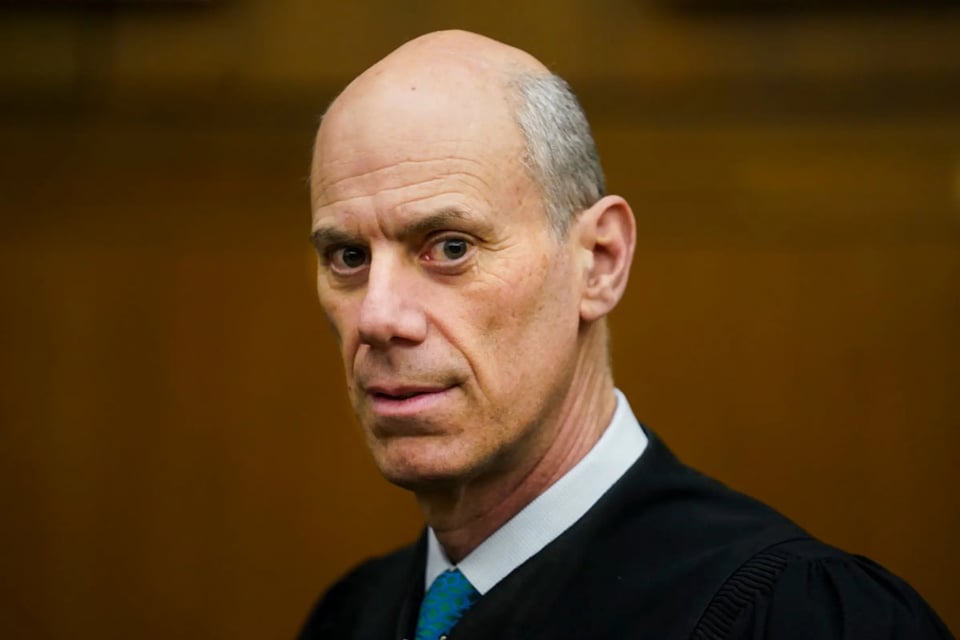
Boasberg, who has been chief judge of the D.C. District Court since 2023, has a storied career in the U.S. judiciary.
In his early days, Boasberg was a U.S. attorney specializing in homicide prosecutions. Former President George W. Bush appointed him to the D.C. superior court in 2002 as an associate judge presiding over civil, criminal, and domestic violence cases, while former President Obama appointed Boasberg to the District Court in March 2011 as a federal judge, which the Senate confirmed unanimously.
Boasberg also served on the U.S. Foreign Intelligence Surveillance Court—the court where the U.S. government seeks approval of “electronic surveillance, physical search, and certain other forms of investigative actions for foreign intelligence purposes”—beginning in May 2014, as appointed by Supreme Court Chief Justice Roberts. Boasberg was the court’s presiding judge from January 2020 to May 2021.
But Boasberg has made headlines and has caught the attention of Trump and his allies for his handling of high-profile cases involving the President and his policies.
In 2023, as one of his first official acts as D.C. District Court chief judge, Boasberg issued a ruling that ordered Trump’s former Vice President Mike Pence to testify to a grand jury as part of a special counsel probe into Trump and the Jan. 6, 2021 U.S. Capitol riot.
And last year, Boasberg ordered Trump to stop his use of the 1798 Alien Enemies Act to deport immigrants suspected of belonging to transnational criminal gangs, in relation to the deportation of hundreds of immigrants to El Salvador. Trump, in retaliation, called Boasberg a “Radical Left Lunatic of a Judge, a troublemaker and agitator” who needed to be impeached, which drew a rare rebuke from Supreme Court Chief Justice Roberts.
The deportation flights continued, and Boasberg indicated in November 2025 that he planned to revive contempt proceedings against Administration officials for violating his orders.Boasberg is also handling a pending case submitted by watchdog group American Oversight against Defense Secretary Pete Hegseth and other Trump Administration officials over alleged violations of federal record-keeping laws for using the encrypted Signal app to discuss a U.S. military operation against Houthi rebels in Yemen last year, which famously leaked by including an Atlantic journalist in the group chat. (Time)
The long road to 2028.
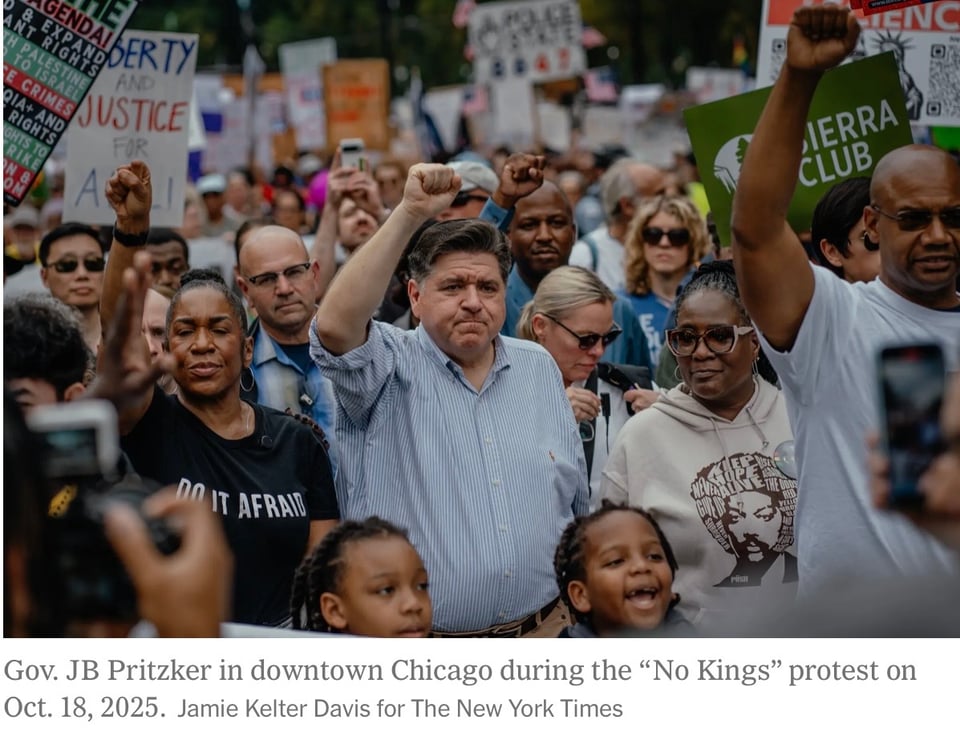
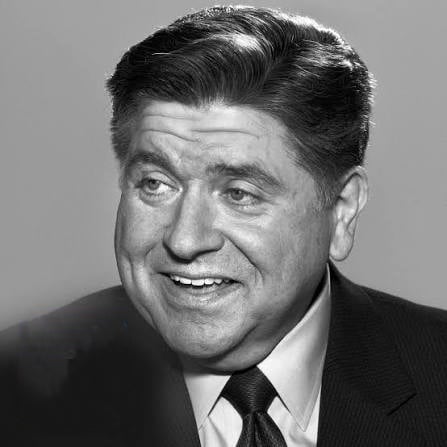
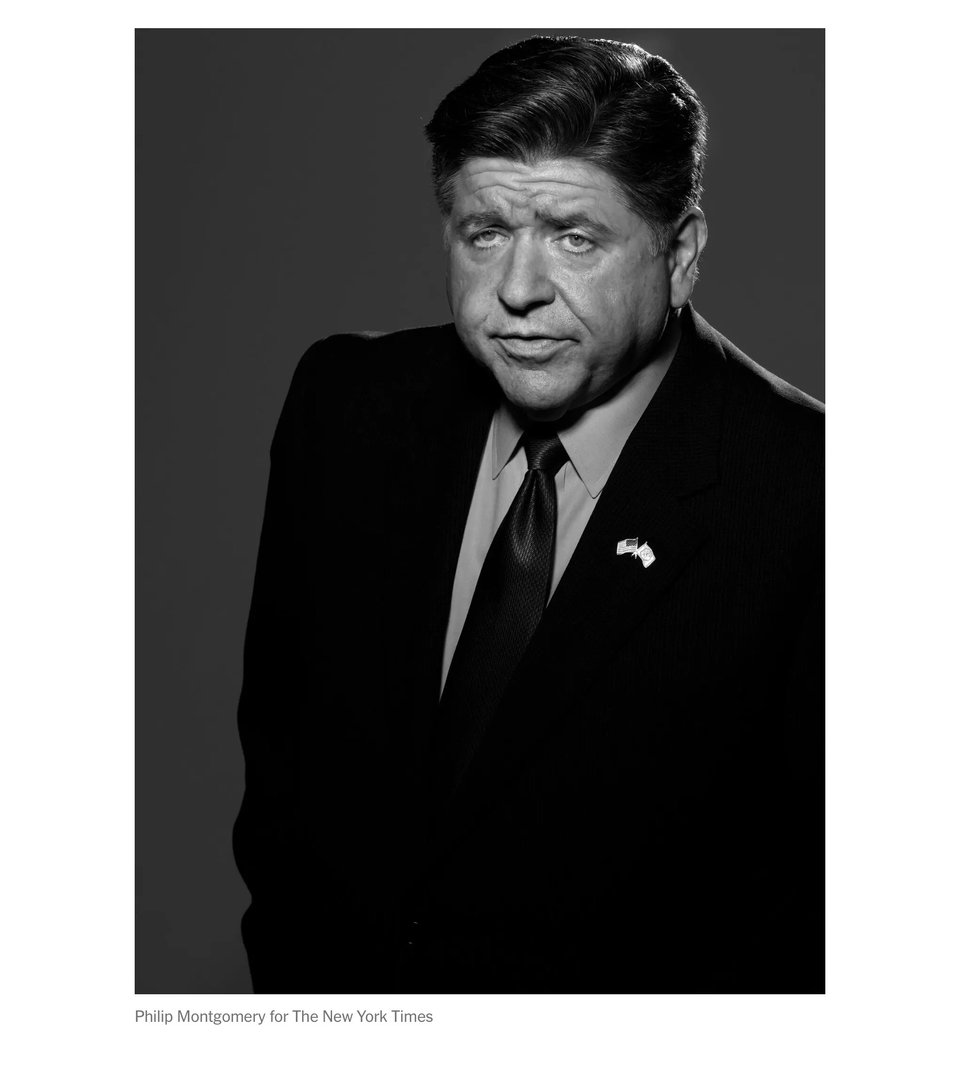
Meet J.B. Pritzker.
The Interview - How Tragedy, Wealth and Trump Shaped JB Pritzker
![[The Interview - How Tragedy, Wealth and Trump Shaped JB Pritzker]](https://assets.buttondown.email/images/c7bb9e3e-e7bc-4248-8369-1c4b70aad515.jpeg?w=960&fit=max)
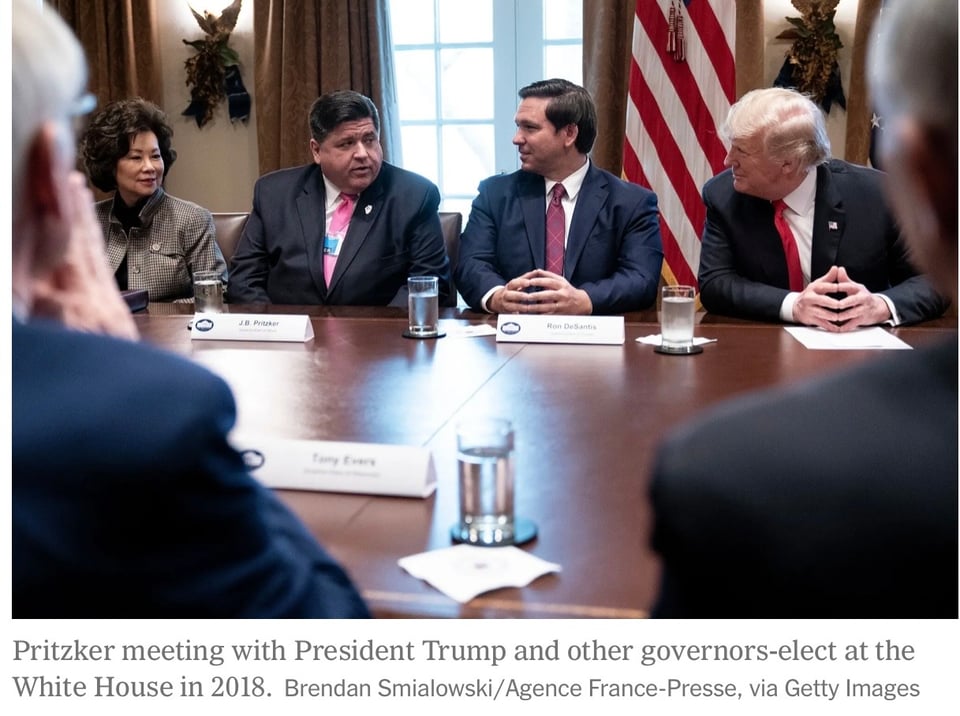
During his two terms as the governor of Illinois, JB Pritzker has become a national figure in the Democratic Party and one of Donald Trump’s main antagonists, at one point telling the president to “[expletive] all the way off.” That combativeness has created a narrative around Pritzker, whose sister, Penny, was secretary of commerce under President Barack Obama, as a potential contender for the Democratic presidential nomination in 2028, even if he’s not saying that yet as he runs for a rare third gubernatorial term.
Pritzker’s rise is interesting for a few reasons. As a member of one of America’s wealthiest families (his uncle founded Hyatt Hotels), Pritzker is a billionaire at a time when anti-billionaire sentiment is ascendant on the left. And as a longtime Jewish supporter of Israel, though very critical of Prime Minister Benjamin Netanyahu, Pritzker is not exactly in sync with the current direction of his party.
I wanted to understand how he’s navigating those potential tensions, how his family’s background, including two formative tragedies, have shaped him and where he sees his party, and the country, going from here.
I want to start with more of a philosophical question. When we look at this era, what do you think the lesson is for Democrats from how President Trump has wielded power to get what he wants?
What President Trump has done is operate like the president of a banana republic. That is, now that he’s got power, he’s going to vanquish his enemies and rule in favor of the people who will enrich him. I think that the lesson is for the country, that this is a dangerous road that we’ve gone down, putting someone like that in public office. We need to stand up against corruption. We need to make sure that whoever gets elected is good and decent and kind. Kindness is something that’s been missing in our politics. So you could say that’s a lesson for Democrats. I think it’s a lesson for all elected officials.
You’re talking about overreach and ruling like an authoritarian. Another version, though, is that Trump’s been able to push through an aggressive agenda — the “shock and awe” theory of governance. I’ve heard so many voters complain about incrementalism.
I complain about it, too.
Are there lessons to be taken from the frustration of voters and the way that Trump’s managed to do it?
If there’s a lesson, it’s that there should be a Project 2029 for Democrats.

Now, remember: Project 2025 also included taking away people’s rights and freedoms. It included tearing down the safety net that holds up our working families and that stands up for the most vulnerable in our society. So there are things about the agenda that I think are reprehensible and anti-democratic. But yes, the speed of the agenda — and it’s not shock and awe so much as when you run and win on an agenda, you can accomplish that agenda and need to do it as soon as possible.
What does a Project 2029 agenda look like for you?
I don’t think you can speak of it in shorthand, but we’ve got to restore the rule of law, and that means holding people accountable who’ve broken the law. I’m talking about the people in this administration who’ve broken the law and federal agents who’ve broken the law.
That means criminally prosecuted?
Criminally prosecuted, civilly prosecuted. Whatever it is that we can do. A second thing is just thinking about people’s everyday lives, lifting people up and making things more affordable in the world. How about finally we Democrats get to universal health care? Obamacare was terrific and it advanced the cause, but we still have a whole lot of people who don’t have coverage. And now, of course, it’s being taken away from a lot of people. Another part of the agenda is, we’ve got to raise the minimum wage in this country. Minimum wage is $7.25. It’s about $14,000 a year if you have one full-time job. You can’t survive on $14,000 as a single person. Even if you hold two minimum-wage jobs, $28,000 a year — you can’t raise a family on that.
Why do you think there hasn’t been a Project 2029 yet?
You talked about incrementalism earlier. I do think that people feel like we need the public to come along on every issue, and so let’s play them out over several years so that we can get consensus. But some of these issues have been around for an awful long time. I guarantee you that if you polled the American public about raising the minimum wage, 80 percent, including a majority of Republicans, would say it’s time. I don’t think we need to be incrementalist about some things that are universally understood.
The Texas Senate primary is being looked at very closely on both the left and the right. James Talarico defeated Jasmine Crockett, and that race was seen as something of a bellwether for the kind of approach that works best for Democrats. What were your takeaways?
If you look across the last five or so elections — if you include Abigail Spanberger’s election in Virginia, Mikie Sherrill’s election in New Jersey, Zohran Mamdani’s election in New York City, the primary in Texas, as well as the nomination of Roy Cooper in North Carolina — they’ve run on an affordability agenda. They’ve run on making sure that working people understand we Democrats are the ones who are fighting for them, not the other guys. Now, I know that what you’re asking me is: Is there a split in the Democratic Party? But the truth is that both of these candidates in Texas exhibited the ability to excite young people who historically haven’t voted in large numbers. You didn’t hear either one of those candidates speaking in incrementalist terminology. They were out there talking about transformative change. That is the lesson.
But there’s another thing that people are inferring. Jasmine Crockett positioned herself as a fighter against Trump. And James Talarico has taken a completely different tack. You have adopted a very combative position in regard to President Trump. When you look at the lesson that some are drawing from Talarico, some would say maybe there’s another way to do this where you can stand for what you believe in but you don’t have to adopt the same public combativeness that President Trump adopts.
When you’ve got somebody who’s taking people’s rights away, when he is not following the law, when he is corrupt and enriching himself — I mean, moms are being shot in the face — I don’t know how on earth you can say, Well, let’s work with him. You can’t work with him. He’s got an entire history of not living up to his promises. He can’t be trusted. I’m talking about when he was in business, you shake hands with him on something or sign a contract, he’d break it and sue you, even though he was in the wrong. In politics, every time he’d make friends with someone and then, all of a sudden, he’s turned on you. It’s happened repeatedly. He’s not a loyal person. He expects loyalty to him, but he’s not loyal back.
Mayor Mamdani of New York, whom you mentioned and who has been one of the bright lights for Democrats, has tried to woo Trump. He’s tried to work with him where he can because, as we’ve seen, the federal government wields enormous power and it’s hard to do things without it. What do you think about that way of doing things? Remember, I’ve been in office now for seven years. I was in office when Donald Trump was president the first time. When the pandemic hit, I called the president and asked for help — told him we needed ventilators, we needed masks and that he should invoke the Defense Production Act, but that we absolutely immediately needed to save people’s lives and needed the federal government. He promised to do that and didn’t deliver. This is in the most dire of circumstances. Look what he’s done to FEMA, the Federal Emergency Management Agency, which normally steps in when there are disasters. He’s ripped it apart. You can’t get help from the federal government anymore.
You seem to be implying that Mayor Mamdani is a neophyte.
I’m not taking anything away from him. I understand why you try. I’m just saying I have my own experiences. Maybe our different circumstances are leading us to different conclusions.
I’d like to talk about how you became you. You suffered a lot of tragedy very young. Your father, Donald, died at the age of 39 of a heart attack, when you were 7 years old. That stuck in my mind because my father also died at the age of 39, when I was 5. What impact did that have on you? Do you remember that age and what happened?That’s obviously young, and you have limited memories, but of course I remember. My mother and father were actually out of town in Hawaii, and so my mother called her friends and said: “I need you to go to our house and make sure that our kids aren’t watching TV. I don’t want them to find out anywhere except from me.” And so her friends came and arranged to take us out for the day. We went to a place called Fisherman’s Wharf in San Francisco and it seemed like just a fun day, but it allowed my mother to get back.
I remember her coming back and taking us into their bedroom and sitting us down and telling us what happened. I think back on it now as an adult with children, and I think how hard that must have been for her. I know how hard it was for me to hear it, but how hard must that have been to tell your children that they’ve lost their father? People do it every day, unfortunately. She just lost the love of her life. And all of a sudden, she’s alone with three young children. So I remember all of that.
As an adult, I went back and found many of their friends who were in their 70s or 80s to talk to them about it. They remember distinctly, because my father was the youngest friend of theirs who had ever died, their first friend who died. And they remember how profound it was for them because he was also the life of the party. He was the person the whole room leaned toward, because he was a big, gregarious personality. And so it’s something I think a lot of people were profoundly impacted by. After that, my mother, who was an alcoholic — all the challenges you can imagine for someone who’s now become a widow with three young children, and then add on to that a disease that is so hard to overcome. …

You had to take care of her with your siblings. She went to Alcoholics Anonymous. She checked herself into a place that could help her. She tried really hard. It wasn’t like she was drunk all the time. She was sober a lot. She was one of the smartest people I’ve ever met, and I don’t think that’s just the view of a 7-year-old. I remember one day when I was 8 or 9, she sat us down and said, “I want you to know that sometimes it probably feels to you like I don’t love you because I’m not being the mother to you I want to be, but I want you to understand that this is a disease. I have a disease and I’m trying very hard to overcome it, and I’m going to overcome it.” She actually gave us a book to read about alcoholism, about the struggle that people have to overcome this disease. But unfortunately she was never able to overcome it. It overcame her and took her life.
You became an orphan at 17. That’s an extraordinary series of losses. How would you say that shaped you?
I don’t want to aggrandize it or minimize it and just say that a whole lot of people go through tragedy and experience it differently and come out of it differently.
Losing both parents is a particularly difficult one for a child. Yes, and a lot of the outcome has to do with how old you were when those things happened — were there people around you who cared about you and took care of you and made sure that you weren’t going to fall off the edge of the earth?
Who were those people for you?
My brother and sister and I were very close, and I was lucky I had two older siblings, so that was helpful for me. My parents’ friends cared deeply about us, and we had a broader family who really put their arms all the way around us and made sure that we were going to be OK. I just feel lucky because a whole lot of people, as you know, don’t have resources, don’t have a family that would step in and care for them and don’t have a large group of friends who can do what their friends did. There are a lot of lessons. Going through that, you learn compassion for other people because you’ve been through it yourself.
Your great-grandfather, the patriarch of the Pritzker clan, came to the United States in the late 1800s, fleeing the Jewish pogroms in Ukraine. He became incredibly successful and your family became one of the wealthiest in America, running one of best-known hotel companies in the country.
Can I interrupt you just for a moment to say it was a motel business? My father and his brother built something that nobody thought would be successful. I only mention that because I think we overlook how hard it is to build something like that from scratch.
You are uncomfortable talking about your family’s wealth. Is that a statement?
It’s a statement and a question. I’m proud, I really am. I also feel incredibly lucky. I’m not uncomfortable. I’m just uncomfortable with the assumptions that people make about you. That obviously was part of what shaped me. I also think that the values that my parents taught me about social justice and compassion are things that, whether you’re wealthy or you’re poor or you’re middle class, those values that you grow up with are who you are. If you have resources, you can do more to carry out those values for other people, perhaps. But that’s how I think about it.
When I ran for governor in 2017, Donald Trump was president of the United States. The [wealthy Republican] governor of Illinois was failing the state miserably. And here comes a wealthy guy running as a Democrat. And it’s easy for people to be like, Why would Democrats want some wealthy guy when we’ve got a failed wealthy president and a failed wealthy governor? So I get it. I understand people had that in their heads, and for good reason. You had two bad examples. I had to go everywhere in the state and talk to everybody so people could understand that it’s where your heart is, it’s what your values are that matters — not how much you have or how little you have.
The reason I want to stay with this, and Donald Trump is obviously one example, is there is a real discomfort at the moment with wealth in politics. You’ve used a lot of your own money to finance your campaigns, to the tune of hundreds of millions of dollars. A lot of people might say that’s just not fair. I understand, but I will also tell you that what people know about me is that there’s no special interest that could buy me or tell me what to do.
What do you make of the moniker “the billionaire class” that has become very popular, especially on the left? Do you think all billionaires should be lumped together? You asked the question upfront, that I seem to be sensitive about wealth. And it’s in part because of a question like the one you just asked. I know that there are people who just want to lump everybody who is wealthy together and say that they are evil or they’re fighting against them. All I can say is, that’s not true of me, and it’s not true of a number of people I know.
Sign up for The Interview Hosts David Marchese and Lulu Garcia-Navarro talk to the world’s most fascinating people. Get it sent to your inbox.
You have positioned yourself as a leader in the national Democratic Party. As we speak, we’re in the second week of a war with Iran. How do you think it’s going? President Trump got us into this war without clear objectives, and the result of that is no one knows where we’re supposed to be going. So although President Trump has talked about trying to avoid “forever wars,” it seems like if you get into a conflict and don’t know how it’s supposed to end, that can easily turn into a forever war. When you’re then spending billions of dollars to get into a conflict where we were not drawn into it for any reason other than Donald Trump’s choice, you have to wonder, Is Donald Trump actually carrying out the mandate that he thinks he was elected to carry out? I thought he said he wasn’t going to get us into more conflicts, and yet we have Venezuela, Iran, he’s talking about invading Cuba. There’s a lot going on here that is evidence of Donald Trump lying about who he was going to be when he got elected. But as far as the war, with 140 American troops that have been reported wounded and half a dozen or more who have been killed, I wonder how long this conflict will go. I think the American public does not want to see it go any further. And again, what are we trying to achieve?
We’re seeing polling that shows that a majority of Americans are against the conflict. It’s having this polarizing effect on the left and the right, specifically around Israel’s involvement. The Democratic Party writ large has been moving away from unequivocal support of Israel. Recent polling showed overwhelming sympathy toward Palestinians in the wake of the war in Gaza among Democrats. And I’m wondering what you think the United States government’s relationship with Israel should be going forward.
I’ve been terribly disappointed with the leadership who was elected in Israel. I respect the fact that it has been a democracy and they elect their leaders. But they’ve made the same kind of mistake that the United States electorate has made in electing someone like Benjamin Netanyahu. The result of Netanyahu’s leadership has been to create additional wars, drawing the United States into those wars and, very importantly, not carrying out what I think are the fundamental values of people who live in Israel, and that is the value of human life and the value of protecting people who are vulnerable and innocent. With regard to the leadership of Iran, these were torturous, murderous people. So no love lost on my part when it comes to the leadership being decapitated in Iran. I question whether that was a job that we should be involved in and whether we should be replacing leadership across the world who we disagree with or think are terrible.
But I must admit I’m challenged by this current situation, because Israel was created as a safe haven for Jews. We were in danger of extinction across the world. And Israel became that hope for Jews everywhere. And it has carried out, I think over almost all of the years of its existence, a desire simply to live in peace and within its own borders, to construct a society where people can live and work and exist and hope that they wouldn’t be attacked. Unfortunately, Israel has been under attack over a lot of years. Meanwhile, here we are where Israel had an opportunity after the atrocities that were committed by Hamas on Oct. 7 of 2023. There was an opportunity for Israel to then do what I think it has, over its history, done, which is to operate in a humanitarian fashion, to make sure that food aid was delivered to the innocent, to make sure that when bombs were being dropped or the war was being conducted in Gaza, that it would minimize innocent deaths. That didn’t happen. That’s on Netanyahu.
I believe strongly that we need to not only secure and grant the right to exist for the state of Israel as a safe haven, but also that we should have a state where Palestinians can be safe and live in peace, and that should be in Gaza, if you ask me. So I am torn because we now have a U.S. government supporting policies that I don’t think the majority of Americans believe in and I don’t think a majority even of Israelis believe in. But that’s what’s being carried out now.
I hear you using the words “torn” and “challenged.” I know that this must be, as it is for many Jews, an incredibly difficult conversation to have. You used to be on the board of AIPAC, the pro-Israel lobby group, and you’ve since distanced yourself from them. [After publication, Gov. Pritzker clarified that he was a donor to AIPAC, but never served on its board.] And last August, you also endorsed a Senate effort to block U.S. arms sales to Israel. You said it sends “the right kind of a message.” It made me wonder if you’re undergoing a personal evolution.
Well, I abandoned AIPAC more than a dozen years ago. It was an organization that had at one time been bipartisan in nature and really all about preserving a strong relationship between the United States and Israel. But about a dozen years ago, the organization began to lean much more to the right and much more pro-Trump, who had then become a candidate for president, and that disturbed me greatly. AIPAC back then was not a PAC, I might add. It was a public affairs council; it didn’t have a political action committee that was giving money to candidates. But the organization became political. They created a super PAC. They began to get involved in elections directly and choosing to support candidates who were MAGA and right-wing and Trumpy. I just didn’t want anything to do with that.
Do you feel like the leadership of Israel changed, AIPAC changed and you felt distanced from it, or have your own views changed?
It’s hard for me to answer that question. I think that it’s certainly true that AIPAC changed, and that’s why I walked away. Again, do I believe that Israel has a right to exist? I do, and my grandfather’s name is on a square in Jerusalem because my family has always believed that there should be a safe haven for Jews. But I also believe that others have a right to that kind of safe haven. And so, have my views changed? No, I think I’ve always believed that.
Where do you think that leaves someone like you? If you were in a position to decide U.S.-Israel policy, which I absolutely understand that you are not, what exactly should America’s relationship be to the state of Israel right now?
We should be a peacemaker. That’s what we should do. Simply going along with Benjamin Netanyahu’s plan — that he’s had for many years, by the way — to attack Iran, we should have asked the question, Are there alternatives? The fact that Donald Trump went along, that’s the example of the thing that we shouldn’t be doing.
This issue is one that has divided a lot of Jewish families. I’m wondering, on a personal note, if that’s been something that’s come up in yours, especially as you’ve been deciding what positions to take publicly? Anybody who’s got a family of more than one or two people, there are a lot of different views. There are a few Republicans in my family. I don’t think there’s anybody who’s pro-Trump, but a few Republicans. And we have differences of opinions on lots of issues that come up, even among Democrats.
I’m Cuban. We argue about everything.
There’s a joke among Jews that if there are two Jews, there are three opinions about any issue. [Laughs]
In his memoir, Gov. Josh Shapiro of Pennsylvania said Kamala Harris’s vice-presidential vetting team asked him about his faith, and even if he was an Israeli agent. You were also vetted, and I’m wondering if they asked you the same things in the same way.
They did not ask me those same things in the same way. Going through that experience of being vetted for vice president is like getting the worst kind of colonoscopy. Some of it, I guess, seemed offensive to Josh Shapiro. I don’t know what led them to ask that question. I wasn’t asked and yet I’m Jewish, and I’m as much an adherent to my religion as Josh Shapiro is. So not exactly sure who asked that question or why. What I can say is that I wasn’t asked those things. I was asked hard questions, for sure, but nothing quite like that.
We’re kind of dancing around this central thing, which I feel compelled to ask you, which is that you are often mentioned as a potential 2028 candidate for president. What are you weighing as you’re making that decision?
I’m not weighing that decision. I know you find that surprising, but I’m running for re-election as governor. That’s what I’m focused on. Listen, I’m proud and pleased that people think that my leadership is something that would put me on the stage as a potential presidential candidate. The reasons that people are doing that have more to do with the conviction that I have offered on the subject of stepping between Donald Trump and the people of my state and protecting people and speaking out and being unafraid. I wish more Democratic politicians were doing that right now, and more politicians in general. I wish Republicans would get religion about standing by the law and the Constitution. So I guess that’s why people have considered me as a potential candidate.
Governor, looking at the world right now and America’s place in it, it reminds me of what many Democrats see as President Biden’s fundamental miscalculation. When he became president, he pitched that Trump was an aberration, that we can go back to the before times. And I think we’ve now seen that there’s no going back to what came before. As Canada’s Mark Carney said in Davos, “The old order is not coming back.” Looking at the future beyond Trump, what do you think is coming? What keeps you up at night, and also what gives you hope?
Donald Trump has made this world less safe. What keeps me up at night is that when we say that the world order is changing, it means less order and more adventurism — not just by the United States but by other countries too. If the free world isn’t willing to act as a collective against the Russian aggression on Ukraine, then we allow countries simply to decide: We don’t like our neighbor, or we’d like to have some of their territory, we’re just going to invade. If we have a more powerful army, it’s ours for the taking. That is the world I’m afraid is now upon us.
I agree that Donald Trump may have permanently blown up a world in which the United States was the leader and where now maybe we won’t be anymore. I’ve talked to a lot of Americans who live in Europe and I’ve asked them: “Do you think we can re-establish the trust that we had with our allies in Europe? Can we put it back together so that we’re all working in unison with one another, with the United States at the helm?” I asked how long it would take to do that. Two of them said 20 years, and the third one said never. So that is the fear that I have.
Now, what am I hoping for? I’m hoping that when we’re finally able to re-establish ourselves as a trustworthy ally, that we can go to the most important of our international relationships and restore a sense of order and direction, and that the United States can be the most important of the allies among a plethora of equals. And then our job, if we’re able to do that, is to restore hope among the American people. I think that people have lost the sense that we belong to the greatest nation in the world, that we’re all lucky to be here and that we have obligations. How about if we return to a world where people feel like they owe something and are willing to give to our country, and to promote our country throughout the world
as a leader of peace? (New York Times)
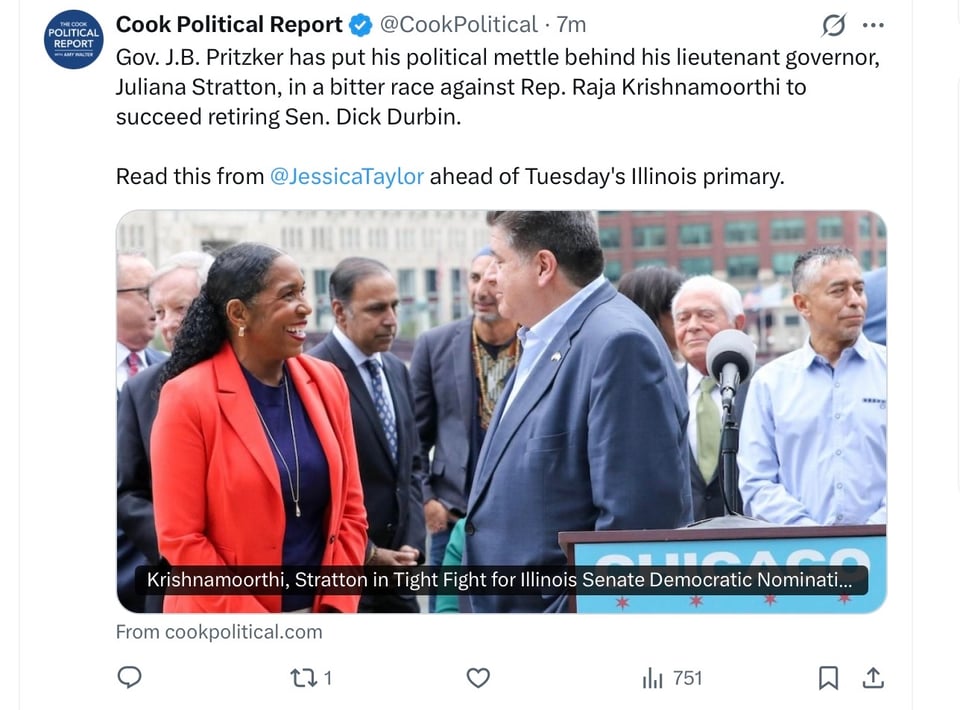
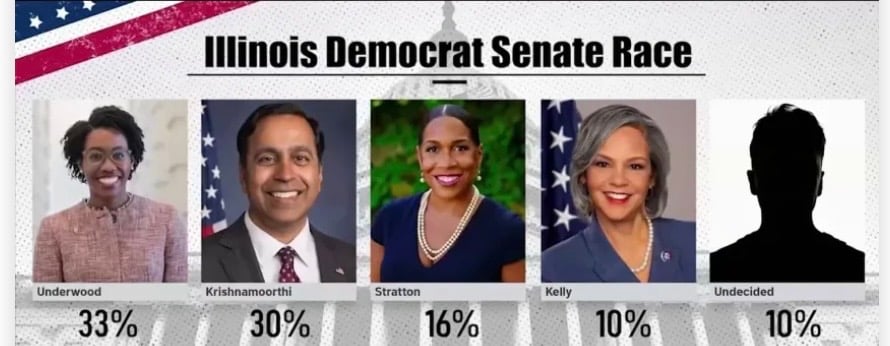
Today is also Primary Day in Illinois.