Tuesday, June 23, 2026. Annette's Roundup for Democracy.
Today is Primary Election Day in New York.
Vote. Take a friend. The polls open at 6:00 am and close at 9 pm.
Some Trump grifting you may have missed.
One more thing.
Trump's pathetic condition Now.
The reflecting pool isnt reflecting. It is filled with algae.
Reflecting Pool algae bloom is one of biggest recorded in years after $14M renovation.
An analysis of satellite imagery of the Lincoln Memorial shows algae levels spiked days after Trump’s renovation was completed.
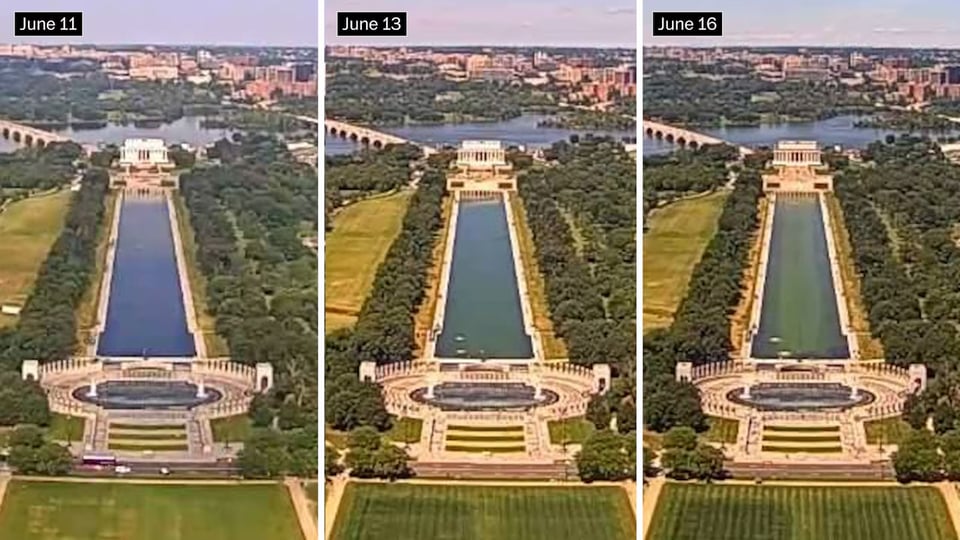
Days after the completion this month of a $14 million renovation, the shallow water in the Lincoln Memorial’s Reflecting Pool had more algae in it than at any recorded point in the month of June for at least five years, according to a specialized analysis of satellite data.
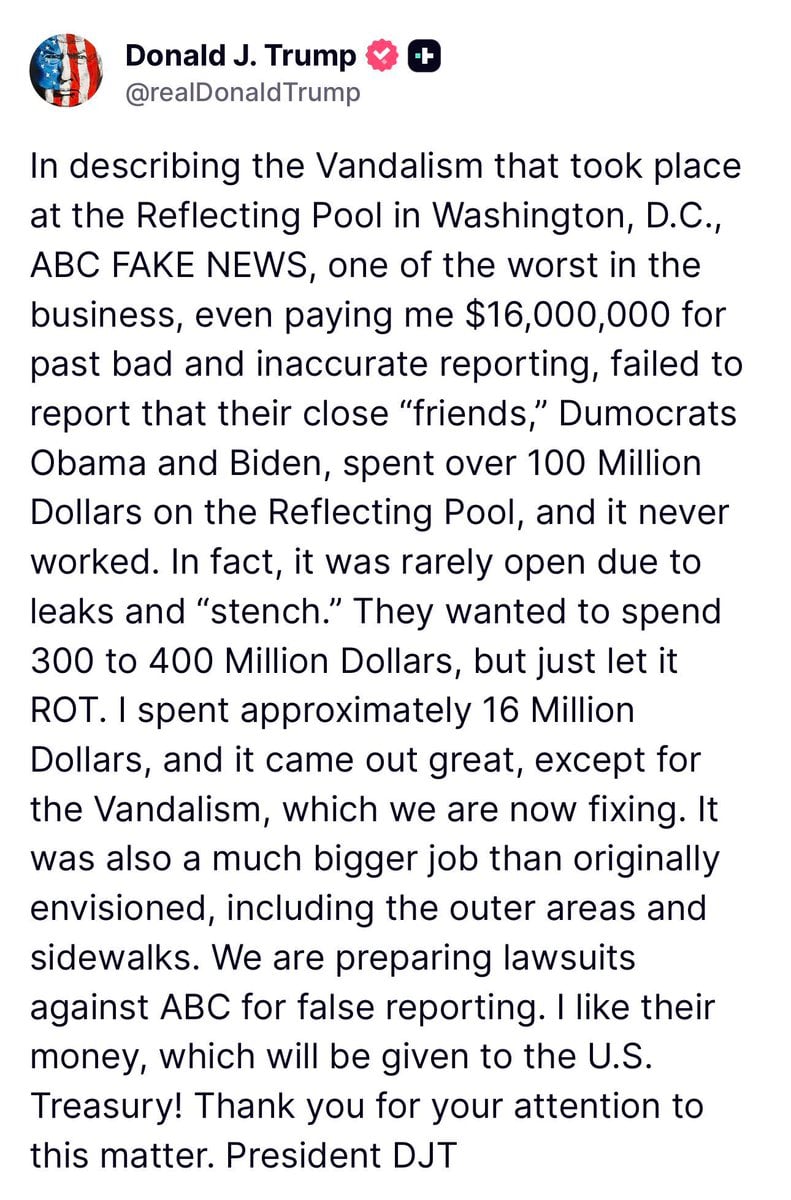
President Donald Trump vowed in April to clean up what he called the “filthy” and “disgusting” water in the Reflecting Pool. He promised to resurface the basin to eliminate persistent leaking and to paint it “American flag blue.” Once the pool started to be refilled, on June 4, he praised its “clean, beautiful water.”
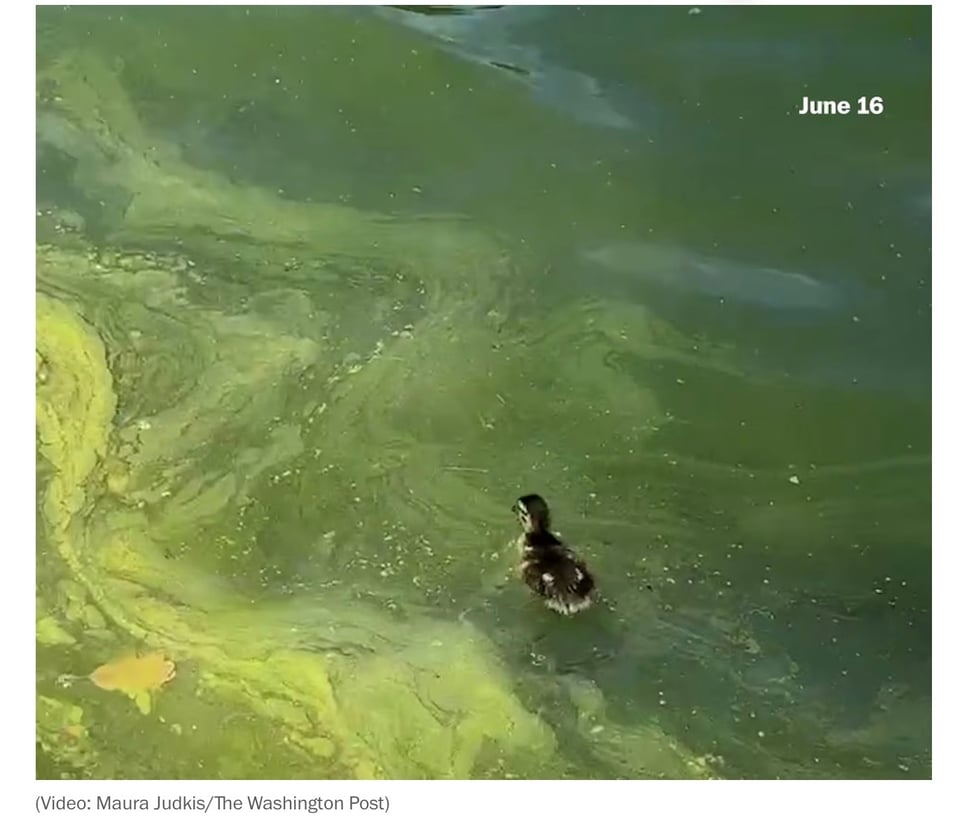
But the algae blooms that have long plagued the pool came roaring back, spawning more than a few conspiracy theories and much debate about the renovation. Some social media users said they suspected “bureaucrats” had seeded the algae bloom in an act of sabotage, while others claimed photos showing the reappearance of the algae were taken during the Biden years. Trump administration officials said the algae was caused by residual material in supply lines that had been dormant for weeks.
Regardless, there was a lot of it.
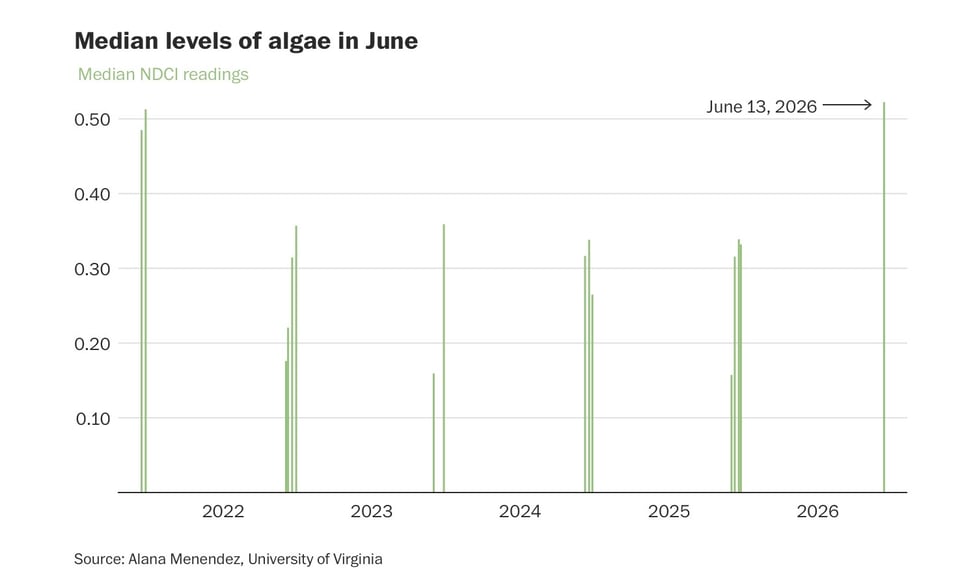
At The Washington Post’s request, Alana Menendez, a postdoctoral researcher at the University of Virginia’s Department of Environmental Sciences, analyzed light-reflectance data from a European satellite called Sentinel-2. The satellite captures clear images of the Reflecting Pool several times a month, and the data it produces can be used to estimate the presence of chlorophyll-a, a pigment found in algae.
A higher value of that metric, known as the normalized difference chlorophyll index (NDCI), points to more algae in the water, Menendez said.
Menendez’s analysis detected more algae in the reflecting pool in an image taken Saturday — in the week after it reopened — than in any June images going back to 2021. The algae level was among the highest measured in any month in the past two years, according to the analysis.
Hot and sunny weather — which the Washington area has been experiencing — creates conditions in which the plantlike aquatic organisms thrive. The D.C. area experienced a heat wave just as the pool was being refilled earlier this month.
Menendez found there was a strong indication of an algal bloom in the Reflecting Pool on March 10, when it was unseasonably hot. Just before construction began, on April 1, the bloom had reduced.

“We would expect June to have more algae naturally than February, March or April because there is more light availability and higher temperatures,” Menendez said.
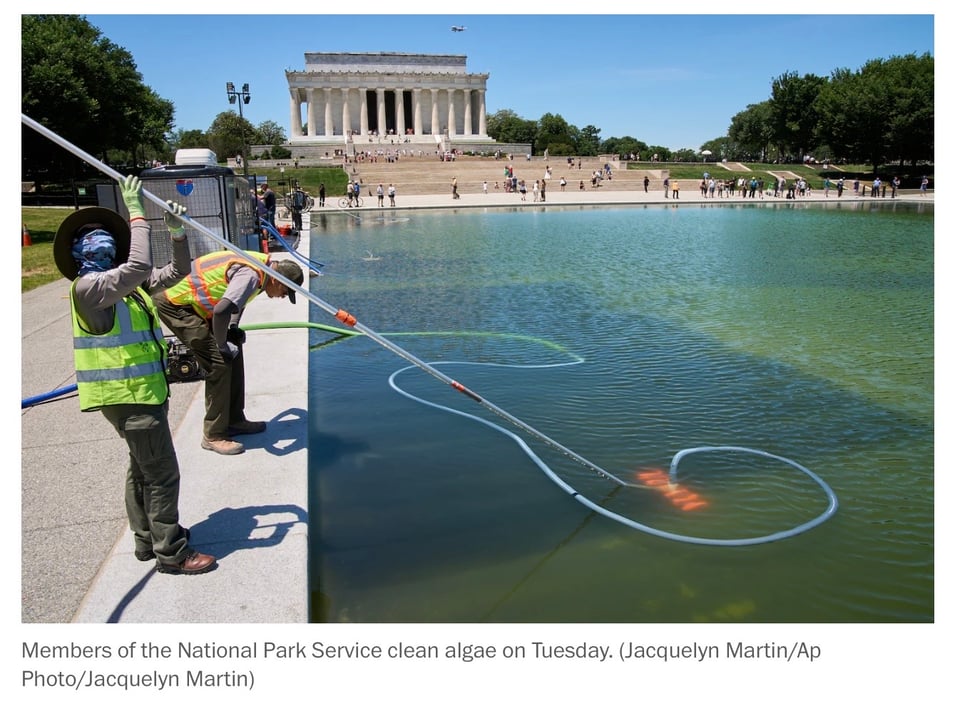
The Interior Department, which oversees the Park Service and contracted for the work, said in a statement that it is treating the pool with hydrogen peroxide and using “high-tech nanobubble ozone technology” to effectively cut off the algae’s food supply.
White House spokesperson Taylor Rogers said the nanobubble equipment would “keep the Reflecting Pool crystal clear.”
“Thanks to President Trump, new lining and industrial grade materials will permanently seal the Reflecting Pool, which previously leaked 16 million gallons per year and wasted countless taxpayer dollars,” she said.
Trump has not publicly commented on the algae problem. On Monday, he posted that he would host a Trump rally on July 4 “with the backdrop of the Lincoln Memorial and surrounding the beautifully new Reflecting Pool.”
Algae has been an on-and-off problem for the 6.75 million-gallon Reflecting Pool since it was built in the 1920s. It quickly reappeared after a more than $30 million renovation that was completed in 2012, though that project also changed the source of the pool’s water: Previously, it had been fed from the city’s drinking water, but after the renovation the water was drawn from the Tidal Basin, saving the city 32 million gallons of water a year.
In its statement, the Interior Department said the Obama-era renovation “resulted in massive algae clumps taking over the pool’s surface following years of construction that cost taxpayers millions upon millions only to be broken and disgusting days later.”
Last month, a local advocacy organization sued to stop Trump’s changes to the Reflecting Pool, alleging that the Interior Department failed to undergo required federal reviews for the project. The Trump administration in response called the work “routine maintenance” that will have “trivial aesthetic and environmental impact” and was not subject to certain environmental reviews.
Contractors finished the project before a federal judge could rule in the case.
As the pool was being filled earlier this month, Ed Stierli, an official with a different advocacy group, National Parks Conservation Association, wondered if the dark paint color was increasing the water temperature, exacerbating the algae problem.
“These are all questions that would normally be answered during that review process that just was not done in this case,” he told The Post.
By midday on Tuesday, the area was filling up with summer tourists and some locals who came to see how green the pool had become.
“It’s the biggest tourist attraction now,” called out a biker as he wheeled past. (The Washington Post)
One more thing.
The article above, written on June 18, states optimistically, "President Trump has not publicly commented on the algae problem." That is no longer the case.
Friday night, Trump blamed “Radical Left Lunatics, most likely Dumocats [sic], who have spent their lives trying to ruin our Country,” for “some real problems with Vandalism at the beautiful Reflecting Pool.” By this evening, he was blaming “multiple individuals for vandalizing our Nations magnificent Reflecting Poll [sic]. Who would do such a thing? These are very serious crimes having to do with the destruction of National Monuments. Years in jail! Work will begin immediately on its repair.” (Source. June 20, 2026, Letters from an American, Heather Cox Richardson.)
From Really American Media -
Trump’s $15 million Reflecting Pool renovation has now produced at least five arrests and 14 citations, and the pool still does not work. The latest person caught up in it is David Hearn, a 62-year-old U.S. Olympic canoe slalom athlete who says he touched a loose flap of the pool’s coating out of curiosity after a 52-mile bike ride. He was arrested, held for five hours without being read his Miranda rights, and charged with destroying government property.
“We’ve already heard many lies from this administration,” Hearn told the Daily Mail. “That’s just another lie.”
Trump claims vandals cut a “250 foot long gash” in the liner with a knife and poured “corrosive and destructive chemicals” into the water, and he says anyone caught deserves years in jail. What he is not mentioning is that the algae bloom currently choking the pool is the result of his own administration’s renovation work. The Interior Department blamed residual algae left behind in the pool’s pipes during cleaning, and CNN found abnormally high phosphate levels in the water afterward. A Smithsonian algae researcher called the chemical imbalance a “field day” for algal growth.
Trump in Defeat
The president went to war triumphant and will likely leave greatly weakened. by Jonathan Lemire.
President Trump lost. The war he waged against Iran promises to conclude in a humbling whimper with the signing of a cease-fire agreement later this week. The United States is left weaker—diminished militarily, strategically, economically, and perhaps morally.
The war, which the United States fought alongside Israel, accomplished none of the goals that Trump named at the outset. Instead, it only empowered the hard-liners in Tehran and arguably emboldened them to someday seek a nuclear weapon. Despite that, the president was so desperate for the war to end that he repeatedly backed off his threats—allowing Iran to call his bluff—and upbraided his close ally Israeli Prime Minister Benjamin Netanyahu for responding to attacks in the region in a manner that jeopardized the negotiations.
Trump won’t admit to any of this. He has spent recent days furiously spinning the tentative deal as a clear win, and has seethed at unflattering comparisons with the deal that President Obama struck with Iran more than a decade ago, aides and outside advisers told me. Trump, they said, has privately denounced Iran hawks, some of whom are among his closest allies in the Republican Party, for questioning the strength of the agreement. Within the administration, there is a divide on the deal, but Trump sided with those advocating for the war to wind down, no matter the terms, as fears mount about the economic toll on Americans and the political costs for Republicans in the midterms.
Trump’s own anger masks a desperate desire to find an off-ramp from a conflict that did not go the way he had planned, an outcome that has threatened to leave the United States—and Trump—reduced in the eyes of the world. For a decade, Trump has dominated the global stage and wielded extraordinary executive power. But now he is saddled with low poll numbers and unhappy Republicans, and he may soon have to contend with a Democratic Congress. His evolution into a lame duck is accelerating, and the political world is poised to soon look beyond him and focus on the 2028 contenders hoping to succeed him. World leaders, who were once cowed, have begun to defy him. Trump’s defeat in Iran, and the way he lost, may hasten his irrelevance.
It’s not usually a vote of confidence for your deal when you won’t let anyone else read it. But Trump and his team have threatened to not release the Iran agreement until after it is signed in Geneva on Friday. Officials have said that the deal will extend the cease-fire over the next 60 days and that Iran will reopen the Strait of Hormuz, allowing the U.S. to drop its naval blockade and oil to flow from the region again. Although Iran has agreed to not collect fees on the strait for the next 60 days, it has (according to Iranian state media) left open the door to doing so afterward—and the deal delays addressing Iran’s uranium-enrichment program, despite Trump having cast it as his urgent motivation for war. The president’s lead negotiators, Jared Kushner and Steve Witkoff, have supported the agreement, as has Vice President Vance, who has been promoting it during preplanned TV appearances to sell his new book. Secretary of State Marco Rubio, Secretary of Defense Pete Hegseth, CIA Director John Ratcliffe, and others have expressed quiet reservations with how the deal will be implemented, according to four outside advisers and senior White House officials who, like others, spoke with me on the condition of anonymity to discuss private conversations.
As the war dragged on, it became clear that Trump’s goals for the conflict were going unfulfilled. The Iranian navy was damaged, but Tehran’s ballistic-missile capability survived, as did its ties to militia proxy groups such as Hezbollah and the Houthis. The hard-line regime in Tehran appears poised to sell oil again and receive up to $300 billion in funding from Gulf states that it could use to rebuild. Iran has tightened its grip on the Strait of Hormuz and demonstrated that it can close the waterway at will. Although Tehran has promised not to build a nuclear weapon, no enforcement mechanism has been established. And to the shock of some Iran hawks, Trump yesterday seemed to back off his previous pledge to seize the uranium, saying, “You could make the case, ‘Why are you even bothering?’ Because it’s not really valuable.”
Iran has seemingly come out of the conflict with an ability to check Israel’s freedom to strike Lebanon and potentially elsewhere; in recent days, Trump has blasted Netanyahu for endangering the cease-fire and demanded that he call off an attack on Beirut. Trump’s broadsides, including calling the prime minister “a very difficult guy,” threaten to widen a rift between the U.S. and its longtime ally in the Middle East. Despite Trump’s reprimands, Netanyahu has insisted that Israel will continue to authorize attacks that it deems necessary for self-defense.
“The president has made the decision that this is over,” one of the senior administration officials told me. “That’s all that matters now. And Netanyahu will have to listen, period.”
The White House, in defending the deal, has stressed that any financial relief to the Iranians is performance-based, that Tehran will see the funding only if it keeps the strait open and maintains its pledge to not develop a nuclear weapon. Olivia Wales, a White House spokesperson, told me in a statement that “what the President has achieved on the battlefield and at the negotiating table is nothing short of remarkable and will strengthen American security for many years to come.”
The war has cost trump. It has rattled the nation’s economy. The Pentagon estimated that it had spent roughly $29 billion on the conflict by mid-May, but independent experts believe that it has spent tens of billions more. The U.S. military’s munitions supply has been depleted, putting at risk its ability to defend its interests in Asia and Europe. The United States’ failure, despite its overwhelming military might, to bring Iran to its knees could encourage China, Russia, or North Korea to take aggressive action. In the eyes of many, Washington has hurt its moral standing around the globe; promises to help the Iranian people rise up went unfulfilled, and more than 170 people, mostly children, were killed by a U.S. strike on a girls’ school in the war’s first hours. Overall, more than 3,000 people in Iran were killed in the conflict, according to Iranian officials. Thirteen U.S. service members were also killed.
The war’s outcome may usher in a new phase of Trump’s presidency. He is unlikely to abandon his adventurism on the world stage, and aides told me that he is eager to pivot to Cuba soon—looking for regime change, likely through economic pressure, but not ruling out military force—and he may revisit a bid for Greenland. This week at the G7 summit, he also resurfaced his ambition to help end the Russia-Ukraine war. His triumph in Venezuela feels like a distant memory. Leaders in Europe are now standing up to him. China’s president, Xi Jinping, has not given him the trade deal he wants.
Back home, Trump is still the most powerful figure in politics. But those small acts of Republican defiance are adding up. He has had a series of losses in the courts, including in his efforts to remake the nation’s capital in his own image. Democrats are favored to capture at least one house of Congress this November, which would give them the ability to slow Trump’s agenda and open investigations into his administration. Once the midterms conclude, the race to replace Trump will begin. Although that will further diminish Trump, it is unlikely that he will go out with a whimper. (The Atlantic)
One more thing.or two.
Trump knows his war has gotten him in deep doo-doo.
Trump is attacking The View.
Maybe he is bored with attacking universities. (That was a joke.)
Trump’s FCC is pressuring ABC over The View. The FCC, led by Trump-appointed chair Brendan Carr, is looking at whether The View should count as a “bona fide news interview program.” That matters because bona fide news interview programs are exempt from the FCC’s equal time/equal opportunities rule for political candidates.
ABC/Disney is fighting back. ABC has filed with the FCC asking for a ruling that The View does qualify as a bona fide news interview program. The FCC opened that question for public comment, with comments due June 22, 2026 and reply comments due July 6, 2026.
ABC is now running ads asking viewers to support it. The network has launched an on-air and online campaign telling viewers the FCC action threatens free speech and urging people to file comments. Some ads reportedly use Barbara Walters’ founding vision for The View as part of the argument.

The Farmers' Market on Sundays alongside the Natural History Museum on Columbus is one of my favorite places in New York City.
Do you have a Farmers Market near you?
Ours is on Columbus Avenue from 77th Street to 81st Street. There is no place I would rather be on a Sunday morning.
The Greenmarket Is 50 Years Old
“It wasn’t always here, and it won’t be here unless we keep supporting it.”
On a dreary Saturday morning this spring, the chef Peter Hoffman was giving out hugs. We’d arrived at the Union Square Greenmarket to shop, but Hoffman kept running into people he knew, embracing an employee at Deep Mountain Maple, saying “hi” to a book publisher he hadn’t seen in a while, checking in on a former neighbor’s daughter. Eventually, he started bagging up some wavy Romano beans at the Lani’s Farm stand while I checked out its collection of homemade soy sauce and kimchee. Then we hit some other stands, and within 15 minutes, I’d bought Chioggia beets, radishes, strawberries, cucumbers, a croissant made with local wheat, and blue-shelled tea eggs from a Finger Lakes–based wine-maker.
Hoffman, who helped jump-start this city’s farm-to-table, locavore era when he opened Savoy in Soho in 1990, doesn’t live in the city anymore — he moved to the Hudson Valley four years ago — but he still makes a point of shopping at the Greenmarket whenever he passes through. Why? “The diversity,” he says. Not only are the people shopping and selling food diverse, but the food is, too. Because the Greenmarket program extends to farmers within a 250-mile radius, it’s possible to buy produce from five or six different growing zones, Hoffman explains. That means, to give an example from this time of year, strawberries and asparagus from New Jersey may arrive in the city several weeks before upstate farms have them. “Could I have lived somewhere else and done my career?” he says. “It’s just, like, no.”
Of course, Union Square wasn’t always filled with overflowing displays of purple kale and Sungold tomatoes. The city’s first Greenmarket launched 50 years ago — July 17, 1976 — on 59th Street and Second Avenue. The market at Union Square, then a part of the city filled with drugs that most New Yorkers tried to avoid, came a month later.
The markets’ opening was inspired by the idea oing revitalize urban spaces as European-style open-air food markets, says Angela Davis, the director of food access and agriculture at GrowNYC, the nonprofit that currently runs over 60 Greenmarkets. The urban planners Bob Lewis and Barry Benepe were behind the plan. Benepe, Davis explains, “had seen the disappearance of farmland, so he had this crazy idea: Let’s get farmers together and let’s find a profitable place for them to connect to customers and connect to New Yorkers.”
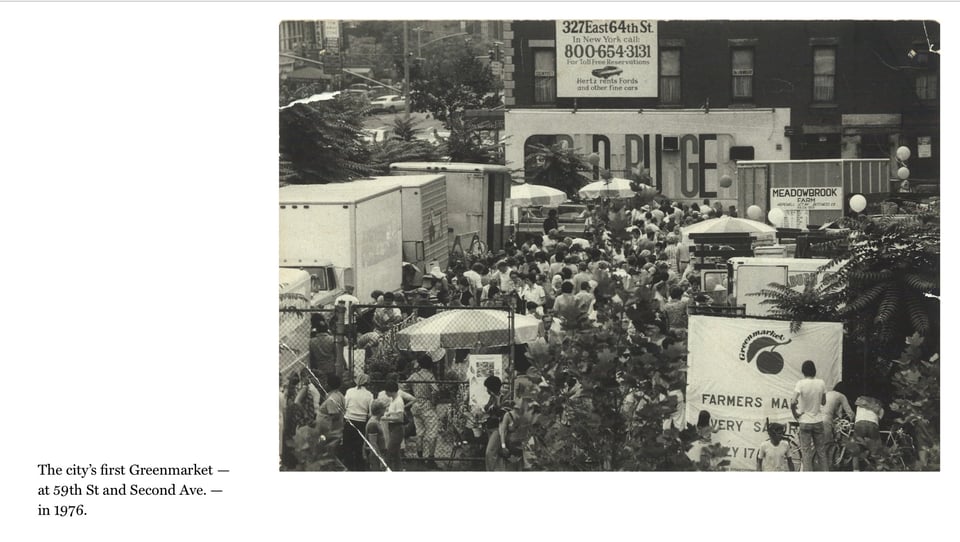
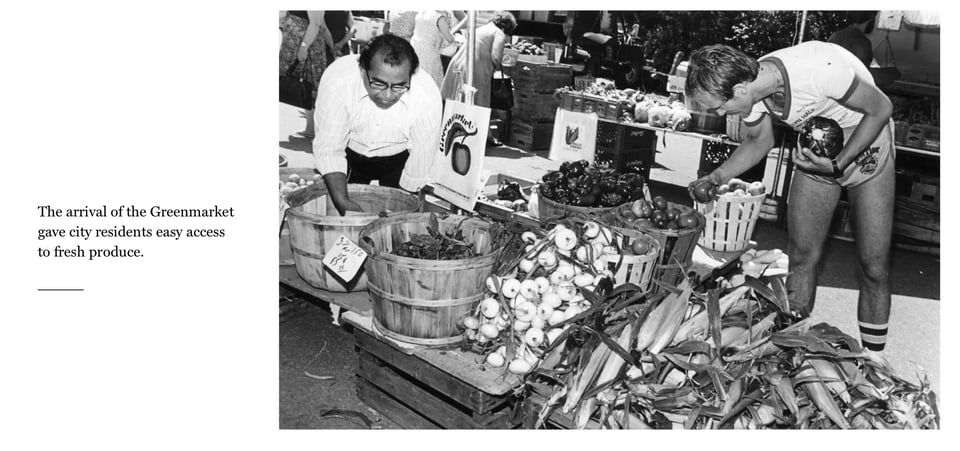
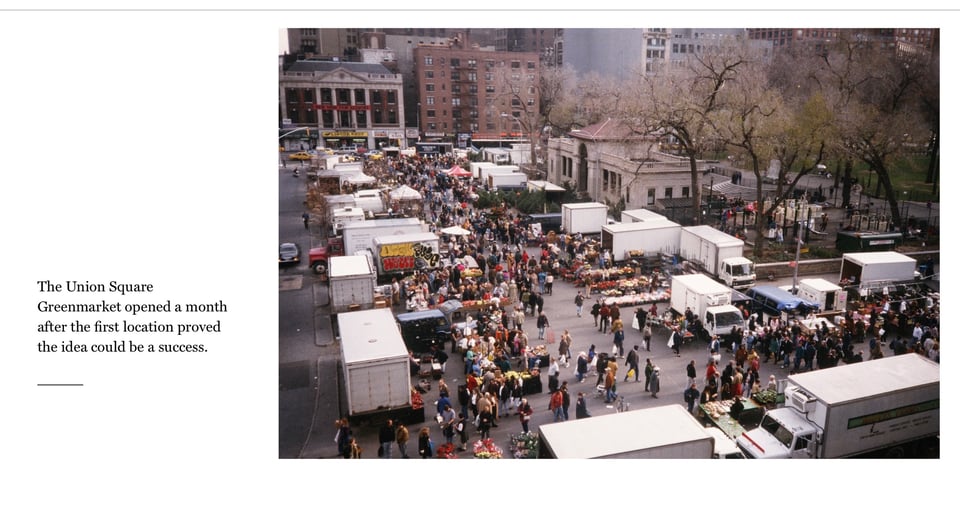
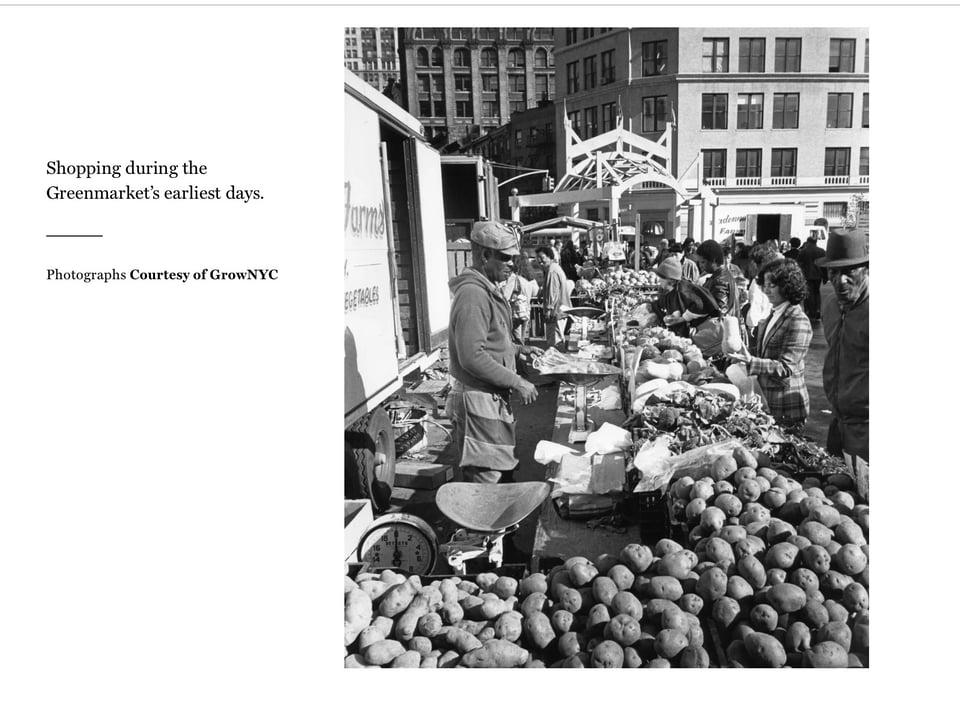
Benepe summed up the first day in a 1978 booklet called The Rebirth of Farmers Markets in New York City: “Farmers accustomed to small crowds at roadside stands were amazed and pleased to be surrounded by throngs of customers for hours on end, while the market customers were equally astonished to find farmers from the country selling a variety of fresh-picked seasonal produce right in the city.” The name Greenmarket was trademarked, Benepe writes in the book, to help distinguish the markets from “too many so-called ‘farmers markets’ which sell the usual Hunts Point wholesale produce imported from all over the U.S. and Mexico and the Caribbean.”
That first Midtown East location was chosen to prove the project’s viability in a highly visible, well-trafficked part of Manhattan. It opened with seven growers from Long Island, New Jersey, and upstate farms who sold early-summer sweet corn, lettuce, tomatoes, and ripe peaches. Many of the farms were barely scraping by. On the first day, Davis says, they’d sold out of everything by the early afternoon.
By all accounts, convincing New York to embrace these markets was not easy. From the early 19th century to the 1930s, New York City had been teeming with street vendors, particularly in immigrant enclaves like the Lower East Side. But increasing chaos and unsanitary, unregulated conditions led to Mayor Fiorello La Guardia’s “war on pushcarts,” which saw the formation of many indoor markets (the only one that survives to this day is Essex Market). Even in the 1970s, three decades later, the idea of bringing outdoor food shopping back to New York had not been popular. To make it happen, Lewis handled farmer outreach, while Benepe worked to persuade city agencies to pass permits amid public outcry over the parking spaces that the proposed markets would engulf.
“Barry’s wheelhouse was very much tenacity — not taking ‘no’ for an answer — and he really battled through so much to change the way people thought about open-air markets,” says Liz Carollo, GrowNYC’s assistant director of food access and agriculture.
“They pushed and shoved and demanded the space, and it’s important to not take that for granted,” says Michael Anthony, a chef whose style at Gramercy Tavern has been defined by his devotion to the Greenmarket. “It wasn’t always here, and it won’t be here unless we keep supporting it.”
Even into the ’90s and early 2000s, getting great ingredients was a far more difficult job for chefs than it is now. “As a Swedish guy, it took me a while to get access to the best purveyors,” says Marcus Samuelsson, who moved to New York three decades ago to work at Aquavit. Even with the right contacts, success wasn’t guaranteed. “So much of sourcing was importing,” says Lena Ciardullo, the executive chef of Union Square Cafe, “which means ingredients that were great at one point in time, but by the time they got here, they weren’t.” The Greenmarket democratized the whole process, and even more than that, it allowed for a real dialogue between chefs and growers. Would ingredients like ramps, shishito peppers, or Tristar strawberries be coveted like they are today without these kinds of conversations? “I don’t think New York would be the culinary capital it is without the Greenmarket,” says Anita Lo, who ran the small restaurant Anisa from 2000 to 2017. “We’d be less connected to the land and our ingredients, and that would be very sad.”
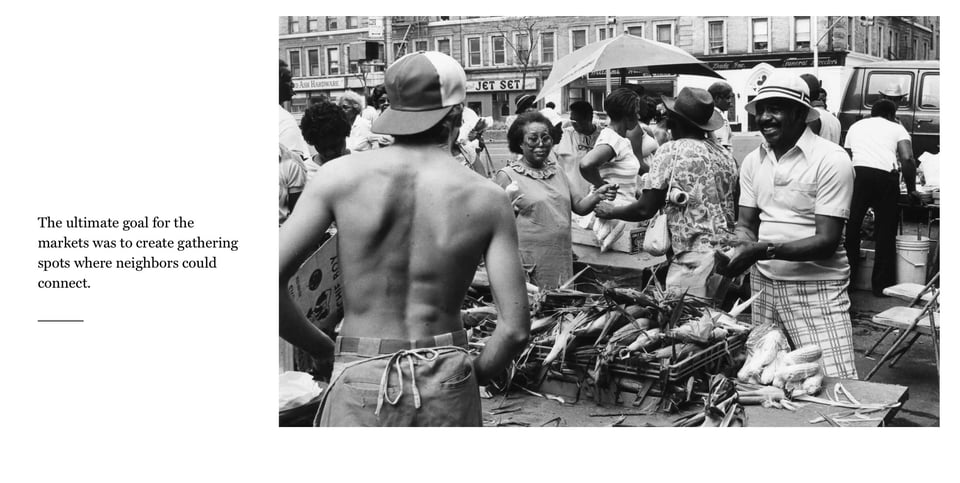
We might also be less connected to one another. As Hoffman reminds me while we tour Union Square’s Greenmarket, a light drizzle beginning to pick up, the whole project was envisioned as a public gathering space. It wasn’t founded by chefs or activists; it was the result of urban planning. When we run into people we know at the markets, it’s because we share at least one interest: good food.
Everyone loves the Greenmarkets, right? But they are as vulnerable to economic hardship as anyone and saw their budget slashed after federal and local cuts last year. If the organization is going to survive another 50 years, it will need even more support. “I think it’s a miracle every time a market goes up,” says Andrina Sanchez, GrowNYC’s communications manager. Consider, she says, the farmers who have to plan and plant months in advance, who weather storms throughout the season, fight off blight and frost, and drive for hours to arrive in time to open at 8 a.m., selling their products in frigid cold or blazing heat. “The whole operation,” Sanchez says, “is insane.” (New York Mag., Grub Street)
in case you need an excuse for a party.