Tuesday, June 2, 2026. Annette’s Roundup for Democracy.
Welcome to Trump’s America where people we need are fired or quit.
Trump Administration Sees Striking Exodus of Legal Talent
The departure of more than 10,000 federal lawyers has left some agencies without sufficient staff and has boosted the ranks of state attorneys general offices and advocacy groups.
President Trump’s upheaval of the federal government has led to an exodus of more than 10,000 lawyers since the beginning of 2025, a striking loss of legal talent that has left some agencies pushing to find attorneys to carry out his agenda.
Roughly one in five lawyers who worked in the government at the end of 2024 had left by March of this year, according to a New York Times analysis of federal employment data.
Along with the usual retirements and turnover in the federal work force, the last year saw deep staffing cuts and the resignations of some staff members who objected to Mr. Trump’s policies. Their departures show how rapidly the president has eroded the image of the federal government as the gold standard for lawyers seeking public service roles.
Instead, many of those looking for such work are flocking to the offices of Democratic state attorneys general and nonprofits that are challenging administration policies in the courts, boosting Mr. Trump’s opponents with seasoned lawyers.
“There’s all this awareness that people in the federal government are dissatisfied, are angry, are frustrated, and want no part of it,” said Phil Weiser, Colorado’s attorney general, who has hired 22 lawyers from across the federal government in the last year. “That’s translating directly to people saying, ‘I want to be part of organizations that actually operate with integrity, that people want to be a part of, that people feel good about doing the right thing.’”
Wariness of the Trump administration is also palpable inside law schools, where many aspiring lawyers who would have once jumped at the chance to hold a federal government job are seeking alternative paths, according to faculty members and students.
“A lot of people my age are asking, ‘Is it worth getting a job, and will that help career wise — having one year of Trump administration experience on your résumé?’” said Matthew Duray, who described himself as a conservative Republican and just finished his first year at George Mason University’s Antonin Scalia Law School. “Or will that hurt? And that’s the question I guess everyone’s asking, and that’s the bet you have to make ahead of time. But it’s hard to know long term.”
Departures Outpace Hires
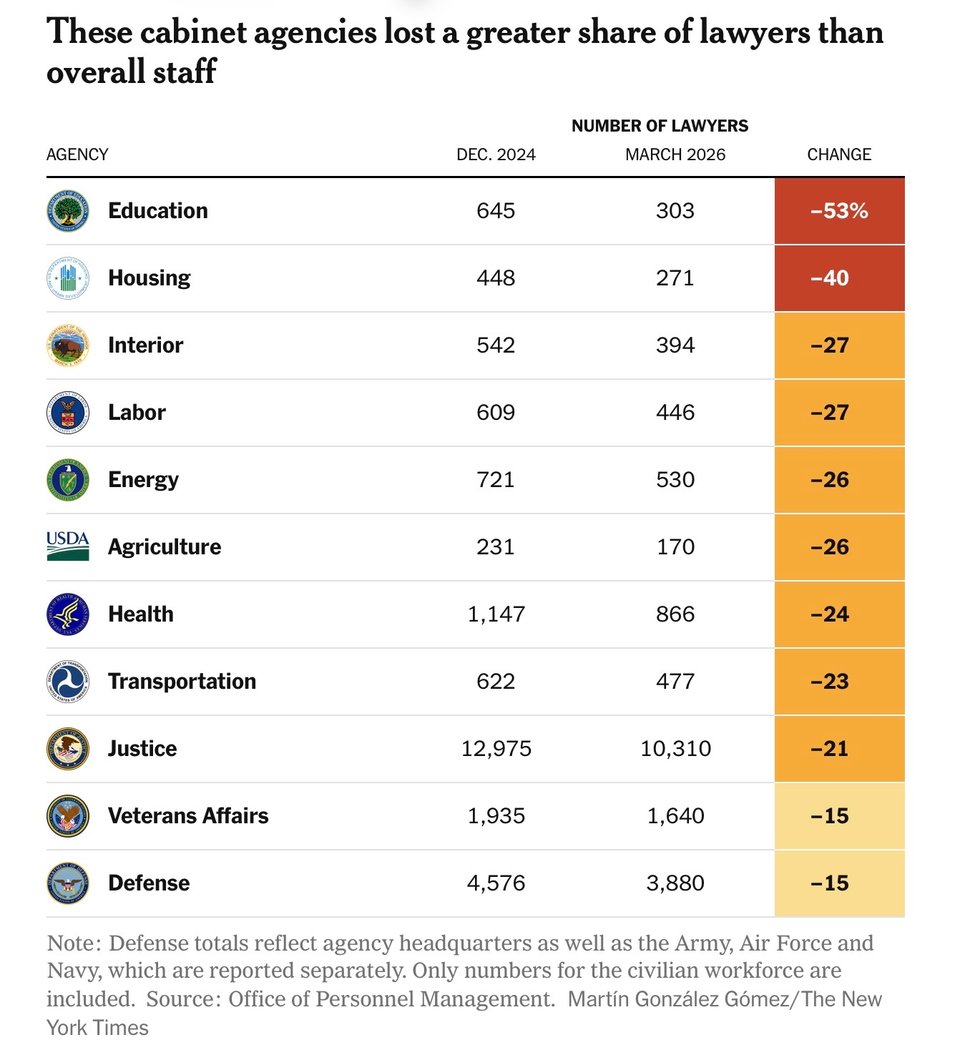
While federal agencies brought on about 3,200 lawyers since the beginning of 2025, departures still outpaced hiring, data shows. Lawyers also exited the government at a faster rate than turnover in the overall work force. All told, the federal government employed about 37,000 civilian lawyers at the end of March, 17 percent fewer than it did at the end of 2024.
The Justice Department, which employs more than a quarter of all government lawyers, saw the largest decline in raw numbers. But other agencies — including the Department of Education, the Consumer Financial Protection Bureau and the Department of Housing and Urban Development — lost an even greater share of attorneys.
The only major agency to gain lawyers was the Department of Homeland Security, which saw its legal ranks grow by 21 percent as it drove Mr. Trump’s immigration crackdown.
It is difficult to assess the scope of the impact the legal departures have had on government functions. In some ways, it has meant fewer internal obstacles for a president who saw career lawyers as an impediment to much of his first-term agenda.
But the deficit of lawyers has also meant that there are fewer of them available to defend the administration’s policies in court, and to enforce laws across the government.
“There are a lot of things that just can’t get done without lawyers — appearances in court, reviewing of regulations,” said Erik Heins, a former lawyer at the Department of Housing and Urban Development who was fired last year after raising concerns internally about fair housing lawyers being reassigned to other offices. As of March, the agency employed 40 percent fewer lawyers than it did at the end of 2024.
The Education Department, which shed more than half of its lawyers since the end of 2024, now needs more attorneys for its civil rights division to clear a backlog of discrimination cases, Linda McMahon, the education secretary, recently told Congress.
The Justice Department, which saw its attorney ranks shrink by a fifth, has relaxed its hiring requirements for some positions.
“We are fast-tracking applications to bring talented professionals on board,” Harmeet K. Dhillon, the assistant attorney general for the Justice Department’s civil rights division, declared in a recruiting ad posted on social media this spring.
But the overt political pressure inside the Justice Department to carry out Mr. Trump’s retribution agenda has turned off some potential candidates. (New York Times)
Trump’s disastrous behavior causes more problems about Iran.


Big News. Research in America now moves forward.
No one knows why.
NSF Reverses Funding Freeze for Duke, Harvard and Yale.
The National Science Foundation has reversed its recent freeze on new grant funding for Duke, Harvard and Yale Universities, Nature reported. Limitations on new grants for Princeton University, however, remain in effect.
The reversal took place on May 28, one day after Nature published a story detailing a funding pause for all four institutions.
An NSF database showed that on April 9 the accounts of the four universities had been marked with a note that said, “Future Awards to Organization on Hold,” Nature reported. As of Thursday, the note had been removed from every account except Princeton’s.
So far this year, the number of new grants received by each institution is down significantly from previous years, but that seems poised to change; “a few grants” have already been released to researchers at both Harvard and Duke since the freeze was lifted, an NSF staff member told Nature.
NSF did not respond to Inside Higher Ed’s request for comment on why the funding freeze was repealed. (Inside Higher Ed)
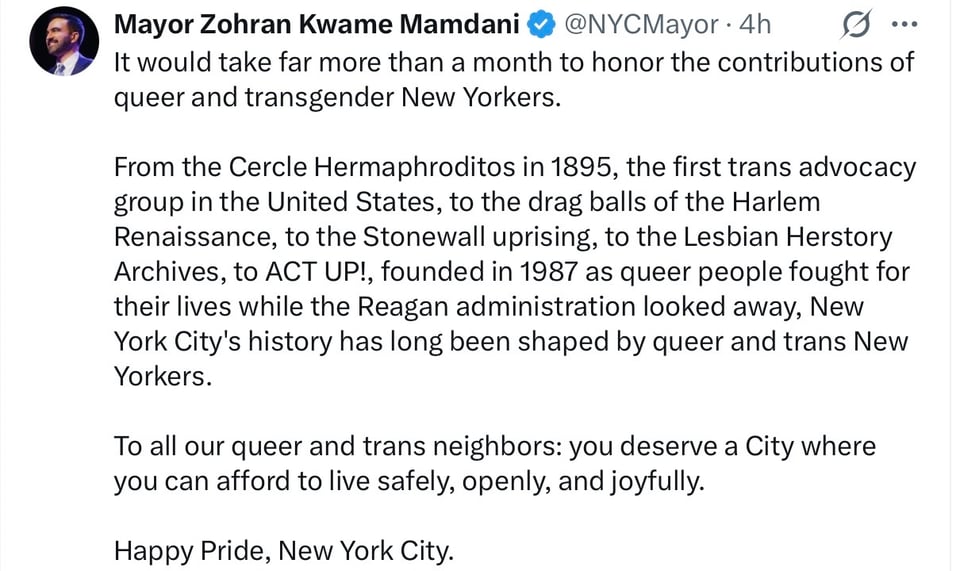
It’s Pride Month.
The Debates for the new Congressperson in CD 12 continue in New York City.


One more thing.
My cousin Stephanie Ruskay is running for the Assembly.

The Barack Obama Presidential Center opens to the public on June 19, 2026 — Juneteenth — in Jackson Park on Chicago’s South Side. The official grand-opening celebration runs June 19–21, 2026.
Entry is by Timed tickets. Buy them below.👇
Museum Admission — Obama Presidential Center
A Guide to the Bookstores owned by your favorite authors.
NEW YORK (AP) — When Ann Patchett opened Parnassus Books in 2011, two major bookstores in Nashville had closed and physical bookstores in general seemed endangered as Amazon’s share of the market kept growing. Amazon remains the dominant force, but physical, brick-and-mortar stores have rebounded — and stores owned by authors such as Patchett are now a niche unto themselves, found everywhere from Brooklyn to New Mexico.
Here’s a virtual tour of author-owned bookstores across the U.S.
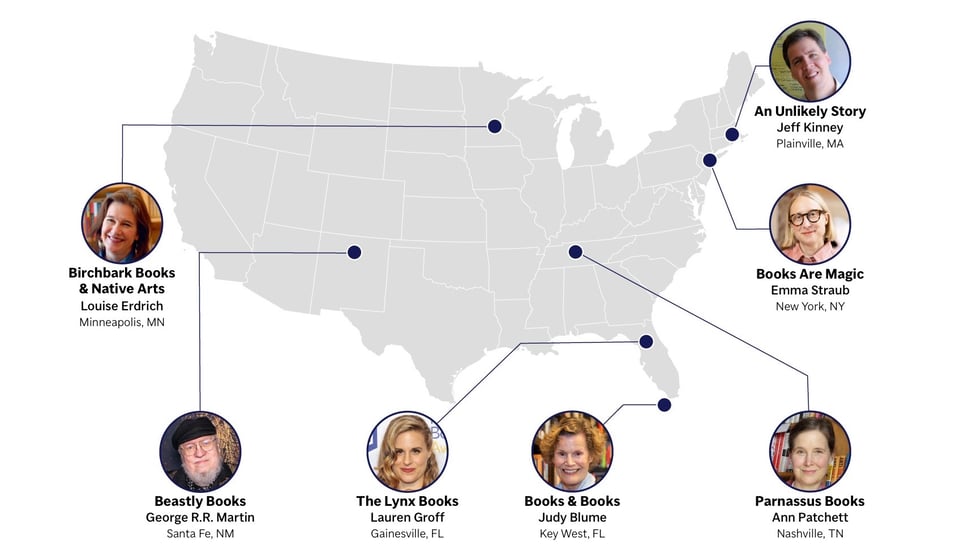
Judy Blume: Books & Books, Florida.
Judy Blume and her husband, George Cooper, are longtime residents of Key West, Florida, and have become fixtures in the local culture. Cooper helped restore an old movie theater into a multiplex venue and Blume and Cooper helped found the nonprofit Books & Books — an outpost of the Miami-based sellers that opened in 2016 — located just off the town’s main road. Blume may be known worldwide for such novels as “Are You There God? It’s Me, Margaret,” but on a given day you can find her ringing up a sale at the register, or helping a customer choose a book. Or you can see her greet the many fans who have traveled far to meet the author they say changed their lives.
Louise Erdrich: Birchbark Books & Native Arts, Minnesota.
Founded by Louise Erdrich in 2001, Birchbark is based in Minneapolis and has a mission tied closely to the author’s Ojibwe background (she’s an enrolled citizen of the Turtle Mountain Band of Chippewa Indians). Her store specializes in Indigenous literature and bills itself as a meeting point for “literate Indigenous people who have survived over half a millennium on this continent.” Birchbark even served as a muse for Erdrich’s 2021 novel, “The Sentence,” narrated by a bookstore employee whose boss just happens to be a woman named Louise. “I guess I have some things in common with her,” the author confided to GMToday.com.
Lauren Groff: The Lynx Books, Florida.
Lauren Groff’s store in Gainesville, Florida, isn’t just a member of the author-owned circle but part of a wave of stores opened in recent years that have a larger social mission. Based in a state that ranks among the country’s leading book banners, The Lynx is a general-interest bookstore that Groff and husband/co-owner Clay Kallman opened in 2024 and emphasizes books forbidden in schools and libraries. “One of the purposes is to create a lighthouse, sort of showing that the rest of the country and world that Florida is not an intolerant backwater,” Groff, author of National Book Award finalist “Fates and Furies,” told the Southern Literary Review in 2025. “It is full of good people who work very hard to allow for the freedom of expression, tolerance, and love of all people.”
Jeff Kinney: An Unlikely Story, Massachusetts.
Local stores are expected to be modest in scale, but the blockbuster sales for the “Diary of a Wimpy Kid” series expanded the ambitions of author-owner Jeff Kinney to superstore heights. He didn’t simply reconfigure an existing building, but had a new one built from scratch, with all the trimmings. An Unlikely Story is a bookstore housed in a colonial-influenced, 3-story building in downtown Plainville, Massachusetts that also includes a cafe, event space and writing-drawing quarters for the author. Kinney, who opened his store in 2015, recently said he is planning to add a restaurant, beer garden and park to the downtown area.
George R.R. Martin: Beastly Books, New Mexico.
Like the stores run by Groff and Erdrich, the Santa Fe, New Mexico-based Beastly Books is very much an extension of the worldview of its owner, “A Game of Thrones” author George R.R. Martin. It is a “cozy den” for speculative fiction, according to the store’s homepage, and a haven for banned books, locally written works and rare first editions. Founded in 2019, Beastly Books is located close to another Martin outpost, the Jean Cocteau Cinema, and is named in part for Cocteau’s classic film adaptation of “Beauty and the Beast.”
Ann Patchett: Parnassus Books, Tennessee.
Not every bookstore opening leads to a guest appearance with Stephen Colbert, but a year after the launch of Parnassus, Ann Patchett found herself on “The Colbert Report,” whose host likened her venture to the Nora Ephron comedy “You’ve Got Mail,” in which Meg Ryan plays an independent store owner driven out of business by a nearby chain. The Nashville-based Parnassus has since become one of the country’s signature independent sellers, visited by “You’ve Got Mail” co-star Tom Hanks among others, and a platform for Patchett to champion fellow authors.
Emma Straub: Books Are Magic, New York.
Like Patchett, Emma Straub became a bookstore owner in the aftermath of a local absence: BookCourt, where the author once worked, had closed. She and her husband, Michael Fusco-Straub, opened Books Are Magic in 2017 in Brooklyn. The store with the pink murals in front became a local hit and gained national recognition, cited as a personal favorite by Jenna Bush Hager of the “Today” show. Straub and her husband have since opened a second Books Are Magic location in the borough.
(Associated Press)

