Tuesday, July 21, 2026. Annette's Roundup for Democracy.
Feel optimistic as the Midterms approach!
First this.
It’s No Longer So Much Fun to Be MAGA in Washington.
by Sally Quinn.
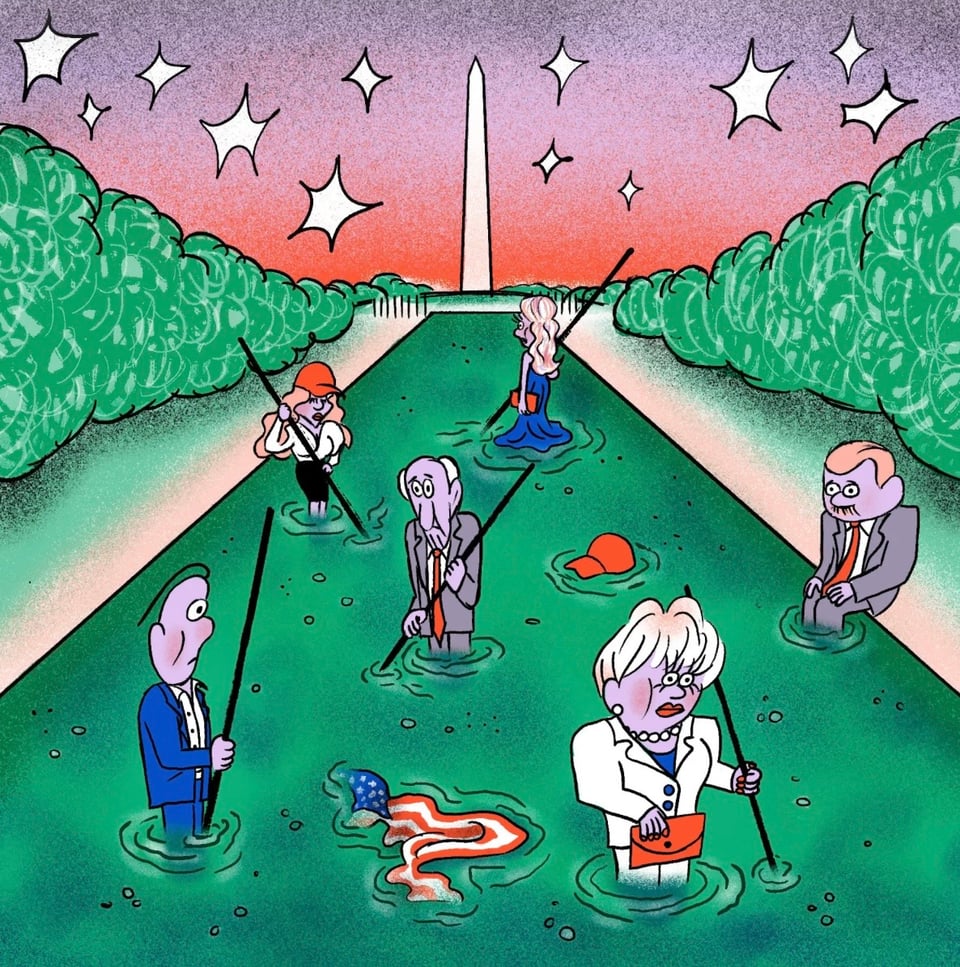
The worst part about living in Donald Trump’s Washington has been seeing just how much fun he and all the MAGA vandals he brought to power have been having sacking and pillaging the place. This while the rest of us longtime Washingtonians who abided by norms, shared values and even bipartisanship were filled first with shock, then a feeling of helplessness, and hopelessness. It could border on passivity. What could be done?
A year ago, I wrote a guest essay for Times Opinion about how scared many of us were in Washington: “Nobody feels safe. Nobody feels protected. This is a city where people seek and, if it all goes well for them, wield power. But today in Washington, those who hold — or once held — the most power are often the most scared. It is not something they are used to feeling.”
Sometimes it felt as if the Trumpists could smell our fear, and seemed to be enjoying it.
Last fall, when the MAGA revolution was at its most brazen and apparently unstoppable, I remember running into Kellyanne Conway at a newish private club, already packed with crypto types, who scolded me: “Sally, I wish you would stop writing all these pieces about how terrible Washington is now and how everyone is so depressed and scared. We’re having fun! You know what your problem is? You’re not invited to the right dinners and parties.”
I held my tongue. But there is a reason I have avoided the gleeful, glitzy new MAGA society that has sprung up over the last year and a half, and tried to ride it out with my friends.
Lately, the vibe has shifted. The MAGA Republicans don’t seem to be having such a good time ransacking the place anymore.
It’s not that the party is over, exactly. And to be clear, there’s lots more damage that will be done to this city, and to our democracy — not to mention America’s place in the world — before Mr. Trump and his rabble are through. But it’s clearly starting to dawn on the MAGA minions that the morning after is going to be a doozy.
Now they’re the ones in despair, fearful and losing hope.
Even the true believers are questioning the MAGA theology.
Why are we at war with Iran still? Our military is humbled, our reputation in tatters, and now gas prices are going up again.
The distractions keep coming, of course. The cage fights on the White House lawn; the sweltering, sparsely attended 250th celebrations; the desperate speech claiming rigged elections. Even the algae-clotted Reflecting Pool has become a spiritual destination, a shrine for democratic pilgrims.
Many Republican lawmakers are beginning to quiet-quit. The Wall Street Journal called it the G.O.P. “zombie Congress” — not in open revolt, exactly, but not ready to take a bullet for the president and his self-serving crusades as the midterms approach.
Then there’s Mr. Trump’s estrangement from some of his biggest allies: Tucker Carlson, Megyn Kelly, Candace Owens, Alex Jones and Ann Coulter, not to mention former Representative Marjorie Taylor Greene. Even onetime Trump-skeptical Republican senators who had joined the bandwagon, like Bill Cassidy and John Cornyn, have, after being primaried by Trump-endorsed challengers, been more vocally critical. And even Joe Rogan has had his altercations with the president.
All of that is heartening to Washingtonians who see these rifts as representative of Mr. Trump’s weakening fan base throughout the country.
One night last month, the New York financier and Times Opinion contributor Steven Rattner and his wife, Maureen White, had their popular annual cocktail buffet at the Hay Adams Hotel on the rooftop overlooking the White House. Everyone gathered on the balcony to see the Claw — the U.F.C. fighting stage built on the South Lawn of the White House — which then dominated the view. The minute people looked at it, they would burst out laughing. It was so garish, so grotesque and so bizarre that the only proper reaction was disbelief.
The many Democratic politicians and supporters in attendance were feeling energized. There were signs of — dare we say it — bipartisanship, a cause for optimism: The Senate had just voted against Mr. Trump's war with Iran, and his poll numbers were sliding perilously toward the 20s. Mr. Rattner’s toast was simple: “I feel hopeful.”
One of the Democrats at the Rattner dinner was Senator Mark Warner of Virginia, vice chairman of the Intelligence Committee. Mr. Warner said that the mood in Washington, especially among the Republicans, had changed considerably since the early days of the second Trump administration. The proposed $1.776 billion fund for those supposed victims of government persecution “is such an abuse that nobody can defend it. Will that translate into huge electoral wins? I think so.”
Mr. Warner pointed to the war in Iran: “absolute folly.” Not to mention the self-dealing, the ballroom, the Reflecting Pool, the pardons, the at least $2.2 billion the president made in his first year back in office. “My colleagues say: ‘We can’t go on like this. This is obscene.’ But will they say it publicly?”
Even Lindsey Graham, whom I considered a friend and who was popular in the Senate and one of the few senators always advocating bipartisanship, had lost his moral compass. Before his death last week, he’d remade himself into one of Mr. Trump’s staunchest supporters. What will he be remembered for? His loyalty to a president he once openly despised?
The cage fights may have been the tipping point for many here — the moment, with the combatants tromping with cartoonish bravado through the White House, that it became clear that Mr. Trump was punch-drunk, raging against his enemies.
The day before the cage fights, Cafe Milano, one of the hottest restaurants in Washington for the past 34 years, was packed. Much to the chagrin of some of the regulars, a number of the MAGA crowd in town for the U.F.C. event were there, including Ivanka Trump, Jared Kushner and David Ellison, whose Paramount+ had exclusive broadcast rights to the fights.
But the mood felt off. Less jubilant. As if they knew that the U.F.C. fights were really going to be the moment when MAGA jumped the shark.
“The Republican Party is in shambles today,” J. Michael Luttig, a former judge on the U.S. Court of Appeals for the Fourth Circuit who turned against Mr. Trump, told me.
“Trump eats his own,” he said, pointing to Senators Cornyn and Cassidy, whom the president successfully had primaried. “Taking them out was a turning point for Congress.”
The presidential historian Michael Beschloss, who from Day 1 of Mr. Trump’s first term warned of a potential dictatorship, likened the mood in Washington today to an earlier time. In 1931, with the country in the grips of the Great Depression, Republicans lost control of the House for the first time in 12 years. Two years later, they lost the White House. “I don’t see people looking fearful, helpless and hopeless here anymore,” Mr. Beschloss said. “We have now seen that democracy is alive and kicking.”
“People are genuinely disgusted and they’re now combative,” said Leon Wieseltier, editor of Liberties magazine, about the mood shift. “Like Popeye, they’re essentially saying, ‘That’s all I can stands, and I can’t stands no more.’ Before he eats his spinach to fortify himself.” (Sally Quinn, guest columnist, New York Times)
How stupid can they get!
The trail of damage from Trump's malicious policies is long.
In the 19th century, and early 20th century, suffragists who knew the cost of war.
In the Civil War, 620,000 to 750,000 soldiers died.
In World War I, Worldwide military deaths: Approximately 9.7–10 million.
* Worldwide civilian deaths: Approximately 7–10 million (from combat, disease, famine, and genocide).
* Total deaths: Roughly 16–20 million.
The suffragists’ demand for the vote was often linked to efforts to stop war.
Wars fought from the sky lead to fewer deaths, but does that matter to those who find themselves with empty seats at their kitchen tables! Or have no money for food coming to their family because of a lost bread-winner?
What Trump's war brings.
Nigerian children pay the price for Iran War as malnutrition and poverty surge.
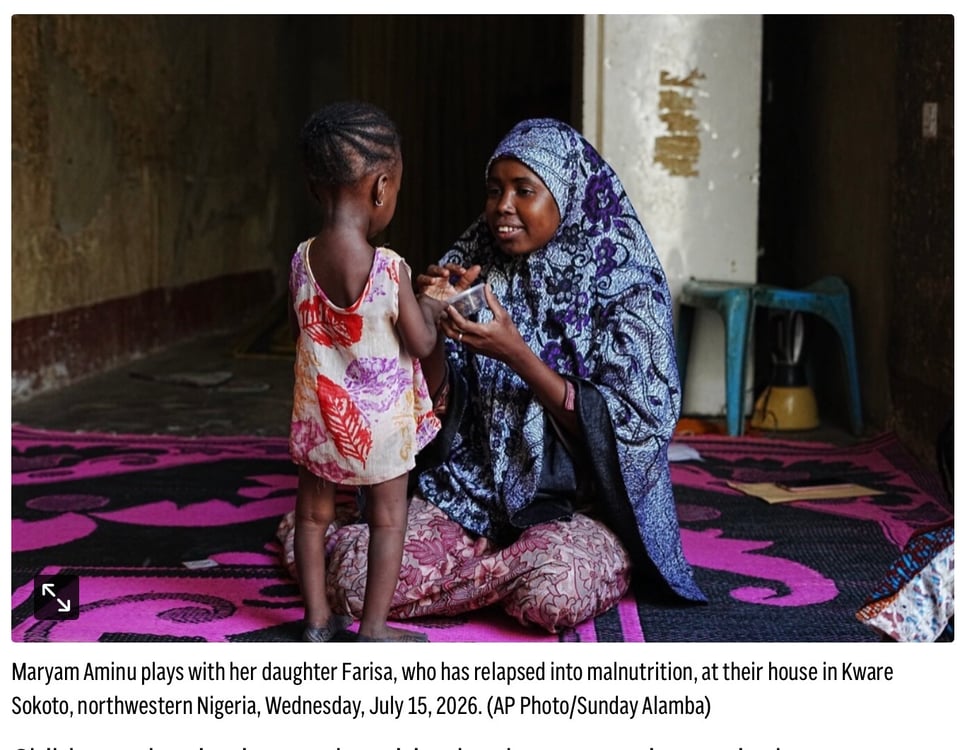
SOKOTO, Nigeria (AP) — Maryam Aminu was hardly surprised when the last of her six children was diagnosed with malnutrition in April for a second time. She was barely feeding the 18-month-old regularly, let alone with nutritious foods.
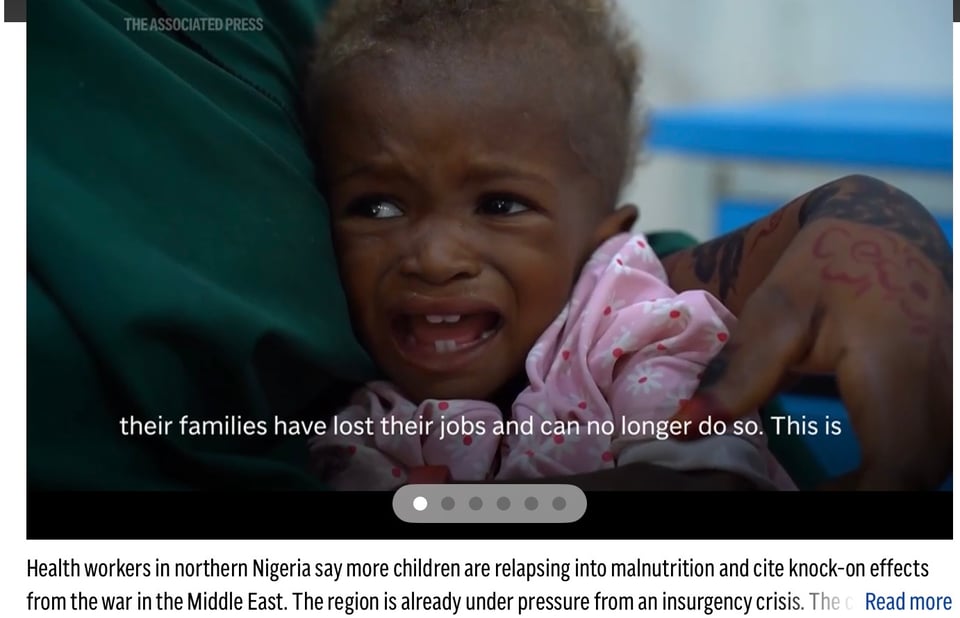
Although the family in northwest Nigeria has struggled with economic hardship, their situation deteriorated after February, when her husband, Shehu Aminu, lost his job as a taxi driver due to a spike in the retail price of petrol caused by the war in Iran.
“When she was diagnosed the second time, even though I suspected it, I was sad and angry because I knew why,” Aminu said in the living area of their unvarnished two-bedroom house in the quiet town of Kware, Sokoto, as ash from the coal stove billowed into the room. “Times are tough, and the food is not consistent.”
Children relapsing into malnutrition has become an increasingly common occurrence in the state and across northern Nigeria, according to local health and aid workers, who cite knock-on effects from the Iran war.
Northern Nigeria, one of the world’s poorest regions, is already under pressure from an insurgency crisis. Now, the conflict in the Middle East has worsened food security for millions of people living in poverty, especially children.
At the same time, Nigerian President Bola Tinubu’s vast economic reforms sparked high inflation after fuel subsidies were removed three years ago and the currency was devalued. A World Bank technical report this week stated that 139 million Nigerians are now poor or vulnerable to poverty.
If the war in the Middle East continues, up to 23.4 million additional children could fall into monetary poverty — meaning a lack of income or consumption — by the end of the year, the United Nations children’s agency UNICEF said in a report this week. It warned that at least 80% would be in Africa and Asia.
“Children are paying the price for the escalating conflict in the Middle East, including children far beyond the region,” said UNICEF Executive Director Catherine Russell. “The longer this continues, the worse the consequences will be.”

Dangers ahead for children
Amid the Iran war, the closure of the Strait of Hormuz — through which a fifth of the world’s oil and gas passed before the war — sent a ripple effect across the world. A worldwide fuel shock drove up the prices of everything from gas and groceries to fertilizer and airline tickets.
In Nigeria, fuel pump prices jumped from 800 naira ($0.58) per liter in February to 1,400 naira ($1.02) in April, with a knock-on effect on the prices of food and necessities.
U.S. President Donald Trump has been trying to force Iran to fully reopen the route for months, turning to everything from airstrikes and naval blockades to negotiations and threats.
In Sokoto, where the soaring prices have brought more hardship for families, health workers told The Associated Press that they’ve been seeing more children returned to health facilities this year after falling back into malnutrition.
At a hospital in Sokoto, records shared with AP show nearly 40 children previously treated for malnutrition since February are currently under treatment again, in addition to those not documented.
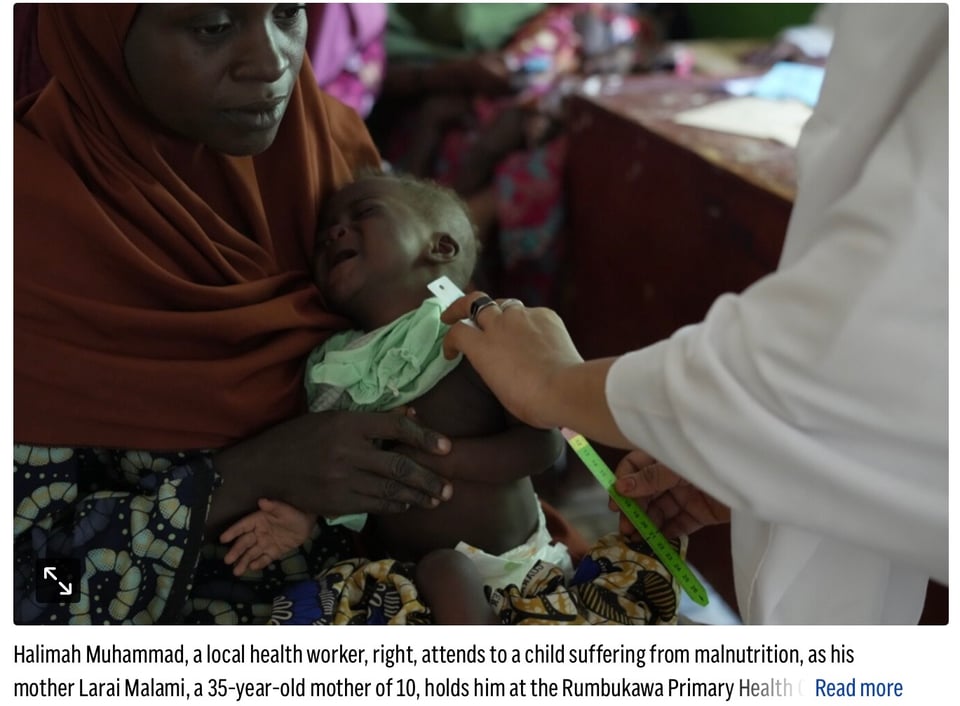
“I am worried and sometimes angry about the increasing numbers we are seeing,” said health worker Halimah Muhammad.
Beyond current realities, soaring prices and economic hardship mean that children in poor households are more likely to be stunted in the long term, UNICEF’s Russell said in an interview with the AP as she was visiting Sokoto this week.
“Their development will be compromised. They are less likely to stay in school because their parents are under so much financial stress. So the long-term implications for children are absolutely terrible,” said Russell.
The war has also affected fertilizer supplies and prices, threatening the planting season and worsening the fate of mostly farming communities in northern Nigeria who have struggled to access their farmlands amid a deadly conflict with armed groups.
“I wake up every morning unhappy, seeing I can no longer provide for my family,” said Shehu, Maryam’s husband. “Then, 2,000 naira could buy you a nutritious meal for the whole family. Now, you need 5,000 naira to buy what 2,000 naira would buy.”
Most of their meals are pap, a kind of corn pudding, and rice. “There is no way to feed the children,” he said.
‘I wish she were excited and full of life’
People in northwest Nigeria are caught between regular attacks by bandit groups who specialize in kidnapping for ransom and Islamist militants who have been expanding their territory. The Iran war, analysts say, compounds the impact.
“This distant war offers no relief for the north’s vulnerable,” Ikemesit Effiong, a partner at SBM Intelligence, a Lagos-based geopolitical risk advisory, said.
Larai Malami, a 35-year-old mother of 10, gave birth to her last child in December, but the infant has already been diagnosed with malnutrition twice.
Her family has been struggling after her husband lost his job as a motorcycle rider and crossed the border into neighboring Niger to look for work.
Malami worries about the fuel price because it keeps the price of food high and her husband away. “I worry that the child might never be fully well,” she said.
That is a sentiment shared by Aminu, too. “I wish she were excited and full of life,” she said. (Associated Press)
Did you have a rough weekend?
Ours started on Thursday. Air quality readings that were in the dangerous zone. Brutal thunderstorms. Even in Montauk, we live in an America hurt by the climate policies imposed on the world by Trump and his enablers.
Trump says climate change is a hoax.
The only hoax I know may be the vote count in the 2024 election thanks to Elon Musk. But I have no proof of that so let's move on, and win big in 2026 and 2028.
Majority of US voters link extreme weather to climate crisis, study finds
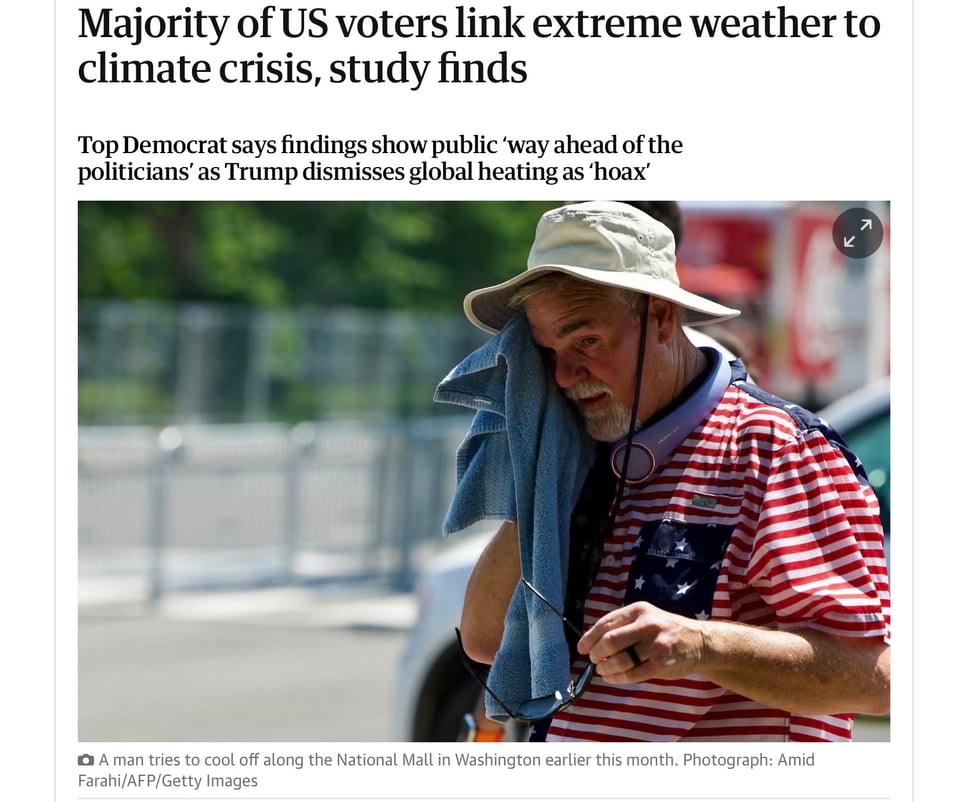
Amid a summer of dangerous heat, drought and floods, a majority of Americans are connecting increasingly severe weather to the climate crisis, new polling shows, despite efforts by Donald Trump to dismiss global heating as a “con job” and a “hoax”.
It’s a sign that attempts to suppress and polarize climate concerns may not be seeing full success, said Grace Adcox, senior climate strategist at Data for Progress.
“We started with the question of ‘are extreme weather events increasing,’ because we thought [that] if we can find consensus on that, that can be an entry point to being able to have a more bipartisan conversation about climate and climate intervention,” she said.
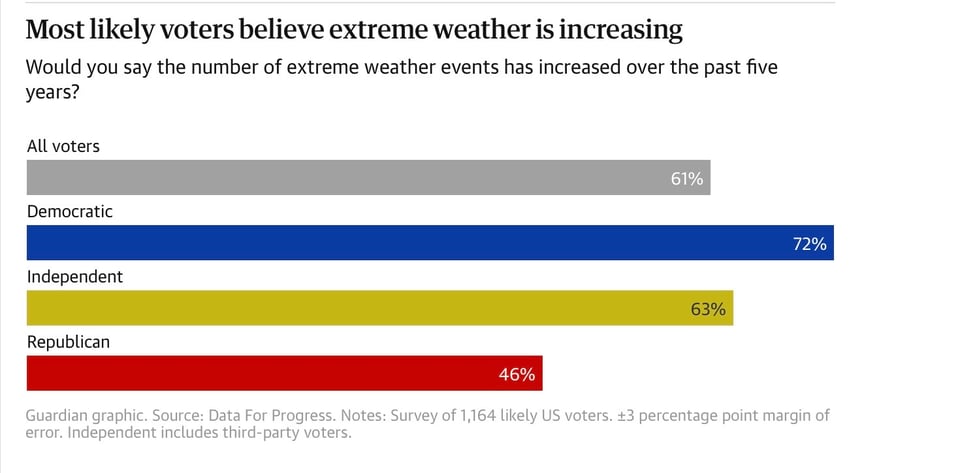
About 61% of likely American voters believe extreme weather events have become more frequent over the past five years, the survey from the progressive polling firm Data for Progress, shared exclusively with the Guardian, found. That includes 72% of Democrats, 63% of Independents, and nearly half – 46% – of all Republicans.
Sheldon Whitehouse, the Rhode Island senator who has long criticized Democrats for quieting their talk of global warming – or “climate-hushing” – said the new data “adds to the mountain of evidence that the public is way ahead of the politicians on the dire consequences of climate change”.
“Climate hushers who ignore this righteous fight should take note,” he told the Guardian.
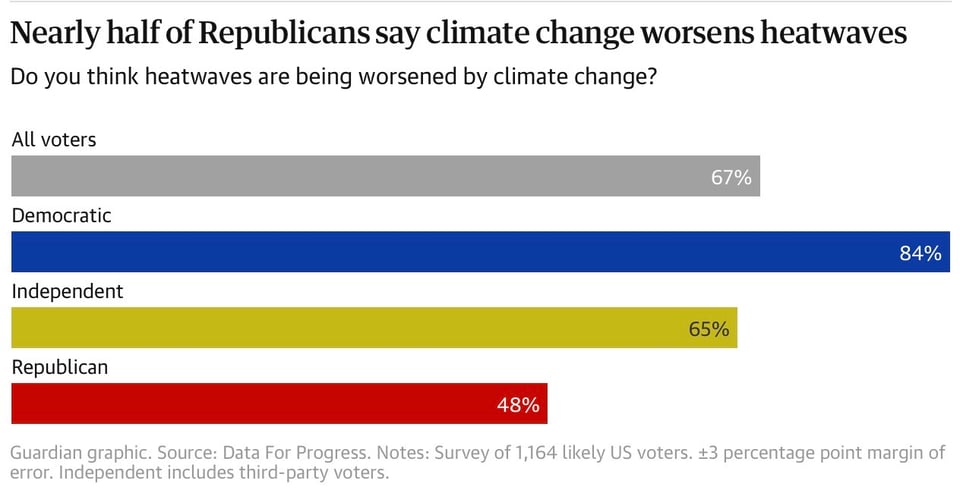
The researchers also asked participants about whether or not specific forms of extreme weather are being “worsened by climate change”. Majorities linked climate change to worsening wildfires (64%), droughts (63%), flooding and flash flooding (62%), hurricanes (59%), and severe thunderstorms and hailstorms (59%). But heatwaves topped the list, with 67% saying climate change is making them worse – including 48% of Republicans, the highest share for any of the extreme weather events surveyed.
That could be because nearly everyone in the US has experienced unusually hot days or weeks in recent years, said Adcox. High temperatures kill more people annually in the US than hurricanes, tornadoes and floods combined.
“There are regional differences across experiences with extreme weather,” said Adcox. “Extreme heat happens to have the biggest footprint in the American context compared to some of these other types of extreme weather.”
The finding indicates that scorching conditions could provide an “interesting opening salvo” to speak about the climate crisis, she added.
Anthony Leiserowitz, director of the Yale Program on Climate Change Communication, said the new poll’s findings are “very consistent” with the conclusions researchers have drawn based on Yale’s surveys, which have shown Americans are increasingly linking extreme weather to the climate crisis and want to protect workers from heat.
But Jennifer Marlon, a senior research scientist at Yale who also focuses on climate communications, said despite this, it’s not clear if most Americans understand why exactly the climate is changing.
“This is probably the biggest misconception out there – many Americans still think the warming is due to some kind of natural cycle. But it isn’t,” she said, adding that a spring survey from Yale Program on Climate Change Communication found 27% of people think that the changes are mostly natural.
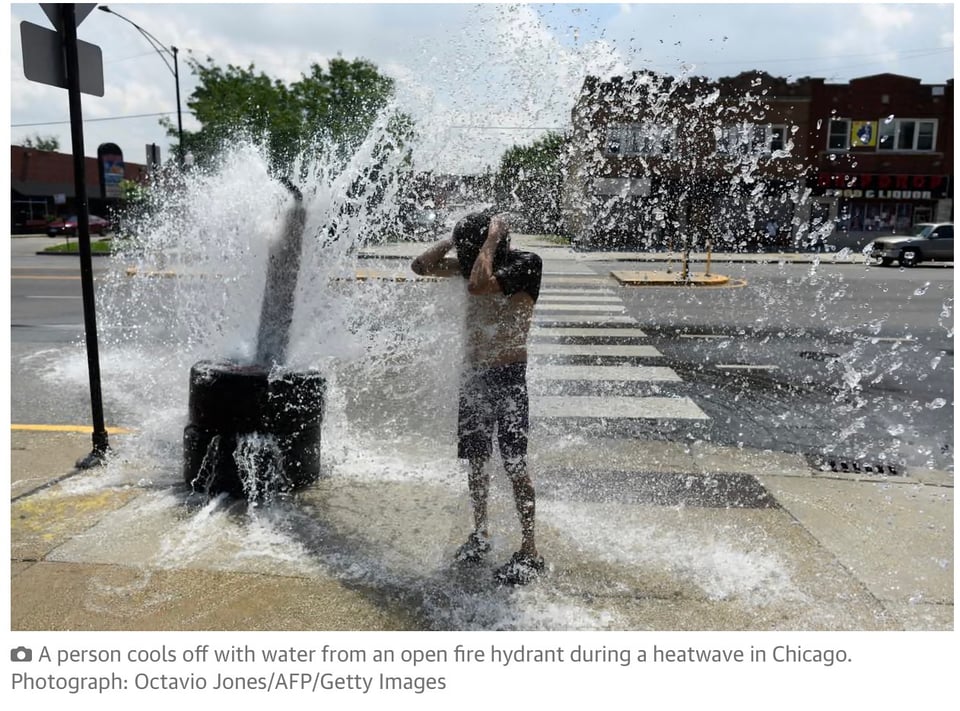
The survey findings could help inform how to frame future conversations about the climate crisis with skeptical Americans, said Adcox. For instance, the data indicates heat may be the form of extreme weather that invites most conversation about climate.
“You can say, hey, this extreme heat event is crazy, so let’s talk about it, let’s talk about why it’s happening,” she said.
Another survey finding also indicates that even Americans who may not be convinced that the climate crisis is human caused – or even that it is happening – would support some climate justice-focused measures.
Amid global and national rising temperatures, workers who labor outdoors – such as construction workers, farm workers and roofers – are among the populations most vulnerable to heat-related illness.
In fact, extreme heat is a leading contributor to workplace injuries and deaths. Some indoor workers, including those in warehouses, commercial kitchens and manufacturing facilities, can also face severe heat risk due to a lack of air conditioning, poor ventilation, humidity and other factors. It’s a risk that the polling indicates most Americans think lawmakers should address.
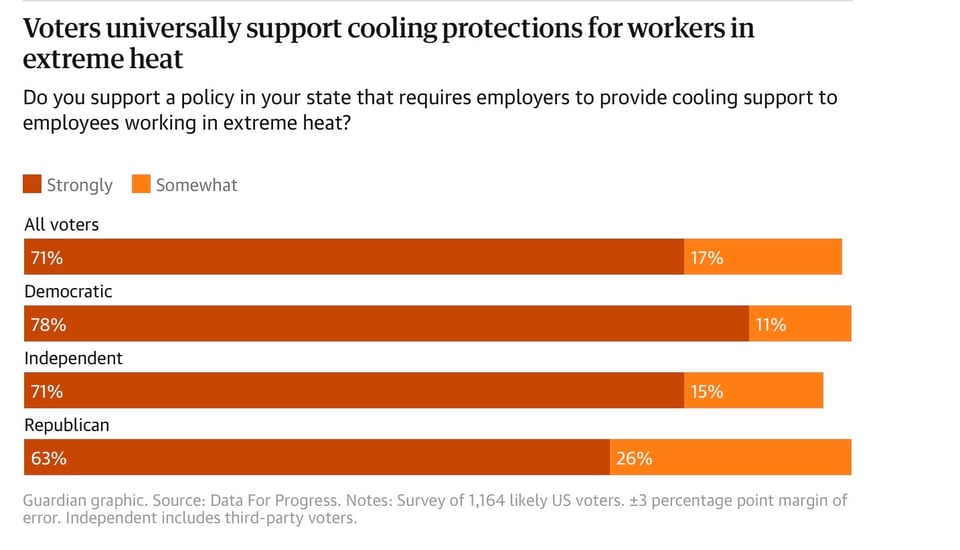
About 88% of participants in the Data for Progress survey said they favor policies in their own state requiring employers to provide heat protections like access to drinking water, shade, breaks, and air conditioning. Only 7% of likely voters said they oppose the policy, indicating broad support for the protections that previous Data for Progress polls have also shown.
“These findings send a powerful message: protecting workers from dangerous heat isn’t a partisan issue,” said Jessica E Martinez, executive director of the National Council for Occupational Safety and Health, a network of two dozen local grassroots worker organizations. “When 88% of likely voters … support requiring employers to provide basic, lifesaving heat protections, it’s clear the public expects every worker to be protected.”
She said the polling indicates the public would support the creation of a federal heat standard – something workers have demanded for years, but on which progress has stalled under Trump.
The current administration this April also allowed the Occupational Safety and Health Administration’s nationwide enforcement initiative focused on protecting workers from heat illness, then later issued a revised but vastly weakened program.
“Our hope in continuing to profile the broad and particularly strong support that we see across partisanship for extreme heat protections for workers is a way for us to illustrate what could it look like to take an approach to climate that puts working people first,” said Adcox. (The Guardian)
Democrat or Democratic Socialist?
Mayor Mamdani of New York City finessed this answer beautifully in his interview with the New York Times.
Do you see yourself as a Democrat or a democratic socialist?
Because you said “our party,” and obviously you ran as a Democrat.
I am both. I’m a Democrat and I’m democratic socialist. So much of what makes me proud to be a Democrat is looking at what our party used to stand for. You think about the Four Freedoms, you think F.D.R., you think the New Deal. Those are at the core of what our party’s identity is, and yet it feels like to experience it, you have to read about it. You can’t see it around you anymore. And that isn’t something that I’m willing to accept, and I know that many feel similarly.
Perhaps more Democrats should answer as Mamdani did too.
The Democrats’ ‘Capitalism vs. Socialism’ Debate Is Beyond Useless
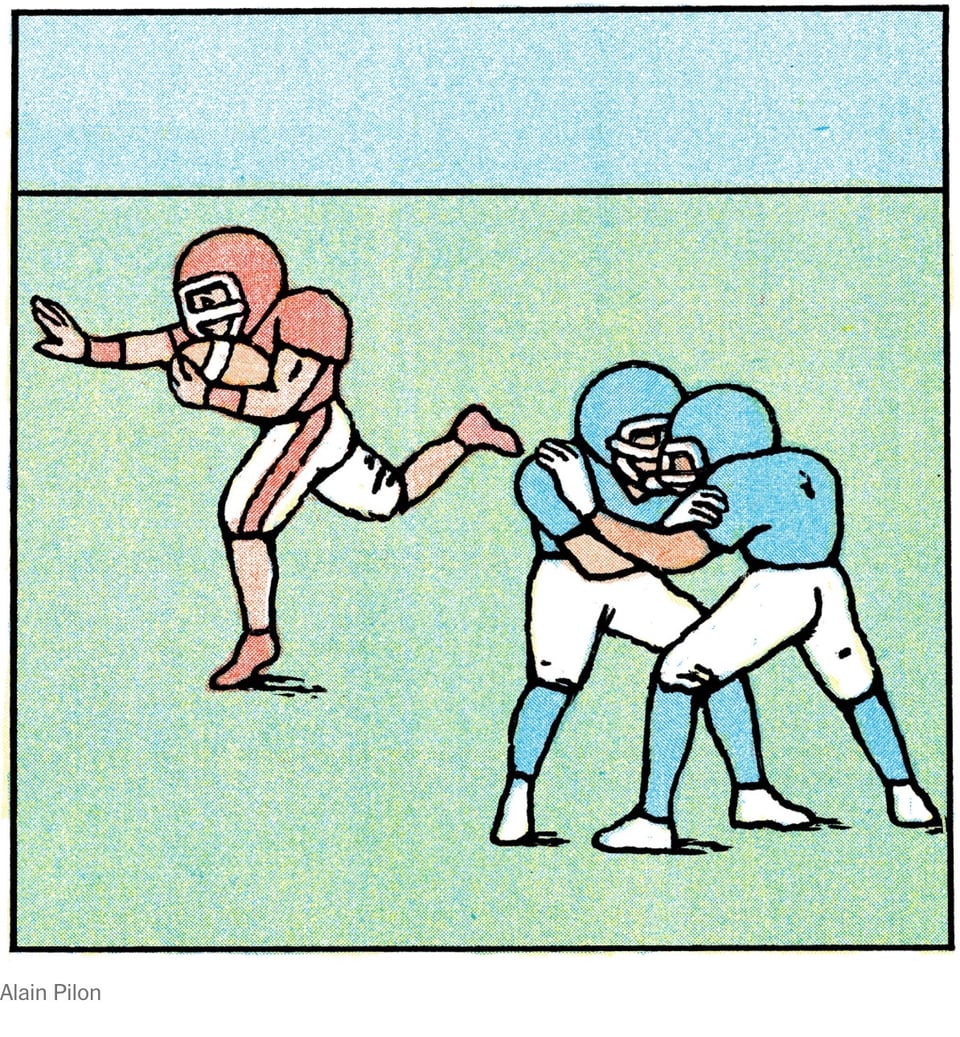
Do Democrats want to win this year’s midterm elections? Or would they prefer to indulge in self-involved arguments over the relative merits of capitalism and socialism that are irrelevant to the choices they’ll face if they win power?
It’s hardly surprising that Republicans, including President Trump, have seized upon the victory of democratic socialists in a few high-profile primaries to cast their partisan adversaries as a bunch of reds. But Democrats have no business allowing themselves to be baited into a debate that is both useless and misleading.
It’s not easy being a big-tent party that must unite the center and the left if it’s to create a durable majority. Democrats will make their task far harder if they pretend that the choice before them is captured by two abstract words. Coalition building is hard. Cold War-style, “the reds are coming” politics won’t do it. Neither will “leftier than thou” entreaties.
Their problem is aggravated because Republicans took down their own once reasonably roomy tent.
The G.O.P. used to include a significant contingent of moderates and even a hardy band of liberals. Now the party is best characterized by Ronald Reagan’s 1981 quip that, in his administration, “the right hand doesn’t know what the far-right hand is doing.” That wisecrack has become even more apt as the party of Lincoln has shed all its progressives and most of its middle-of-the-roaders.
Bernie Sanders’s 2016 presidential campaign captured this mood and sent a wave of young energy into the Democratic Socialists of America. The arrival of the new-generation left was heralded by the victory of Alexandria Ocasio-Cortez, then 28 years old, in a 2018 New York City congressional primary.
The D.S.A. had fewer than 10,000 members before Mr. Sanders ran. It grew to 45,000 by 2018 and then doubled its membership over the next four years. Between 2013 and 2017, the median age of its membership dropped from 68 to 33.
The triumph of Zohran Mamdani in New York City’s mayoral election last year and recent primary victories by D.S.A.-backed congressional candidates in New York and Colorado unleashed a wave of elation on the Democratic left and cries of alarm among some of the party’s moderates. Mr. Suozzi organized a statement signed by 10 Democratic House members asserting, “We are capitalist, not socialist.”
What’s wrong with Democrats arguing about the relative merits of capitalism and socialism?
Such polemics clearly distract from their need to stay focused on economic discontent and Mr. Trump’s corrupt abuses of power, but there is a larger problem. The capitalist-versus-socialist debate obscures broad agreement among Democrats on all sorts of things. Suozzi Democrats and A.O.C. Democrats alike want more progressive taxation; universal access to affordable health insurance, child care and housing; enhanced worker rights; climate action; and civil rights and voting rights.
The two sides still have a lot to argue about over the forms these initiatives should take — for example, how to enforce antimonopoly laws, what tax fairness should look like and whether to establish a single-payer health care system or build on Obamacare. But these are hardly world-historical questions of the sort implied by a grand battle between capitalism and socialism.
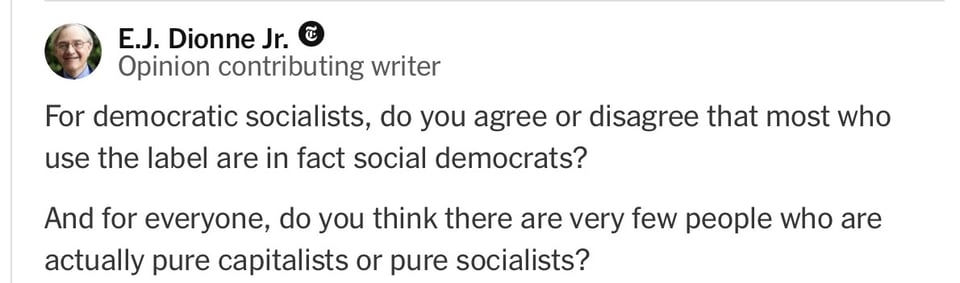
Within the party, moreover, there is no such thing as a pure capitalist or a pure socialist. Each camp uses the qualifier “democratic” to describe its respective brand, pointing to a shared acceptance of limits on both state power and the power exercised by wealthy corporate interests.
None of this should mean dismissing the left insurgency, which reflects frustrations that span the party’s philosophical barricades. Virtually all Democrats this year are running as populist critics of a system in which the share of the gross domestic product going to wages has declined from 64 percent in 2001 to 53.8 percent in 2025. We shouldn’t be shocked that more attention is being paid to struggles between labor and capital.
There’s a particular challenge with the word “socialism,” because most contemporary politicians who use it, here and abroad, are advocating greater social justice, not the wholesale dismantling of market capitalism.
You don’t have to believe me on this. “The next time you hear me attacked as a socialist, remember this,” Mr. Sanders declared in 2015. “I don’t believe government should own the means of production, but I do believe that the middle class and the working families who produce the wealth of America deserve a fair deal.”
At the time, I could not resist observing: “Honestly, Bernie, you’re really a social democrat.” (In fact, the politician who has moved aggressively to take government ownership shares in private companies — at times, it should be said, with Mr. Sanders’s support — is Mr. Trump.) Most self-described democratic socialists are social democrats — think Norway and Denmark — who seek to balance state and market, public provision and private ownership, the creation of wealth and its just distribution.
Socialists in capitalist democracies regularly seek formulations that square these circles. One of the more creative ones was offered recently by the British Labour Party’s Andy Burnham, who is set to become his country’s prime minister. Mr. Burnham champions “business-friendly socialism.”
An oxymoron? No, argues the British economics writer Will Hutton. “Rather than an intellectual pantomime horse,” Mr. Hutton wrote recently, “it is a concept with a long pedigree trying to capture the necessary complementarity of the private and public sectors.”
In any event, it’s absurd to claim that socialists are about to take over the Democratic Party. Despite the D.S.A.’s victories, a careful study by the Cook Political Report’s Erin Covey found that in 22 primaries in the Republican-held House seats Democrats hope to flip, 14 were won by centrist or center-left candidates, while the other eight nominees are largely seen as viable by party leaders. Ms. Covey noted that establishment picks are likely to prevail in the vast majority of the remaining 15 target-seat primaries.
When November’s choices are set, the overwhelming majority of Democratic candidates will not call themselves socialists. The debate that will matter to voters won’t be over idealized economic systems but about which party is more likely to deliver relief and opportunity to those who feel left out. Shame on Democrats if they lose this argument because they allow feuds over abstractions to substitute for the shared work that social and economic reconstruction will require. (E.J. Dionne, Jr., guest columnist, New York Times)
Spain Humiliates Trump After He Refuses to Get Out of Victory Photos
Donald Trump presented Spain’s World Cup team with the trophy ... and then refused to leave.
Spain’s World Cup–winning team have made it abundantly clear that they did not want Donald Trump in their victory photos.
The official account for Spain’s national football league shared an altered image of the country’s celebration in New Jersey Sunday, snipping the U.S. president out of photos after he refused to leave the dais. The FIFA World Cup account also cropped Trump out of the shot, leaving only the president’s shoulder in view.

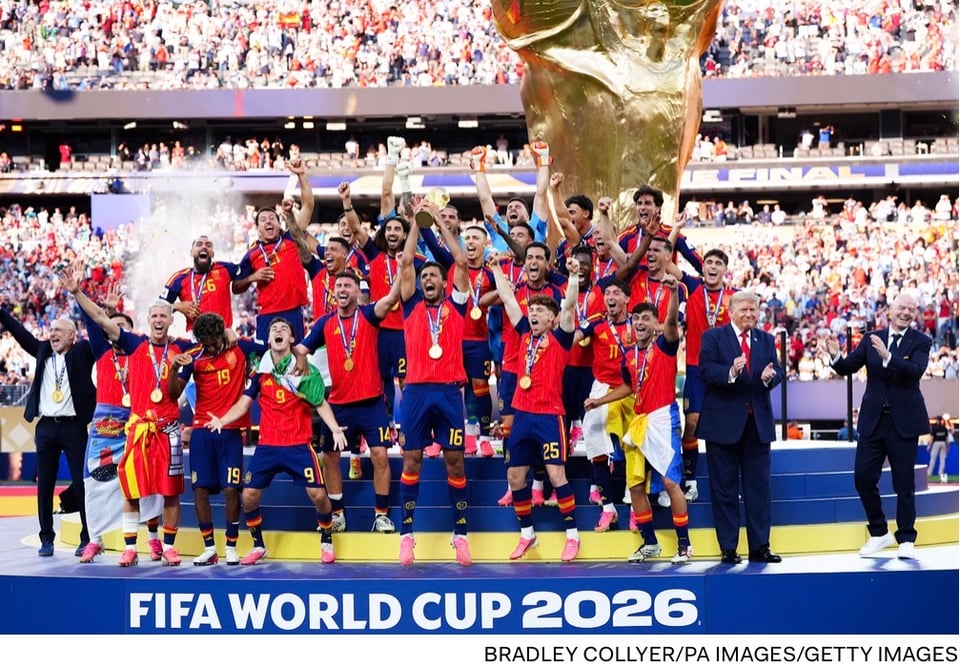
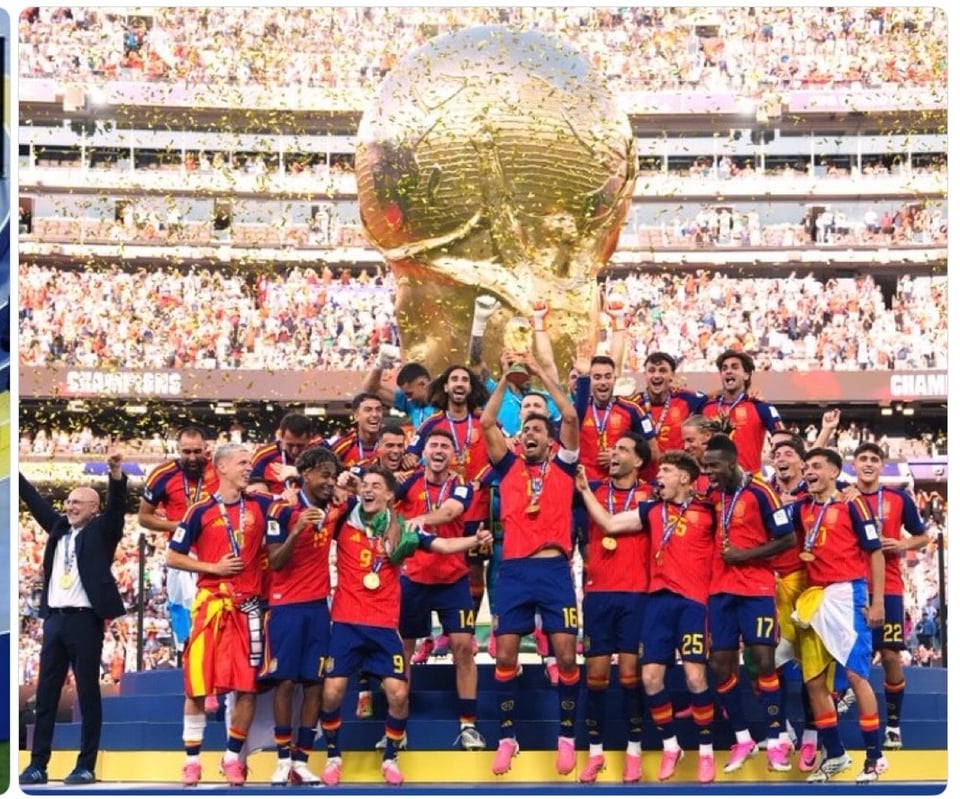
Trump handed the World Cup trophy to Spain’s team alongside FIFA president Gianni Infantino, after they beat Argentina 1-0. But the U.S. president then refused to leave the picture, apparently trying to run out the clock before the traditional trophy lift by chatting with the players as he jockeyed for a prime position in front of the group.
Spain’s team, however, was not having it. Video footage of the historic celebration captured several players politely pushing Trump away as they prepared for their official photograph.
Yet Trump stayed anyway, lingering beside the team even after repeated attempts by Infantino to pull him off the stage. He finally exited only after the team lifted its trophy and blew the confetti cannons in a glaring attempt to ensure he’d be included in the photograph.
His insistence on remaining in frame followed weeks of scathing remarks by Trump against Spain and its prime minister, Pedro Sánchez, over NATO defense spending. Trump has referred to Spain as “hopeless,” derided its people as “bad,” and also threatened to “cut off all trade” with the longtime U.S. ally as he ramped up his NATO disputes. In the months prior to that, he also raged against Spain after it refused to let the U.S. military use Spanish bases to bomb Iran.
None of that hostility was on display after the game, however—at least publicly. Back at Joint Base Andrews, Trump said he had “spoken to Spain” and “congratulated them on having a great team.” He also noted that he had “no tension” with the country’s leadership.
“I have no tension with anybody,” Trump remarked cavalierly. (New Republic)
One more thing.
Individual Spanish players let their opinions be known too.👇

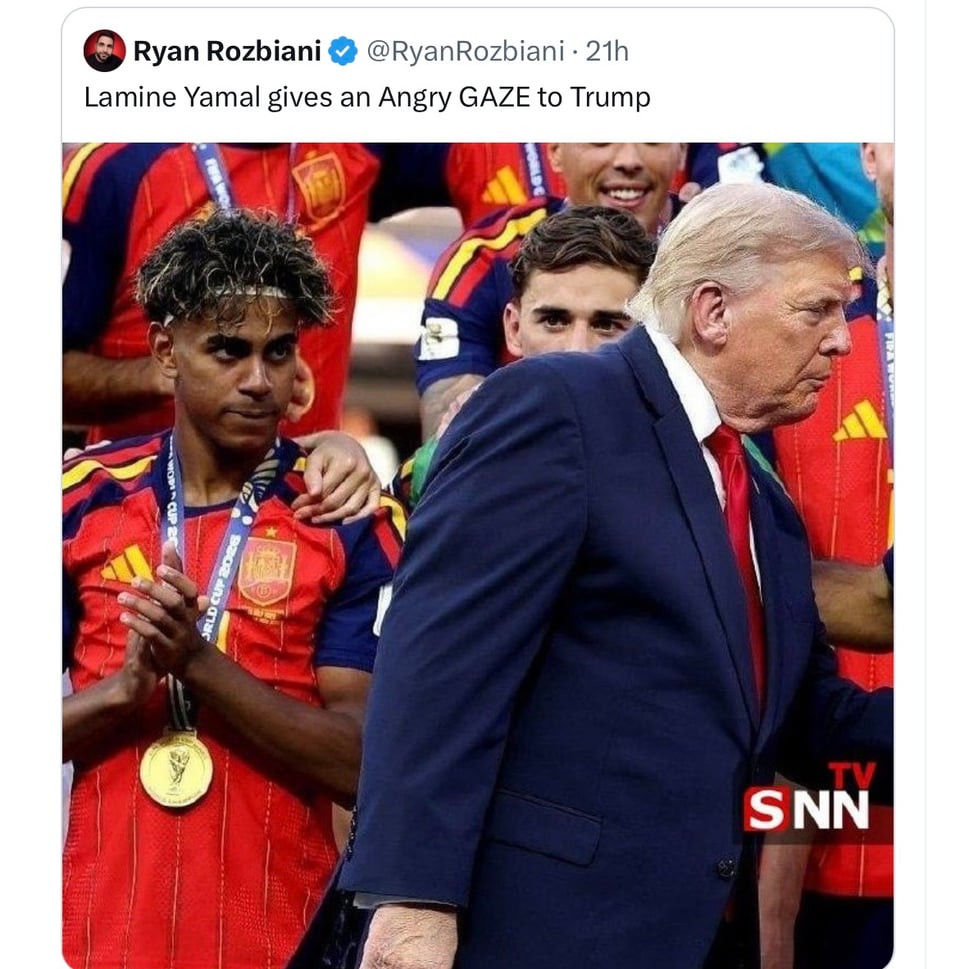
From People magazine.
U.S. President Donald Trump was in attendance for the World Cup final between Spain and Argentina on Sunday, July 19, and the fans let him know how they felt about it.
As he waited to present the championship trophy to Spain after their 1-0 win over Argentina, the president was seated in a private box at MetLife Stadium in East Rutherford, N.J., which was renamed the “New York New Jersey Stadium” for the duration of the World Cup.
As Trump joined FIFA President Gianni Infantino on the field to present players with their medals, fans at the stadium rang out in boos. The president was seen waving to people in the stands as they audibly expressed their resistance to his presence at the game.
I GIVE MY KID THE TALK
By Jesse Eisenberg

me: Come sit down, honey.
my kid: Is something wrong, Dad?
me: No, nothing’s wrong, sweetheart. Nothing at all. We just need to have a chat.
my kid: Is it about the broken vase? Because I cleaned it all up!
me: You did clean it up. You did a great job cleaning that vase up. It’s something else. You’re getting older, and there are some things you don’t know about. And I want you to hear it from me, your father, instead of some kids at school.
my kid (fidgety): O.K.?
me: We need to talk about Stephen Sondheim.
my kid: St-st-st-stephen who?
me: Stephen Sondheim. He was a composer and a lyricist. He wrote the best musicals of the twentieth century.
my kid (anxiety building): Uh, Dad, I don’t know if I should hear this.
me: You have to! The shows are great!
my kid: O-O-K., Dad.
me: You’ve probably heard of some of the more popular ones, like “Sweeney Todd” and “Into the Woods”? Maybe from some of the older kids at school?
my kid: I did hear an eighth-grade boy say something about “Sweeney Todd.”
me: What did he say, honey?
my kid: I can’t remember. Just something about the score using dissonant chords?
me: That’s right, kiddo. That’s very good. What else did he say? It’s O.K. Don’t be scared.
my kid: He said something about the lyrics being adjusted for Len Cariou, who was the original Sweeney.
me: That’s true, too. What else?
my kid: I don’t know, Dad, it was confusing. Something about the story being told exclusively through song?
me: No! That’s not true! This is what I was worried about. This is why I’m glad we’re having this talk. That older boy is wrong—he’s just trying to scare you. “Sweeney Todd” is not exclusively music. There is actually a libretto by Hugh Wheeler.
my kid: H-h-hugh who?
me: Hugh Wheeler. A frequent Sondheim collaborator. They met through Hal Prince.
my kid (momentarily charmed): They met through a prince?!
me: Not a real prince, sweetheart! Just a man named Prince. Now, this older boy—did he mention anything else? Anything that made you feel weird? Did he bring up any of Sondheim’s lesser works?
my kid: Sondheim had lesser works? I’m scared, Dad!
me: Don’t be scared, honey! They weren’t lesser in the qualitative sense. Just lesser known. Did he say anything about “Pacific Overtures”? Or “Anyone Can Whistle”? Or “Frogs”? Did this older boy mention “Frogs”?
my kid (really nervous now): When’s Mom coming home?
me: Mom is out all night.
my kid: But, Dad, I’m tired!
me: Then drink a cup of coffee! You must know about Sondheim!
my kid: O.K., O.K.
me: Good. I’m sorry I got so upset. It’s just, he’s written so many important songs! (Composing myself; a beat) I love you. You know that, right?
my kid: Yeah, I know.
me: Good. You might be tempted to go online and watch videos.
my kid: W-what kinds of videos?
me: Videos of “Cats,” “Les Mis,” “Rent.”
my kid: What’s wrong with those?
me: They’re not—real, honey. They make musicals look fun, but they’re not real life. Not like Sondheim’s “Company” or “Assassins” or his newly reconsidered “Merrily We Roll Along.” Those shows are real. They’ll stand the test of time. They’ll be revived at City Center and still feel relevant to a modern audience.
my kid: That’s a lot to remember!
me: Don’t worry. You’re not navigating this alone. Now I need to know—have any of the older kids invited you to see “MJ the Musical” or “Mamma Mia!” or even “Moulin Rouge”?
my kid: No, I don’t think so.
me: Good. Those are jukebox musicals. And they killed Sondheim!
my kid: S-s-sondheim was killed?
me: Yes, he was.
my kid (starting to cry now): But, Dad! Why?! Why did they kill him?!
me: Because they were taking shortcuts and pandering. Like parasites, those jukebox musicals wormed their way into Broadway and slowly killed the medium.
my kid: Daddy, I’m scared! Are the jukeboxes going to kill you and Mama? Or me?
me: No, sweetheart. As long as they keep reviving Sondheim’s work and occasionally gender-swapping Bobby, we’ll be fine.
my kid: Are you sure?
me: I’m sure, honey. Everything’s going to be O.K. (My kid sniffles and calms down. A nice pause.)
my kid: Dad?
me: Yes, hon?
my kid: I thought you were going to finally tell me about sex.
me: No, kiddo. As a Sondheim fan, you’ll never have to know about that. ♦︎ (The New Yorker)

