Tuesday, January 6, 2026. Annette’s Roundup for Democracy.
January 6. Trump’s Greatest Day of Shame.
Or is it ours since we have not punished him for creating a riot in our nation’s Capitol?
Federal law required the Jan 6 plaque to be hung on Capitol grounds by March 2023
— Scott MacFarlane (@MacFarlaneNews) January 6, 2026
It has not been.
(MORE) pic.twitter.com/jc1RJoFVBD
Venezuela first.
Now this happened last night.
BREAKING: Possible coup underway in Venezuela, per local reports.
— Polymarket (@Polymarket) January 6, 2026
Diosdado Cabello is reportedly leading a coup to oust newly sworn-in president Delcy Rodríguez.
— AF Post (@AFpost) January 6, 2026
Follow: @AFpost pic.twitter.com/kDqNzEDh83
The US is making plans to try to intercept a fleeing oil tanker that Russia has claimed ownership of, according to four people familiar with the matter, setting up a possible confrontation between Washington and the Kremlin… confirming CBS: https://t.co/9YRNBbW7TI
— Natasha Bertrand (@NatashaBertrand) January 5, 2026
Maduro’s Ouster Plays Right Into Putin’s Hands
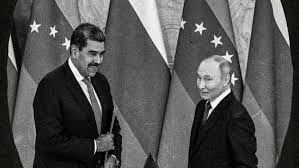
In the initial rush of news on Saturday morning, many commentators speculated that the abduction of President Nicolás Maduro of Venezuela was also a blow to President Vladimir Putin of Russia, since Venezuela and Russia are allies. To the contrary, it is a victory for Putin, because it is a blow — quite likely fatal — to the new world order of law, justice and human rights that was heralded in the wake of World War II.
That order was never as robust as its champions made it out to be. Many of the multilateral institutions created to foster cooperation and enforce international law have been dysfunctional, often because they were sabotaged by their most powerful members. And yet, some mechanisms worked; some laws were enforced; some crimes were punished and many more were probably prevented; millions of people had their freedom and dignity affirmed; and a reasonable hope persisted that a law-based, humanistic world order would be built. No longer.
When he addressed the public in a news conference on Saturday, President Trump announced that U.S. forces had abducted the president of Venezuela and his wife in the name of democracy, justice, freedom for the Venezuelan people and the safety of Americans. It was a mockery: Despite what the hoodlums running our country may actually believe, abduction — whether on a street in Boston, in an apartment building in New York or Chicago, or in Maduro’s compound in Caracas — never serves the cause of justice.
Illegality does not uphold the law. Starting wars of aggression does not make anyone safer. Colonization does not bring freedom. And colonization is what Trump promised when he dismissed María Corina Machado, a Nobel laureate with a credible claim of a popular mandate and international recognition, as lacking leadership qualities and said, in various ways, no fewer than four times, “We are going to run the country.”
This was a very particular kind of mockery, familiar to anyone who has paid attention to Putin. Russia’s president has claimed that his invasion of Ukraine was a mission to liberate the people of that country. He has claimed to be defending Russia’s sovereignty, which Ukraine’s existence never threatened. Putin has even claimed that Ukraine has illegitimately appropriated infrastructure created by his nation (well, by the Soviet Union, which Putin conflates with Russia) — just as Trump falsely claimed that Maduro perpetrated the largest theft of American property in history by nationalizing the oil industry that U.S. companies had helped build.
There is a world of difference between Maduro, an autocrat who has stayed in power by falsifying elections, and Ukraine’s legitimate, democratically elected president, Volodymyr Zelensky. But what matters here is the similarity between the aggressors: Trump and Putin.
For years, Putin has been asserting a vision of a world divided by a few powerful men into spheres of influence. This, too, is the post-World War II order — the Cold War order, in which countries colonized by the Soviet Union were excluded from the liberal aspirations asserted by the West. It has long been clear that Trump instinctively shares this point of view: Carving up the world appears to be what he thinks political power is for. Whoever wrote the National Security Strategy that was made public in December codified this worldview as the Trump Corollary to the Monroe Doctrine, the United States’ two-centuries-old assertion of power over the Western Hemisphere. During Saturday’s news conference, Trump appeared to have renamed the corollary the “Donroe Doctrine.”
Half a century ago, as a Soviet third-grader, I sat through months of lessons devoted to natural resources. The Russian term — polezniye iskopayemiye — is telling: It literally translates as “beneficial extractables.” Those Soviet school units were so boring that I can still remember the sense that the minute hand of the classroom clock was standing still. I remember, too, that granite is solid, metal is found in ore, oil is necessary for modern life and the purpose of land acquisition is extraction. I remember, too, a giant map of the Soviet Union in which the many mineral-rich regions were colored bright red. This, I remember being told, was our wealth.
Trump seems to have arrived, on his own, at the same understanding of geography and politics that was pounded into the heads of Soviet schoolchildren, including Putin and me. During Trump’s news conference, he responded to most questions — whether they were about the mechanics of “running” Venezuela, the cost of such governance, or other countries’ geopolitical interests in the region — with answers about all the oil the United States will pump out of the Venezuelan wells. His politics is the politics of self-enrichment, one big quest for beneficial extractables. During his first presidential campaign, he used to criticize George W. Bush for failing to “take the oil” during his war in Iraq. Some of us wondered at the time: How do you “take the oil”? This is how: You take the country.
Another thing Trump and Putin share is their disdain for European values, the very values of cooperation, justice and human rights that the post-World War II international order was designed to uphold. Putin’s speeches drip with this disdain, much like Trump’s national security strategy does. The Donroe Doctrine, it seems, may allow Trump to take Venezuela, Cuba — which he and Secretary of State Marco Rubio have openly threatened — and any other part of the Americas Trump desires. (I am sure he will return before long to talk of making Canada the 51st state.)
If so, it will also allow Putin to take as much of Europe as he wants to bite off. Russia’s hybrid warfare in Europe — acts of both political and infrastructural sabotage, including suspected jamming of air-traffic-control frequencies at numerous European airports — has escalated since Trump returned to office. The Trump administration’s continued pressure on Ukraine has emboldened Putin. The invasion of Caracas, carried out in ways eerily similar to what Moscow had once planned for Kyiv, will embolden him further. A similar message has no doubt been received in Beijing: If Trump can take Venezuela and Putin can take Ukraine, surely President Xi Jinping of China can take Taiwan.
Putin was Maduro’s ally, but allies come and go; worldviews, and the desire to force the world to conform to them, stay. Putin’s world has just become more harmonious. Not because, as conspiracy theorists would have you believe, Putin tells Trump what to do, but because these two autocrats really do view the world in the same way. We have a saying for this in Russian: Two boots make a pair. (M.Gessen. New York Times columnist)
Is Greenland next?
Q: Can you rule out that the US is going to take Greenland by force?
— Republicans against Trump (@RpsAgainstTrump) January 5, 2026
Miller: Greenland should be part of the US. By what right does Denmark assert control over Greenland? The US is the power of NATO...Nobody is gonna fight the US militarily over Greenland pic.twitter.com/qY8tDQ1fNh
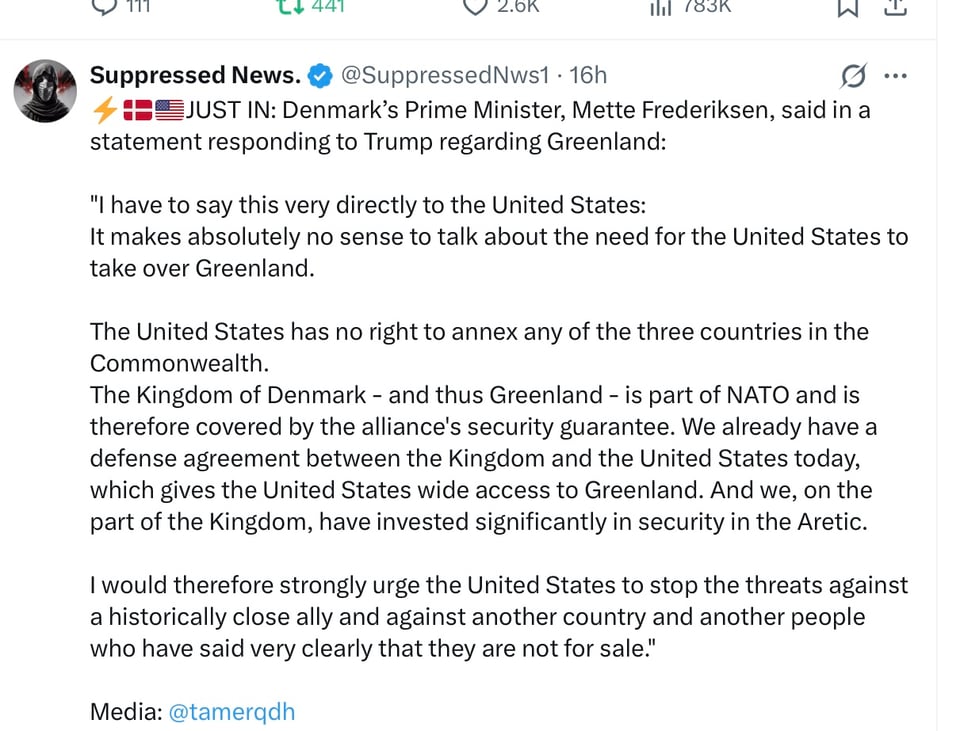
⚡️🇩🇰🇺🇸JUST IN: Denmark’s Prime Minister, Mette Frederiksen, said in a statement responding to Trump regarding Greenland:
— Suppressed News. (@SuppressedNws1) January 4, 2026
"I have to say this very directly to the United States:
It makes absolutely no sense to talk about the need for the United States to take over Greenland.
The… https://t.co/yEuLdYoYKr pic.twitter.com/imIXe9S0VW
Stephen MILLER: The US is using its military to secure our interests unapologetically in our hemisphere. We're a superpower and under President Trump we are going to conduct ourselves as a superpower. It's absurd that we would allow a nation in our backyard to become the supplier of resources to our adversaries but not to us.
Touch if you want to see Stephen Miller rant.👇
First tweet after pinned tweet.
“Damn straight we did!” Stephen Miller has epic meltdown on CNN, Jake Tapper literally rolls his eyes at him. pic.twitter.com/PFBF1i9SCw
— Mike Sington (@MikeSington) January 6, 2026
Could Greenland Be the End of NATO?
After Venezuela, Europeans think Trump may actually be serious. By Shane Harris, Isaac Stanley-Becker, and Jonathan Lemire
![Greenland is in Trump’s crosshairs] (https://assets.buttondown.email/images/bc2ac4d2-21c0-4a16-a601-fc74a8e37e74.webp?w=960&fit=max)
Danish officials think they know how Donald Trump might seize Greenland. In a late-night Truth Social post, the president announces that the Danish territory is now an American “protectorate.” Because neither Denmark nor its European allies possess the military force to prevent the United States from taking the island, they are powerless to resist Trump’s dubious claim. And as the leading member of NATO claims the sovereign territory of another state, the alliance is paralyzed. Arguing that possession is nine-tenths of the law, Trump simply declares that Greenland now belongs to the United States.
This chain of events, which some Danish officials and security experts proposed to us in recent months, may have seemed faintly ridiculous as of last Friday. By the weekend—after the toppling of Venezuelan President Nicolás Maduro and Trump’s ensuing insistence that the United States now “runs” Venezuela—it seemed far less so. For months, Danes have anxiously imagined an audacious move by the Trump administration to annex Greenland, whether by force, coercion, or an attempt to buy off the local population of about 56,000 people with the promise of cutting them in on future mining deals. Now those fears are spiking.
Shortly after U.S. forces captured Maduro, Katie Miller, a former White House official who is married to the senior Trump aide Stephen Miller, posted on X a map of Greenland covered in the U.S. flag, with the caption “SOON.” Officials in Denmark told us that they were furious—and rattled. Then, yesterday morning, in an interview with our colleague Michael Scherer, Trump reasserted his intention to annex Greenland. “We do need Greenland, absolutely,” he said.
European leaders have long downplayed Trump’s acquisitive posture and tried to ignore his comments. Not after what happened in Venezuela. Today, the Danish prime minister, Mette Frederiksen, argued that the president’s threats are credible. “Unfortunately, I think the American president should be taken seriously when he says he wants Greenland,” she told the Danish Broadcasting Corporation (DR).
U.S. officials and Trump allies we spoke with downplayed the possibility of military action in Greenland. (Stephen Miller told CNN’s Jake Tapper today that it would hardly be necessary. “No one is going to fight the U.S. militarily over the future of Greenland,” Miller said, reiterating that the territory should belong to the United States.) But Trump has pointedly not ruled out taking Greenland by force. And if the U.S. goes down that road, NATO will effectively cease to exist the moment the first military personnel enter Greenlandic territory.
“If the United States attacks another NATO country, everything stops,” Frederiksen said on DR.
The German foreign minister, Johann Wadephul, made clear to reporters during a visit to Lithuania that Greenland falls under Article 5 of the alliance, which states that an attack on one member is an attack on all, obligating other members to respond: “Greenland is part of the Kingdom of Denmark. And since Denmark is a member of NATO, Greenland will, in principle, also be subject to NATO defence.”
But how exactly would that play out in practice? One European official was blunt: “We won’t be able to defend Greenland. Are you kidding?”
Boosters of trump’s greenlandic ambitions are delighted by the Venezuela operation and by the president’s restated commitment to their cause. “I think it’s a big opportunity and a new beginning for Greenland, with Trump’s interest,” Jørgen Boassen, the president’s most prominent and vocal advocate in Greenland, told us. Boassen, known for his collection of MAGA hats and for wearing T-shirts with Trump’s face printed on them, said that Greenlanders yearn for independence from Denmark and from “Danish elites” in Greenland who don’t speak the native language or understand local culture.
Those long-standing rifts aside, polls do not show widespread Greenlandic support for swapping the Danish flag for the Stars and Stripes. Boassen insisted that many Greenlanders are afraid to speak up in favor of annexation because they would face professional and political retribution. He claimed that Danish authorities shut down his Facebook page, which is his primary means of spreading his support for Trump’s policies. (We were able to access the page this afternoon.) Boassen said that “Trump has heard about people suffering” and that he is “a savior for us right now.”
European leaders see matters very differently. Since yesterday, they have dispensed with the kind of equivocation that sometimes marks their public statements about the American president. British Prime Minister Keir Starmer told Sky News, “Greenland and the Kingdom of Denmark are to decide the future of Greenland, and only Greenland and the Kingdom of Denmark.” France’s foreign minister, Jean-Noël Barrot, wrote on social media, “Greenland is neither for the taking nor for sale.”
As for the Danes, they’re cycling through various stages of grief, according to Rufus Gifford, who served as U.S. ambassador to Denmark under President Barack Obama. Above all, they can’t figure out what Trump’s true intentions are, Gifford told us. The likeliest outcome, in his estimation, is that the president uses the leverage of U.S. security guarantees for Ukraine to pressure European countries, including Denmark, to accept U.S. plans for the Arctic island. Indeed, a former senior U.S. official in Europe told us that one reason NATO leaders didn’t speak up sooner, and more emphatically, in opposition to U.S. territorial designs on Greenland was fear that Trump would lash out in response and curtail U.S. support for Ukraine, possibly interrupting intelligence sharing and weapons sales.
The former official said that panic first set in about U.S. plans a year ago, after MAGA acolytes, led by Donald Trump Jr., made a trip to Nuuk, Greenland’s capital. “From the standpoint of the Danish government, that’s when it began to get really heated,” said the former official, who, like some others, spoke with us on the condition of anonymity because of the matter’s sensitivity. The visit had a carnival atmosphere, with locals flocking to see the visiting delegation that had arrived in the president’s personal airplane, dubbed “Trump Force One.”
Danish officials and experts told us it was on this trip that Trump lost any prospect of popular support from Greenlanders. Rumors circulated that Trump’s son was handing out $100 bills to local homeless people. That wasn’t true, but Trump Jr. did buy the people lunch, said Boassen, who helped organize the trip. Still, many Greenlanders believed that Trump Jr. was exhibiting the kind of colonialist mentality that they have long complained about.
Over the following months, some dared to hope that Trump had moved on from his dreams of acquiring Greenland. But a series of recent moves created a new sense of urgency for Denmark. In December, Trump named Louisiana Governor Jeff Landry as special envoy to Greenland. (Landry’s office didn’t respond to a request for comment.) The same month, the president appointed Tom Dans, an ally, entrepreneur, and investor involved in organizing American excursions to the island, to lead an Arctic research commission. The U.S. ambassador to Denmark, Ken Howery, told us in a statement that members of his staff have “interacted” with Dans and that he expects to meet with him, given Dans’s new role. Dans wrote on social media that he would make “the ARCTIC GREAT AGAIN!” He declined to comment.
The operation in venezuela seems to confirm that the president is willing to back up his demands of foreign nations with military action, a kind of gunboat diplomacy for the 21st century. People close to the president told us that Trump is enamored with the success of the military interventions he has ordered in Iran, Nigeria, and now Venezuela—and that he will not shy away from wielding force again. And he’s happy, at least, to use the threat of force as leverage while he eyes Greenland. Some around Trump have delighted in Europe’s impassioned reaction to his latest expression of interest in the mineral-rich island. “Let them squirm,” one close outside ally told us. “Maybe we’ll take it; maybe we won’t. But after what we just saw in Caracas, do you want to try to call Trump’s bluff?” Trump said this past weekend that Greenland is not yet at the top of his to-do list, but he offered multiple timelines—from 20 days to two months—for when he might fully engage on the issue.
Western diplomats and security officials we spoke with were apoplectic. One told us that Denmark and its Nordic neighbors have been taking the president’s statements seriously for a year but have remained uncertain about how to interpret them and, especially, how to respond. The editor in chief of the Copenhagen-based newspaper Berlingske wrote in a column today that Denmark and its allies should seek to raise the cost for Washington of any possible military aggression, including by moving more military assets to the island: “It won’t be able to stop the USA, but it will be a symbolic step.”
A Danish lawmaker, who spoke with us on the condition of anonymity to address the security situation candidly, said that the very notion of the U.S. invading Greenland—both mounting an invasion and defending against it—is absurd. The island is nearly four times the size of France and is mostly ice. The lawmaker told us that Danes are particularly baffled by Trump’s designs on Greenland because he could accomplish all of his security objectives by working with Denmark, a committed U.S. ally. During the Cold War, there was even a nuclear-powered U.S. base built under Greenlandic ice. “If the Americans want another military base, just say where,” the lawmaker said. “If you want a radar, you can put it up.”
Carsten Søndergaard, a career Danish diplomat who served as an ambassador to Russia and as the permanent representative to NATO, told us that additional U.S. troops in Greenland, as well as mining rights, could be negotiated, to the benefit of all parties. “A hostile takeover of an ally’s territory will have severe consequences for the transatlantic relations and the West. So much is at stake,” he said.
There was one specific jab at Denmark, made by Trump aboard Air Force One last night, that the Danish lawmaker felt compelled to counter. “You know what Denmark did recently to boost up security on Greenland?” Trump joked to reporters. “They added one more dogsled.”
A Danish naval unit, called the Sirius Patrol, actually does conduct reconnaissance missions by dogsled in the unforgiving northeastern part of the island. The U.S. Department of Defense—or the Department of War, as Trump’s team has taken to calling it—even celebrates the unit’s history on its website: Danish, Norwegian, and Greenlandic hunters patrolled Greenland’s coast by dogsled to fend off German intruders during the Second World War. Drawing on that legacy, the unit still conducts long-range missions and “enforces Danish sovereignty in the Arctic wilderness of northern and eastern Greenland,” according to the Defense Department.
Patrolling is typically done in pairs, sometimes for months on end without other human contact. The Danish lawmaker said that it’s a tough job in some of the bleakest conditions in the world. “Very few U.S. soldiers,” he told us, “would survive a week up there.” (The Atlantic).
Hegseth is going after Mark Kelly.
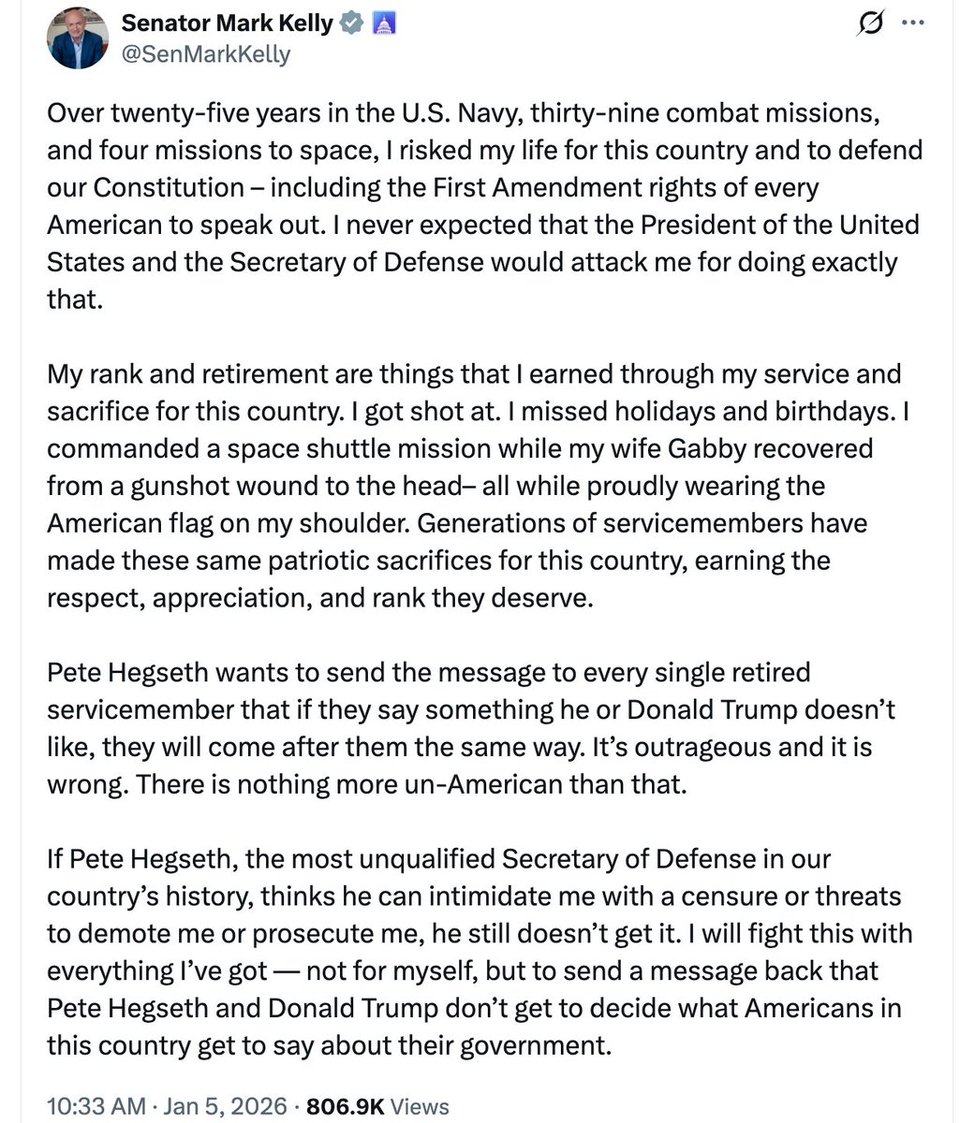
Maybe a little good news?
Maybe a bit of nerve from Republicans?
The House.
— Catherine Rampell (@crampell) January 5, 2026
A Senator


