Tuesday, January 13, 2026. Annette’s Roundup for Democracy.
February 20 is the day of a national strike.
Eve and I will join. Will you? Share the word.
Free America Walkout.

On January 20 at 2 PM local time, we will walk out of work, school, and commerce because a Free America begins the moment we stop cooperating with fascism
★ We walk away from fascism.★
★ We walk towards a Free America.★
★ We fight for a future that belongs to us all. ★
★ Everybody in, nobody out. ★
★ Welcome to the Free America Walkout. ★
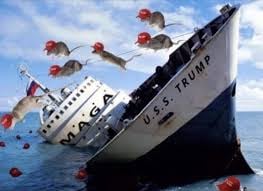
Republicans have been following a rat onto a sinking ship for a long time. Something changed their minds.
Congress Is Reversing Trump’s Steep Budget Cuts to Science.
After the White House called for billions of dollars in funding reductions, senators and representatives are rescinding the proposed cuts and even boosting funds for basic research.

Each year, the president submits a budget request to Congress in advance of the annual appropriations process, but only Congress has the power of the purse.
Congress is racing to undo thousands of cuts to federal science programs that President Trump called for last year when planning the government’s current budget.
If enacted, the president’s bid for an overall cut in scientific funding to $154 billion from $198 billion — a plunge of 22 percent — would have been the largest reduction in federal spending on science since World War II, when Washington and the seekers of nature’s secrets began their partnership.
This week, the Senate Appropriations Committee released a bipartisan package of bills that largely scraps Mr. Trump’s planned cuts. Analysts say that, if the proposed budgets hold up in the weeks ahead, Congress will set aside roughly $188 billion for federal research — a drop of about 4 percent from the most recent annual budget.
“That’s pretty solid,” said Alessandra Zimmermann, a budget analyst at the American Association for the Advancement of Science, a scientific group based in Washington. “Congress is really starting to push back.”
Surprisingly, analysts foresee a possible rise of more than 2 percent in the budget category known as basic research — the blue-sky variety that produces fundamental strides and spinoffs in fields such as health care and artificial intelligence. Last year, the Trump administration called for a cut in federal basic research of more than one-third.
Mr. Trump sought even larger cuts for the National Science Foundation, which sponsors much of the nation’s basic research. He proposed that its budget be slashed to $3.9 billion from $8.8 billion, a drop of 56 percent. The Senate package countered with a reduction to $8.75 billion, or less than 1 percent.
The bipartisan accord on funding science, Ms. Zimmermann said, stands in sharp contrast with the Congressional impasse that shut down the government last fall as Democrats and Republicans clashed over the renewal of subsidies for the Affordable Care Act.
“They’re working together now,” she said. “It’s a return to normalcy.” The new cooperation, Ms. Zimmermann added, is “promising for the eventual passage of the bills.”
Each year, the president submits a budget request to Congress in advance of the annual appropriations process. Only Congress has the power of the purse.
In a statement, Senator Patty Murray of Washington State, the top Democrat on the Senate Appropriations Committee, praised the package of bills as good not only for investigating nature but also for enhancing public safety and the welfare of American families.
“Democrats fought to protect investments that matter,” she said. The package, she added, “rejects President Trump’s push to let our competitors do laps around us.”
Senator Susan Collins, Republican of Maine and chairwoman of the Appropriations Committee, called the package “a fiscally responsible” move that will “spur scientific research necessary to maintain U.S. competitiveness.”
The Senate package includes $24.4 billion for NASA (a 1.6 percent cut), $8.8 billion for the Environmental Protection Agency (a 4 percent cut), $8.4 billion for the Department of Energy Office of Science (a 1.9 percent increase), $6.2 billion for the National Oceanic and Atmospheric Administration (roughly flat), $1.4 billion for the U.S. Geological Survey (a 2 percent cut) and $1.2 billion for the National Institute of Standards and Technology (a 2.3 percent increase).

The bipartisan package of bills includes $6.2 billion for the National Oceanic and Atmospheric Administration.
In New York City, the package would aid scientists displaced by the closure of the NASA Goddard Institute for Space Studies, which was famously located upstairs from Tom’s Restaurant at Broadway and West 112th Street, near Columbia University. The diner’s facade appears in “Seinfeld” episodes.
On Thursday, the House voted to approve the Senate package. Many federal programs have recently had their budgets frozen at last year’s levels. Congress, eager to avoid another shutdown, is working to pass spending bills before stopgap measures expire on Jan. 30.
So far, the House’s moves on this year’s science budgeting add up to an estimated total of $185 billion — close to the Senate figure of $188 billion, and putting the two chambers not far apart for negotiations on a final budget.
The improved budgetary picture cannot undo the damage that the Trump administration’s frenzy of budget cutting and administrative chaos brought to the nation’s scientific establishment, analysts say. They see the cycles of cuts and reinstatements as taking a toll that in some cases may require years to mend.
Analysts also note that the administration has made policy shifts on how appropriated funds are spent. For instance, the National Institutes of Health, which traditionally hedged its scientific bets by supporting a wide range of investigators, is now dividing its annual budget into fewer projects.
On Thursday, the House voted to approve the Senate package. Many federal programs have recently had their budgets frozen at last year’s levels. Congress, eager to avoid another shutdown, is working to pass spending bills before stopgap measures expire on Jan. 30.
The bipartisan package of bills includes $6.2 billion for the National Oceanic and Atmospheric Administration.
So far, the House’s moves on this year’s science budgeting add up to an estimated total of $185 billion — close to the Senate figure of $188 billion, and putting the two chambers not far apart for negotiations on a final budget.
The improved budgetary picture cannot undo the damage that the Trump administration’s frenzy of budget cutting and administrative chaos brought to the nation’s scientific establishment, analysts say. They see the cycles of cuts and reinstatements as taking a toll that in some cases may require years to mend.
Analysts also note that the administration has made policy shifts on how appropriated funds are spent. For instance, the National Institutes of Health, which traditionally hedged its scientific bets by supporting a wide range of investigators, is now dividing its annual budget into fewer projects. (New York Times)
One more thing.
The Republican majority can be as narrow as a single vote, frequently shifting due to absences or vacancies.
On January 10, The Washington Post proclaimed, “ A majority in name only? House Republicans are barely hanging on.”
“ On Thursday, neither party really had the majority in the House. Over the course of seven roll-call votes, the final tally showed five times that the exact same number of Republicans and Democrats had voted. The actual tallies of “yeas” and “nays” varied between noncontroversial legislation passed by wide margins to a narrow victory for House Minority Leader Hakeem Jeffries (D-New York), helped by a bloc of renegade Republicans. But each side repeatedly had the same number of members casting votes, with 213 lawmakers on both sides of the aisle and a handful of Republicans missing.”
Can’t wait to see how this plays out, even before November 2026.
Welcome Speaker Jeffries.
Stakes are raised in our Domestic Fights.
Trump v. Powell
Fed Changes Course and Takes On Trump’s Political Fight.
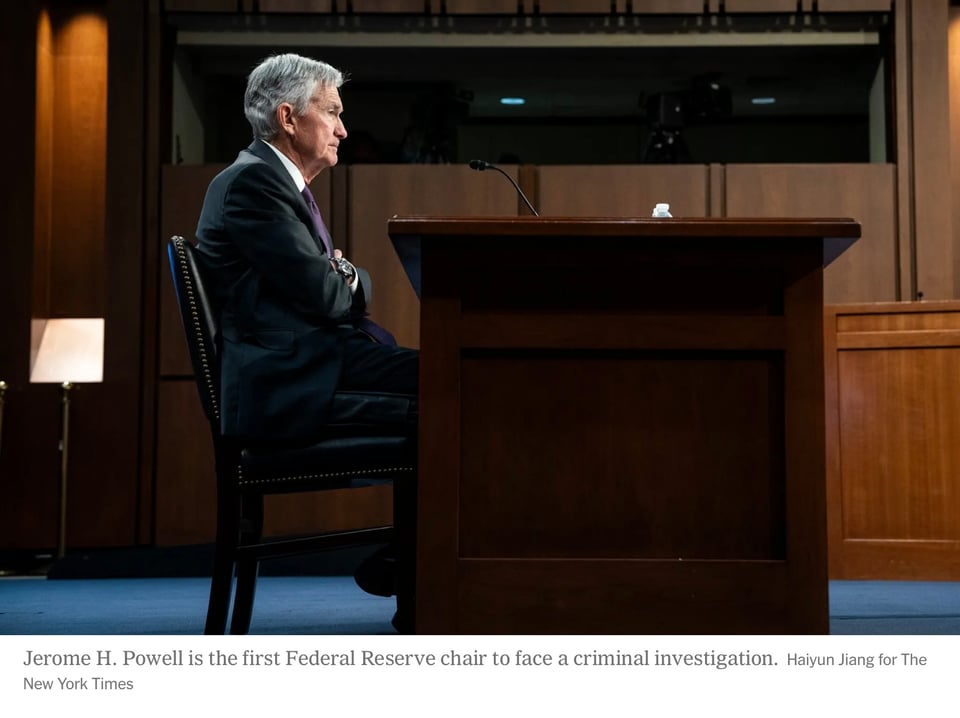
The Justice Department’s decision to open up a criminal investigation of Jerome H. Powell, the chair of the Federal Reserve, is a major escalation in the pressure campaign against the central bank to cut interest rates.
Jerome H. Powell wanted to avoid a fight. That had long been his approach to handling President Trump and his relentless attacks on the Federal Reserve, which in his second term had taken on heightened intensity.
Between an executive order wresting more control over the Fed’s oversight of Wall Street to Mr. Trump’s attempt to oust a sitting member of the policy-setting board of governors, the Fed had stuck to a time-tested strategy: Avoid provoking the president. At times, that meant bending to meet his demands in areas like climate change and bank regulation. But Mr. Powell, the Fed chair, drew the line when it came to protecting the central bank’s autonomy to set interest rates.
A criminal investigation into whether Mr. Powell lied to Congress, revealed by The New York Times on Sunday, has prompted the central bank to jettison its cautious approach and fight. The battle’s outcome could determine whether the Fed remains an independent entity.
“Trump is now exercising the nuclear option, so there is no longer a reason for Powell not to speak his mind,” said Maurice Obstfeld, a senior fellow at the Peterson Institute for International Economics, who was formerly the chief economist at the International Monetary Fund.
Mr. Powell’s decision to push back, which came in a rare video message on Sunday evening, tees up the most challenging moment in his roughly eight years at the helm of the central bank. Mr. Powell, whose term as chair ends in May, must now decide how hard to continue fighting and whether to remain in his role as a governor, a term that is set to expire in 2028.
A ‘New Threat’
Mr. Powell and staff members at the Fed worked through the weekend after the Justice Department served the central bank with grand jury subpoenas late on Friday. What culminated was a two-minute video released Sunday evening featuring Mr. Powell bluntly calling out the administration for seeking to leverage a criminal investigation into costs related to the Fed’s renovation of its headquarters as “pretexts” to coerce the central bank into lowering borrowing costs.
“This new threat is not about my testimony last June or about the renovation of the Federal Reserve buildings,” Mr. Powell said on Sunday. “The threat of criminal charges is a consequence of the Federal Reserve setting interest rates based on our best assessment of what will serve the public, rather than following the preferences of the president.”
The Fed has cut interest rates only gradually, reducing them by 0.75 percentage points since September to a new range of 3.5 percent to 3.75 percent. Mr. Trump has demanded rates as low as 1 percent, calling Mr. Powell a “numbskull” and a “stubborn mule” for refusing to concede.
Friday’s subpoenas relate to renovations that have been taking place since 2022 at the Fed’s headquarters in Washington. The sprawling project, which is set to be completed in 2027, is $700 million over budget and is expected to cost roughly $2.5 billion.
Mr. Trump seized on the renovations as a new line of attack against the central bank this summer, accusing Mr. Powell of mismanagement and taking the rare step of showing up at the construction site for a tour. Legal experts saw it as the potential groundwork to try to remove the Fed chair for “cause,” the only justification a president can use to lawfully fire an official at the central bank. Cause has typically meant gross malfeasance or a dereliction of duty while in office, although it has never been tested.
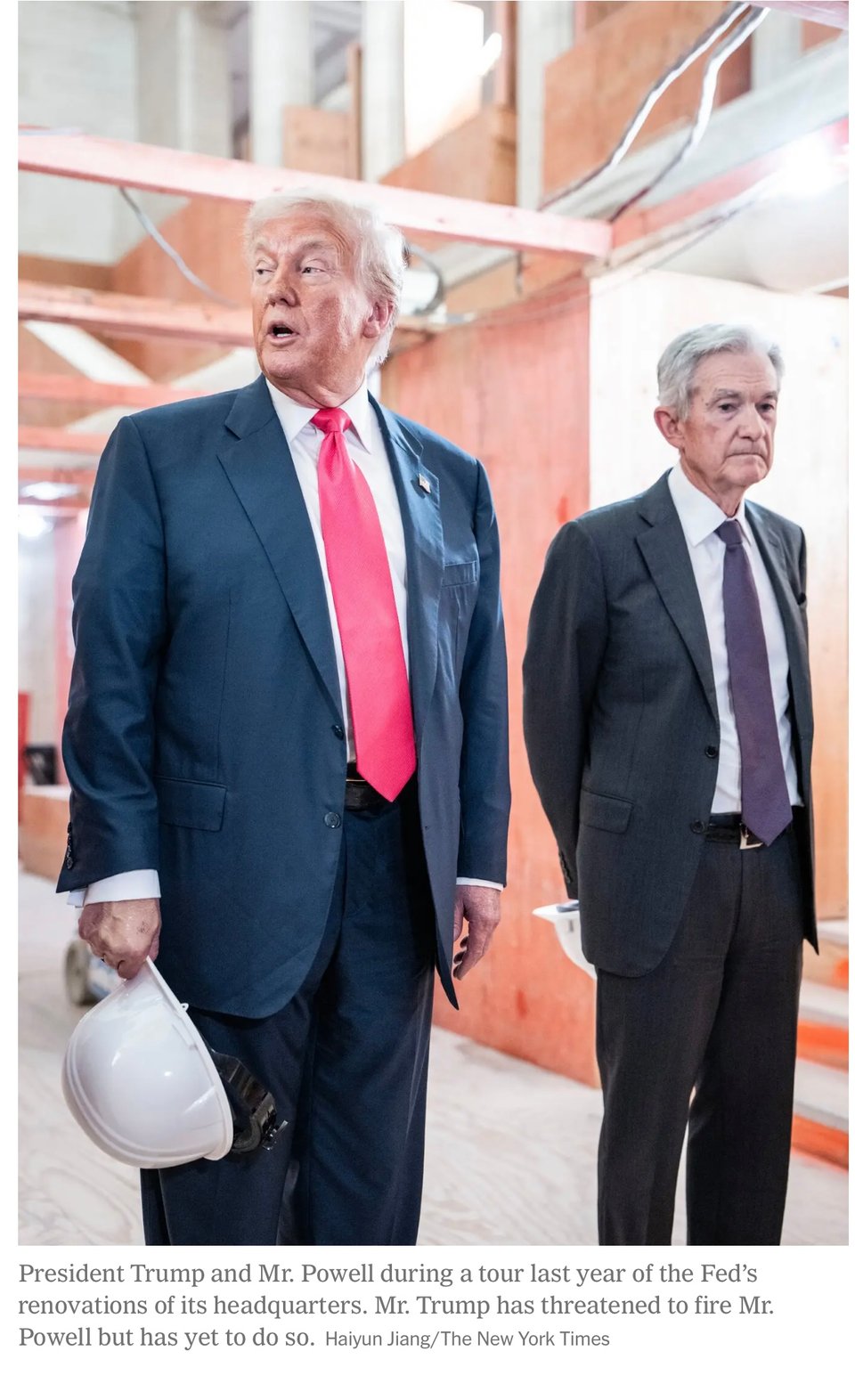
Mr. Powell’s decision to respond directly by video reflected the explosive nature of the Justice Department’s move. Never before has a Fed chair faced a criminal investigation. It also represented a stark departure from the administration’s attacks on Mr. Powell to date, which had typically taken the form of personal insults from Mr. Trump. The president, who nominated Mr. Powell to the job during his first term, had also threatened to fire the Fed’s chair, but had not acted on it. Still, Mr. Powell had pre-emptively retained outside counsel, hiring Williams & Connolly, a top litigation firm in Washington.
Mr. Trump instead tried to oust Lisa D. Cook, whom the Biden administration had appointed to the Fed. The president, citing allegations of mortgage fraud, said he had cause to remove her. Arguments for the case will be heard by the Supreme Court on Jan. 21.
Mr. Powell, a lawyer by training, and close advisers saw the Justice Department’s investigation as a sharp escalation in the administration’s affront against the institution that required a forceful response.
Mr. Trump denied having knowledge of the U.S. attorney’s investigation, saying on Sunday that he did not “know anything about it, but he’s certainly not very good at the Fed, and he’s not very good at building buildings,” referring to Mr. Powell.
In the past, Mr. Powell had demurred from commenting directly on the president’s attacks. Instead, he spoke in favor of the importance of the Fed maintaining its longstanding independence, a protection Congress granted the central bank so that officials set rates with an aim to attain low, stable inflation and a healthy labor market, rather than to the benefit of whomever is in the White House. But that changed on Sunday.
“He didn’t mince words,” said Kenneth Rogoff, a professor of economics at Harvard and a former chief economist of the International Monetary Fund. “He’s tended to turn the other cheek, and he’s reached a moment where he can’t.”
“The Fed seems to recognize that this administration rarely stops pressuring people and organizations to get what it wants, so anyone who won’t capitulate to that pressure ultimately needs to fight back,” added Douglas Elmendorf, a former director of the Congressional Budget Office who teaches at Harvard.
Mr. Powell on Monday got the backing of every living former chair of the Fed, as well as multiple former Treasury secretaries who called out what they described as “prosecutorial attacks to undermine that independence.”
This is how monetary policy is made in emerging markets with weak institutions, with highly negative consequences for inflation and the functioning of their economies more broadly,” they wrote in a joint statement.
Janet L. Yellen, who served as Fed chair between 2014 and 2018 and was among the statement’s signatories, said in an interview that the investigation constituted the most significant attack ever on the central bank’s independence.
“The fact that he is willing to go that far to intimidate a Fed official suggests he’s going to stop at nothing to get his way with respect to Fed policy,” she said.
“If you can bring charges for no reason whatsoever against your enemies, we’re no longer living in a society governed by the rule of law.” She added: “That’s the end of Fed independence.”
Independence Imperiled?
The guardrails protecting the Fed’s independence were crafted by Congress to avoid a president having undue influence over major policy decisions that have significant sway over the trajectory of the economy.
One of the foremost protections revolves around the seven members of the powerful board of governors. Those officials are nominated by the president and confirmed by the Senate, but they cannot be fired at will. They also serve staggered 14-year terms.
Rate decisions are voted on by a 12-person committee made up of the members the board, the president of the Federal Reserve Bank of New York and a rotating set of four presidents from the 12 regional banks.
If Mr. Powell opts to stay on as a governor — something he has declined to publicly comment on — that would deny Mr. Trump the opportunity to appoint another member to the board.
“It’s harder for him to go now,” Scott Alvarez, the Fed’s former general counsel, said of Mr. Powell. “If he goes now, it’s under a cloud. If they hadn’t done anything, he might have just left.”
The president gained an unexpected vacancy in August when Adriana Kugler abruptly stepped down as governor after repeatedly violating the central bank’s trading rules. He tapped for the job one of his top economic advisers, Stephen I. Miran, who took only a temporary leave of absence from the White House.
Mr. Trump is also in the final stages of selecting Mr. Powell’s replacement for chair. Kevin A. Hassett, the director of the White House National Economic Council, is a top contender.
Appearing Monday on CNBC, Mr. Hassett said that he had “not been involved” in the Justice Department’s decision to investigate the Federal Reserve. He said that he had not been briefed on the matter, and that he would “expect” the president had not been as well.
Pressed repeatedly during the interview on the extent to which the president hoped to use the investigation to pressure the Fed to lower interest rates, Mr. Hassett at one point told CNBC: “In the fullness of time, we’ll find out whether it looks like a pretext.”
Asked on Monday about the investigation, Karoline Leavitt, the White House press secretary, took the opportunity to criticize Mr. Powell.
“I do know one thing for sure, Jerome Powell is not very good at his job,” she said in an interview with Fox News. “As to whether he’s a criminal, that’s an answer the Department of Justice is going to have to find.”
In a sign that the investigation could have an impact on the Senate confirmation process, Senator Thom Tillis, Republican of North Carolina and a member of the Banking Committee, on Sunday vowed to oppose any nominee for the Fed, including any coming chair vacancy, citing reports of subpoenas.
The investigation will also have broad implications for Ms. Cook’s case. The Supreme Court will be ruling on how much latitude a president has to remove a Fed official and the extent to which they can define what constitutes cause.
“I hope the Supreme Court is watching, because it would eviscerate the independence of the Federal Reserve if the president could remove somebody on an allegation rather than on a finding of some criminal behavior,” Mr. Alvarez said. “The fact that the D.O.J. has alleged this doesn’t make it true.”
Kathryn Judge, a professor at Columbia Law School, added that “the Federal Reserve will not remain independent if the president feels entitled to use every tool at his disposal to harass and intimidate Fed officials.” !(New York Times)
One More Thing. Or Two.
“ A perturbed Treasury Secretary Scott Bessent told President Trump late Sunday that the federal investigation into the Federal Reserve chair "made a mess" and could be bad for financial markets, two sources familiar with the call told Axios.”
Senator Mark Kelly v. Pete Hegseth
Mark Kelly sues Hegseth over effort to demote his Navy rank
Sen. Mark Kelly (D-Ariz.) is suing to stop Defense Secretary Pete Hegseth from going after his Navy rank for his participation in a video that President Trump called "seditious."
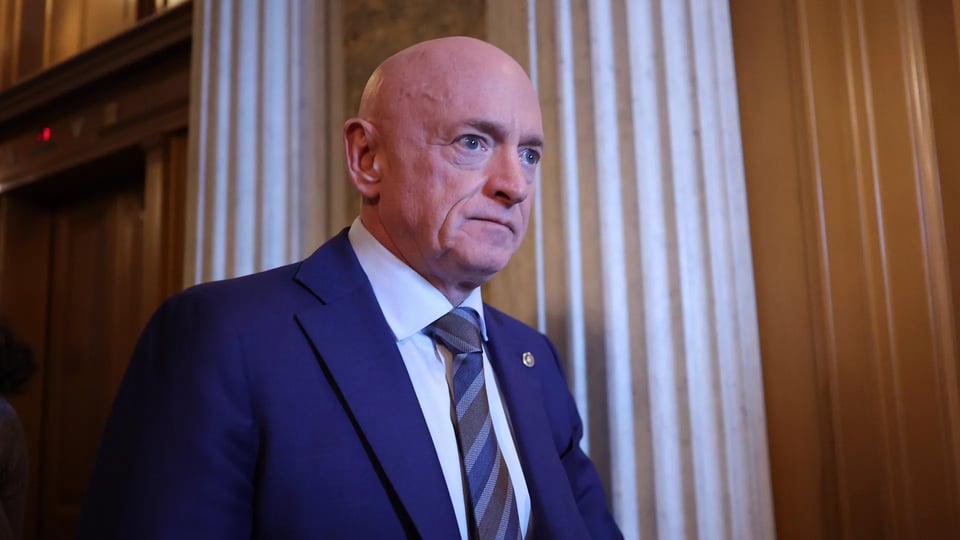
Sen. Mark Kelly is suing Defense Secretary Pete Hegseth.
Why it matters: Kelly, a retired Navy captain, alleges that the Trump administration's attempt to punish him by demoting his military status "sends a chilling message to every retired member of the military."
What they're saying: "Pete Hegseth is coming after what I earned through my twenty-five years of military service, in violation of my rights as an American, as a retired veteran, and as a United States Senator whose job is to hold him—and this or any administration—accountable," Kelly said in a statement.
"His unconstitutional crusade against me sends a chilling message to every retired member of the military: if you speak out and say something that the President or Secretary of Defense doesn't like, you will be censured, threatened with demotion, or even prosecuted," he said.
Catch up quick: In November, Kelly appeared in a video with five other Democratic lawmakers, reminding military and service members they could disobey unlawful orders.
President Trump immediately called the video "SEDITIOUS BEHAVIOR, punishable by DEATH," and the Pentagon opened a military investigation into Kelly.
Last week, Hegseth issued a formal Letter of Censure against Kelly, began the process to demote his rank and threatened criminal prosecution if the senator didn't change his behavior.
The latest: Kelly filed a lawsuit in federal court in Washington, D.C. on Monday, asking a judge to deem the censure illegal and prohibit Hegseth from moving forward with the demotion process.
Between the lines: Kelly's attorney alleges in the lawsuit that Hegseth's attempts to punish the senator violate his First Amendment right to political speech and "trample on protections the Constitution singles out as essential to legislative independence."
The lawsuit also alleges that Hegseth doesn't have legal authority to demote Kelly.
The intrigue: Multiple military attorneys told Axios that the military can only use misconduct committed while an officer was actively serving to determine an officer's retirement rank. Kelly retired in 2011.
Eugene Fidell, a senior research scholar at Yale Law School, said Hegseth's demotion attempt was "dead on arrival" and predicted that a judge will expeditiously side with Kelly and award him attorney fees, to be paid with taxpayer dollars.
Senior military defense attorney Annie Morgan said Hegseth's attempt to demote Kelly is "patently politically motivated" and "undermines the legitimacy of military justice."
The other side: "We are aware of the litigation. However, as a matter of policy, the Department does not comment on ongoing litigation," a War Department spokesperson said in a statement. (Axios)
One more thing.
Where Things Stand
Fed investigation: Some notable Republicans have criticized the Trump administration’s criminal investigation of the Federal Reserve chair, Jerome H. Powell. Two members of the Senate Banking Committee, Thom Tillis of North Carolina and Kevin Cramer of North Dakota, voiced concerns with the inquiry as did Senator Lisa Murkowski of Alaska, who suggested it was an attempt at “coercion.” Three former Fed chairs joined a statement supporting Mr. Powell, denouncing the investigation as an “unprecedented attempt” to undermine the Fed’s independence. (New York Times)
Breakin’ News. 💥💥
Trump and Hegseth seem to have violated international Law in yet another way.
U.S. Attacked Boat With Aircraft That Looked Like a Civilian Plane
Even accepting the Trump administration’s claim that there is an armed conflict with suspected drug runners, the laws of war bar “perfidy.”
The Pentagon used a secret aircraft painted to look like a civilian plane in its first attack on a boat that the Trump administration said was smuggling drugs, killing 11 people last September, according to officials briefed on the matter. The aircraft also carried its munitions inside the fuselage, rather than visibly under its wings, they said.
The nonmilitary appearance is significant, according to legal specialists, because the administration has argued its lethal boat attacks are lawful — not murders — because President Trump “determined” the United States is in an armed conflict with drug cartels.
But the laws of armed conflict prohibit combatants from feigning civilian status to fool adversaries into dropping their guard, then attacking and killing them. That is a war crime called “perfidy.”
Retired Maj. Gen. Steven J. Lepper, a former deputy judge advocate general for the United States Air Force, said that if the aircraft had been painted in a way that disguised its military nature and got close enough for the people on the boat to see it — tricking them into failing to realize they should take evasive action or surrender to survive — that was a war crime under armed-conflict standards.
“Shielding your identity is an element of perfidy,” he said. “If the aircraft flying above is not identifiable as a combatant aircraft, it should not be engaged in combatant activity.”
The aircraft swooped in low enough for the people aboard the boat to see it, according to officials who have seen or been briefed on surveillance video from the attack. The boat had turned back toward Venezuela, apparently after seeing the plane, before the first strike.
Two survivors of the initial attack later appeared to wave at the aircraft after clambering aboard an overturned piece of the hull, before the military killed them in a follow-up strike that also sank the wreckage. It is not clear whether the initial survivors knew that the explosion on their vessel had been caused by a missile attack.
The military has since switched to using recognizably military aircraft for boat strikes, including MQ-9 Reaper drones, although it is not clear whether those aircraft got low enough to be seen. In a boat attack in October, two survivors of an initial strike swam away from the wreckage and so avoided being killed by a follow-up strike on the remnants of their vessel. The military rescued them and returned them to their home countries, Colombia and Ecuador.
U.S. military manuals about the law of war discuss perfidy at length, saying it includes when a combatant feigns civilian status so the adversary “neglects to take precautions which are otherwise necessary.” A U.S. Navy handbook says lawful combatants at sea use offensive force “within the bounds of military honor, particularly without resort to perfidy,” and stresses that commanders have a “duty” to “distinguish their own forces from the civilian population.”
Questions about perfidy have arisen in closed-door briefings of Congress by military leaders, according to people familiar with the matter, but have not been publicly discussed because the aircraft is classified. The public debate has focused on a follow-up strike that killed the two initial survivors, despite a war-law prohibition on targeting the shipwrecked.
The press office for the U.S. Special Operations Command, whose leader, Adm. Frank M. Bradley, ran the operation on Sept. 2, declined to comment on the nature of the aircraft used in the attack. But the Pentagon insisted in a statement that its arsenal has undergone legal review for compliance with the laws of armed conflict.
“The U.S. military utilizes a wide array of standard and nonstandard aircraft depending on mission requirements,” Kingsley Wilson, the Pentagon press secretary, said in response to questions from The New York Times. “Prior to the fielding and employment of each aircraft, they go through a rigorous procurement process to ensure compliance with domestic law, department policies and regulations, and applicable international standards, including the law of armed conflict.”
A White House spokeswoman, Anna Kelly, issued a statement that did not specifically engage with the perfidy issues but defended the strike as having been directed by Mr. Trump to go after “narcotics trafficking and violent cartel activities.” She added: “The strike was fully consistent with the law of armed conflict.”
It is not clear what the aircraft was. While multiple officials confirmed that it was not painted in a classic military style, they declined to specify exactly what it looked like.
Amateur plane-spotting enthusiasts posted pictures on Reddit in early September of what appeared to be one of the military’s modified 737s, painted white with a blue stripe and with no military markings, at the St. Croix airport in the U.S. Virgin Islands.
Regardless of the specific aircraft at issue, three people familiar with the matter acknowledged that it was not painted in the usual military gray and lacked military markings. But they said its transponder was transmitting a military tail number, meaning broadcasting or “squawking” its military identity via radio signals.
Several law-of-war experts said that would not make the use of such an aircraft lawful in these circumstances since the people on the boat probably lacked equipment to pick up the signal.
Among the legal specialists who said the use of a military transponder signal would not solve a perfidy problem was Todd Huntley, a retired Navy captain who formerly deployed with the Joint Special Operations Command as a judge advocate general, or JAG, and directed the Navy’s national security law division.
Captain Huntley said he could think of legitimate uses for such an aircraft that would make it lawful to have in the arsenal for other contexts, including a hostage rescue scenario in which munitions might be needed for self-defense but were not intended for launching offensive attacks.
The Trump administration kept planning for the boat attacks operation closely held, excluding many military lawyers and operational experts who would normally be involved. Moreover, Defense Secretary Pete Hegseth has sought to undercut the role of military lawyers as an internal check, including by firing the top service JAGs in February.
The U.S. military operates several aircraft that are built on civilian airframes — including modified Boeing 737s and Cessna turboprops — and can launch munitions from internal weapons bays without visible external armaments. Such aircraft are usually painted gray and have military markings, but military and plane-spotting websites show that a few are painted white and have minimal markings.
The U.S. military has killed at least 123 people in 35 attacks on boats, including the Sept. 2 strike.
A broad range of specialists in laws governing the use of force have said the orders by Mr. Trump and Mr. Hegseth to attack the boats have been illegal and the killings have been murders. The military is not allowed to target civilians who pose no imminent threat, even if they are suspected of crimes.
The administration has argued that the strikes are lawful and the people on the boats are “combatants” because Mr. Trump decided the situation was a so-called noninternational armed conflict — meaning a war against a nonstate actor — between the United States and a secret list of 24 criminal gangs and drug cartels he has deemed terrorists.
The legitimacy of that claim is widely disputed. Still, it has put attention on ways particular attacks might have violated the laws of war.
Like General Lepper and Captain Huntley, Geoffrey Corn, a retired lieutenant colonel JAG officer who was the Army’s senior adviser for law-of-war issues, said he does not believe that the Sept. 2 attack took place in an armed conflict. He is now a law professor at Texas Tech University.
But he noted that the United States considers perfidy to be a crime in noninternational armed conflicts: It charged a Guantánamo detainee before a military commission with that offense over Al Qaeda’s 2000 attack on the U.S.S. Cole, in which militants in a small boat floated a hidden bomb up to the side of the warship while waving in a friendly manner.
Professor Corn said an assessment of whether the Sept. 2 attack counted as perfidy would turn on whether the military was trying to make the people on the boat think the aircraft was civilian to “get the jump” on them.
“The critical question is whether there is a credible alternative reason for using an unmarked aircraft to conduct the attack other than exploiting apparent civilian status to gain some tactical advantage,” he said. (New York Times)
This ‘N That.
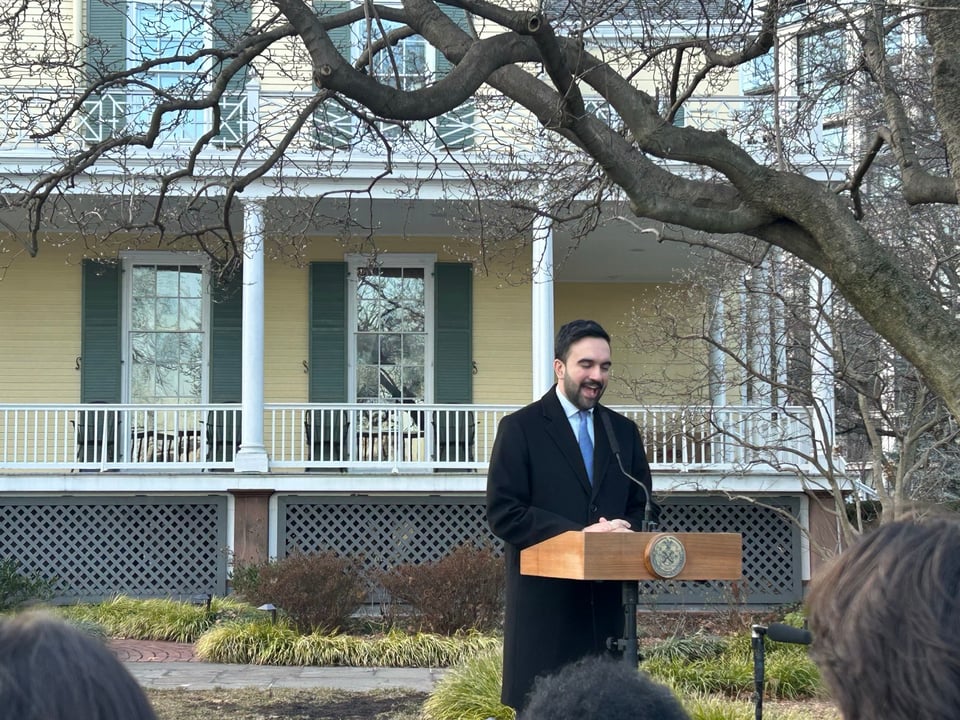
Rama and I feel lucky to be starting a new chapter the way so many New Yorkers have, by moving to a new part of the city. We’re grateful for the welcome to the UES and humbled to be tenants of Gracie Mansion, a home that belongs to the people. pic.twitter.com/1fPZ59Qzel
— Mayor Zohran Kwame Mamdani (@NYCMayor) January 13, 2026
Overnight 16,800 fans cancelled their FIFA World Cup 2026 tickets.
— Marlene Robertson🇨🇦 (@marlene4719) January 12, 2026
FIFA is scheduling an emergency meeting next week to address the mounting protesting relating to safety and political concerns. pic.twitter.com/AuuSYn1MJ5
It’s official: New Orleans mayor Helena Moreno is sworn in by Vice President Kamala Harris. pic.twitter.com/CYqIJolCVr
— Democrats (@TheDemocrats) January 12, 2026
JUST IN: Jack Smith will testify publicly to the House Judiciary Committee on Jan. 22 at 10 am, per Rep. Jordan.
— Kyle Cheney (@kyledcheney) January 13, 2026
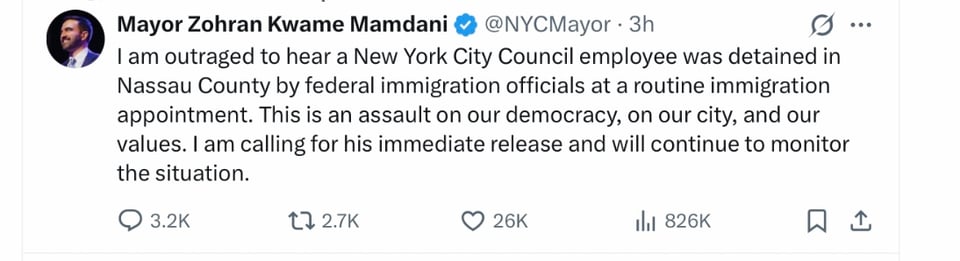
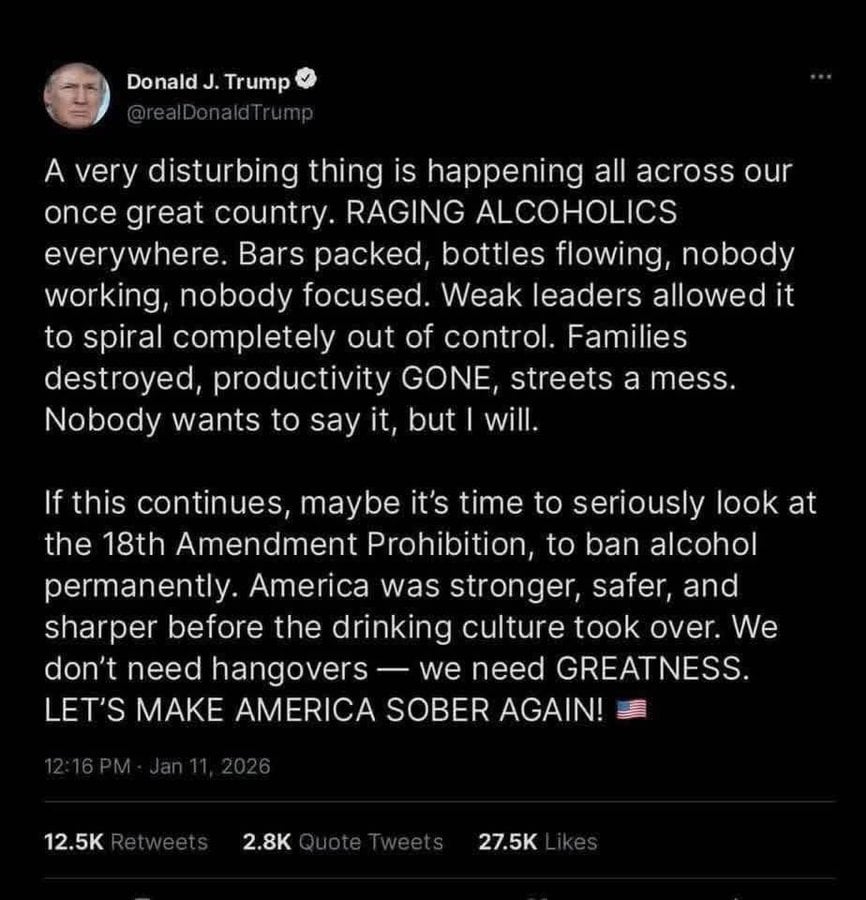
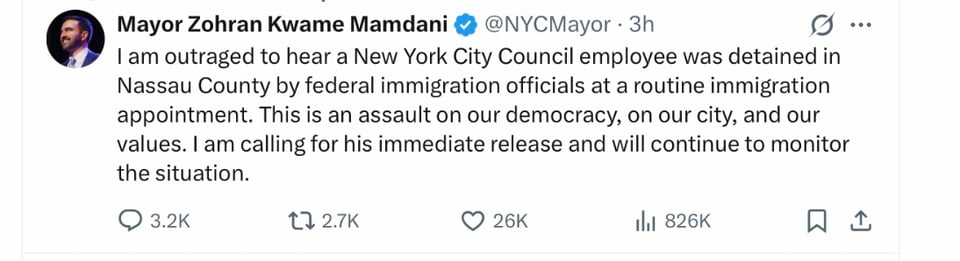
Think his disapproval numbers can’t get lower? May Trump pursue this.
Favorite post of the day on Social Media.
Hope you can see it.
Bless that child.

