Tuesday, December 9, 2025. Annette’s Roundup for Democracy.
Trump Facism is not welcome in Europe.
Trump’s National Security Strategy Sparks European Backlash Over ‘Far-Right’ Rhetoric. Here’s What It Says
The new national security strategy released by the White House calls for asserting U.S. dominance in the Western Hemisphere and “cultivating resistance” within Europe, while reestablishing “strategic stability” with Russia and accepting the Middle East and its leaders “as they are.”
The strategy released late Thursday, which builds on President Donald Trump’s “America First” maxim, marks a sharp escalation of his Administration’s criticism of the country’s European allies and a broader realignment of U.S. foreign policy.
“This document is a roadmap to ensure that America remains the greatest and most successful nation in human history,” Trump wrote in the foreword. “In the years ahead, we will continue to develop every dimension of our national strength—and we will make America safer, richer, freer, greater, and more powerful than ever before.”
Several current and former European officials have pushed back on the strategy, which asserts that Europe is facing the “prospect of civilizational erasure,” alleging that “it is more than plausible that within a few decades at the latest, certain NATO members will become majority non-European”; and calls for the U.S. to take steps to help the continent “correct its current trajectory.”
"It's language that one otherwise only finds coming out of some bizarre minds of the Kremlin," former Swedish prime minister Carl Bildt posted on X, saying the document places the U.S. “to the right of the extreme right in Europe.”
“The stunning section devoted to Europe reads like a far-right pamphlet,” Gérard Araud, a former French ambassador to the United States, similarly observed in an X post, noting that the document “largely confirms” perceptions that Trump is an “enemy of Europe.”
Speaking in Berlin on Friday, German Foreign Minister Johann Wadephul noted that the U.S. was and would remain “our most important ally” in the NATO alliance, but said his country did not need “outside advice.”
In the U.S., Democratic lawmakers also raised alarm about the strategy, with Sen. Richard Blumenthal of Connecticut writing on X that it “foreshadows setbacks—forsaking allies, throwing Ukraine under the bus, & abandoning key strategic goals & basic values.”
Daniel Fried, a distinguished fellow at the Atlantic Council who previously served as the National Security Council's senior director for Presidents Bill Clinton and George W. Bush, ambassador to Poland, and assistant secretary of state for Europe, said the strategy had an “internal incoherence.”
“The strategy’s ideological hostility toward Europe combines with its implied bitterness over perceived US overextension and general disdain for ‘values’ to drive US withdrawal from leadership of the free world—and even the concept of the free world itself,” Fried said in a statement on Friday. “At the same time, the NSS elsewhere recognizes that the United States will need its friends, Europe included, to contend with its adversaries, especially China.”
He added, however, that “to a policy practitioner, the incoherence could provide an opportunity to build on the NSS’s better elements.”
Here’s what to know about the 33-page strategy document and the vision it lays out for the U.S.’s approach to the world.
A ‘Trump Corollary’ to the Monroe Doctrine
The strategy calls for the revival of the Monroe Doctrine, which was first laid out in 1823 by then-President James Monroe to oppose European interference in affairs in the Western Hemisphere, in order ”to restore American preeminence” in the hemisphere and “protect our homeland and our access to key geographies throughout the region.”
The document adds, in line with Monroe’s original aims when formulating the doctrine, that the U.S. will “deny non-Hemispheric competitors the ability to position forces or other threatening capabilities, or to own or control strategically vital assets, in our Hemisphere.”
The Administration described this piece of its security strategy as a “'Trump Corollary' to the Monroe Doctrine.”
To carry it out, the document lays out plans to enlist partners in the region—including both countries aligned with U.S. “principles and strategy” and those with different outlooks but shared interests—to help “control migration, stop drug flows, and strengthen stability and security on land and sea.” It also calls for the U.S. to shift its global military presence away from other regions whose relative significance to its national security has declined and toward the Western Hemisphere “to address urgent threats.”
The U.S. has already amassed its largest military deployment in the Americas in decades as it wages what Trump has described as an “armed conflict” against cartels. Since early September, U.S. forces have carried out more than 20 lethal strikes on alleged drug boats, killing more than 87 people. At the same time, the Administration has intensified pressure on Venezuela—whose president, Nicolás Maduro, faces U.S. drug-trafficking charges—warning that land strikes on the country could come “very soon.”
Beyond the military, the strategy also emphasizes tariffs and “reciprocal trade agreements” as tools that will be used “to strengthen our own economy and industries” in the hemisphere.
‘Cultivating resistance’ in Europe
A section of the plan, called “Promoting European Greatness,” asserts that Europe faces the “prospect of civilizational erasure,” citing what it identifies as key issues on the continent without naming specific leaders or nations.
Among the purported issues it claims Europe is facing are migration policies, “censorship of free speech and suppression of political opposition,” falling birthrates, and “loss of national identities and self-confidence,” which it argues are weakening the continent and putting it on a path to becoming “unrecognizable” in 20 years or less.
The document calls for the U.S. to take a more active role in the continent’s political affairs, including by “cultivating resistance to Europe’s current trajectory within European nations.” It also notes, positively, “the growing influence of patriotic European parties”—likely a reference to far-right, anti-immigration parties that have earned the public backing of the Administration.
The paper adopts the racist conspiracy theory known as the “Great Replacement Theory,” arguing that many NATO countries will soon be “non-European” due to mass immigration. As the theory has left the confines of internet forums and white nationalist sites and entered into the mainstream of prime-time cable news and political speeches, it has fueled racially based violence across the globe.
Beyond this, the document breaks from European officials in their reluctance to name Russia as a threat. It says Europe has a “significant hard power advantage” but “regard[s] Russia as an existential threat.”
The document builds on an already adversarial relationship between the Trump Administration and Europe.
Some of the document echoes Vice President J.D. Vance’s antagonistic speech at the Munich Security Conference earlier this year, in which Vance criticized European nations for their policies on free speech and argued that the continent's gravest danger was not Russia nor China, but their own governments.
The Administration calls the negotiated end to Russia’s invasion of Ukraine a “core interest” for Europe, but criticizes nations that “hold unrealistic expectations for the war perched in unstable minority governments, many of which trample on basic principles of democracy to suppress opposition.”
It claims that “a large European majority wants peace, yet that desire is not translated into policy, in large measure because of those governments’ subversion of democratic processes.”
The policy also states that its policy for Europe should focus on “ending the perception, and preventing the reality, of NATO as a perpetually expanding alliance.”
Deterring conflict in Taiwan
The strategy document calls deterring a conflict over Taiwan a “priority,” and says the ideal way to achieve that is by “preserving military overmatch.”
It says a war between Taiwan and China would have “major implications for the U.S. economy.”
Taiwan’s foreign ministry welcomed the U.S. position in a social media post on Friday morning: “The US National Security Strategy affirms that deterring conflict over Taiwan is essential to the region & the world,” it wrote on X.
The document emphasizes that the U.S. should aim to maintain dominance in the Western Hemisphere, an obvious nod to China’s growing relationship with Latin American and Caribbean nations, through expanding trade routes and political alliances.
Taking Middle Eastern nations ‘as they are’
The document lambasts European leaders while simultaneously promising to stop “hectoring” Gulf monarchies like Saudi Arabia and the United Arab Emirates (UAE) into “abandoning their traditions.” As the document claims to view these nations as “a source and destination of international investment”—and as Trump seemingly prioritizes the broader U.S.-Saudi relationship—the language shows a clear difference in how the Trump Administration views these leaders compared with Europeans.
Trump has amassed significant personal investments in the region and, earlier this year, visited many states in the Middle East. He went on to host Saudi Arabia Crown Prince Mohammed bin Salman in his first visit to the White House since he was blamed for the killing of American journalist Jamal Khashoggi, which sparked international outcry.
The strategy document includes less detailed but equally dominant goals for its presence in the Middle East, designed to “prevent an adversarial power from dominating” the region, specifically in the oil and gas industries and preventing “forever wars.”
The plan touts Trump’s ability to retain good standing in the region, “reinforced by President Trump’s successful revitalization of our alliances in the Gulf, with other Arab partners, and with Israel.”
Plans for further investment in the region were at the core of the document’s approach to the Middle East, which it says will “increasingly become a source and destination of international investment, and in industries well beyond oil and gas— including nuclear energy, AI, and defense technologies.”
The plan echoed similar goals for regions in Africa, where “harnessing Africa’s abundant natural resources and latent economic potential” stands at the core of the agenda.
The Administration wants to “transition from a foreign aid paradigm to an investment and growth paradigm” on the continent.
Earlier this year, Trump shut down the U.S. Agency for International Development, halting the flow of aid into multiple African countries, which experts have said will lead to thousands of deaths.
The document clearly shows a deprioritization of resources devoted to Middle Eastern and African stability, focusing clearly on a shifted focus towards the Western Hemisphere, which mirrors the Trump Administration’s military priorities and focus on Venezuela in the first year in office. (Time Magazine)
One more thing.
Within the Administration, Trump’s National Strategy paper released last Thursday,is often referred to as National Security Council Report (NSC) 88.
In extremist and white-supremacist circles, “88” is a hate symbol referring to the 8th letter of the alphabet H, leading to HH, or shorthand for “Heil Hitler.”
Take that in.
Health Care in America, or Why you should call your elected officials every day!
Trump’s destruction of our insurance system is not welcomed.
Remember even if you don’t use the ACA Marketplace, this will quickly raise your own health care costs too. When more people lose or quit their insurance because of rising costs, they turn more and more to Emergency Rooms for their healthcare. Hospitals are legally required to treat people in emergencies, even if they cannot pay.
When uninsured patients cannot pay their bills:
• Hospitals absorb the cost (“uncompensated care”).
• They shift those costs onto private insurers.
• Insurers raise premiums to cover the gap.
Then too, public health in general falls. Outbreaks of diseases occur. Welcome to the return of measles, and more.
ACA Marketplace Premium Payments Would More than Double on Average Next Year if Enhanced Premium Tax Credits Expire
Affordable Care Act (ACA) enhanced premium tax credits are set to expire at the end of this year. Enhanced premium tax credits were introduced in 2021 and later extended through the end of 2025 by the Inflation Reduction Act. The enhanced tax credits both increased the amount of financial assistance already eligible ACA Marketplace enrollees received as well as made middle-income enrollees with income above 400% of federal poverty guidelines newly eligible for premium tax credits.
Since the introduction of the enhanced premium tax credits, enrollment in the Marketplace has more than doubled from about 11 to over 24 million people, the vast majority of whom receive an enhanced premium tax credit. If enhanced tax credits expire, many Marketplace enrollees will continue to qualify for a smaller tax credit, while others will lose eligibility altogether and be hit by a “double whammy” of losing their entire tax credit and being on the hook for rising premiums.
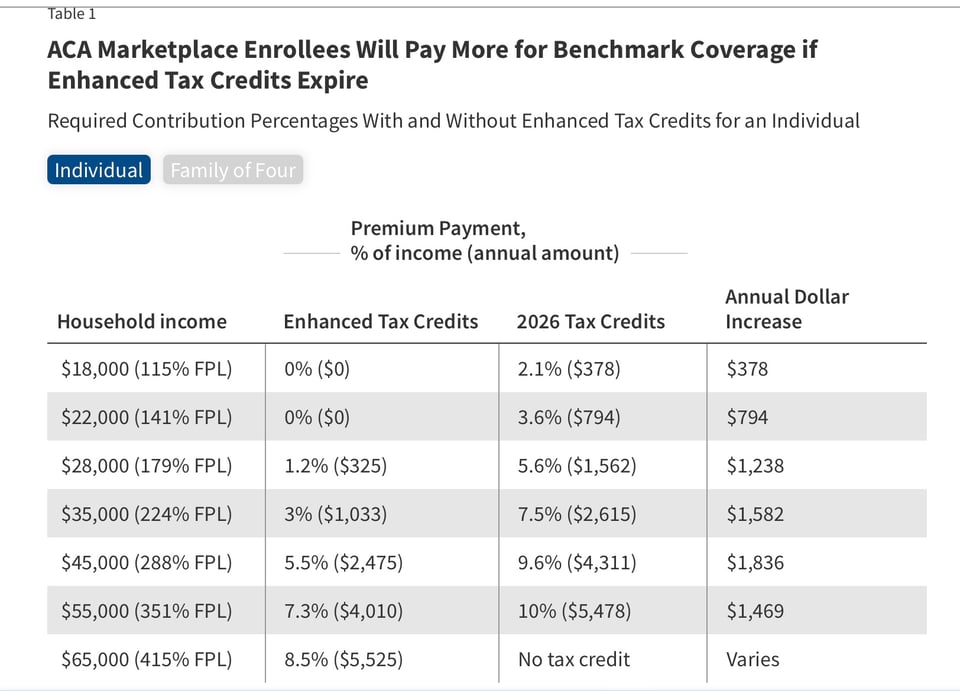
Since 2014, the ACA has capped how much subsidized enrollees pay for their health insurance premiums at a certain percent of their income, on a sliding scale, with the federal government covering the remainder in the form of a tax credit. Enhanced tax credits work by further lowering the share of income ACA Marketplace enrollees pay for a plan. For example, with the enhanced tax credits in place, an individual making $28,000 will pay no more than around 1% ($325) of their annual income towards a benchmark plan. If the enhanced tax credits expire, this same individual would pay nearly 6% of their income ($1,562 annually) towards a benchmark plan in 2026. In other words, if the enhanced tax credits expire, this individual would experience an increase of $1,238 in their annual premium payments net of the tax credit.
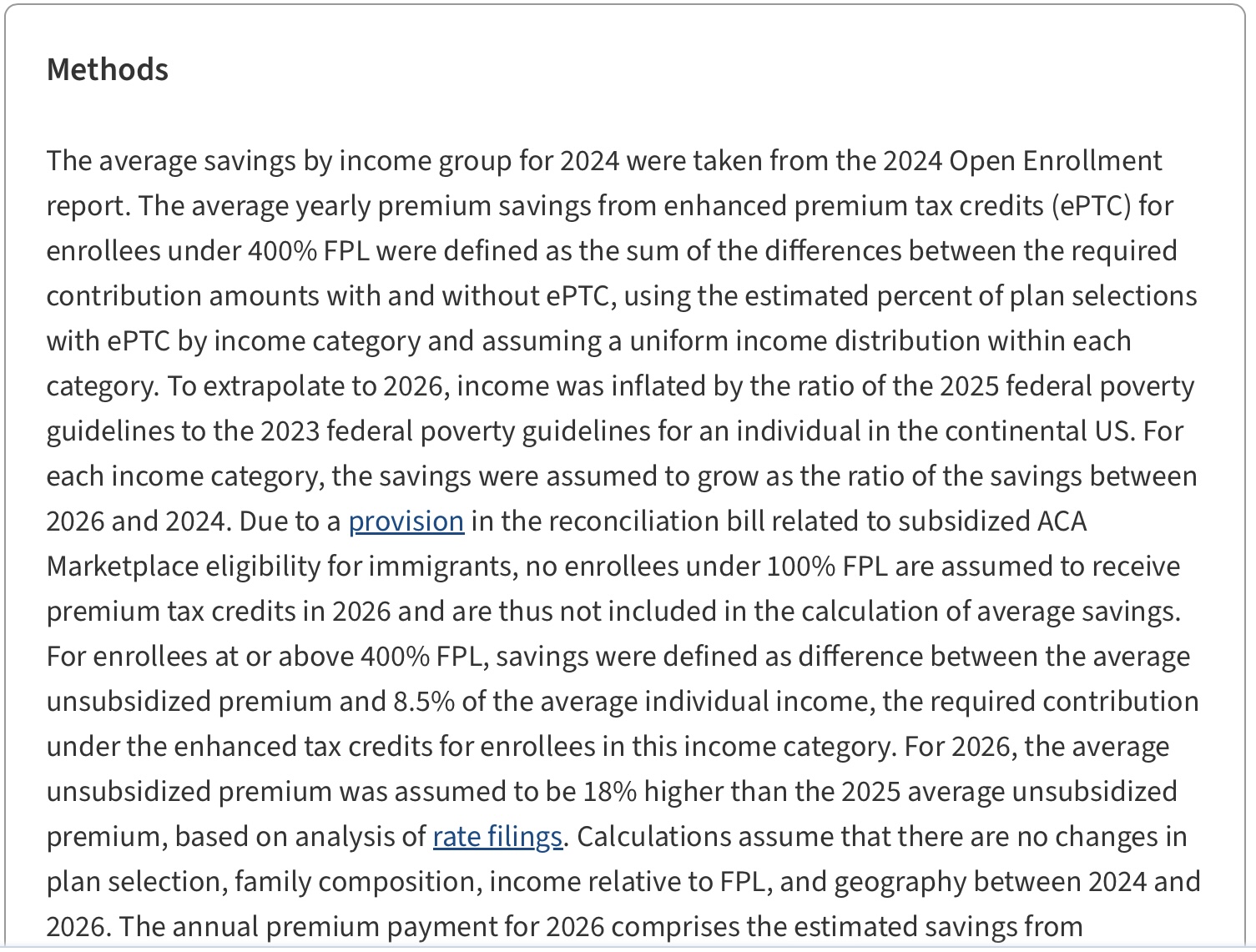
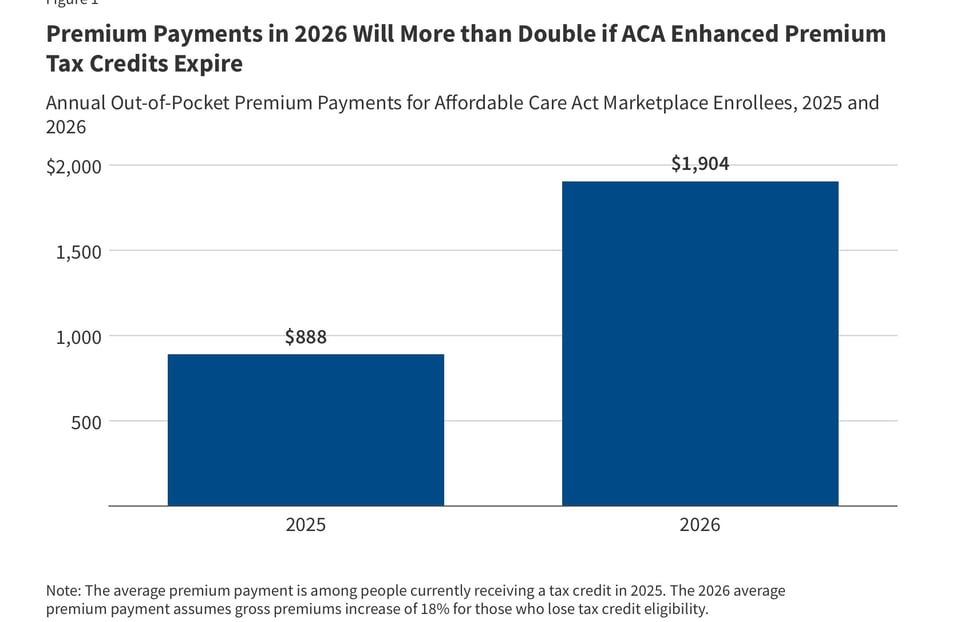
A previous KFF analysis, based on data released by the federal government, showed the enhanced premium tax credits saved subsidized enrollees an average of $705 annually in 2024, bringing their annual premium payment down to $888. Without the enhanced premium tax credits, annual premium payments in 2024 would have averaged $1,593 (over 75% higher than the actual $888). More recent data have not been released.
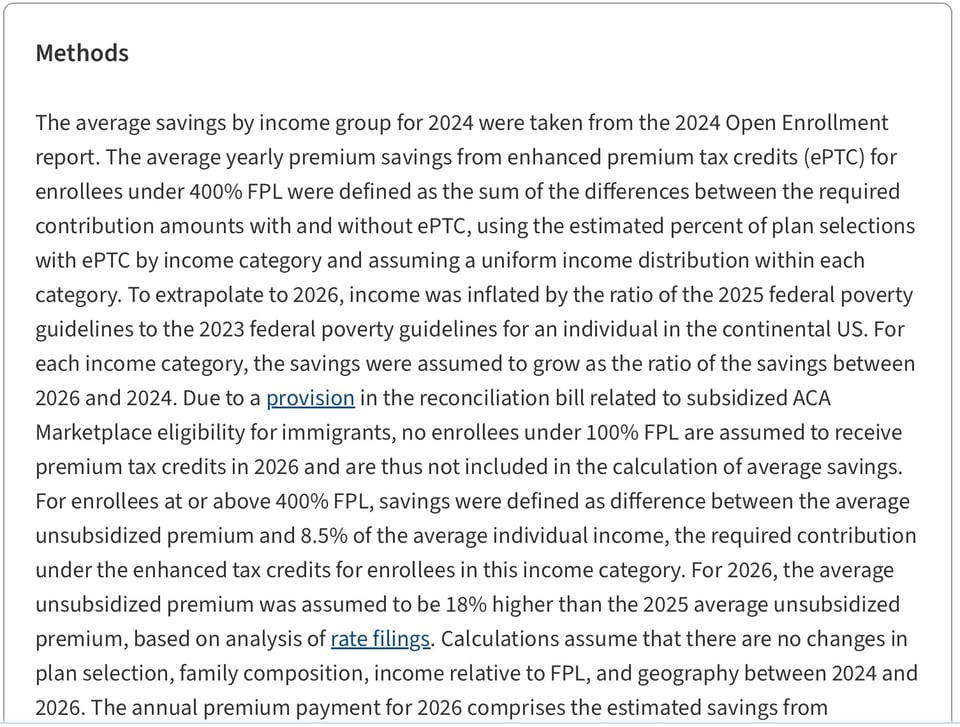
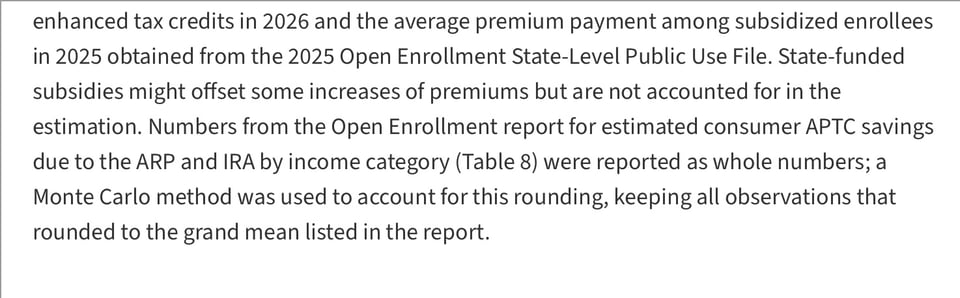
Based on the earlier federal data and more recent other publicly available information, KFF now estimates that, if Congress extends enhanced premium tax credits, subsidized enrollees would save $1,016 in premium payments over the year in 2026 on average. In other words, expiration of the enhanced premium tax credits is estimated to more than double what subsidized enrollees currently pay annually for premiums—a 114% increase from an average of $888 in 2025 to $1,904 in 2026. (The average premium payment net of tax credits among subsidized enrollees held steady at $888 annually in 2024 and 2025 due to the enhanced premium tax credits).
The increase in premium payments with expiration of the enhanced premium tax credits is even higher than previously estimated for two reasons:
Trump administration changes to tax credit calculations, and
Rising 2026 premiums.
The Trump administration made changes to the way tax credits are calculated, which were finalized in the ACA Marketplace Integrity and Affordability rule. The required contribution levels that will be in place for 2026 if the enhanced tax credits are not renewed will be higher relative to the required contribution levels calculated under the original methodology based on rules in effect at the time. This means that enrollees are expected to pay a higher share of their income towards a benchmark premium plan in 2026 than they otherwise would have. Additionally, inflation in private insurance premiums has led to higher premium contribution levels than previously expected.
Additionally, insurers in the ACA Marketplace are proposing to raise their rates by a median of 18%. Fueled by rising health care costs and the expiration of the enhanced premium tax credits, insurers are proposing the largest rate increases in 2026 since 2018, the last time uncertainty over federal policy changes contributed to sharp premium increases. As premiums increase, the enhanced tax credits provide additional savings to enrollees that receive them. This means that middle-income enrollees, whose payment for a benchmark plan is currently capped at 8.5% of their income and will lose financial assistance altogether, will have to cover the cost of premium increases in addition to the amount their tax credits would have previously covered to keep their same plan.
Enrollees across the income spectrum can expect big increases in premium payments
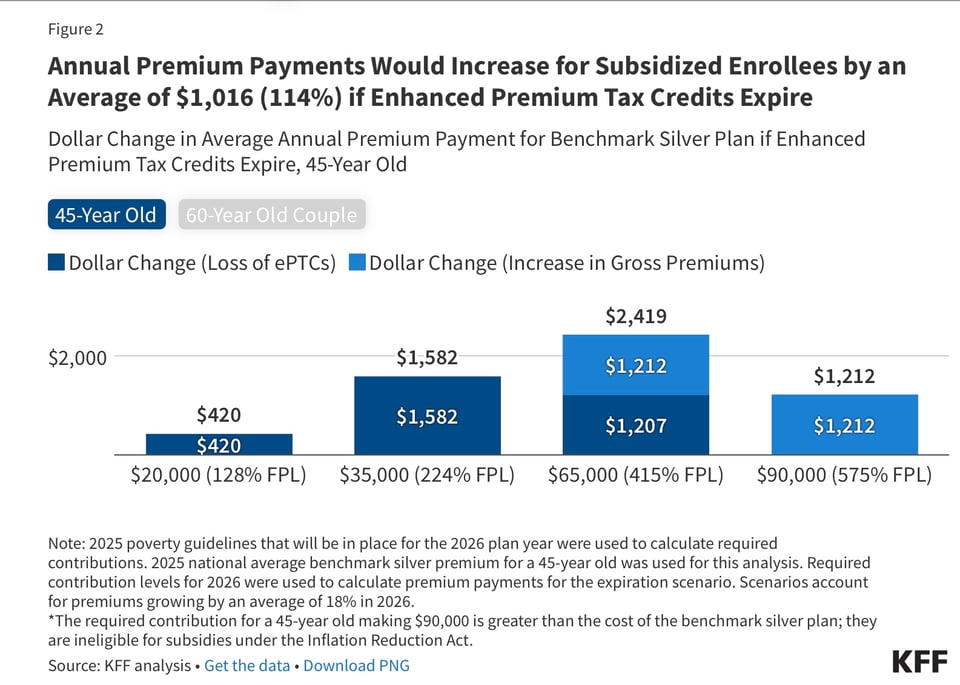
Enrollees with incomes above 400% of poverty will be subject to large increases in premium payments if enhanced premium tax credits expire. On average, a 60-year-old couple making $85,000 (or 402% FPL) would see yearly premium payments rise by over $22,600 in 2026, after accounting for an annual premium increase of 18%. This would bring the cost of a benchmark plan to about a quarter of this couple’s annual income, up from 8.5%. Meanwhile, a 45-year-old earning $20,000 (or 128% FPL) in a non-Medicaid expansion state would see their premium payments for a benchmark plan rise from $0 to $420 per year, on average, from the loss of enhanced premium tax credits. About half (45%) of ACA Marketplace enrollees have incomes between 100-150% of poverty, about a fourth (28%) have incomes between 150-250% of poverty, and roughly 1 in 10 have incomes above 400% of poverty.
(KFF, the independent source for health policy research, polling, and news.)
Obamacare Users Face Higher Deductibles, Higher Premiums.
People who have insurance under the Affordable Care Act are being asked to pay more for plans that will cover less of their care.
Millions of Americans are confronting the highest health insurance costs in years. For those enrolling in Obamacare for next year, the plans will cover a considerably smaller fraction of their medical bills.
More and more people are discovering that their deductibles are rising significantly, worsening fears that they will no longer be able to pay for medical care. That’s on top of higher premiums; they could more than double.
With affordability increasingly out of reach, some people are facing the dire prospect of dropping their insurance altogether, even if they’re still eligible for subsidies. Others may forgo doctors’ visits or trips to the emergency room to avoid the expense.
The contentious debate in Congress over the future of the enhanced subsidies under Obamacare that are set to expire this month has largely focused on the rise in premiums. Most people will still qualify for some federal tax credits in 2026, but many will find that monthly costs are doubling if the generous subsidies are not extended.
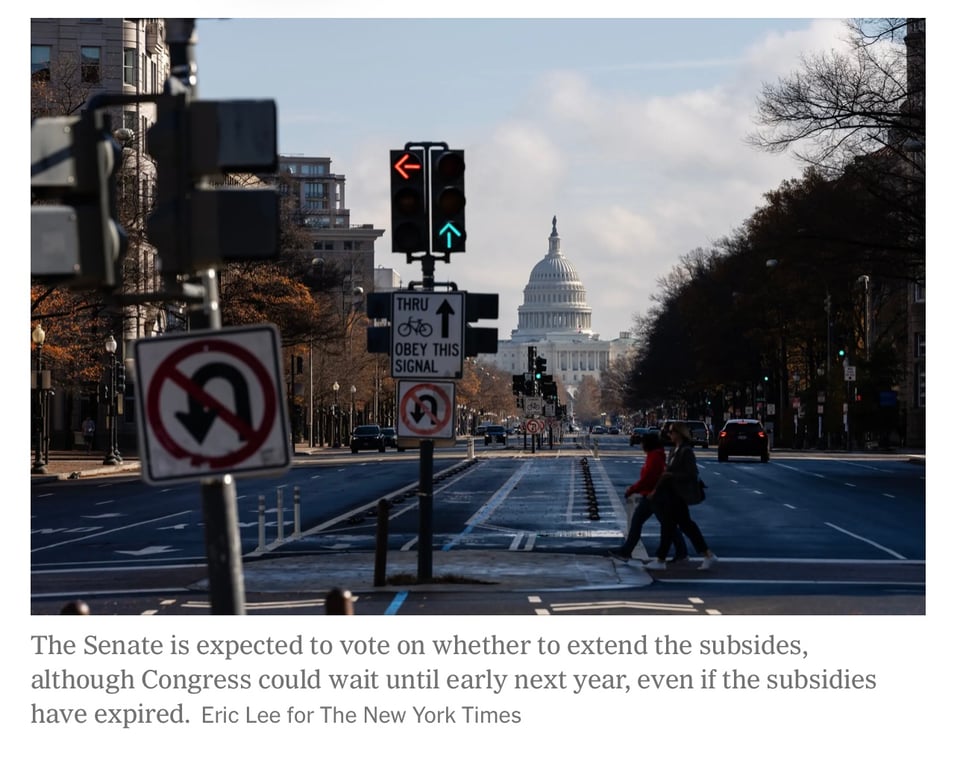
The Senate is expected to vote on whether to extend the subsides, although Congress could wait until early next year, even after the subsidies have expired. President Trump has floated supporting some sort of extension, but it is unclear what kind of compromise would muster enough Republican backing to pass.
As medical costs have climbed, health insurance at all levels has become more expensive. Contributing factors cited are higher overall prices for prescription drugs, the cost and the exploding use of obesity drugs, tariffs and increasing labor expenses.
Because many plans under the Affordable Care Act already carry a high deductible, people may not be able to find cheaper policies to significantly reduce costs.
Nearly a third of the 24 million people who signed up for coverage under the A.C.A. last year enrolled in the least expensive kind of plan available to everyone, a so-called Bronze plan.
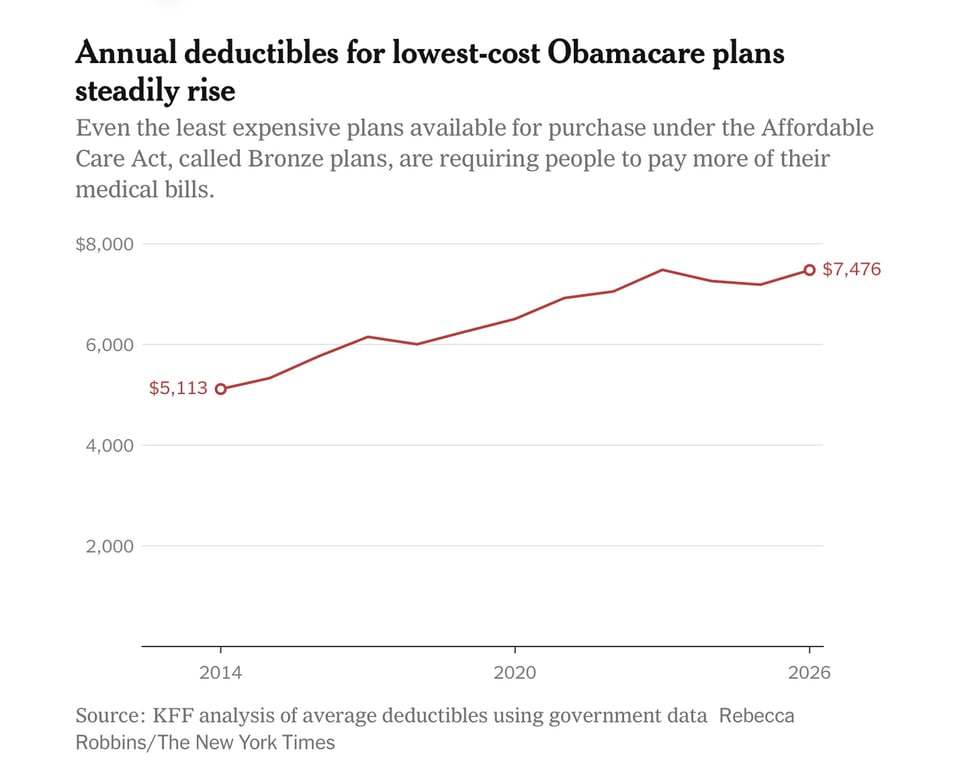
These individuals already pay a large share of their medical bills. The average deductible for a Bronze plan has climbed steadily, to roughly $7,500 in 2026 from under $7,000 in 2021, according to KFF, a health research group.
“They don’t have that option to switch to a lower-premium plan with a higher deductible,” said Cynthia Cox, an expert on Obamacare for KFF.
Some of those affected retired early and must wait until they are 65 to enroll in Medicare. “These people are really in a difficult situation,” she said.
In addition to high deductibles, some plans may require people to pay a large share of out-of-pocket costs in other ways — asking for co-payments, which are fixed amounts when they go to the doctor, or coinsurance, which is a percentage of their medical bills.
Even the caps on how much people have to pay in out-of-pocket costs are going up. The out-of-pocket maximum, which does not apply to those with the lowest incomes, will reach $10,600 next year, about $1,200 more than in 2025.
“People look at $10,600 and panic,” said Jennifer Chumbley Hogue, an insurance broker in Texas who sells A.C.A. plans. “There’s a big difference to the consumer between $9,000 and $10,000.”
Others are worried about the financial risks of a hospitalization, which would require upfront payments of thousands of dollars.
For example, Patty Reed, a small-business employee in Los Angeles, had a plan with no medical deductible, but next year she will have a deductible of $5,200.
That is on top of her plan’s higher premium — $1,700 a month next year. Ms. Reed, 60, had qualified for federal and state subsidies that brought the premium cost down to about $1,100. Because her income varies year by year, it remains unclear whether she will qualify again.
“I feel like I can never get ahead,” Ms. Reed said. She is weighing buying a plan with a higher deductible but worries about what she might have to pay if she goes to the hospital. “It’s a gamble,” she said.
In a KFF poll in early November of people enrolled in Obamacare, a quarter reported that they were “very likely” to go without coverage if their premiums doubled or if they had to pay $50 more a month if they paid no premiums for 2025.
Half said finding another source of insurance if their Obamacare coverage became unaffordable would be “very difficult.”
Eric Littman, a self-employed chiropractor in New Jersey, knows he will be paying more to insure his family of four. “The problem is that what is also going up is the deductible, coinsurance and out-of-pocket amounts,” he said.
Absent federal tax credits, Dr. Littman could pay about $35,000 in annual premiums for a mid-tier plan that will have a higher out-of-pocket maximum of $17,000.
A cheaper plan further limits coverage, raising the specter of even higher personal cash outlays. “You essentially don’t have insurance for the small things — you only have insurance for the $100,000 hospital bill,” Dr. Littman said.
With Republicans and Democrats still at a stalemate over the subsidies, expiration seems increasingly likely.
Some Republicans say they plan to develop an alternative to the Affordable Care Act, and President Trump has suggested replacing the subsidies with cash payments.
Obamacare critics argue the law provides coverage that is far too generous and too costly. They also contend that doling out the expanded subsidies encourages people like Ms. Reed and Dr. Littman to choose plans with lower deductibles and out-of-pocket costs.
If people spent more of their own money, they would be smarter shoppers for medical care, the theory goes. “Americans can be wise consumers,” said Brian Blase, the president of the Paragon Health Institute, an influential conservative health policy group, at a hearing before the Senate Finance Committee in mid-November.
Research contradicts Mr. Blase’s assertions, finding that people with high-deductible plans often go without needed medical care. Their decisions can be haphazard: They may skimp on a lifesaving heart medicine but favor expensive imaging that is much less important. They can be confounded by information overload about doctors, perhaps unable to properly navigate and evaluate the right specialist.
“We have very little evidence that people are good at shopping for their care,” said Adrianna McIntyre, an assistant professor at the Harvard T.H. Chan School of Public Health.
The KFF poll found an additional $1,000 in health care expenses would likely cause two thirds of the Obamacare enrollees to cut back spending on household expenses like food or clothing.
People said they were already struggling to afford medical care with six in ten saying it is already very or somewhat difficult to afford their deductibles and out-of-pocket costs.
For those covered under the Affordable Care Act, next year’s policies are breaking their household budgets and providing coverage that is often much less generous.
“For a lot of people, this isn’t very good insurance,” said John Holahan, a health economist at the Urban Institute, a left-leaning think tank. He thinks some people will drop their coverage next year when confronted with the expense and the amount they could owe in medical bills.
“People will make their judgment that it’s just not worth it to pay a higher premium for policies that have high deductibles,” he said.
Others may opt for so-called junk plans that do not always meet the A.C.A.’s standards and may not pay for expensive medical care or may refuse to cover a pre-existing condition. They may also choose an insurance look-alike, one that promises to pay for medical expenses but is not true insurance, like some plans offered by Christian health-sharing ministries.
The price of an insurance plan typically tries to balance the cost of premiums with how much the plan covers. Under the A.C.A., people with very low incomes are protected from high medical bills by being able to purchase special mid-tier, or Silver plans. About half those enrolled in Obamacare are in these plans.
Some individuals may also be eligible for a catastrophic A.C.A. plan, which is not available to everyone, and has a deductible of $10,600.
Peggy Maryanski, 64, is a retired schoolteacher in Ventura, Calif., and cares for her husband, who has bladder cancer. Her monthly costs are $943, after she receives subsidies, but will go up next year to nearly $1,700 if she stays with the same plan.
She is hesitant to move from her Silver plan to a Bronze one because emergency room visits could go from $400 a visit to 40 percent of the overall cost — after she meets her annual deductible of $5,800.
“It just felt too high a risk for someone my age,” Ms. Maryanski said. “We’re trying to stick with the Silver.”
Other plans don’t offer as wide a selection of doctors. “There are alternatives, but they are not that desirable,” she said.
Even though her husband is covered under Medicare, the couple still pays thousands of dollars in medical bills — in addition to premiums. “It’s a lot,” she said.
“When you retire, there is no income,” she said. “You are spending your savings. You know there is no more from where that came from.” (From Reed Abelson, who have been covering the Affordable Care Act since its passage in 2010. New York Times)
What a guy.

Rachel Scott, ABC News.
Trump to ABC's Rachel Scott: "You are the most obnoxious reporter in the whole place. Let me just tell you -- you are an obnoxious-- a terrible reporter. And it's always the same thing with you. I told you." pic.twitter.com/3GcH2FaKB3
— Aaron Rupar (@atrupar) December 8, 2025
🚨BREAKING: Trump has a full MELT DOWN when a reporter presses him on whether he’ll release the FULL video of the survivors clinging to wreckage before they were killed.
— CALL TO ACTIVISM (@CalltoActivism) December 8, 2025
Trump explodes: “You are the most obnoxious… actually a terrible reporter.”
Release the tape, you COWARD! pic.twitter.com/SEcdFlyNT7
New candidate in Texas.
Texas, let’s win this thing. #JasmineForUS #TexasTough pic.twitter.com/VthTb93kur
— Jasmine Crockett (@JasmineForUS) December 8, 2025
The boy from Queens will soon be a man in Manhattan.
Welcome back, Zohran.
Mayor-elect Mamdani announces plans to move into Gracie Mansion in Manhattan - ABC7 New York.
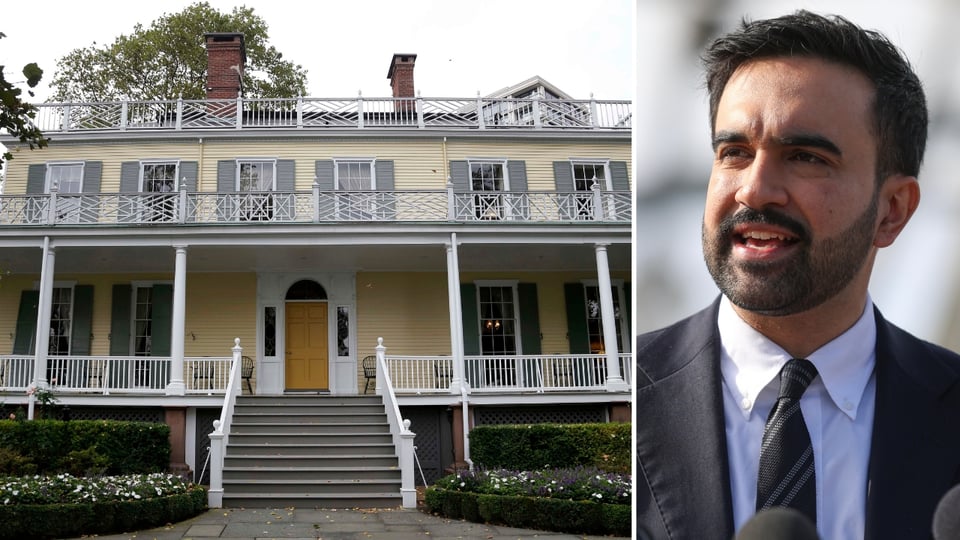
UPPER EAST SIDE, Manhattan (WABC) -- Mayor-elect Zohran Mamdani announced plans to move into Gracie Mansion alongside his wife Rama following his inauguration in January.
He previously said he was undecided, but on Monday announced he'll be making the move.
"This decision came down to our family's safety and the importance of dedicating all of my focus on enacting the affordability agenda New Yorkers voted for," the future mayor said in a statement.
He added that he will miss living in Astoria during his term.
"While I may no longer live in Astoria, Astoria will always live inside me and the work I do," he said in the statement.
READ THE FULL STATEMENT BELOW:
"My wife Rama and I have made the decision to move into Gracie Mansion in January.
"We will miss much about our home in Astoria. Cooking dinner side by side in our kitchen, sharing a sleepy elevator ride with our neighbors in the evening, hearing music and laughter vibrate through the walls of the apartment.
"To Astoria: thank you for showing us the best of New York City. We have called this neighborhood home as our city weathered a devastating pandemic, cruel attacks on immigrants, and years of an affordability crisis. Time and again, this community has shown up for one another. We will miss it all - the endless Adeni chai, the spirited conversations in Spanish, Arabic and every language in between, the aromas of seafood and shawarma drifting down the block.
"This decision came down to our family's safety and the importance of dedicating all of my focus on enacting the affordability agenda New Yorkers voted for.
"My priority, always, is serving the people who call this city home. I will be a mayor for the line cooks on Steinway, for the children swinging at Dutch Kills Playground, for the bus riders waiting for the Q101. While I may no longer live in Astoria, Astoria will always live inside me and the work I do." (ABC News).