Tuesday, December 16, 2025. Annette’s Roundup for Democracy.
The weekend of December 13 and 14 was a terrible weekend of Violence.
The Brown University shooting occurred on Saturday, Gunfire broke out at about 4:05 p.m. during a final-exam review session inside the Barus & Hollis Engineering Building at the college.
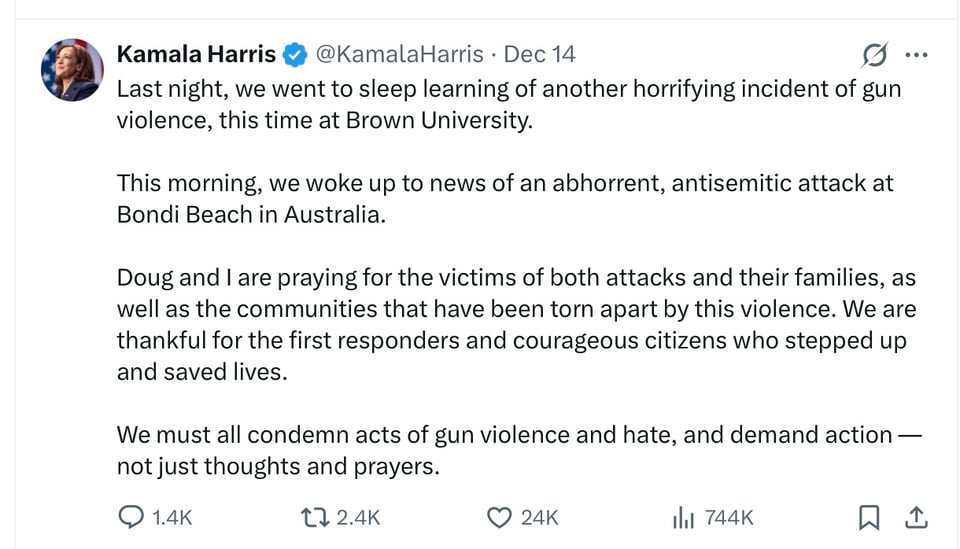
The Bondi Beach shooting occurred on Sunday, in Sydney, Australia. It occurred at 6:47 p.m.during a Hanukkah celebration when two gunmen opened fire.
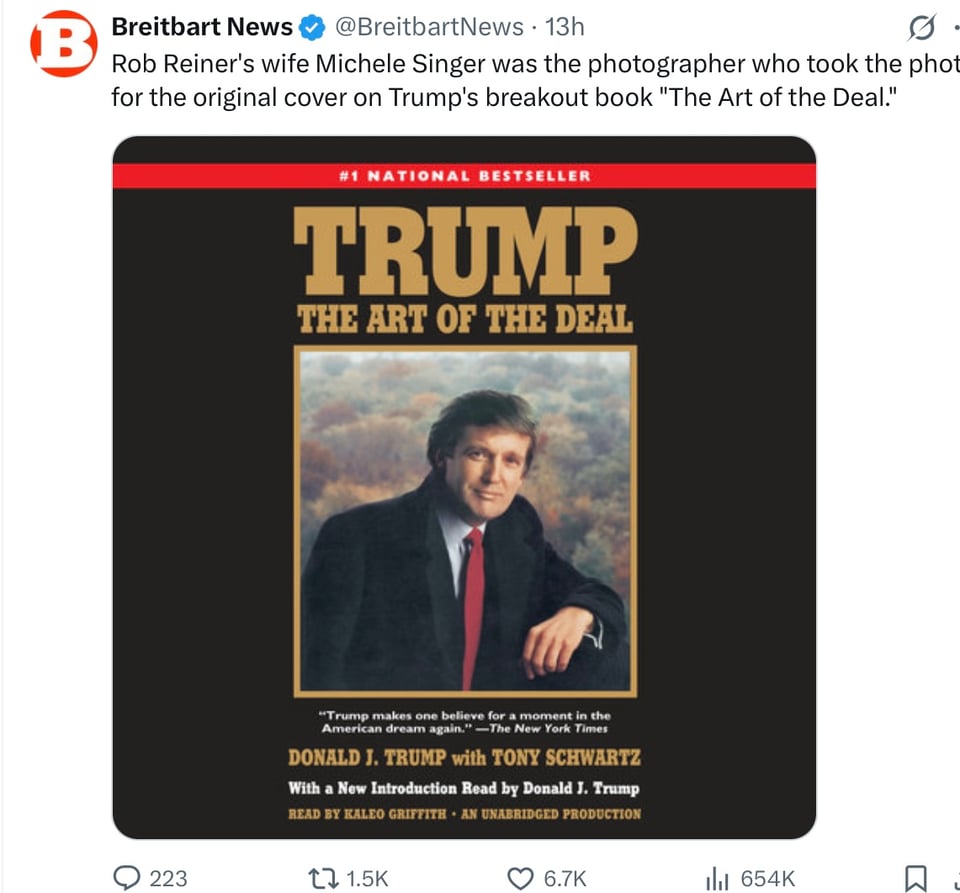
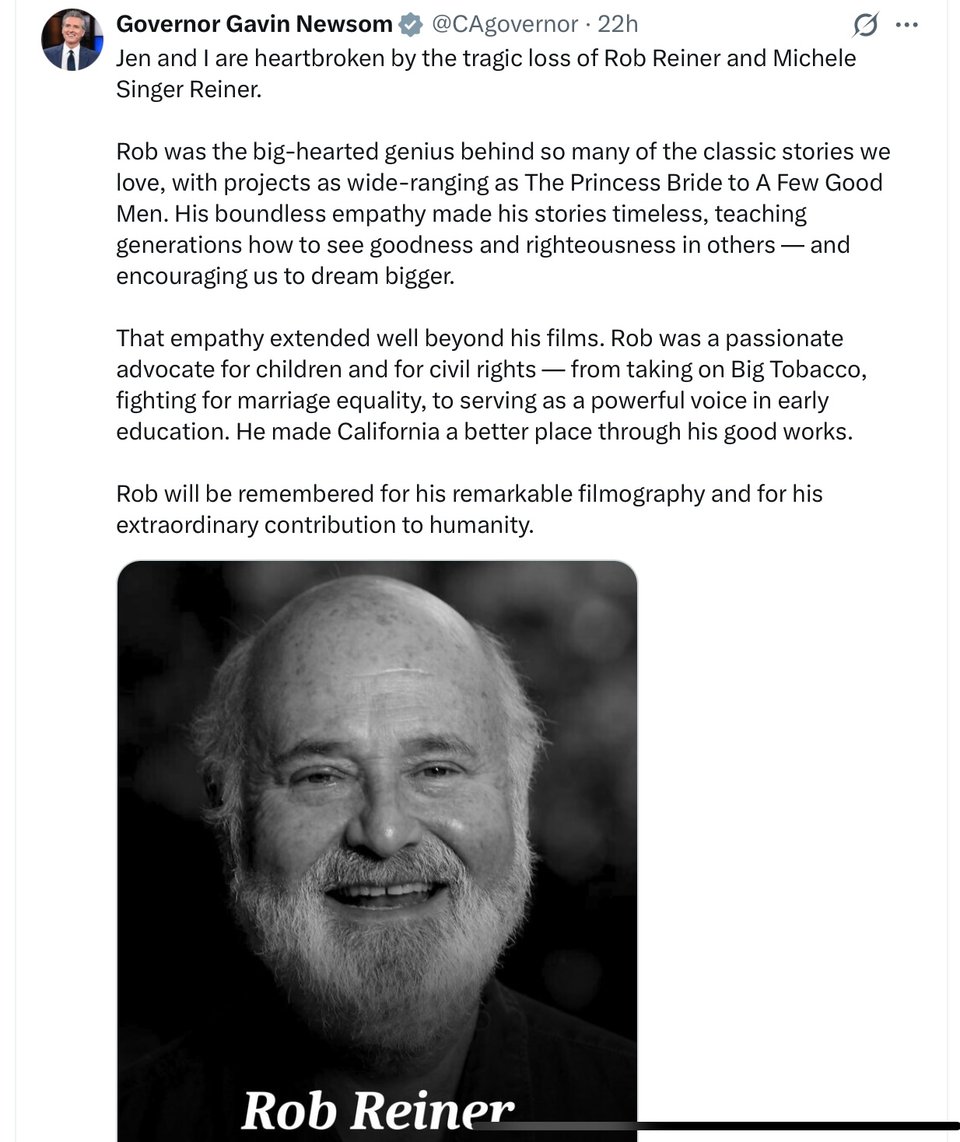
Director/actor Rob Reiner, 78, and photographer/environmental activist Michele Singer Reiner, 70, were found stabbed to death in their Los Angeles home on Sunday.
What a terrible thing it is.
Mass shootings as regime change
“What a terrible thing it is,” said Donald Trump, “And all we can do right now is pray for the victims, and for those that were very badly hurt.” Such was the president’s reaction to the mass shooting at Brown University. We are inured to these clichéd formulations. But they are an essential element of a regime change from the rule of law to the rule of blood. The president’s statement is a betrayal of the very purpose of government and a confession of indifference to that purpose.
Of course there are things that the president, personally, could do. He could fire the incompetent people he appointed to run our national police service, the FBI, and replace them with competent people. He could personally stop lying, and tell his people to stop lying, about the existence of an all-powerful antifa conspiracy. That ridiculous fiction diverts the resources of the FBI and other agencies away from actual domestic terrorism threats. He could order the FBI and other agencies to prioritize domestic terrorism, rather than eliminating the relevant units and sending their personnel to back up ICE.
He could propose gun control legislation that aims to restore the status quo before the era of mass shootings began, which would include a ban on assault weapons. He could do all of these things. He could have done all of these things in the hours after the shooting. He won’t do any of them, of course.
Yet issue here is deeper than Trump. The notion that all elected officials have are their thoughts and prayers, regardless of by whom it is uttered, is a direct attack on the purpose of government itself. It is not a response to the anarchy of gun violence. It is a normalization of it and one of the preconditions to its repetition and spread.
The gesture towards divine power invokes an American taboo -- we are not to criticize anyone who invokes God, no matter how obviously hypocritical and self-serving, as in this case. The taboo, once summoned, prevents us from seeing the obvious, fundamental thing: a basic reason that we have government is to prevent us from becoming a society in which we simply shoot one another all the time.
That is a strand of the tradition that leads to the rule of law. Without law, every conflict is regulated individually, with whatever tools come to hand. With the advance of technology, this becomes ever more problematic. Government, for example the kind established by the United States Constitution, is designed to extend law such that both “the blessings of liberty” and “domestic tranquility” can be preserved. Law brings freedom and security together at a higher level than we can achieve as individuals without it. This means, though, that we concede the monopoly on violence to the government.
In order to have a constitutional order, in other words, we accept a strong presumption against the use of violence, and reserve it for law enforcement and national defense — as necessary. We accept that it is wrong to hurt and to kill others. As a result, we are all both more secure and more free than we would be otherwise. This entire version of politics depends on the idea that violence, unlike for example art or commerce, is not part of the private sphere of life. There cannot be a right to kill someone else, or a right to make money by enabling murder.
This logic, unfortunately, has been lost. Mass shootings serve as advertisements for the gun industry. The NRA, the gun industry lobby, portrays mass killing as a reason why more people should own guns. Like other industries, its concern is to sell its products, which are marketed through anxiety as emblems of safety.
Guns are an unusual product. When you study economics, you are taught that there is a balance between demand and supply. Demand is supposed to match supply. But in the case of guns, the supply creates further demand: the more we kill one another, the more Americans decide that they need guns to protect themselves. When a president says that all that he can do is pray, then what else are people supposed to conclude?
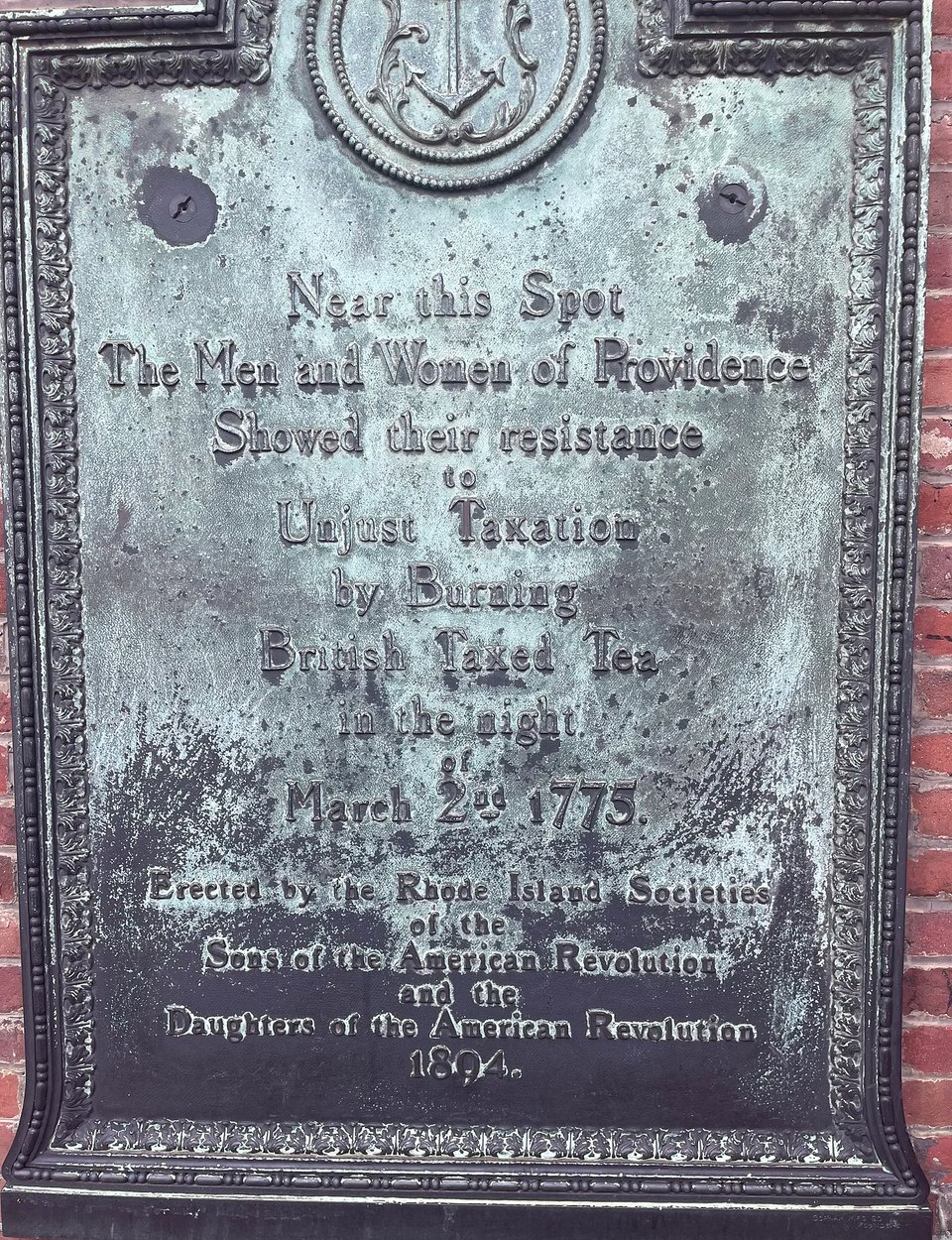
Memorial of revolutionary action, Brown University, photo May 2025.
There is endless debate about the Second Amendment of the US Constitution, on the right to bear arms. Here is the problem, put simply.
In recent decades, the Supreme Court decided that the Second Amendment means something that it plainly does not mean. It is clearly there to help “provide for the common defence” by way of a “well regulated militia.” The Second Amendment is part of a larger document that is meant to establish freedom and safety together by establishing the compact of non-violence known as the rule of law.
The error made by the Supreme Court is obvious in both principle and practice. If justices invent a right for everyone to have the means of easily killing anyone else, they are betraying a basic purpose of government, understood by the framers of the Constitution, which is to prevent a war of all against all and thereby make both freedom and safety possible.
In practical terms, the Supreme Court privatized violence, vastly enlarging an unregulated market for instruments of death. The bigger that market is, the more powerful its lobbyists become. They then artificially generate a nation where death seems normal and the only protection seems to be the ability to deal death oneself. And that is not only horrible in itself, but a very different kind of political system: the rule of blood not law, the angry anarchy that one ordains and establishes a Constitution to prevent.
We are all more free and more safe when we are not living in the shadow of mindless death. And so around the country, in municipalities and in states, laws are passed that would reduce this horror. They are overturned because the Supreme Court has misunderstood the traditions some its justices so ostentatiously claim to venerate, as well as the logic of the rule of law which is the basis of their office.
The president can, of course, do much personally. But we all know that he is far, far too weak for this even to be imaginable. For now, he is nothing but a minor instrument in a larger process, and his language is only interesting insofar as it reveals the kind of regime change that gun violence is helping to bring. When we have the rule of blood rather than the rule of law, we invoke a deity, because we accept that life and death are out of our hands, subject to a capricious and unpredictable fate.
These invocations of God are not all innocent; they are confessions of guilt. They have nothing of the sacred about them; they partake in the sin of murder. They have nothing of the American about them; they undermine the country’s constitutional order and work towards its replacement with the rule of blood. And they are unfair to God, at least as Jefferson and the other framers understood Him: that he gave us the opportunity to govern ourselves. God is not to blame when we choose to throw that opportunity away. (Timothy Snyder, Substack)
Donald Trump is the nastiest and most divisive guy.
Trump Blames Rob Reiner for His Own Murder
This morning’s Truth Social post was nauseating even by the president’s standards.
The president is the only person in the United States with the megaphone to speak to the nation and guide them through moments of tragedy. This morning, Donald Trump used that megaphone to hijack the apparent murder of the director Rob Reiner and his wife, Michele Singer Reiner, in service of his political grievances.
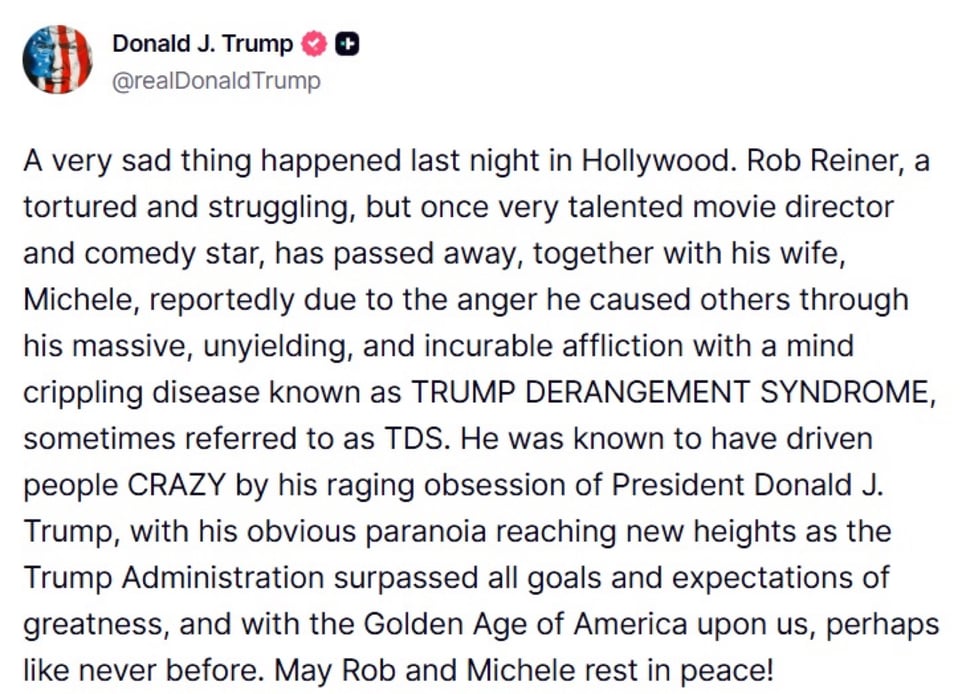
“A very sad thing happened last night in Hollywood. Rob Reiner, a tortured and struggling, but once very talented movie director and comedy star, has passed away, together with his wife, Michele, reportedly due to the anger he caused others through his massive, unyielding, and incurable affliction with a mind crippling disease known as TRUMP DERANGEMENT SYNDROME, sometimes referred to as TDS,” Trump wrote on Truth Social. “He was known to have driven people CRAZY by his raging obsession of President Donald J. Trump.” He then closed, incongruously, “May Rob and Michele rest in peace!”
The post was nauseating even by Trump’s standards. Though Reiner was an outspoken Trump critic and longtime progressive activist, no serious reports have tied the deaths to his politics. Police have arrested the Reiners’ younger son, who had spoken publicly about struggling with addiction and homelessness. This makes Trump’s post seem even stranger. Did he invent this idea in the hope that a Trump supporter had killed the Reiners? Was his post intended as a threat to other anti-Trump people, warning that speaking out might get them killed? Is he simply extraordinarily cruel?
Looking for a considered meaning in Trump’s words might be a wild-goose chase, though. The simplest reason Trump posted this is the same reason he posts anything: The man cannot resist making everything about himself, even if it’s the heartbreaking murder of a beloved artist in an alleged domestic dispute. If “TDS” is the tendency to become irrationally obsessed with Donald Trump and project that obsession onto everyone else, then somebody is indeed deranged, and it wasn’t Rob Reiner.
Trump’s post creates some pungent ironies. “You won’t see people on the right celebrating the horrific murder of Rob Reiner and his wife,” the Trump ally and conspiracy theorist Jack Posobiec wrote on X last night. “Compare to the Left’s reaction to Charlie Kirk’s murder,” Posobiec added. That’s an illuminating comparison. When Kirk critics brought up his more inflammatory rhetoric after his assassination in September, some prominent figures on the right, including the attorney general, accused them of hate speech, and scores were fired from their jobs. (This came at the same time that many right-wing pundits were celebrating Kirk as a champion of free speech.) Evidently the same standards don’t apply to Trump—though the replies to his post on Truth Social suggest some revulsion even among the kind of devoted fans who hang out on his personal social network.
Trump has never shined in moments that call for dignity and restraint. Yesterday, discussing the mass shooting at Brown University on Saturday, the president seemed cold: “Things can happen,” he said. Empathy does not come naturally to him, even when it would be politically beneficial. Visiting Puerto Rico after Hurricane Maria during his first term, Trump gave us the indelible image of tossing paper-towel rolls to beleaguered survivors.
This is what makes Trump’s post about the Reiners not just despicable and cruel but also bad for the country. In moments of national mourning or trauma, a president can seek to bring people together: Think of Ronald Reagan’s remarks after the Challenger disaster, George W. Bush’s speech atop the rubble at Ground Zero, or Barack Obama’s eulogy at the memorial for victims of the Mother Emanuel massacre. Absent these presidents’ genuine ability and instinct to inspire unity, a leader can fake it, offering at least a boilerplate statement. If nothing else, they can just keep quiet.
But not Trump. He finds the most divisive way to insert himself. The president began this year with another lowlight: After an air crash over the Potomac River in Washington, Trump was quick to point fingers (DEI was, absurdly, one of the supposed culprits) and slow to console. His choices deny the country a chance to mourn, and they take moments that could be unifying—surely Americans of all political views can agree on the greatness of When Harry Met Sally and The Princess Bride—and turn them into opportunities for anger.
Which is, in effect, Trump’s political project. As James Mattis, Trump’s first defense secretary, said in June 2020, “Donald Trump is the first president in my lifetime who does not try to unite the American people—does not even pretend to try. Instead, he tries to divide us.” Some signs have emerged of Americans rejecting this attitude, including huge “No Kings” protests and Trump’s sinking approval rating. But by other measures, Trump has been successful. The country is sad, angry, and divided—coming to resemble its president more all the time.(David Graham, The Atlantic)
Rob Reiner Remembered: One of Hollywood’s Great Comic Voices Meets a Tragic End
It’s a sad day in Hollywood — an unthinkable, upsetting and all-around shocking day — when filmmaker Rob Reiner and his wife Michele could have been stabbed to death in their own home, allegedly by someone so close.
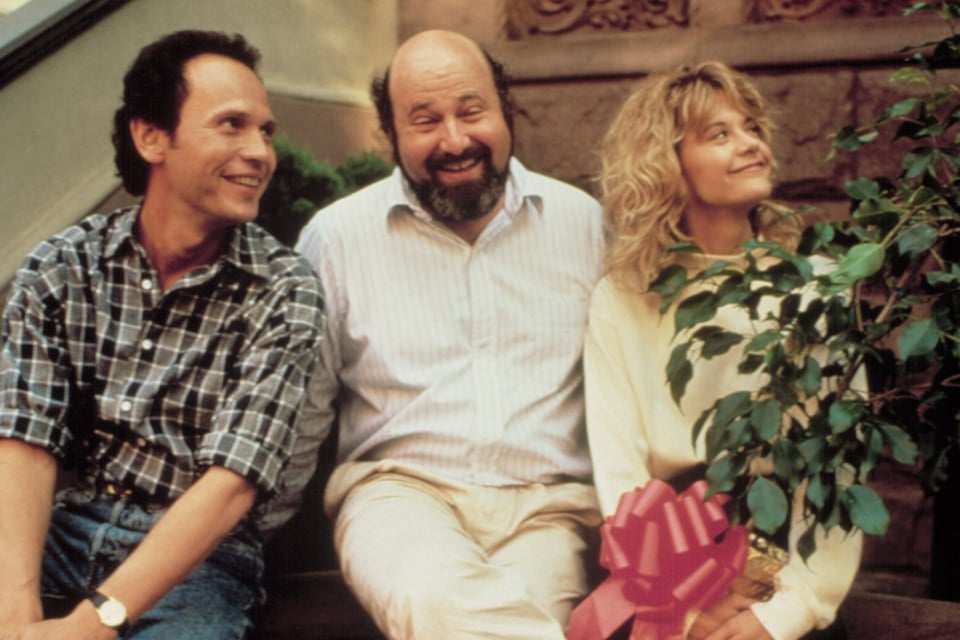
The particulars are hazy, the initial reports nearly impossible to wrap one’s head around. It’s clear that in the days ahead, the scandal will likely overshadow the career of one of the industry’s most beloved directors, a man widely admired for his work, his activism and his contagiously optimistic spirit. In the “100 Best Comedy Movies of All Time” list recently published by Variety, Reiner was responsible for no fewer than three of the entries.
I’m not exaggerating in the slightest when I say that among American studio talents, I consider Rob Reiner the best director never to have been nominated for best director. Just look at his credits. The guy was the Billy Wilder of our generation: a filmmaker with an instinct for comedy who could operate across genres, making films with brash, larger-than-life characters you recognized instantly and felt you’d known your whole life.
Reiner wasn’t a stylist like Martin Scorsese — the filmmaking idol on whom “This Is Spinal Tap” “director” Marty DiBergi was based (and for whom he finally got to act in “The Wolf of Wall Street,” playing Leonardo DiCaprio’s dad). He wasn’t a visionary technological innovator like Robert Zemeckis — the performance-capture pioneer who took “The Polar Express,” a project Reiner had initiated with Tom Hanks, and made motion-picture history with it.
But he made at least six hall-of-fame films, practically one after another over the course of an 11-year run (a number forever associated with him). After nearly a decade of playing Archie Bunker’s son “Meathead” on Norman Lear’s seminal 1970s sitcom “All in the Family,” Reiner kicked off his directorial career with the endlessly quotable, mock rock doc “This Is Spinal Tap” in 1984, hitting new comedic heights by poking fun at an absurd (yet plausible) heavy metal band. Two years later, he delivered that greatest of coming-of-age films, “Stand by Me” — a movie featuring kids who really act like kids, facing the notion of mortality for the first time.
Then came what I’ve long considered to be my desert-island movie — as in, the one film I’d save if I was banished somewhere with a projector, a screen and a single print I’m certain I’d never get tired of watching: “The Princess Bride.” More on that in a minute. I was exactly the right age when Reiner’s head-in-the-clouds, heart-on-the-sleeve postmodern fairy tale was released, but grown-ups at the time went crazy for his down-to-earth follow-up, “When Harry Met Sally…,” which almost singlehandedly revived the romantic comedy genre.
Right there, you’ve got four movies that defined the ’80s, and we haven’t even gotten to his two most acclaimed credits: “A Few Good Men,” the decade’s most-quoted (and surely also its most-rewatched) courtroom drama, in which Jack Nicholson bellows, “You can’t handle the truth!” at Tom Cruise’s stubborn military lawyer. Reiner reteamed with screenwriter Aaron Sorkin three years later on “The American President,” another irresistible Hollywood romance, this one with a backbone idealistic enough to inspire “The West Wing.”
I know I’m not alone in adoring all six of those movies, though it’s telling that none are the type where one spends much time thinking about the man calling “action!” Sorkin’s fingerprints are all over the latter two. “This Is Spinal Tap” is commonly associated with Christopher Guest, who went on to make several more improv-driven mockumentaries in the same mold. Nora Ephron often gets credit for “When Harry Met Sally…,” though the script was informed by where both she and Reiner were in their respective romantic lives at the time.
If Reiner gets too little credit, it’s because he had the wisdom and grace to subtract himself from the equation — by which I mean, when watching a Rob Reiner movie, audiences were never thinking about the director: how this shot was brilliant or that cut was clever. He wanted our attention to be focused on the characters, taking great care to cast each and every role with the absolute right actor, then trusting those performers to bring more than the script dictated to their parts.
There must be a case somewhere in Reiner’s filmography of someone being wrong for the role, but I can’t think of an example (then again, I never saw “North”). Instead, my mind goes to a dozen uncannily inspired choices in “The Princess Bride”: From Andre the Giant to Mandy Patinkin to Wallace Shawn, those actors fit their characters like a six-fingered glove (in Guest’s case, at least). Plucked from TV, “Santa Barbara” star Robin Wright was both radiant and duly indignant in the title role, while English actor Cary Elwes was no less swoon-tastic as the lowly farmboy who braves exile, poison and even death to satisfy true love.
The script was William Goldman’s, but striking the balance between sincerity and irreverence — plus the all-important comic timing — should be treated as Reiner’s contribution. With “The Princess Bride,” the director accomplished the tricky task of blending several classic Hollywood genres: fairy tale romance, fantasy adventure, swashbuckling action and kid-friendly comedy. At first, the studio wasn’t sure what to make of it. As with “This Is Spinal Tap,” it took time for audiences to embrace the film. Rest assured, those two cult favorites eventually found their following, to the extent that Reiner broke one of his own rules and finally made a sequel (“Spinal Tap II: The End Continues”) this year.
You can’t look at a Rob Reiner movie and reverse-engineer the man’s genius the way you can a film by Spielberg or Kubrick (though I’d argue “Stand by Me” is a better Stephen King adaptation than “The Shining”). Consider his filmography as a whole, however, and it’s easy to identify three subtle but vital qualities that made Reiner’s movies so appealing.
First, there’s the way he worked with actors, inviting them to improvise. That was the basis of “Spinal Tap”’s success, and proved to be an asset throughout his career.
Second, as the son of Carl Reiner, Rob had either inherited or absorbed the principles of comedy, incorporating humor into all his films (it’s my opinion that all Hollywood movies are comedies, to some degree at least, and that this tendency toward levity is what sets American cinema apart).
And third, he worked carefully on the scripts with his writers. Some projects he originated, via his Castle Rock shingle, and others he refined over rigorous brainstorming sessions. Sorkin has often credited Reiner’s process with making “A Few Good Men” into the rock-solid film it is. These days, too few studio directors polish their scripts to the same degree, worrying not just about dialogue, but structure, stakes and what makes a character feel real.
It makes sense that Reiner would be strong on those fronts. He met Mel Brooks when he was just four years old. Little Rob grew up at the feet of showbiz legends (his father, Carl, wrote for Sid Caesar’s “Your Show of Shows”), and he paid his dues, studying theater at UCLA, observing and learning from Norman Lear and directing TV movies before crossing over to film.
Reiner’s career stagnated somewhat in the 21st century, though he made a very funny, disarmingly intimate portrait of best friend Albert Brooks (no relation to Mel) for HBO two years ago, “Albert Brooks: Defending My Life.” And of course, there was this year’s “Spinal Tap” sequel, which features more than a few sidesplitting moments — and a few epic cameos from the likes of Paul McCartney and Elton John.
Can a filmmaker be both beloved and underappreciated at the same time? Rob Reiner was. Thinking of what happened to the 78-year-old mensch and his wife this weekend, one word comes to mind: inconceivable. ( Peter Debruge, Variety)
There were many other responses to these three acts of violence as well as to Trump’s reaction to them.
From Zohran Mamdani, Mayor-elect of NYC.on the massacre at Bondi Beach.
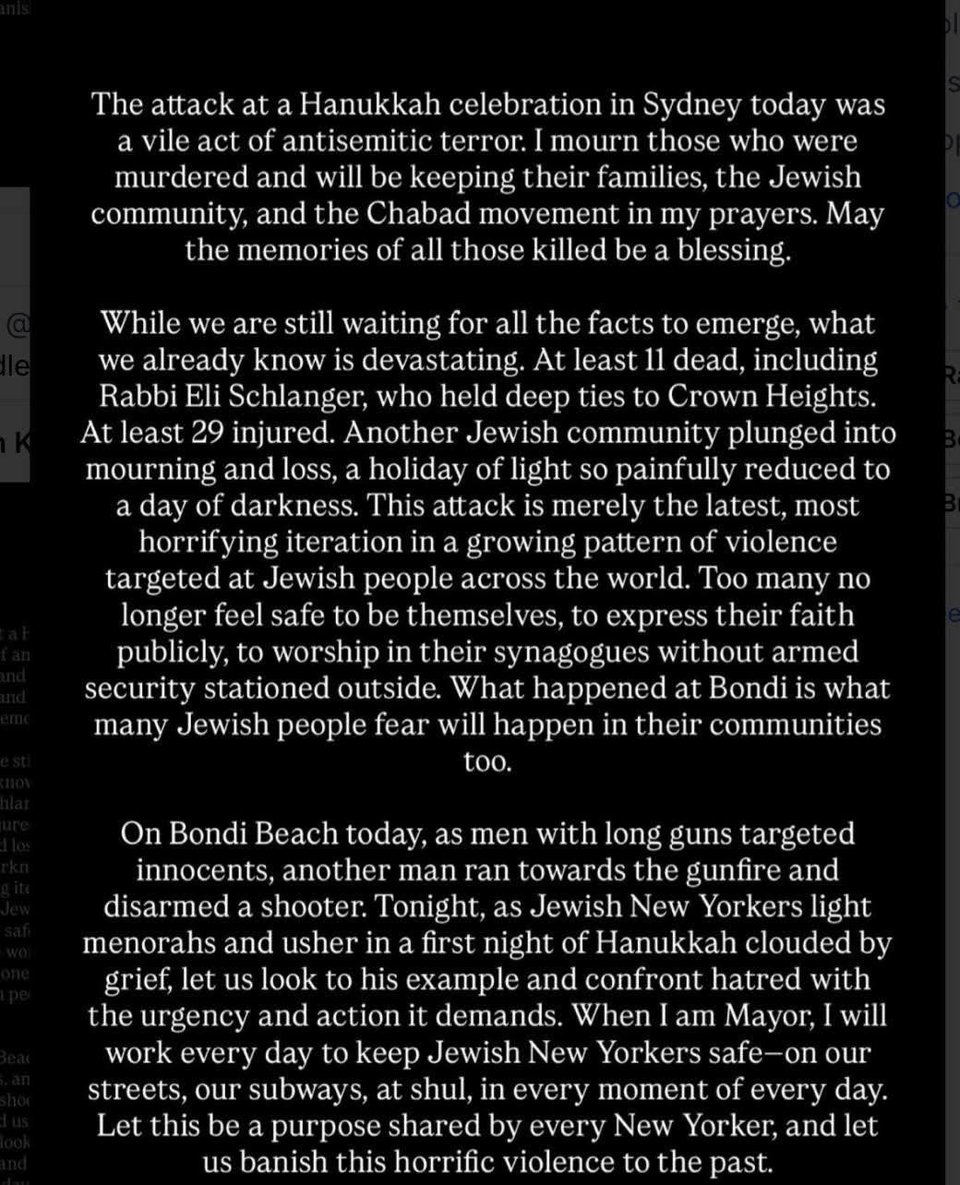
More on Bondi Massacre.Sydney, Australia tonight.

Responses to Trump’s reaction to Rob Reiner’s murder, including Trump’s.
BREAKING: Finally, 3 Republicans have criticized Trump for his awful comments on Rob Reiner's death: Mike Lawler, Marjorie Taylor Greene, and Thomas Massie all condemned Trump's post.
— Really American 🇺🇸 (@ReallyAmerican1) December 16, 2025
No comment from cowardly leader, Speaker Johnson.pic.twitter.com/urN5mIpYtR
BREAKING: Mike Johnson just won the coward of the year award for refusing to condemn Donald Trump’s awful comments about Rob Reiner. It’s going to be amazing when Democrats take the Speaker’s Gavel from Johnson. pic.twitter.com/5OW4nUNNOw
— Democratic Wins Media (@DemocraticWins) December 16, 2025
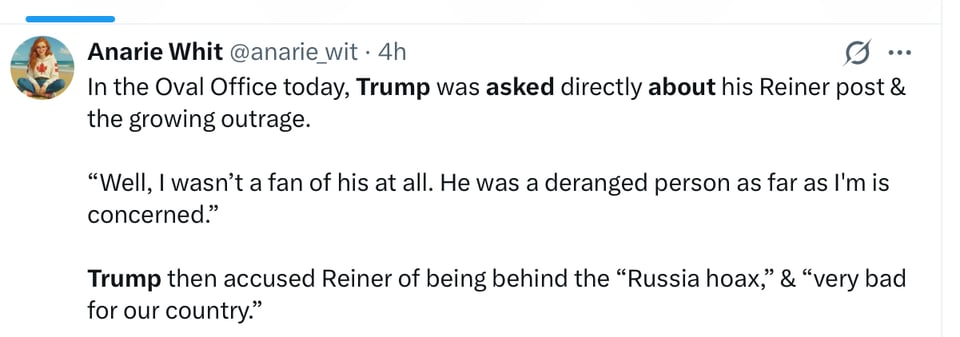
Rob Reiner on Charlie Kirk's death:
— Ed Krassenstein (@EdKrassen) December 15, 2025
“Absolute horror, and I unfortunately saw the video of it. It’s beyond belief what happened to him. That should never happen to anybody. I don’t care what your political beliefs are. That’s not acceptable. That’s not a solution to solving… pic.twitter.com/A3lSgF40fI
Two babies were born in New York within a year of each other soon after WWII.
— Bill Kristol (@BillKristol) December 15, 2025
One, Rob Reiner, lived a life of humanity and achievement. He brought us delight and joy. His memory will be a blessing.
The other, Donald Trump, will be remembered as an embarrassment to our nation. pic.twitter.com/oDgA0xFYRx
BREAKING: Following Trump's sociopathic comments about Rob Reiner's death, six churches in Idaho announced they'd be hosting "MAGA bonfire" events this weekend for congregants to burn their red hats and Trump flags.
— The Halfway Post (@HalfwayPost) December 15, 2025
Jill and I send our deepest condolences to everyone whose lives were touched by Rob Reiner and Michele Singer Reiner’s extraordinary contributions. We take solace in knowing their work will live on for generations to come.
— Joe Biden (@JoeBiden) December 15, 2025
Michelle and I are heartbroken by the tragic passing of Rob Reiner and his beloved wife, Michele. Rob’s achievements in film and television gave us some of our most cherished stories on screen. But beneath all of the stories he produced was a deep belief in the goodness of…
— Barack Obama (@BarackObama) December 15, 2025
Ask Trump.
My post on Twitter in honor of those Jews killed at Bondi Beach.
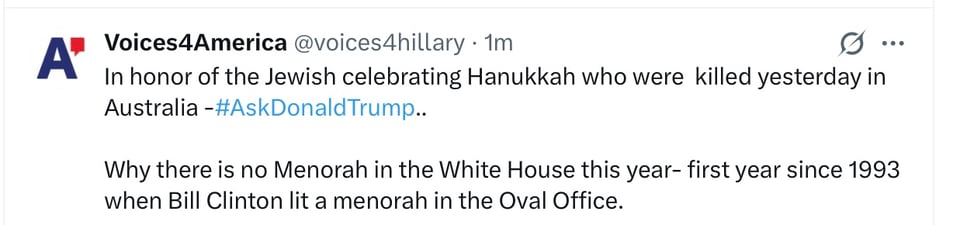
Feel free to re-post on your social media.
One more thing.