Tuesday, April 28, 2026. Annette’s Roundup for Democracy.
Virginia’s redistricting sticks.
We can expect 4 more Blue Congresspeople.
Assassination attempt?
An attack disrupted the annual White House Correspondents’ Association dinner on Saturday night, where the President was set to speak. Cole Tomas Allen, a thirty-one-year-old man from California, was arrested.
Inside the White House Correspondent’s Dinner as Gunshot Rang Out by New Yorker staff writer Antonia Hitchens.
I thought a caterer might have dropped a stack of plates, but then I heard shouts of “Shots fired!”
In the spring of 1981, President Ronald Reagan was shot outside the Washington Hilton on his way out of a luncheon. Cabdrivers sometimes call it the Hinckley Hilton—a weird local homage to the shooter, John Hinckley, Jr. On Saturday evening, I walked by the hotel, in the rain, as antiwar protesters yelled through bullhorns at journalists streaming inside for the annual White House Correspondents’ Association dinner. It was the War Crimes Correspondents’ dinner, they shouted. I was on my way to the White House to join the press pool, the small contingent of media that travels with the President wherever he goes. We loaded into vans in the motorcade and waited for Donald and Melania Trump to enter the Beast, the President’s bulletproof limousine. A reporter next to me scrolled through posts on George Santos’s X account, where he was criticizing the red-carpet fashion. As we rode through the streets of downtown D.C. back to the Hilton, the motorcade slowed for a long-languishing construction project around Dupont Circle. When we pulled up to the hotel, I saw a Trump official I know standing on the street corner in his tuxedo. “I’m late as fuck,” he texted me.
Trump was attending the dinner for the first time as President. The Marine Band played “Hail to the Chief” as he came out onto a dais at the front of the ballroom. “It is meaningful that you are with us tonight,” Weijia Jiang, the president of the White House Correspondents’ Association, said. After Jiang’s opening announcements, wranglers guided the press pool outside the ballroom, where they set up chairs for us and put out boxed dinners. Boris Epshteyn, one of Trump’s longtime fixers, ambled around in a white tuxedo jacket. We made small talk as guests inside the ballroom tucked into their appetizers. The President and the First Lady were talking with the mentalist Oz Pearlman, who was leaning over and showing them something on a piece of paper; he seemed to be performing a trick of some sort.
Around eight-thirty, as I was trying to decide whether I would have a turkey sandwich or a veggie sandwich for dinner, I heard what sounded like a caterer dropping a stack of plates down a flight of stairs. (“I thought it was a tray going down,” Trump would later say.) Shouts of “Shots fired!” soon followed, and members of the Secret Service and other law-enforcement officers raced by us. I was pushed against the wall; three members of the waitstaff pulled me into a stairwell with them. They were sobbing. We heard what seemed like more gunfire. I opened the door to go back into the hotel lobby. Robert F. Kennedy, Jr., stumbled by with his wife, Cheryl Hines, escorted by a security detail. Dessert hadn’t been served, but it looked like there was cake frosting on the back of his suit jacket. I watched as Jeanine Pirro, the U.S. Attorney for Washington, D.C., was ushered away; Kash Patel, the director of the F.B.I., ran by, holding a cellphone to his ear.
A group of agents had already whisked Trump out of the ballroom, while guests on the dais and seated across the room ducked under tables. Law-enforcement officers, clad in helmets and flak jackets and wielding long guns, materialized on the stage. One W.H.C.A. photographer took out his camera and pointed it at the fleeing crowd.
Trump insisted that the show would go on. (“I fought like hell to stay,” he later said.) Eventually, we were moved back into the ballroom. There were cloth dinner napkins all over the ground. I took a seat at a table of half-eaten goat-cheese salads and an empty bottle of red wine. Over the loudspeaker, someone said that the “dinner service will resume momentarily.” Seconds later, the wranglers rushed us out—the President was leaving. We sprinted past Pete Hegseth and his wife, up the stairs and across the red carpet. National Guardsmen lined the rope where guests had posed earlier for photographs.
The motorcade drove back to the White House in three minutes. “We are flying,” as a veteran reporter in one of the vans put it. “Fastest motorcade I’ve ever been in.” Trump had announced on Truth Social that he would be giving a press conference shortly. I took a seat in the briefing room. The flags that typically stand behind the podium when the President speaks were hastily brought in. Trump appeared, flanked by Cabinet officials. Melania stood to the side with Karoline Leavitt, the press secretary, whose maternity leave had started the day before. Reporters and staffers from the press office were still in tuxedos and evening gowns, some holding their high heels.
Trump spoke quietly. A man armed with multiple weapons had charged a security checkpoint, he said. The assailant had been taken down by the Secret Service and was in custody. “I’ve studied assassinations,” Trump said. “The people that have gone through this, where they got ’em”—he cited Abraham Lincoln—“the people that do the most, the people that make the biggest impact, they’re the ones that they go after.” He went on, “Just take a look at the names. They’re big names, and I hate to say that I’m honored by that, but I’ve done a lot. We’ve done a lot. We’ve taken this country, and we were a laughingstock for years, and now we’re the hottest country anywhere in the world. We’ve changed this country, and there are a lot of people that are not happy about that.” He also blamed the Hilton. “It’s not a particularly secure building,” he said. (A friend of mine used to sneak into an annual conference held there to avoid paying for a ticket.) “I didn’t want to say this,” Trump continued, “but this is why we have to have all of the attributes of what we’re planning at the White House. It’s actually a larger room, and it’s much more secure. It’s drone-proof, it’s bulletproof glass. We need the ballroom. That’s why Secret Service, that’s why the military are demanding it. They’ve wanted the ballroom for a hundred and fifty years for lots of different reasons. But today’s a little bit different.” He told us that we would try the dinner again soon, but that he might update his remarks. He’d been working with comedians on a speech roasting the press. “I was all set to really rip it,” he said. “I said to my people, This would be the most inappropriate speech ever if I made it now. So I’ll have to save it. I don’t know if I could ever be as rough as I was going to be tonight. I think I’m going to be probably very nice. I’ll be boring the next time.” ♦︎ (The New Yorker)
Trump is using the shooter incident to 1) bolster his demand for his White House ballroom, 2) support his request for a larger Homeland Security budget, 3) open new attacks on Democrats and the media.
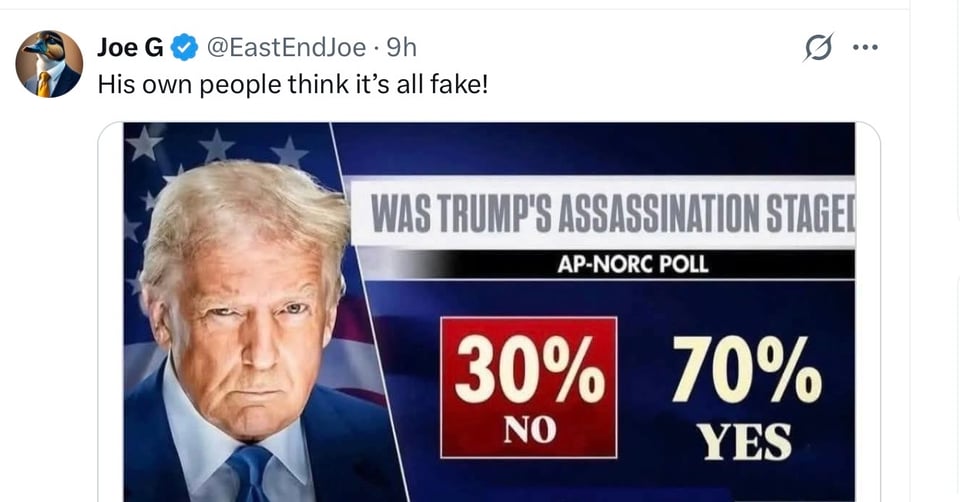
Still, there are plenty of doubters.
Jimmy Kimmel is again the target for Trump and Melania Trump.
Below is what Kimmel said. Kimmel recorded this joke two days before the shooter incident at the White House Correspondent’s Dinner.
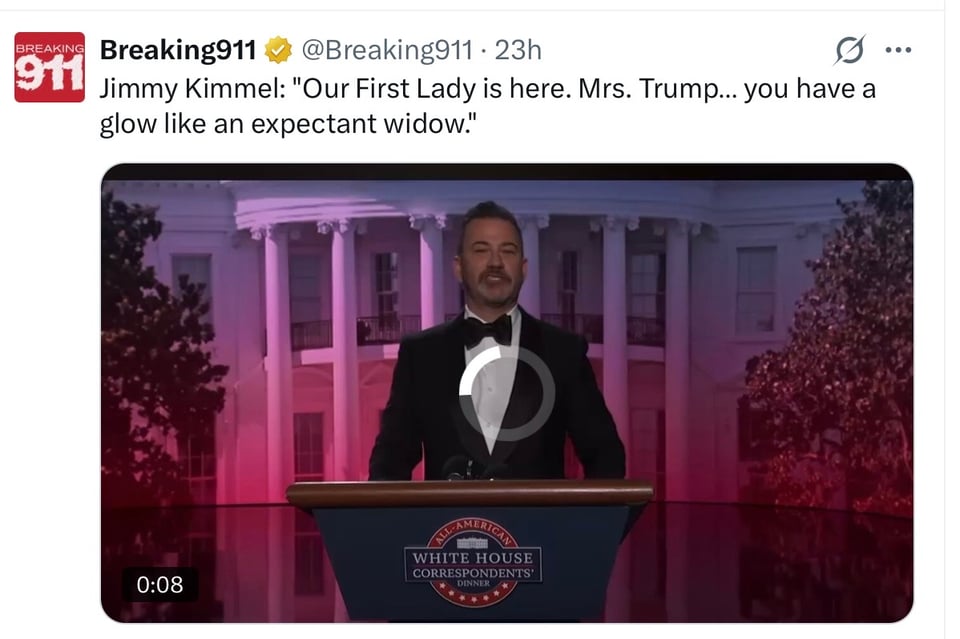
President Trump and first lady Melania Trump demanded in separate social media posts on Monday that ABC pull Jimmy Kimmel from its airwaves over a bit involving the White House correspondents’ dinner, delivered two days before it occurred.
— The New York Times (@nytimes.com) April 27, 2026
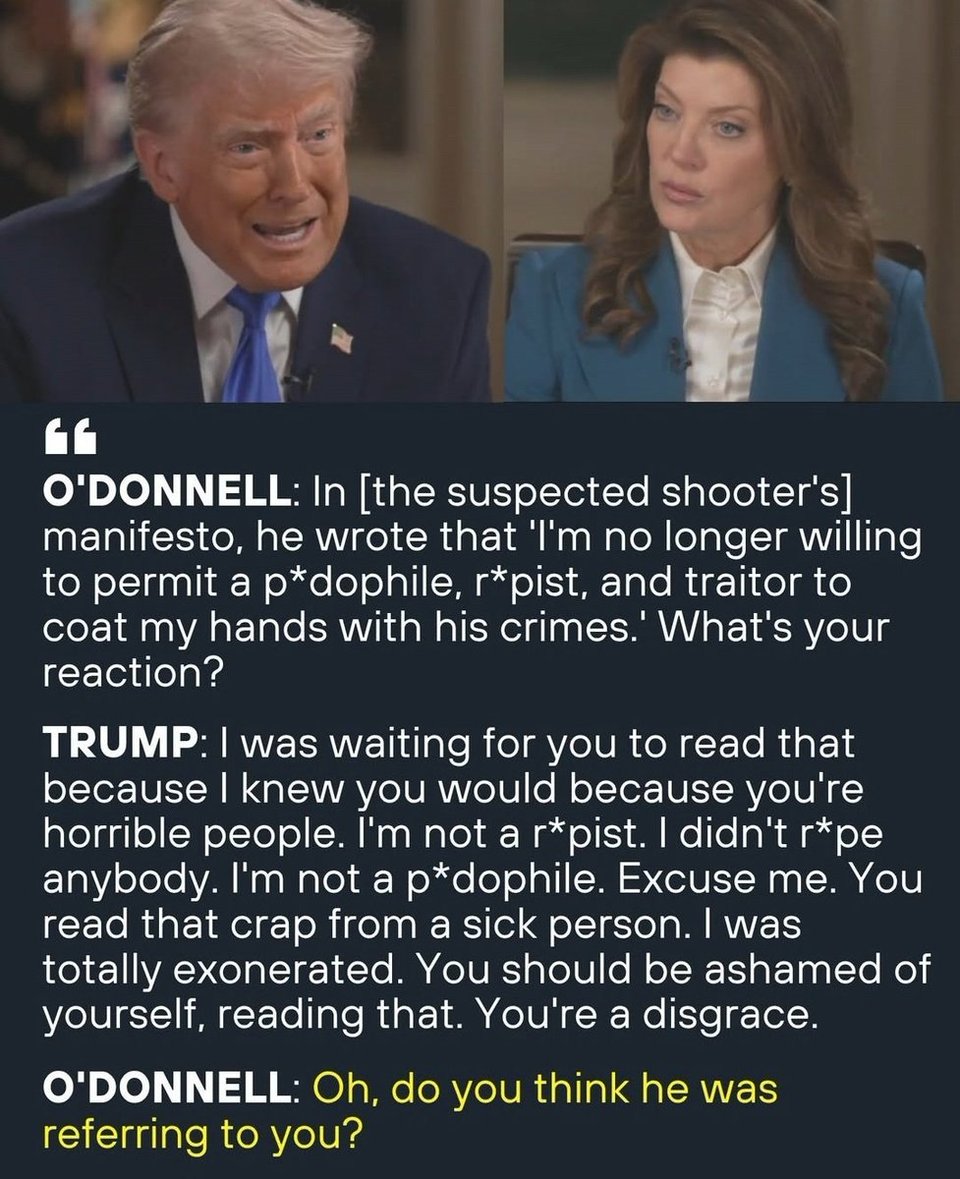
Wonder what gets to Trump?
This happened yesterday.
One more thing. Or two.

Preservationists won't drop lawsuit against Trump's $400M White House ballroom after DOJ request
WASHINGTON (AP) — Preservationists are pressing ahead with their lawsuit against President Donald Trump's planned $400 million White House ballroom, declining a request by the Department of Justice to withdraw the complaint following the shooting at the White House Correspondents' Dinner on Saturday.
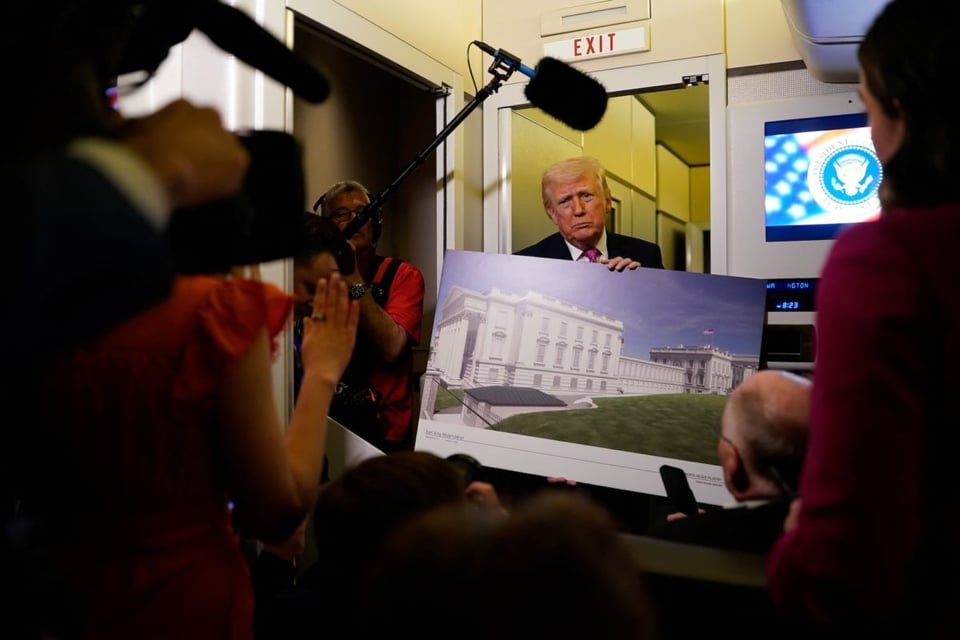
Trump and other conservatives have made a renewed push for the ballroom in the wake of Saturday's media dinner shooting, arguing it exposed the difficulties in ensuring presidential security at large events outside the White House grounds, and urging the National Trust for Historic Preservation to drop its lawsuit.
Top Justice officials said the government would ask a court to dismiss the lawsuit "in light of last night's extraordinary events" if the Trust did not voluntarily drop it.
Trust attorney Gregory Craig declined that request, writing to the Justice Department that the legal issues at the heart of the lawsuit are unchanged.
"What Saturday's awful event does not change is that the Constitution and multiple federal statutes require Congress to authorize construction of a ballroom on White House grounds, and that Congress has not done so," Craig wrote.
A spokesperson for the Justice Department did not immediately return a message seeking comment.
The preservation group sued in December, a week after the White House finished demolishing the East Wing to make way for a ballroom that Trump said would fit 999 people. Trump says the project is funded by private donations, although public money is paying for a below-ground bunker and security upgrades.
In its lawsuit, the Trust argued that Trump had overstepped his authority by moving forward with the project without first getting approval from key federal agencies and Congress.
A federal appeals court has allowed Trump to continue the project, ruling a day after a lower court judge continued to block above-ground construction on the site and scheduling a June 5 hearing to review the case. (PBS)
Republicans Push for Trump’s White House Ballroom After Gala Attack.
The attack on a press dinner in Washington, which is being called an attempted assassination of President Trump, has also renewed the fight over reopening the Homeland Security Department.
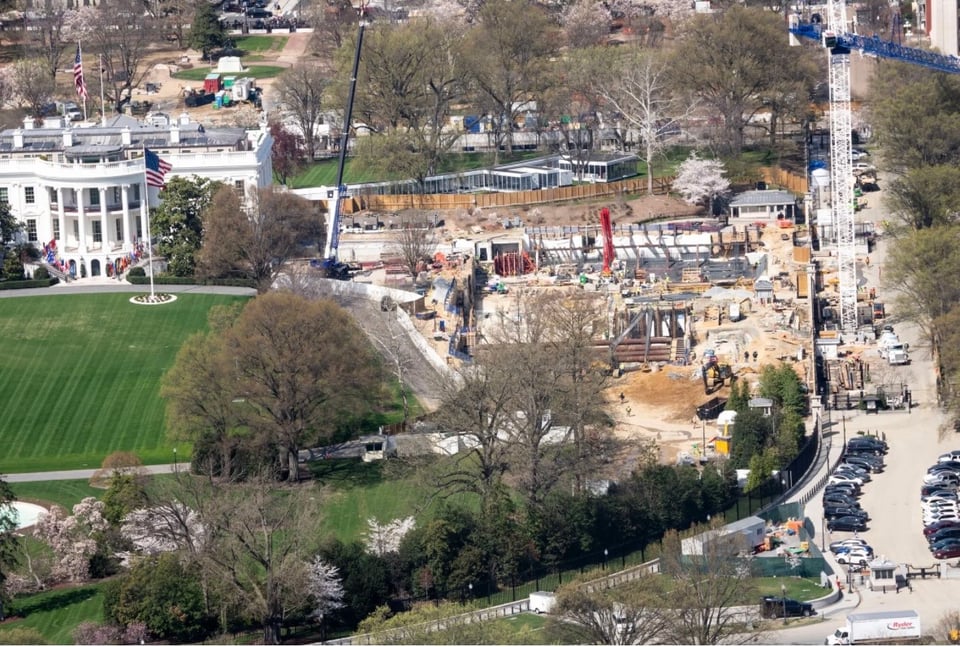
An aerial view of the construction site for President Trump’s planned ballroom.
Congressional Republicans are escalating their efforts to authorize the building of President Trump’s planned ballroom at the White House in the aftermath of the attack on a press gala in Washington on Saturday night that exposed security vulnerabilities.
Senator Lindsey Graham, the South Carolina Republican who chairs the Budget Committee, said on Monday that he wanted Congress to move legislation as quickly as possible to provide $400 million for construction of a secure White House ballroom that would also house national security facilities beneath it.
“We saw Saturday that America has a problem,” Mr. Graham told reporters. “That problem is, it is very difficult to have a bunch of important people in the same place unless it is really, really secure.”
Other Republicans were weighing in as well. Representative Lauren Boebert of Colorado said she planned to propose legislation this week that would give the go-ahead for the project, as did Senator Rand Paul of Kentucky, the chairman of the Homeland Security Committee.
Senator Tim Sheehy, Republican of Montana, said he would take to the Senate floor to try to win quick unanimous approval of the ballroom construction, an effort likely to run into Democratic opposition.
“It is an embarrassment to the strongest nation on earth that we cannot host gatherings in our nation’s capital, including ones attended by our president, without the threat of violence and attempted assassinations,” Mr. Sheehy said on the social media platform X.
Mr. Trump plunged ahead with his ballroom project without any congressional approval of the project or the demolition of the historic East Wing that made room for it. A federal judge halted the work, saying that the construction had not won the necessary go-ahead from Congress, which typically would provide the money and some oversight, although an appeals court allowed construction to continue while it reviews the decision.
Within hours of the attack at the annual gala at the Washington Hilton, Mr. Trump and his allies said the foiled effort nonetheless showed the need for a highly secured structure that could host such events safely.
Republican lawmakers agreed.
“By funding these necessary upgrades to the ballroom and the White House’s security infrastructure, President Trump and future presidents will be able to host large events without having to leave the White House grounds,” said an announcement by Mr. Graham, Ms. Britt and Senator Eric Schmitt, Republican of Missouri.
The episode at the hotel on Saturday also spurred more calls to end a shutdown at the Department of Homeland Security that has lasted for more than 70 days. House Republicans have so far refused to take up a bipartisan Senate bill that would fund much of the agency outside immigration enforcement, despite earlier agreement by Speaker Mike Johnson to do so.
Mr. Johnson said on Monday that he was not ready to bring the bill to the House floor and wanted to make some “modifications.” If such a measure could make it through the House, the Senate would then have to pass it for the third time.
Senator Chuck Schumer of New York, the Democratic minority leader, said Republicans should focus on passing that legislation, which includes money for the Secret Service, instead of a new White House party space.
“If Republicans truly want to improve security, they should join Democrats in funding the Secret Service, not Donald Trump’s luxury ballroom,” Mr. Schumer said Monday.
Mr. Trump never sought congressional authorization for the ballroom project and said he would spare taxpayers the expense by relying on private donations. That raised questions about donors trying to curry favor with the administration through the project. Mr. Graham said he wanted the ballroom and adjacent facilities to be paid for with public dollars that would be offset by other federal fees, adding that private funding should be used for extras such as china.
Should Congress ultimately provide money and the authority for the job, it could also give lawmakers more say-so in the work — oversight that could meet White House resistance.
Representative Hakeem Jeffries, Democrat of New York and the minority leader, criticized the ballroom as “a vanity project” and argued that Republicans were improperly focused on an issue that would not address more pressing concerns of the American people.
“I have not seen a specific request with respect to the ballroom, but needless to say, we have to drive down the high cost of living,” he said at a news conference. “Life has become more expensive as a result of Donald Trump and Republican policies over the last 15 months.”
But Mr. Graham and other Senate Republicans sought to dispel the notion that the ballroom was a presidential vanity project, saying the real beneficiaries would be future presidents given the time line for construction.
“This is not about Trump. It’s about the presidency of the United States,” Mr. Graham said. “It is about the person who occupies that office not being put at risk if they choose to go off campus.”
The dinner that for decades has taken place at the Washington Hilton is sponsored by the White House Correspondents’ Association, a group of journalists who cover the White House, not by the administration. It is unclear whether the association would agree to hold such an event on the White House grounds. (New York Times)

