Thursday, March 5, 2026. Annette’s Roundup for Democracy.
Jasmine Crockett does the right thing.
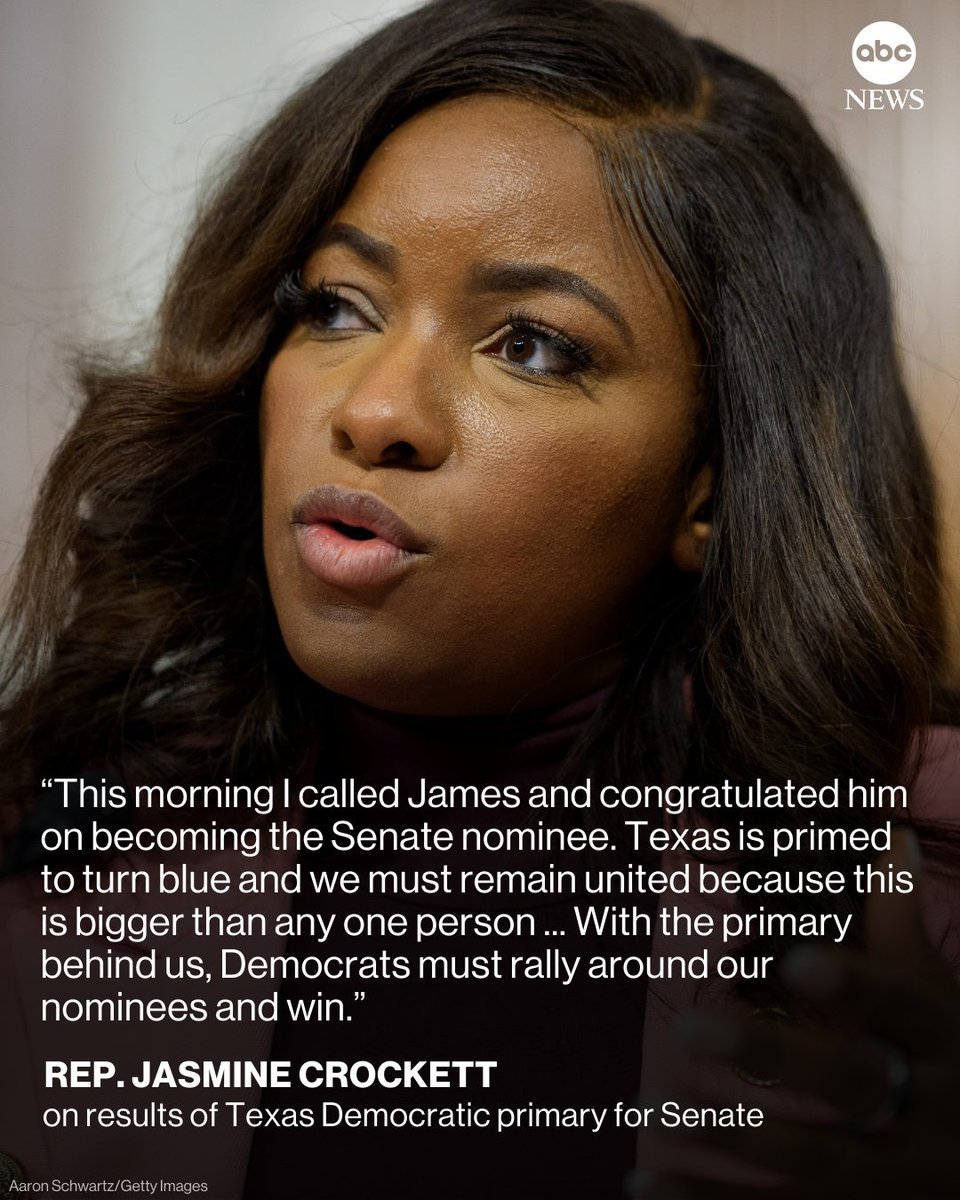
“This morning I called James and congratulated him on becoming the Senate nominee,” Ms. Crockett said. “Texas is primed to turn blue, and we must remain united because this is bigger than any one person. This is about the future of all 30 million Texans and getting America back on track.”
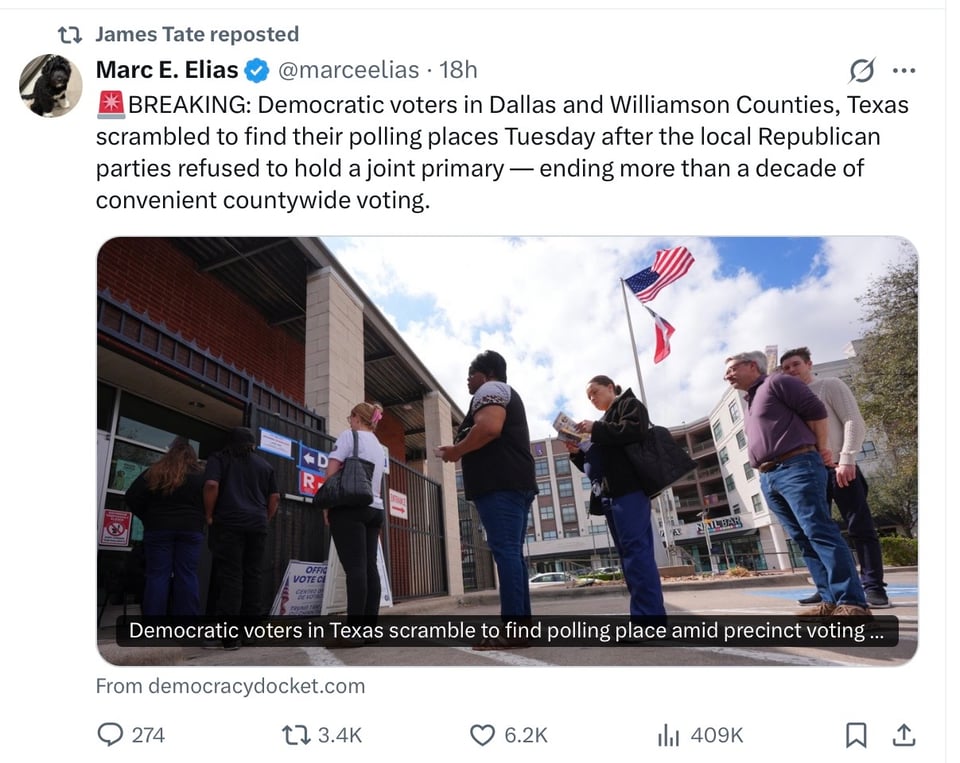
Yes, 200,000 voters in Dallas County were likely disenfranchised by Ken Paxton’s chaos producing actions, but Crockett didn’t take the bait. Instead of internal Democratic fighting in Texas from now until god knows when, she is joining forces with her opponent, to turn Texas blue.
Thank you, Jasmine Crockett.
Representative Jasmine Crockett concedes to the next Democratic Senator from Texas- !- James Talarico
Representative Jasmine Crockett issued a statement Wednesday conceding the Democratic Senate nomination in Texas to James Talarico, a state lawmaker and seminarian, in a contest that served as an early test of the party’s direction heading into the November midterm elections.
Late Tuesday, it had not been clear whether Ms. Crockett would concede immediately, or whether a last-minute legal fight over Dallas County’s voting procedures would slow Democrats’ pivot to the general election. Ms. Crockett told supporters at her election night party Tuesday that people had “been disenfranchised” in Dallas County.
“This morning I called James and congratulated him on becoming the Senate nominee,” Ms. Crockett said. “Texas is primed to turn blue, and we must remain united because this is bigger than any one person. This is about the future of all 30 million Texans and getting America back on track.”
“Tonight, our campaign is shocking the nation,” Mr. Talarico told supporters around midnight local time, adding: “The people of our state gave this country a little bit of hope. And a little bit of hope is a dangerous thing.”
In the Republican race, Senator John Cornyn, the embattled incumbent, was headed for a May runoff against Ken Paxton, the state’s scandal-plagued attorney general, after neither candidate won the outright majority needed to advance under the state’s electoral system. Representative Wesley Hunt finished a distant third. President Trump has declined to endorse a candidate, but hinted that he might in the runoff.
A twist in the Democratic race came Tuesday evening when a state district judge ordered Dallas County to keep its polls open for two extra hours after changes to rules involving polling locations caused confusion about where some voters could cast their ballots.
The issue was further complicated hours later when the Texas Supreme Court temporarily blocked the lower court’s ruling and ordered that ballots be separated if they were cast by voters who were not in line by 7 p.m. local time, the time polls initially were to close.
The Democratic contest between Mr. Talarico, who has called for a more compassionate politics, and Ms. Crockett, a partisan brawler, has in part offered a test of Democratic voters’ appetite for a less combative form of resistance to the Trump administration. (New York Times)
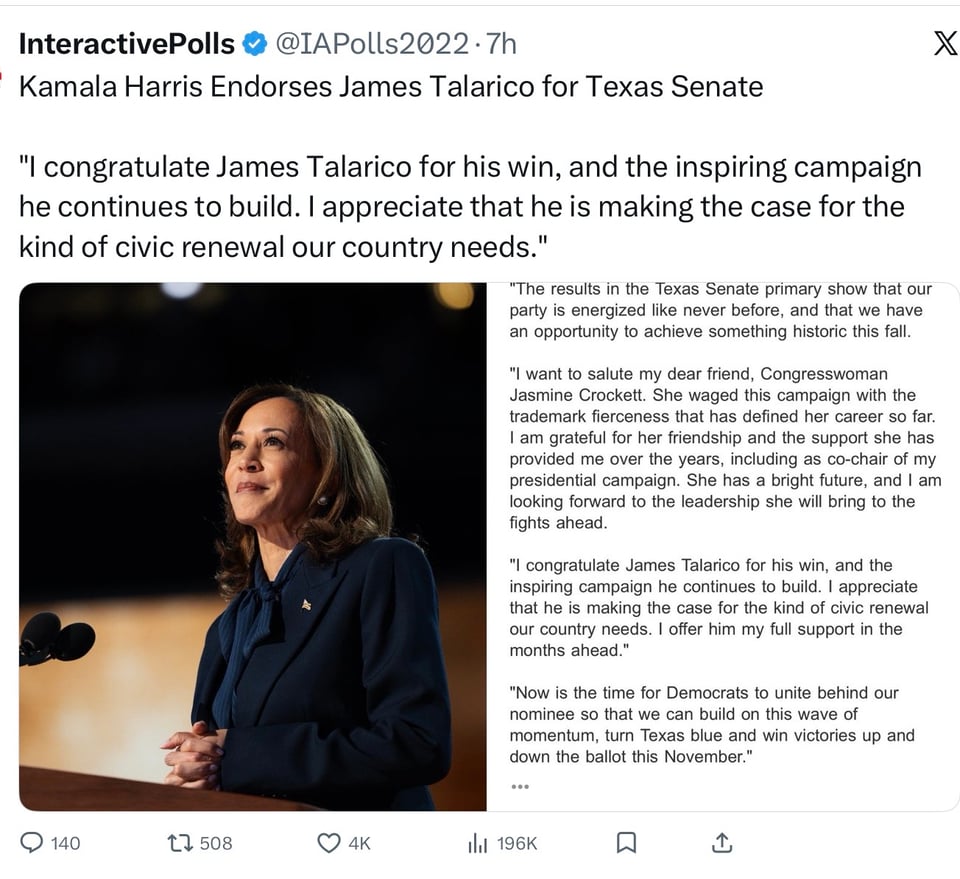
Kamala Harris who had endorsed Jasmine Crockett did the right thing too.
One more thing. Or two.
Our turnout was bigger than their turnout.
The Democratic voters in Dallas County are yet to be counted, but the Democratic turnout in Tuesday’s primary in Texas is already more than 2.2 million votes, eclipsing GOP turnout by 100,000+ votes and more than doubling the 967,503 Democrats who turned out in the 2024 Senate primary.
Primary turnout may not predictive of the general election outcomes, but this was a big number for Democrats in a red state, and it may highlight our enthusiasm for voting in November.
We have a chance to give James Taraluco a head start for the midterms.
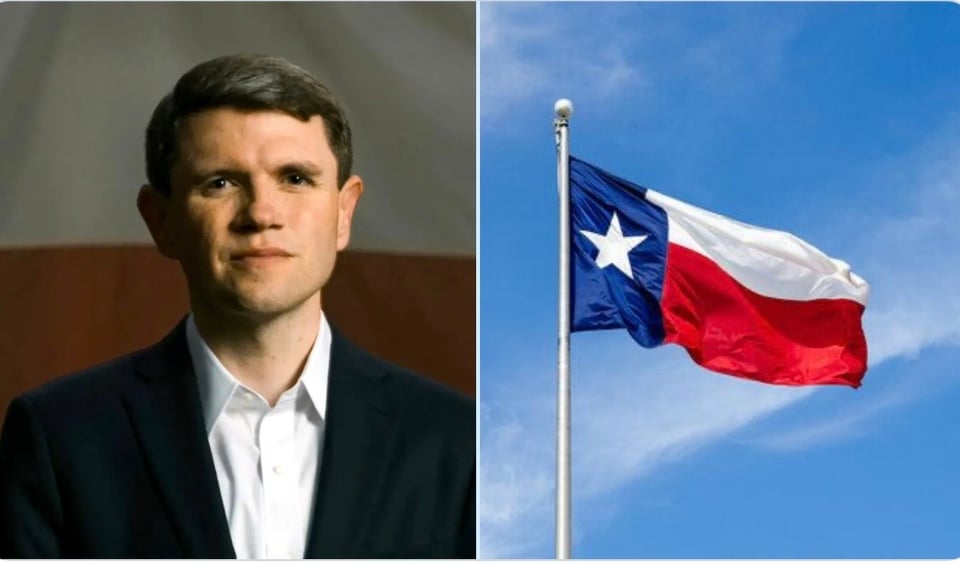
The Republicans won’t have their candidate until May 26. Cornyn and Paxton have to fund an expensive run-off to determine which of them will be James’ opponent for the Senate. This will likely be a blood bath.
Trump said he will endorse a candidate and ask whomever he does not endorse between Senator John Cornyn and Attorney General Ken Paxton to drop out.
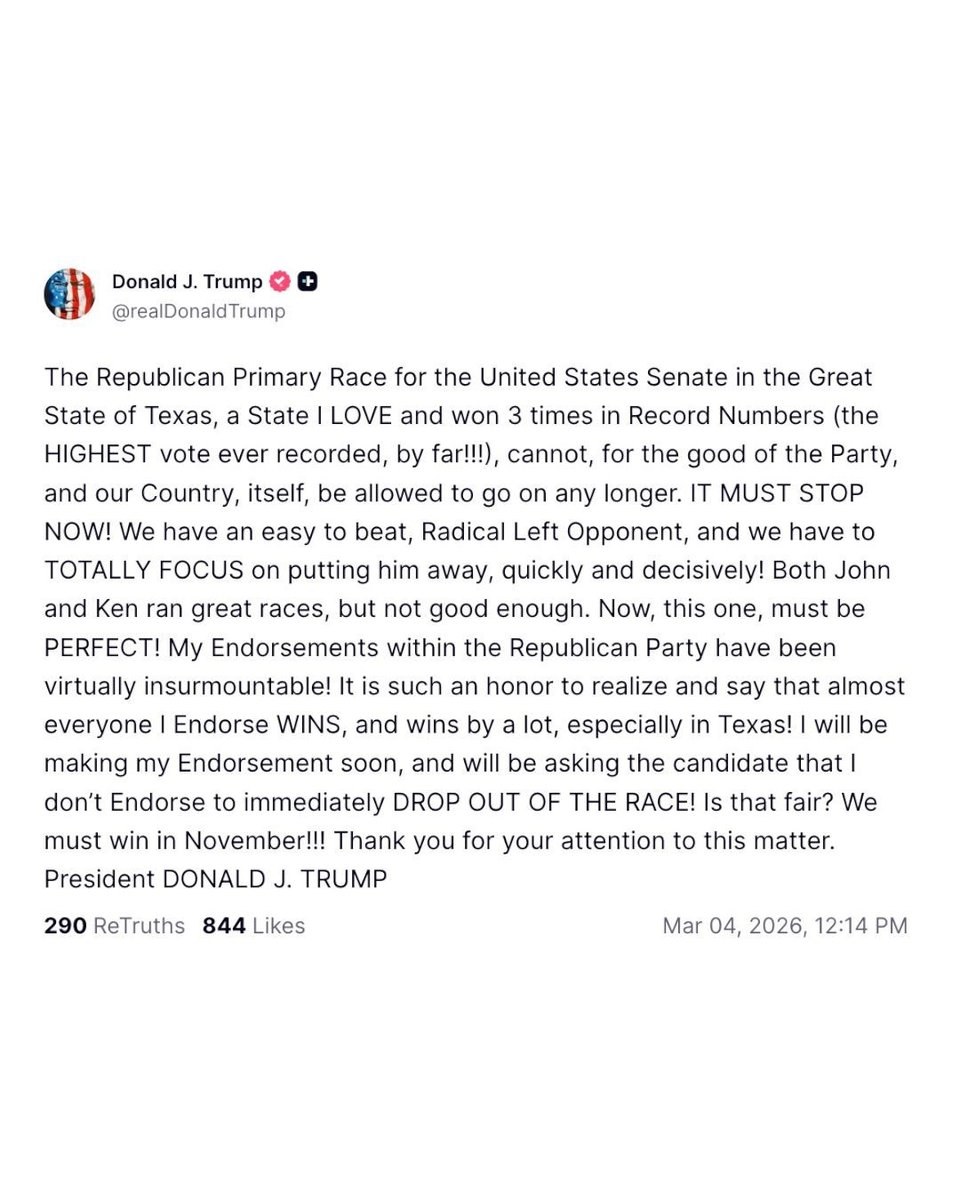
Yes, Texas will be an expensive Senate seat to win, but, unless Trump succeeds in getting one of the Republicans to drop out, Talarico has 12 weeks ahead of him during when Republicans will won’t be aiming at each other, not him.
Click on this link to get the Talarico campaign going NOW! And post about this contest on your social media.
Learn about and support “Democracy Summer.”
This Summer, Students From Hundreds of Colleges Will Heed One Urgent Call By Michael S. Roth, president of Wesleyan University.
Between 1962 and 1966, Martin Luther King Jr. visited Wesleyan University four times to talk with students and teachers about the struggle for civil rights and nonviolent activism. It was a dark time in this country, but Dr. King told his audience that moral ends could yet be achieved through moral means, and that “we can move through the darkness of the hour to the brightness of a new day.”
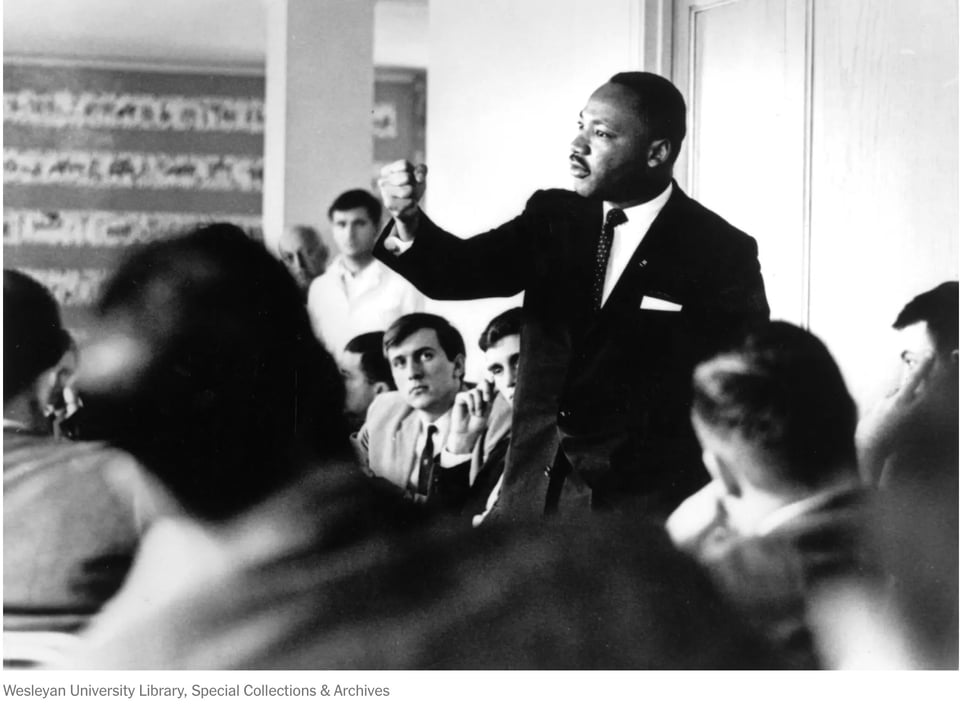
Some undergraduates heeded that call, and were inspired to join the many others around the country traveling to Mississippi, where voting rights were under attack. Freedom Summer, as that unforgettable season in 1964 was called, involved dangerous work. Many participants were beaten or arrested. A few were murdered. But they shook the conscience of a nation, and their efforts eventually led to the passage of the Voting Rights Act.
American voting rights are once again endangered, this time by the White House. The threat of violence isn’t nearly as immediate as it was in 1964, but from demanding Minnesota’s voter rolls to reinvestigating the 2020 election to making remarks about nationalizing elections, the Trump administration’s actions should leave no doubt as to what the nation is up against. Now is the time for everyone — Republicans, Democrats and independents — to come together and defend our foundational democratic right. And higher education has a unique role to play.
Inspired by those volunteers seven decades ago, Wesleyan University and a network of hundreds of schools and allied organizations are uniting for Democracy Summer, a nationwide program to educate citizens and protect our elections in the coming year.
This isn’t some passing fad: American colleges and universities have been educating people to participate in public life since the founding of the Republic. Thomas Jefferson and George Washington regarded civic education as a fundamental component of liberty. Throughout the 1800s, colleges considered this work — training people to fulfill their duty as citizens — to be central to their mission, because they knew, as Frederick Douglass put it, that learning was “the direct pathway from slavery to freedom.”
The brave volunteers of Freedom Summer knew it, too, and put it into action with Freedom Schools, which taught basic math and reading skills while also helping students explore their role in a functioning democracy.
That is the resolve that we now all must muster to secure our most fundamental right, our most fundamental freedom. Doing so won’t just strengthen our republic; it will also directly enhance the education of students who participate, empowering them to build a better future. And what better way this summer to celebrate our nation’s 250th birthday?
The Democracy Summer network includes research-intensive universities like Yale and Duke, big state schools such as Michigan and Texas and small religious institutions such as Goshen College and Trinity Washington University, as well as interest groups from the American Association of Colleges and Universities to Interfaith America. Civic engagement centers at more than 400 colleges and universities have joined the effort, and more are expected.
How these schools interpret the mandate to protect our democracy is up to them. Many will work with organizations such as Campus Compact and Civic Nation to encourage voting. Others are focused on promoting free speech and civil dialogue on their campuses. They might work on local issues by canvassing and organizing in communities, or focus on national obstacles to voting such as poor access to polling places, misinformation and administrative constraints. Many will offer internships that enable students to join campaigns from Alaska to Texas, or hold workshops on how to register voters and help them get to the polls. And by the end of the summer, as midterm elections come into view, the network of schools will dispatch thousands of students for meaningful work, under the guidance of election administrators and civic organizations, to recruit poll workers and monitor voting as it’s underway. Many different ways to ensure one simple promise: that every eligible voter has the chance to cast a ballot, and that all ballots are accurately counted.
The Trump administration has taken steps to limit how colleges and universities distribute voter registration materials. But Democracy Summer is not a partisan effort: We are drawing students from conservative-leaning civics centers and older progressive organizations alike, and they will work side by side, in districts where they feel politically at home as well as those where they are outliers. Nor is this a one-time effort. The elections of 2026 are crucial, but we are building democratic muscles in young people that should endure well beyond the current election cycle.
Leonard Edwards, who met Dr. King during one of his visits to Wesleyan, was asked about why he joined Freedom Summer. It was “the fastest decision I could make,” he said. “This was my chance to make a difference on an issue that had bothered me my entire life.” Mr. Edwards went on to be a distinguished superior court judge in California, an expert on juvenile justice. Looking back, he concluded: “I couldn’t have chosen a better foundation than doing the work in Mississippi.”
College students may not be an exact demographic match for the country as a whole, but they are a diverse lot, and the work of Democracy Summer will offer all of them the same strong foundation that Mr. Edwards described. It will bring students out of their campus bubbles, providing young people with an extraordinary opportunity during our semiquincentennial to learn about the broad array of problems, opportunities and aspirations in America, and to learn how to listen to and communicate with people who don’t share their own convictions or life experiences.
Higher education has thrived in the ecosystem of freedoms provided by our democracy. Today that ecosystem is under enormous strain, and as teachers and students we must now rise to its defense. We can, as Dr. King said, “move through the darkness of the hour to the brightness of a new day.” (Op-Ed, New York Times)
What is Democracy Summer?
The Democracy Summer project trains and deploys the next generation of Democratic organizers and leaders to win elections all over America.
Founded by Congressman Jamie Raskin, backed by the Democratic Congressional Campaign Committee, and buoyed by thousands of supportive alumni across the country, Democracy Summer engages high school and college-aged young people in state-of-the-art tactics in voter registration, canvassing and digital political organizing. Moreover, through on-line seminars with leading historians, law professors, political organizers and union and elected leaders, it provides an intensive education in the historical struggle for democratic freedom and essential lessons for effective political leadership today.
How did Democracy Summer begin?
Democracy Summer was born in 2006 during Jamie’s first-ever campaign for Maryland State Senate when he was running against a 32-year incumbent who was president pro tem of the Maryland Senate and chair of the Montgomery County Senate delegation.
Jamie wanted to get his three kids and a dozen nieces and nephews involved in his campaign. He knew that if he was going to compete against a powerful incumbent backed by machine politics and big money, he needed to mobilize young people and then get them to convince their families and friends to join in.
Promising young people not just a lot of hard work but a “school for democracy,” Jamie launched the Democracy Summer program which included in-depth discussion of the major issues Jamie was running on, including abolition of the death penalty, marriage equality, restoration of voting rights to former prisoners, campaign finance reform and replacement of the electoral college with a national popular vote for president.
What is Democracy Summer?
The Democracy Summer project trains and deploys the next generation of Democratic organizers and leaders to win elections all over America.
Founded by Congressman Jamie Raskin, backed by the Democratic Congressional Campaign Committee, and buoyed by thousands of supportive alumni across the country, Democracy Summer engages high school and college-aged young people in state-of-the-art tactics in voter registration, canvassing and digital political organizing. Moreover, through on-line seminars with leading historians, law professors, political organizers and union and elected leaders, it provides an intensive education in the historical struggle for democratic freedom and essential lessons for effective political leadership today.
How did Democracy Summer begin?
Democracy Summer was born in 2006 during Jamie’s first-ever campaign for Maryland State Senate when he was running against a 32-year incumbent who was president pro tem of the Maryland Senate and chair of the Montgomery County Senate delegation.
Jamie wanted to get his three kids and a dozen nieces and nephews involved in his campaign. He knew that if he was going to compete against a powerful incumbent backed by machine politics and big money, he needed to mobilize young people and then get them to convince their families and friends to join in.
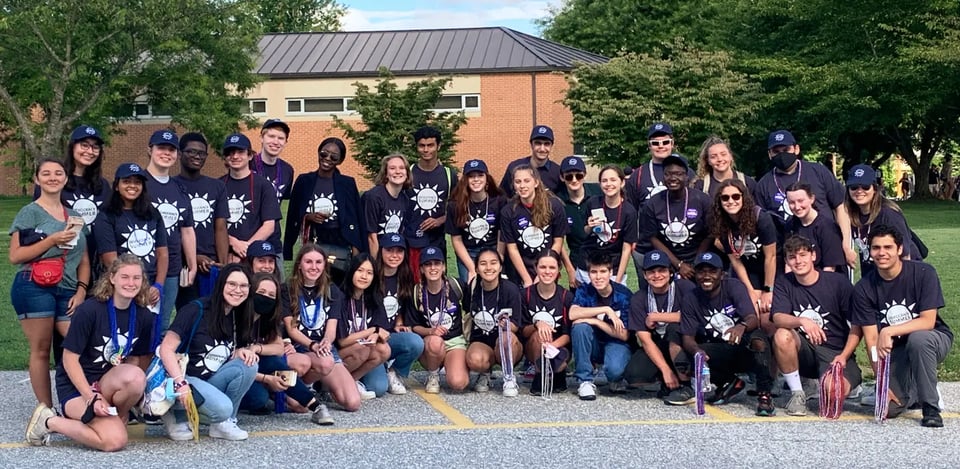
Promising young people not just a lot of hard work but a “school for democracy,” Jamie launched the Democracy Summer program which included in-depth discussion of the major issues Jamie was running on, including abolition of the death penalty, marriage equality, restoration of voting rights to former prisoners, campaign finance reform and replacement of the electoral college with a national popular vote for president.
In prior years, the program has also featured powerful supplementary teachings on the climate crisis, gun violence prevention and the power of the NRA, the assault on reproductive freedom, wealth inequality and tax policy, immigration and refugee policy, the Electoral College and the National Popular Vote campaign, redistricting and gerrymandering, the domestic budget and the military budget, U.S. foreign policy and Congressional power to declare war, education policy, civil rights and civil liberties, and the continuing spread of voter suppression tactics in GOP-controlled state legislatures. Other popular speakers have included Rev. William J. Barber II, Prof. Laurence Tribe, Bob Bauer, Senator Elizabeth Warren, Rep. Alexandria Ocasio-Cortez, Greg Moore, Rob Richie, Cindy Terrell and many more.
How can I get involved?
We have planned an exciting program for Democracy Summer 2026!
For six weeks during the summer, Fellows will commit to participating in at least 4-5 hours a week of virtual seminars, discussions and workshops, and an additional 10-15 hours a week of in-person organizing with their local Democratic Congressperson or candidate. Most Fellows end up choosing to spend a lot more time than this in campaign activities but these are the minimal expectations. Applicants will be selected both by the national Democracy Summer team and then by your local Democratic Congressperson or Congressional nominee.
Applications for Democracy Summer 2026 are not yet available. Fill out our interest form below to be notified once applications open!
https://docs.google.com/forms/d/e/1FAIpQLScdSb2510JSr4BY-2JGG8JTgTpUwSzWbxrkpol7rXJ9mSTwZA/viewform
Share this information about Democracy Summer with college students you know. Use your social media to alert students that they can help assure Americans with the right to vote.
Tell them to sign up to apply for Democracy Summer 2026 once applications open!
https://docs.google.com/forms/d/e/1FAIpQLScdSb2510JSr4BY-2JGG8JTgTpUwSzWbxrkpol7rXJ9mSTwZA/viewform
One more thing.
An example of successful student activism I didn’t know about. Did you?
Student activism at the Universities in California leads to jobs for undocumented students.
Hundreds of students call for UC to implement undocumented student hiring plan - Daily Bruin
Pressure from student activists across California led to this verdict, last November.👇
CALIFORNIA SUPREME COURT REAFFIRMS UNDOCUMENTED STUDENTS’ ACCESS TO ON-CAMPUS
November 4, 2025 (Los Angeles, CA) — In a historic decision, the California Supreme Court last week affirmed and upheld the California Court of Appeals’ prior ruling that the University of California’s (UC) employment policy that bans the hiring of undocumented student workers discriminates on the basis of immigration status and therefore unlawful under state law. While the case is centered on the UC system, the Court’s decision has broader implications, extending to other state entities and higher education systems governed by similar employment policies.
With nearly 90,000 undocumented college and university students across the state, the high court’s decision carries significant socioeconomic potential. This watershed decision opens doors for undocumented individuals—not only at the University of California, but across the state’s entire higher education and public sectors—to access career-aligned and financially sustaining employment opportunities.
Immigrants Rising looks forward to continuing advocating alongside students, partners, and stakeholders to ensure that all individuals, regardless of immigration status, can access jobs and other paid opportunities.
“For far too long, undocumented students have been discriminated against by the very same institutions of higher education that they contribute to and participate in. The California State Supreme Court decision rights this wrong and makes it clear that the UC cannot continue to exclude individuals from campus employment on the basis of immigration status. We call for the immediate implementation of this ruling so that undocumented students and individuals can maximize their academic pursuits and contribute more fully to their campuses and the state’s economy while gaining the financial stability that comes with employment,” said Dr. Iliana Perez*, Executive Director of Immigrants Rising.
Immigrants Rising is a proud member of the Opportunity for All Coalition and is grateful to the many student activists, legal advisors, and the Center for Immigration Law and Policy who have courageously led and sustained this effort for years, despite significant opposition.
*Iliana Perez, Executive Director of Immigrants Rising, is a plaintiff in the Umaña Muñoz & Perez v. Regents of the University of California case in her individual capacity, and not as an executive of Immigrants Rising. (Immigrants Rising)
Live in New York State? Do you need another reason to support Governor Hochul?
New York State Voter? Do you need another reason to support Governor Hochul?
Democrats Question Credentials of Armed Squad Created by Trump Ally
Bruce Blakeman, the Republican candidate for governor of New York, formed a band of special deputies. A lawsuit calls the unit’s members unqualified and says that some appear to have arrest records.
When the Republican leader of a suburban New York county began hiring armed citizens two years ago to be deployed as special deputy sheriffs on his orders in times of emergency, critics accused him of creating an unlawful, unnecessary, personal militia.
The leader, Bruce Blakeman, the Nassau County executive and a close ally of President Trump, dismissed the concerns as political carping by Democrats. The goal, Mr. Blakeman said, was “another layer of protection” for the county’s 1.4 million residents. Those joining the planned 75-member force would be well qualified and well trained, he said.
But in a filing in state court on Tuesday, the plaintiffs in a lawsuit seeking to halt the program challenged that assertion, arguing that the little they had learned through the discovery process about those who have been deputized suggests their credentials are lacking.
Without disclosing identities, the filing, on behalf of two Democratic county legislators, says that four people involved in the program “appear to have either been arrested or have had warrants issued for their arrest.”
Five appear to have been in their 70s when they enrolled in the program, well past New York’s mandatory retirement age of 62 for most police officers, the filing says. Six belong to the county’s auxiliary police force, the plaintiffs say, underscoring the program’s superfluous nature.
The filing also says that one person enrolled in the program is a member of Mr. Blakeman’s “extended family” who has no background in law enforcement and works in real estate. Another, the filing says, is a doctor who was a member of Mr. Blakeman’s transition team.
The résumés indicate that the special deputies picked to date are unqualified “compared to the people who do this for living” and support the argument that the program is ill conceived, Carey Dunne, a lawyer for the plaintiffs, said in an interview.
Mr. Blakeman, in a statement, defended the program. “All special deputies went through an extensive background check and were trained in criminal law and firearms, and all had valid New York State carry permits,” he said, calling them “respected members of the community, many of whom served in the military and professional law enforcement.”
The doctor is the Nassau County Police Department surgeon, according to a county official.
Mr. Blakeman, the Republican nominee for governor in New York this year, has not hesitated to wade into contentious issues. He has deputized county police detectives to engage in immigration enforcement and ordered that transgender athletes be barred from playing at county-owned facilities unless they are competing on coed teams or teams that match their birth gender.
When the special deputy program began, he said he wanted a group of armed people he could quickly deploy “to protect infrastructure or government buildings or schools or hospitals, that would free up” the county’s 2,600-officer police force in case of a hurricane, blackout or other disaster. The deputies have yet to be activated.
“I didn’t want to be in a situation where we had a major emergency and we needed help and people were not properly vetted or trained,” he said. Military veterans and retired members of law enforcement would get priority in hiring, the job posting said. Applicants were required to have a valid pistol license and would be paid $150 a day upon being activated.
Critics, including county Democrats, condemned Mr. Blakeman for bypassing legislators to create the program and shrouding it in secrecy by denying public records requests about it. Giving police powers to civilian gun owners, they said, could lead to accidental shootings, and they argued that the squad was an implied threat to minorities and the county executive’s political foes.
The issue grew especially heated when Mr. Blakeman said in a television interview soon after the program was announced that the special deputies might be used to patrol chaotic demonstrations. Asked in the interview whether he could declare a political protest an emergency, he said, “if the riot was to a level where they were burning buildings.” (He later said of the program: “Of course, it would not be used for political purposes.”)
The Democratic lawmakers sued Mr. Blakeman; the county sheriff, Anthony LaRocco; and the county government in State Supreme Court in Nassau County in February 2025. They asked that the special deputy squad be disbanded and declared illegal and that no public money be spent on it.
“Authorizing minimally trained private citizens to wield force on behalf of the government — and during an emergency, no less — poses clear and obvious safety risks,” they wrote in the suit. In response, Mr. Blakeman called the lawmakers “a disgrace for bringing this frivolous action.”
In October, a judge heard oral arguments in the case, denied the defendants’ motion to dismiss the suit and rejected a counterclaim against the plaintiffs; a second motion to dismiss is pending. (New York Times)
This ‘n That.
The Financial Cost of Trump Kennedy Measles
Highly contagious measles virus costing the U.S. millions
According to a new report from the Yale School of Public Health, if measles vaccination rates continue to drop just 1% annually for the next five years, the financial cost to the U.S. could reach $1.5 billion a year. (NBC News)
Pointing out.

This doesn’t count the illness to children and the possible long term effects, the play days missed, the damage to school systems, communities and families, including costs in pay to families forced to be caregivers.
Trumpian updates
Trump’s War in Iran. An Analysis and A Prediction.
The dry and the wet burn together. By Eskandar Sadeghi-Boroujerdi
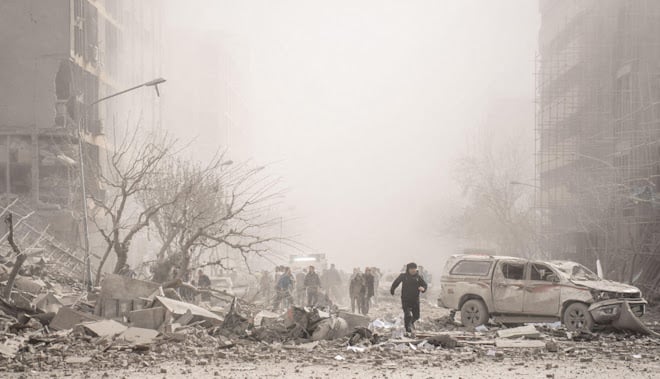
The aftermath of an airstrike near Ferdowsi Square in central Tehran, 2 March 2026 (Hamid Vakili/Parspix/Abaca Press/Alamy)
‘The dry and the wet burn together’ is a Persian expression invoked when a fire spreads without discrimination. Once the blaze begins, distinctions collapse: between the combustible and the damp, the guilty and the innocent, perpetrators and victims.
The war launched against Iran by the United States and Israel is a war of choice and of hubris. There is scarcely even the pretence that it was compelled by evidence of an Iranian dash for a bomb or an imminent attack. Such claims do not survive scrutiny; they barely withstand repetition. We are witnessing the realisation of a long-cherished ambition, a neoconservative fever dream that Benjamin Netanyahu has lobbied for, in one form or another, for decades. What sanctions could not achieve, what covert action, assassinations and cyber-warfare failed to deliver, direct military force would now accomplish, with the killing of Ayatollah Ali Khamenei as its centrepiece.
Trump and Netanyahu made their maximalist aims clear at the outset. This would be about ‘regime change’. What kind of regime would follow was left opaque, for the rest of the world to speculate on with trepidation. It’s a destructive and failed policy that Trump once vowed to retire for good. Like his mendacious pledges to restore dignity to the American working class, the promise was jettisoned as soon as he assumed office.
In a farcical re-enactment of the Iraq War script, we were told that the Islamic Republic would collapse like a house of cards. But unlike in 2003, there has been little attempt to persuade the wider world, or even the US Congress. The rhetorical labour that accompanied the invasion of Iraq, however flawed or dishonest, has largely been abandoned. Even senior US military officials have struggled to explain how the campaign’s objectives would be achieved swiftly or decisively. The assumption of inevitability has replaced the burden of argument.
The absence of justification is not incidental. It is a morbid symptom of an international system in crisis. The certainties of the United States’ hegemonic stewardship of the ‘international rules-based order’ have been deformed beyond recognition by the Gaza genocide, but no alternative architecture has cohered in their place. Instead there is a politics of gangster imperialism that has neither international nor domestic consent.
The premise of the war rests on a profound misreading of the Islamic Republic. For all its internal fissures and its battered legitimacy, it is not a brittle personalist dictatorship like Saddam Hussein’s Iraq or Muammar Gaddafi’s Libya. Iran’s formative experience was the eight-year conflict with Iraq, when it was diplomatically isolated and militarily outgunned, yet survived through a combination of ideological mobilisation and asymmetrical adaptation. Since then, the regime has invested in decentralised command structures, missile and drone capabilities, and regional networks designed precisely for the scenario now unfolding: a confrontation with conventionally superior adversaries. Whether it can survive a full-blown war with the globe’s largest purveyor of organised violence is an open question, but it was always unlikely to collapse in the first days of the conflict.
Iran’s aim now seems to be not to secure immediate victory but to raise the cost of the war to prohibitive levels. It sees the conflict as existential. If regime change is the declared objective, then compromise is not an option. What follows is a strategy of endurance and attrition. The Islamic Republic has long prepared for the possibility that the US and Israel might eventually opt for direct confrontation.
The killing of Khamenei may have altered the internal calculus. For years, he was seen, even by critics within the system, as cautiously seeking balance among competing power centres. His death removes a figure who, for all his rigidity, sometimes acted as a brake on more adventurous impulses – such as widening the retaliation to include the Gulf states that form part of the American imperial archipelago. This strategy may yet backfire on its authors. But for now, the Islamic Revolutionary Guard Corps – firmly in the driving seat – seems determined to pursue it.
None of this is to deny the profound polarisation within Iranian society. Many people have a deep and visceral hatred of the regime. Years of economic mismanagement, corruption, repression and squandered opportunity have corroded the social contract. The upheavals of recent years, including the protests that followed the death of Mahsa Amini in 2022 and the horrific massacre of several thousand demonstrators in January, revealed generational, class and ideological divides that may prove insurmountable.
War alters political psychology in ways that are rarely linear. Those who loathe the clerical establishment may still recoil at the spectacle of foreign jets in Iranian skies and the explicit declaration that their state is to be dismantled. External assault does not erase internal grievance, but it can reorder it. Anger at the regime may be temporarily subordinated to anger at the attacker. What in peacetime appears as irreconcilable fracture can, under bombardment, assume the form of brittle solidarity. The Islamic Republic’s capacity to mobilise people is diminished from its revolutionary zenith, but it has not evaporated. It remains adept at recoding the conflict in civilisational and defensive terms, using a rhetoric of sovereignty, martyrdom and resistance that has been cultivated for decades and acquires renewed force when missiles fall.
Khamenei’s legacy was far from secure. Aged 86, he presided over an era of deepening securitisation: the throttling of reformist and dissident currents, the crushing of the Green Movement in 2009, the brutal suppression of the Mahsa uprising in 2022-23, and a long accumulation of grievances that defy enumeration. Strategic autonomy and deterrence were prioritised over civil liberties, political pluralism and domestic reform, while he advanced a conservative vision that railed against ‘cultural assault’ (tahajom-e farhangi) from without. His central preoccupation was survival – of the regime, of the state, of Iran’s independence – in a region where the fates of Iraq, Libya and Syria served as constant warnings. For many Iranians, this security-first doctrine came at an intolerable cost, and they unambiguously rejected it.
But in Shia political theology, martyrdom carries a particular force. The memory of Karbala and the death of Imam Hussain are not abstract motifs but part of a living political language and religious practice, in which suffering at the hands of an unjust power acquires moral authority. To be killed by an external enemy does not simply remove a leader; it can recast him. No modern Iranian head of state has met such an end. Naser al-Din Shah was assassinated in 1896 by a domestic radical. The last Qajar monarchs died abroad, in Paris and San Remo. The Pahlavis ended their lives in exile, in Johannesburg and Cairo. Khamenei’s death, by contrast, will be narrated across official channels as the ultimate sacrifice in the face of foreign assault. In death, he may acquire a clarity and coherence that eluded him in life.
Many Iranians, and not a few Syrians, have openly celebrated his death, seeing in it the end of a grisly domestic legacy and a regional policy that helped sustain the catastrophic civil war in Syria. But his followers – and they are not few – regarded him as more than a political figure. For them he was a marja’ al-taqlid (‘source of emulation’). His standing did not approach that of Grand Ayatollah Sistani in Iraq, yet his authority extended well beyond Iran’s borders to millions of Shia faithful. The manner of his death may salvage, even elevate, a legacy that had become deeply contested at home and resented abroad.
Some of the most prominent slogans of the past decade targeted him directly: ‘Death to Khamenei’; ‘Death to the Dictator’; ‘This is the year of blood, Sayyid Ali will be overthrown.’ The rage was personalised. Khamenei was not merely a political office-holder (with considerable personal power and a penchant for micro-management) but the patriarchal embodiment of the system. If Trump’s intention was to remove Khamenei from the political landscape, he may instead have fixed him in it, recast in the eyes of his devotees as a figure of sacrifice rather than failure.
Trump’s foreign policy has long oscillated between the language of retrenchment and sudden maximalist displays of force. In this instance, paleoconservative instincts appear to have fused with neoconservative zeal. Netanyahu’s influence is not incidental. For decades he has insisted that only decisive military action could secure Israel’s unchecked regional domination. The degradation of Hizbullah and the collapse of Assad were read in Tel Aviv as evidence that Iran’s regional position had been fatally compromised. There was truth in this: both developments were serious blows to Tehran, and both Washington and Tel Aviv moved swiftly to exploit the moment. But Iran’s deterrence was never reducible to its alliances, many of which were forged in the crucible of US and Israeli overreach. Its strategy was also domestic, layered, decentralised and internally anchored. The expectation that sufficient pressure would trigger the regime’s collapse confused attrition with exhaustion, and vulnerability with surrender.
The consequences are already radiating outward: missile exchanges; attacks on bases, hotels and ports; the activation of allied networks across the region. American officials now admit uncertainty about the campaign’s duration and scope, or even their preparedness to commit ground troops to this reckless endeavour. This is not a limited operation with predictable outcomes. It is an expanding confrontation whose boundaries are increasingly difficult to define.
The war will not restore equilibrium. It will reorder the region both violently and unpredictably. The Islamic Republic is likely to emerge transformed or weakened in ways not yet visible. But the notion that it would simply dissolve under pressure was always fanciful. States formed in revolution and hardened by protracted siege do not yield easily to external diktat.
The dry and the wet burn together. One hundred and sixty-five graves have been dug in Minab, in Hormozgan province, for those killed when US or Israeli missiles struck the Shajareh Tayyebeh school on Saturday morning as classes began. Most of the dead were girls aged between seven and twelve. Washington and Tel Aviv have sought to distance themselves from the carnage; the photographic record of the desolation remains.
Trump has spoken of a campaign lasting weeks; the Islamic Republic’s current leadership has vowed to fight on. Wars of choice rarely confine themselves to their intended targets. They consume not only the combatants but the assumptions that animate them. What began as an attempt to alter the regional balance may instead hasten the erosion of the order that presumed it could interfere with impunity. (Eskandar Sadeghi-Boroujerdi is a British Academy Postdoctoral Research Fellow in the Faculty of Oriental Studies at the University of Oxford and Postdoctoral Associate at St Cross College, Oxford. London Review of Books)
One more thing.
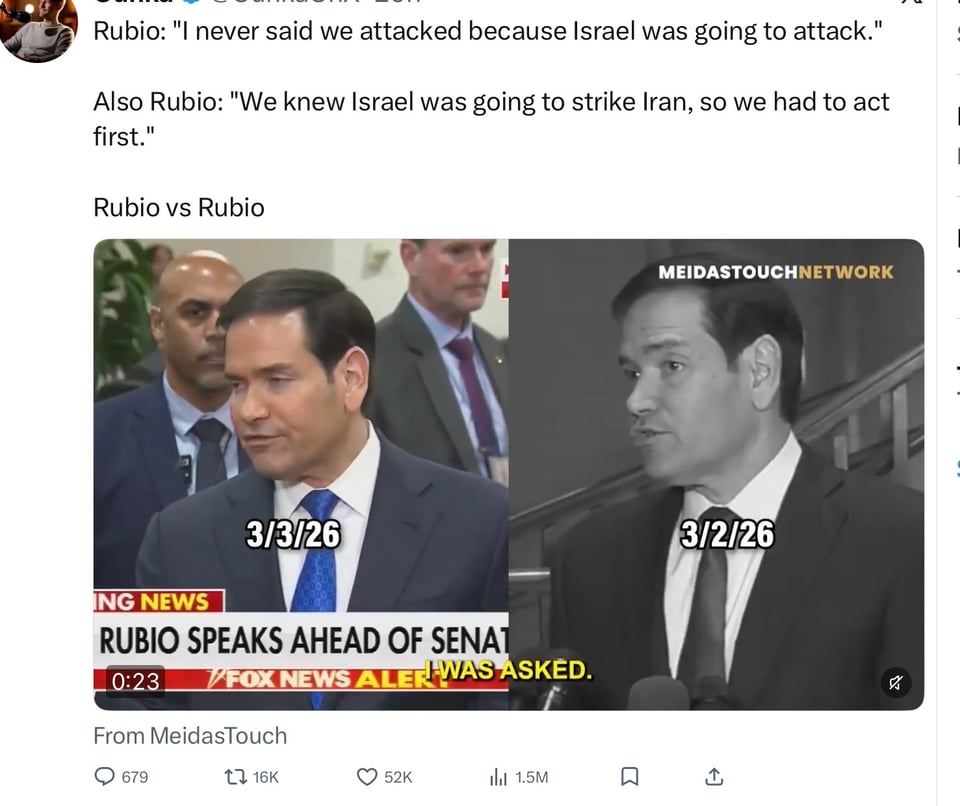
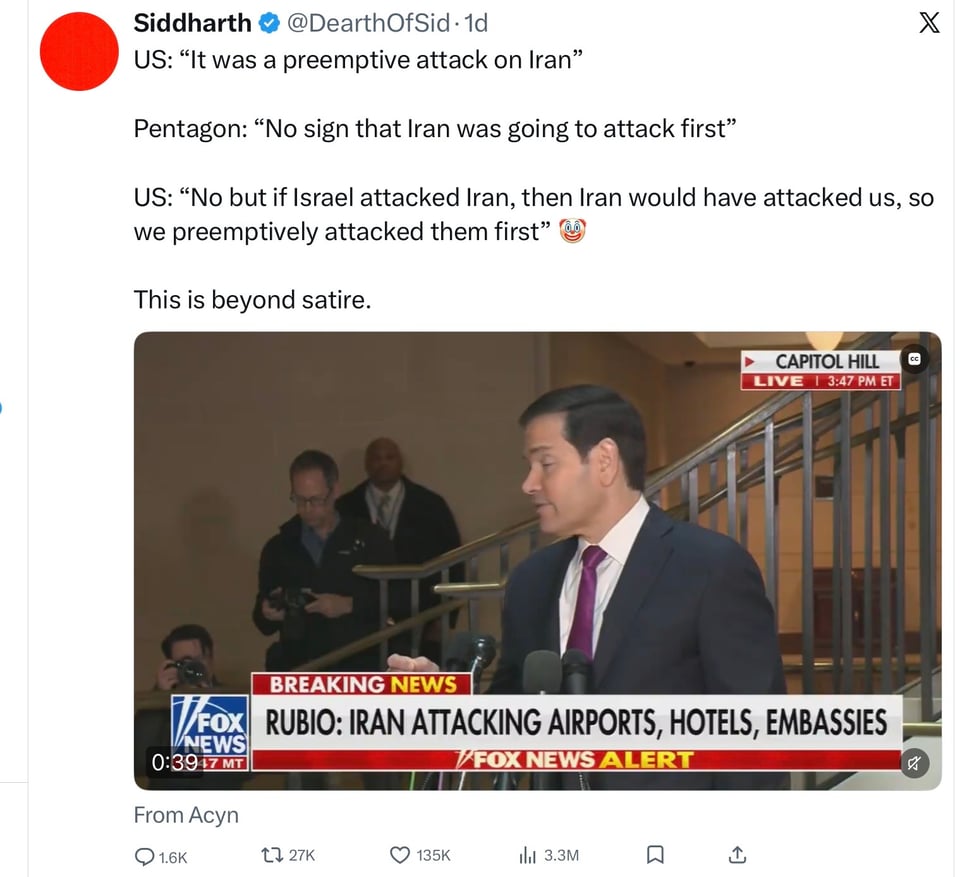
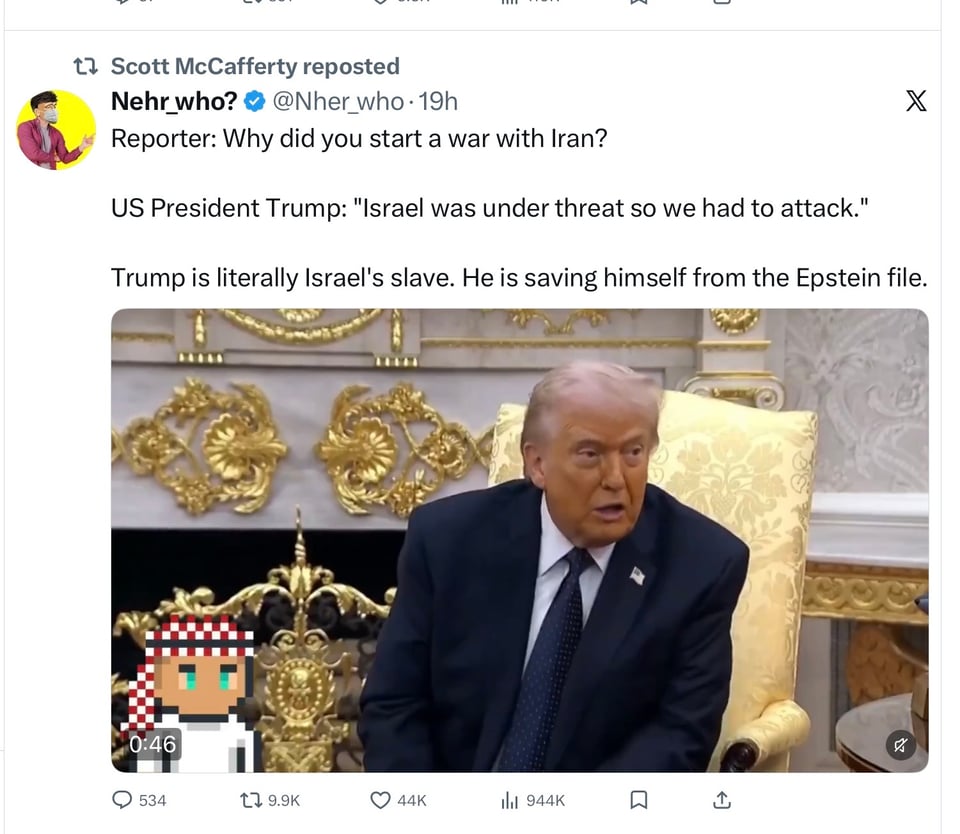
Trump and his secretary of stage still can’t decide why they went to war.
Something to look forward to.