Thursday, January 8, 2026. Annette’s Roundup for Democracy.
Trump’s blockade escalates conflicts with China and Russia.
🚨🇨🇳 BREAKING — China Issued a FINAL Warning Against the Illegal U.S. Blockade of Venezuela. pic.twitter.com/7MCpzdrL6P
— ★★★★★ Pamphlets ★★★★★ (@PamphletsY) January 7, 2026
US forces seized a Russia-flagged ship in the north Atlantic that’s been at the center of a dramatic sea chase across the ocean, an aggressive expansion of its blockade of sanctioned vessels going to and from Venezuela https://t.co/5A2W1wKV5E pic.twitter.com/V2pI8AsBCP
— Bloomberg (@business) January 7, 2026
New York Times on the Russian vessel.
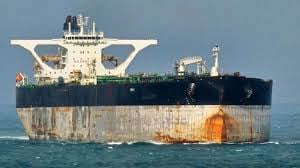
Hours after the U.S. military seized two oil tankers on Wednesday, including a Russian-flagged vessel, the American secretary of state laid out a plan for Venezuela’s near-future that included the United States maintaining control over interim authorities.
The seizure of the Russian-flagged tanker escalated a confrontation with Moscow after the ouster of its ally, Nicolás Maduro of Venezuela. The U.S. military issued a statement saying that forces had “seized” the vessel in the North Atlantic, between Scotland and Iceland, for violating U.S. sanctions. The ship, which was not carrying oil, had previously tried to sail to Venezuela to pick up crude and had been eluding U.S. forces for more than two weeks.
Russia’s Ministry of Transport confirmed that U.S. forces had boarded the vessel, known until recently as the Bella 1 and now called the Marinera, in international waters. It added in a statement that contact with the ship had been lost.
The military later said, in a separate statement, that it had “apprehended a stateless, sanctioned dark fleet motor tanker,” the M Sophia, in international waters in the Caribbean, where it was “conducting illicit activities,” and the ship was being escorted to the United States.
In Washington, Secretary of State Marco Rubio outlined a three-step plan for Venezuela, insisting to reporters that the administration was “not just winging it.” It included stabilizing the country by seizing and selling some 30 million to 50 million barrels of oil — with the U.S., not interim Venezuelan leadership, controlling how the money would be dispersed.
The second step was to ensure that “American, Western and other companies have access to the Venezuelan market in a way that’s fair.” The third step, which he did not elaborate on, is “one of transition” and includes the integration of opposition parties.
“We feel like we’re moving forward here in a very positive way,” he added.
———————-
BREAKING - In response to the tanker seizure, Russia is threatening the United States with a missile strike.
“A military response is necessary: an attack with torpedoes and the sinking of several American ships,” — said Alexey Zhuravlyov, a deputy of the Russian State Duma.
Even if you are not appalled by the illegality of Trump’s attack on Venezuela and care only about American access to Venezuelan oil, the naive stupidity of Trump is still stunning.
Here’s a strong account of the oil industry in Venezuela with realistic expectations about Venezuelan oil.
THE FOLLY OF TRUMP’S OIL IMPERIALISM.
The President has made clear he wants to exploit Venezuela’s vast oil reserves; history suggests that it won’t be easy.
Watching Donald Trump’s press conference at Mar-a-Lago on Saturday, in which he said that the U.S. would “run” Venezuela and seize some of the country’s oil wealth “in the form of reimbursement for the damages caused us by that country,” my mind went back to 2003. In the immediate aftermath of the U.S. invasion of Iraq, I spent several weeks travelling around the country’s oil fields, some of which were still littered with live ordnance, speaking with members of the U.S.-led Task Force Rio—the “Rio” stood for “Restore Iraqi Oil”—and local workers. I also went to Baghdad, where I interviewed officials from the Iraqi oil ministry.
Venezuela isn’t Iraq, of course, and so far, at least, there hasn’t been a U.S. occupation. (Although Trump remarked, “We’re not afraid of boots on the ground.”) Nonetheless, this is the second time in twenty-three years that the United States has deposed the authoritarian leader of an oil-rich nation—the third if you count the nato strikes on Libya in 2011, which hastened the fall of Muammar Qaddafi. History has some lessons to offer.
Unlike Trump, who is an unashamed petro-imperialist, members of the Bush Administration insisted that their push for regime change in Iraq was unconnected to hydrocarbons—Donald Rumsfeld famously said it had “literally nothing to do with oil”—and that the postwar reconstruction of Iraq’s oil industry was designed purely to help the country. At an oil refinery in Basra, I sat in on a meeting chaired by the American brigadier general who headed up Task Force Rio. An aide to the general gave me a handout, which said, “Who will be running the Iraqi oil industry? Iraqis are responsible for the energy sector.”
Many queried U.S. intentions. Iraq then had the second-largest proven oil reserves of any country in the Middle East, and Bush, shortly after taking office in 2001, had declared an energy crisis. At the time, the United States was importing about half the oil it burned. An energy task force led by Vice-President Dick Cheney, who had previously been the chief executive of the oil-services company Halliburton, issued a report that recommended more investments in renewables, energy-saving technology, and fossil fuels. It also called for more imports from Latin America, including Venezuela, which was already the third-largest foreign supplier to the U.S., after Canada and Saudi Arabia. While barely mentioning Iraq, the report said, “Energy security must be a priority of US trade and foreign policy.”
Today, as a result of the shale-oil revolution—fracking—the United States is the world’s largest oil producer, even larger than Saudi Arabia, and a net exporter of petroleum. But the A.I. buildout is rapidly increasing the demand for power, and the Trump Administration, despite its aversion to renewables, is set on achieving what it termed, in its recently published national-security strategy, “Energy Dominance.” In this context, it’s hardly surprising that Venezuela, which now enjoys the status of the country with the largest proven oil reserves—more than three hundred billion barrels—has attracted Trump’s attention. Most of the Venezuelan oil is situated in the Orinoco Belt, which runs east to west in the north of the country. Many of the crude deposits are in the form of a heavy sludge, which is difficult to extract and refine. But, with expertise and capital, it can be done. Moreover, many U.S. refineries, particularly in the Gulf and on the West Coast, are configured for heavy crude.
Despite this domestic refining capacity, ramping up production in Venezuela will be a mighty task. Like its Iraqi counterpart under Saddam Hussein, the Venezuelan oil industry has suffered from many years of sanctions and chronic underinvestment. Many of its skilled employees have emigrated. Last year, the industry produced about a million barrels a day, roughly a third of its output a quarter of a century ago. On Saturday, Trump said that big U.S. oil companies would “go in, spend billions of dollars, fix the badly broken infrastructure, the oil infrastructure, and start making money for the country.” It’s not that simple.
One challenge is the scale of investment required: one energy analyst told the Financial Times it would take more than a hundred billion dollars to double Venezuela’s oil output. Another issue is the price of crude, which recently dipped below sixty dollars, reaching a four-year low. At the moment, Chevron is the only major U.S. oil company operating in Venezuela. Shortly before Christmas, it emerged that the Administration had approached other U.S. firms, such as ExxonMobil and ConocoPhillips, to see if they are interested in returning to a country where they operated before the government of Hugo Chávez, Nicolás Maduro’s predecessor, seized their assets. (Lawsuits sparked by that seizure are still ongoing.) Politico reported that some responses to the Administration’s feelers were negative. “Frankly, there’s not a lot of interest from the industry, in light of lower oil prices and more attractive fields globally,” one source told the news site.
The removal of Maduro from power could change the oil companies’ calculations, but the lesson from Iraq is that they need a guarantee of long-term political stability before they will make major investments. In 2003, Iraq’s interim oil minister told me that attracting foreign investments to Iraq’s underdeveloped oil fields was “only a matter of putting in place a system of contracts.” Philip J. Carroll, a Houston oilman whom the White House had appointed as an adviser to the Iraqi oil ministry, was more circumspect. Oil companies “will want to see an Iraqi government and have confidence in it before sinking down large sums of money,” Carroll said. “They will want to know what the world will be like in six or seven years.” This skepticism proved well founded. More than a decade of civil war and violent insurgency deterred foreign companies from returning to Iraq in any substantial way. It’s only in the past couple of years, more than two decades after the invasion, that the likes of Exxon and Chevron have done so.
Right now, Venezuela’s future is opaque: it’s not even clear what sort of government in Caracas the Trump Administration favors for the longer term: A former ally of Maduro? A democratically elected leader? An American viceroy? Whatever happens in the coming weeks and months, though, Venezuelans of all political persuasions will surely oppose anything that smacks of Yankee petro-imperialism, which was something it took the country a long time to escape.
Nearly a hundred years ago, when Standard Oil of New Jersey (a precursor to Exxon), Gulf Oil (which Chevron acquired in 1984), and Royal Dutch/Shell entered Venezuela, the oil companies obtained highly favorable contracts, which required them to pay modest commissions to the host country. In the nineteen-forties, the Venezuelan government insisted on a fifty-fifty split in oil revenues, and in 1960, Venezuela became the only non-Arab founding member of opec, which was designed to secure better prices from the Seven Sisters—the big Western oil companies, five of them American, which dominated the industry. In 1976, a government led by Carlos Andrés Pérez, one of the founders of the center-left Acción Democrática Party, nationalized much of the oil industry, creating a state-owned company, Petróleos de Venezuela. From then on, this company, which is commonly referred to as P.D.V.S.A., dominated the industry, although some American companies were subsequently allowed to start new projects, until Chávez’s government seized control of them in 2007.
Many Venezuelans accept that Venezuela now needs to bring in foreign capital to rebuild its oil industry. The democratic opposition has drawn up a plan to do this, with the goal of raising production to four million barrels a day. But, after a quarter of a century of political fracturing, sanctions, and myriad economic deprivations, that isn’t the only task facing the country. It also needs to rebuild its infrastructure, reduce its onerous foreign-debt load, and reassimilate millions of people who have left. “What the U.S. needs to do is to implement a form of a Marshall Plan,” Orlando Ochoa, a Venezuelan economist who teaches at the Universidad Católica Andrés Bello, in Caracas, told the Wall Street Journal over the weekend. “This is about much more than coming into the oil and gas sector just to extract crude from the ground.” Surely, it is. But is there any chance of Donald Trump recognizing this and acting upon it? ♦︎ (John Cassidy, Financial Writer, The New Yorker).
What about Greenland?
This analysis 👇 suggests a possible but very surprising solution to Trump’s outrageous demands about Greenland.
The New York Times publishing this gives the analysis credibility.
Will it prove to be valid?
Buy Greenland? Take It? Why? An Old Pact Already Gives Trump a Free Hand.
Analysts say the Cold War agreement allows the president to increase the American military presence almost at will.
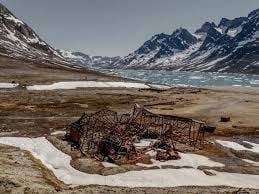
The remnants of an American air base on Greenland called Bluie East Two, which was built during World War II.
President Trump has ridiculed Denmark’s dog sled teams in Greenland.
He has cited mysterious Chinese and Russian ships prowling off the coast.
He seems increasingly fixated on the idea that the United States should take over this gigantic icebound island, with one official saying the president wants to buy it and another suggesting that the United States could simply take it. Just a few days ago, Mr. Trump said: “We need Greenland from the standpoint of national security.”
But the question is: Does the United States even need to buy Greenland — or do something more drastic — to accomplish all of Mr. Trump’s goals?
Under a little-known Cold War agreement, the United States already enjoys sweeping military access in Greenland. Right now, the United States has one base in a very remote corner of the island. But the agreement allows it to “construct, install, maintain, and operate” military bases across Greenland, “house personnel” and “control landings, takeoffs, anchorages, moorings, movements, and operation of ships, aircraft, and waterborne craft.”
It was signed in 1951 by the United States and Denmark, which colonized Greenland more than 300 years ago and still controls some of its affairs.
“The U.S. has such a free hand in Greenland that it can pretty much do what it wants,” said Mikkel Runge Olesen, a researcher at the Danish Institute for International Studies in Copenhagen.
“I have a very hard time seeing that the U.S. couldn’t get pretty much everything it wanted,” he said, adding, “if it just asked nicely.”
But buying Greenland — something that Secretary of State Marco Rubio told lawmakers on Tuesday was Mr. Trump’s latest plan — is a different question.
Greenland does not want to be bought by anyone — especially not the United States. And Denmark does not have the authority to sell it, Dr. Olesen said.
“It is impossible,” he said.
In the past, Denmark would have been the decider. In 1946, it refused the Truman administration’s offer of $100 million in gold.
Today, things are different. Greenlanders now have the right to hold a referendum on independence and Danish officials have said it’s up to the island’s 57,000 inhabitants to decide their future. A poll last year found 85 percent of residents opposed the idea of an American takeover.
Greenland’s prime minister, Jens-Frederik Nielsen, has repeatedly scoffed at the idea of being bought, saying this past week, “Our country is not for sale.”
The relatively short, straightforward defense agreement between the United States and Denmark was updated in 2004 to include Greenland’s semiautonomous government, giving it a say in how American military operations might affect the local population. The roots of the agreement go back to a partnership forged during World War II.
At that time, Denmark was occupied by the Nazis. Its ambassador in Washington, cut off from Copenhagen, took it upon himself to strike a defense agreement for Greenland with the United States. (The island is part of North America, along the Arctic Ocean and close to Canada’s coast.)
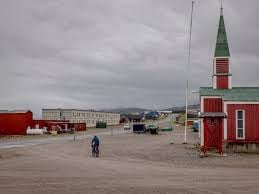
A former American air base in Kangerlussuaq in western Greenland. Under a little-known Cold War agreement, the United States has sweeping military access in Greenland.
The fear was that Nazis could use Greenland as a steppingstone to America. The Germans had already established small meteorological bases on the island’s east coast and relayed information for battles in Europe. American troops eventually ousted them and established more than a dozen bases there with thousands of troops, landing strips and other military facilities.
After World War II, the United States continued to run some bases and a string of early warning radar sites. As the Cold War wound down, the United States closed all of them except one. It’s now called the Pittufik Space Base and helps track missiles crossing the North Pole.
The Danes have a light presence, too: a few hundred troops, including special forces that use dog sleds to conduct long-range patrols. In recent months, the Danish government has vowed to upgrade its bases and increase surveillance.
After American special forces captured Nicolás Maduro, the president of Venezuela, from a safehouse last week, Mr. Trump seemed emboldened. Stephen Miller, a top aide, then claimed that Greenland should belong to the United States and that “nobody’s going to fight the United States” over it. Danish and Greenlandic anxiety skyrocketed.
On Tuesday night, Danish and Greenlandic leaders asked to meet with Mr. Rubio, according to Greenland’s foreign minister. It’s not clear if or when that might happen.
Tensions between Mr. Trump and Denmark’s prime minister, Mette Frederiksen, have been steadily rising, as Mr. Trump pushes to “get” Greenland, as he puts it, while Ms. Frederiksen refuses to kowtow to him.
Just a few days ago, Ms. Frederiksen cited the 1951 agreement, saying, “We already have a defense agreement between the Kingdom and the United States today, which gives the United States wide access to Greenland.” She urged the United States “to stop the threats” and said an American attack on Greenland would mean the end of the international world order.
European leaders issued their own statement on Tuesday, also citing the 1951 agreement and saying, “Greenland belongs to its people.”
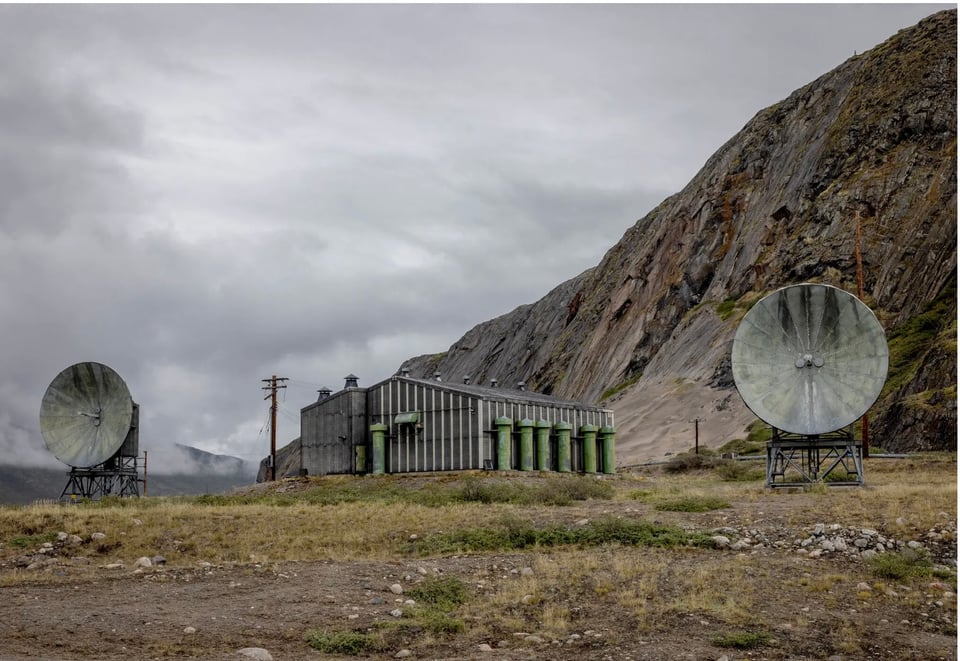
An American built, Cold War-era satellite station, referred to locally as Mickey Mouse, remains on a hill above Kangerlussuaq.
Analysts said that if the United States tried to use the defense pact as a fig leaf to send in a lot of troops and try to occupy Greenland, that wouldn’t be legal either.
According to the 2004 amendment, the United States is supposed to consult with Denmark and Greenland before it makes “any significant changes” in its military operations on the island. The 2004 amendment, which was signed by Gen. Colin L. Powell, who was then the secretary of state, explicitly recognizes Greenland as “an equal part of the Kingdom of Denmark.”
Peter Ernstved Rasmussen, a Danish defense analyst, said that in practice, if American forces made reasonable requests, “the U.S. would always get a yes.”
“It is a courtesy formula,” he said. “If the U.S. wanted to act without asking, it could simply inform Denmark that it is building a base, an airfield or a port.”
That’s what infuriates longtime Danish political experts. If Mr. Trump wanted to beef up Greenland’s security right now, he could. But there has been no such official American request, said Jens Adser Sorensen, a former senior official in Denmark’s Parliament.
“Why don’t you use the mechanism of the defense agreement if you’re so worried about the security situation?” he said, adding: “The framework is there. It’s in place.”
But Greenland’s strategic location is not the only thing that has attracted Mr. Trump’s inner circle. The enormous island has another draw: critical minerals, loads of them, buried under the ice. Here, too, analysts say, the United States doesn’t need to take over the island to get them.
Greenlanders have said they are open to doing business — with just about anyone.(New York Times)
Danish troops told to 'shoot first, ask questions later' if US invades Greenland https://t.co/fzwjEzuRbf
— LBC (@LBC) January 7, 2026
Did ICE murder a woman in Minneapolis?
The woman shot by the ICE agent had a child who is 6. The father died in 2023, leaving the child without either of his or her birth parents https://t.co/kpXEM8R0Zk
— Sam Stein (@samstein) January 7, 2026
Her name is Renee Good.
To all of the MAGA Republicans and ICE defenders who are claiming that this woman in Minneapolis, Minnesota, tried to run ICE officers over with her car before they shot and killed her, here is the actual video.
— Ed Krassenstein (@EdKrassen) January 7, 2026
As you can clearly see, there are three ICE officers to the side of… pic.twitter.com/mWLV0mYVZR
This isn't "self defense" by ICE agents in Minneapolis, Minnesota. It's murder.
— Ed Krassenstein (@EdKrassen) January 7, 2026
Watch in slow motion. The officer fires shots two and three at the woman after the vehicle is clearly out of harms way.
His intention wasn't to defend himself at that point. pic.twitter.com/2qav2KsdwC
🚨HOLY SHIT: Kristi Noem just called the Minneapolis woman a terrorist- claiming ICE agents were “attacked” after an agent jumped to safety before shooting her in the face multiple times.
— CALL TO ACTIVISM (@CalltoActivism) January 7, 2026
Kristi Noem is a complicit monster.
NOEM: “(What the victim did) was an act of domestic… pic.twitter.com/L0T3osOErO
PLEASE SHARE: This appears to be the ICE agent who shot and killed the woman in Minneapolis? Anyone know his name? pic.twitter.com/Mo5H7wXGyu
— Brian Krassenstein (@krassenstein) January 7, 2026

🚨 MINNEAPOLIS MAYOR CALLS IT OUT:
— Brian Allen (@allenanalysis) January 7, 2026
Jacob Frey isn’t buying the spin.
“They’re already trying to frame this as self-defense. Having seen the video myself, I want to tell everyone directly: that’s bullshit.” pic.twitter.com/3nZJLcOO4g
BREAKING: Mayor Jacob Frey after ICE just killed a civilian: “To ICE, get the fuck out of Minneapolis.” pic.twitter.com/QOm8xJuMfZ
— Brian Krassenstein (@krassenstein) January 7, 2026
“Kill someone else!”
— The Tennessee Holler (@TheTNHoller) January 7, 2026
After killing an innocent woman in Minneapolis Trump’s ICE goons are roughing up protestors and firing munitions into people’s faces.
Original video: https://t.co/H232JZxIPB pic.twitter.com/tJKIAoT0Ir
Trump plays judge and jury on woman’s death at the hands of ICE in Minneapolis.
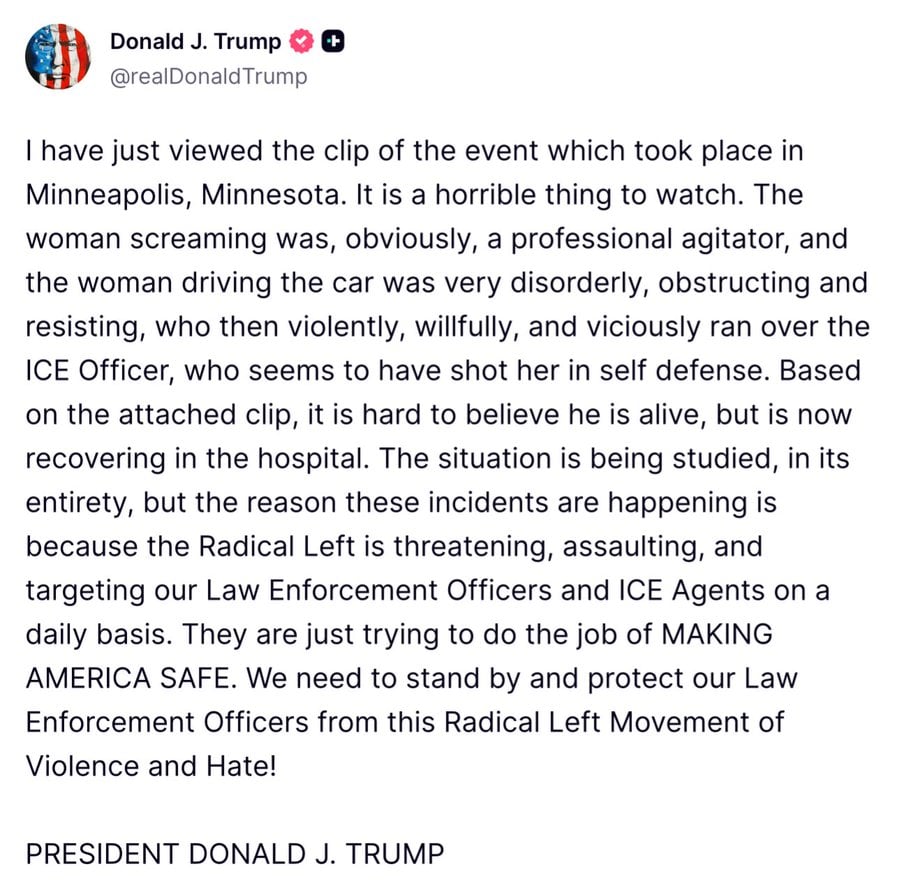
BREAKING: Minneapolis Police, chief Brian O'Hara just contradicted Trump, saying that Renee Nicole Good was the only person injured during today's incident, after Trump said that the ICE officer was injured and recovering in the hospital.
— Ed Krassenstein (@EdKrassen) January 8, 2026
Stop believing President Trump's lies.… pic.twitter.com/Ax3cNgSnjP
This morning, an ICE agent murdered a woman in Minneapolis—only the latest horror in a year full of cruelty.
— Mayor Zohran Kwame Mamdani (@NYCMayor) January 7, 2026
As ICE attacks our neighbors across America, it is an attack on us all. New York stands with immigrants today, and every day that follows.
Protest marches happened in Minneapolis, NYC, And in cities across the country.
More proof that CBS is no longer a news station.
What is the proper reaction to this egregious behavior by the CBS anchor? Yes, call and complain - (212) 975-4321 and ask to be connected with the department that handles viewer complaints or general feedback.
Or maybe better yet, never watch CBS again while it is the Trump network.
Or do both.
CBS News anchor Tony Dokoupil ended the network’s evening newscast Tuesday with a “salute” to Secretary of State Marco Rubio.
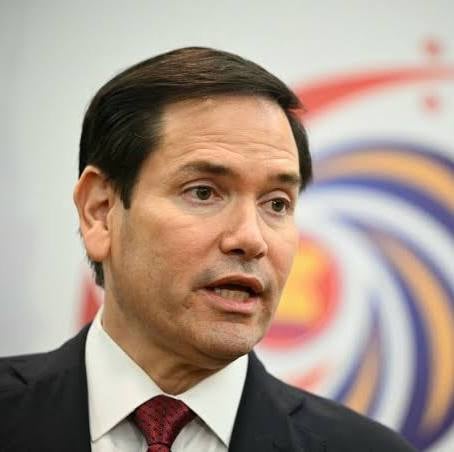
The segment heaped praise on Rubio, the former Florida GOP senator, for taking on a growing number of titles and responsibilities in President Trump’s administration, of which Dokoupil said, “Whatever you think of his politics, you’ve got to admit it’s an impressive resume.”
Rubio currently serves as secretary of State, interim national security adviser and acting national archivist, and was previously tapped for United States Agency for International Development chief before the agency was shuttered.
The collection of jobs have led some on social media to create memes of the top Trump diplomat serving in a variety of other gigs spanning sports, business and global leadership.
“Now AI memes have added to that portfolio, casting Secretary Rubio as the new governor of Minnesota, the new shah of Iran, the new prime minister of Greenland, the new manager of Manchester United, the head of Hilton Hotels and the highest of high honors of all, the new Michelin Man,” Dokoupil said Tuesday.
“These memes may not add up to much, but to Rubio’s hometown fans, which are many here in Miami, it is a sign of how Florida — once a political punchline — has become a leader on the world stage,” the “CBS Evening News” anchor added. “Marco Rubio, we salute you. You’re the ultimate Florida man.”
Dokoupil and CBS News have faced intensifying scrutiny over its coverage of the Trump administration in recent weeks after Bari Weiss was installed as the network’s editor in chief.
Weiss has come under fire for punting a “60 Minutes” segment before the Christmas holiday that was critical of the Trump administration’s immigration policies. She contends the segment was not ready for broadcast, but critics at the network argue it was a politically calculated move.
Weiss was hired by David Ellison, the top executive at Paramount who has promised to retool CBS’ editorial coverage to represent a more “diverse” set of political viewpoints.
A White House social media account shared Dokoupil’s segment Tuesday after it aired, writing “we love [Marco Rubio]!” ( The Hill)
One more thing.
Tonight on Bari Weiss’ CBS: “We’re not certain who’s responsible for the Ukraine war. Putin for invading, or Zelenskyy for refusing to cede their land.” pic.twitter.com/fII915gtpc
— Hoodlum 🇺🇸 (@NotHoodlum) January 7, 2026
Looks like we may win a Senate seat in Alaska.
🚨JUST IN: A DEMOCRAT is now FAVORED to WIN the Senate Race in ALASKA. pic.twitter.com/YM2OvdemcD
— Spencer Hakimian (@SpencerHakimian) January 7, 2026

