Thursday, January 15, 2026. Annette’s Roundup for Democracy.
Poking holes in Trump’s lies.
The New York Times yesterday - surprisingly - exposed a catalog of Trump lies.
Here is their lineup.
Sample 1.
Despite Trump’s Claims, Grocery Prices Are Rising
Weather, supply, tariffs, labor and changing consumer habits continue to drive up the cost of groceries. President Trump falsely claims prices are falling.

The cost of groceries surged last month, according to data released on Tuesday. But President Trump continues to falsely claim that they’ve fallen.
Days away from the first anniversary of President Trump’s second term in office, grocery prices are still rising, undercutting his administration’s rhetoric about how it is making life more affordable for average Americans.
The price of beef has risen 16.4 percent over the last year. The price of coffee is up a whopping 19.8 percent. The price of lettuce is up 7.3 percent and frozen fish 8.6 percent.
Yet Mr. Trump continues to falsely claim otherwise. “Grocery prices are starting to go rapidly down,” he said Tuesday afternoon during a speech in Detroit. It’s not the first time that he has said food prices are down, even when data show they’re not.
There is no single reason that food is growing more expensive, and not all food products are pricier. The price of eggs — long a campaign topic — had dropped sharply over the past year. Some of the things that factor into price — fertilizer, machinery, labor and fuel costs, weather, where food is grown and what customers want — are difficult to control. Some of Mr. Trump’s actions, like tariffs and immigration crackdowns, have contributed to higher, rather than lower, costs. Low-income families are suffering the most, while middle-class shoppers are starting to take a hit. (To read the complete article, click on the link in blue above, New York Times).
Sample 2.
Trump Credits ‘Mister Tariff’ for the Country’s Strength. Economists Beg to Differ.
Many indicators appear to suggest that the United States is growing despite tariffs, not because of them.
President Trump, a lover of tariffs, has become even more enthusiastic about their benefits in recent weeks. In an economic speech in Detroit on Tuesday, Mr. Trump mentioned tariffs more than two dozen times, saying the levies had generated trillions of dollars of investment for the country. That followed a series of social media posts in which he credited them for the country’s strong economy, its declining trade deficit and its booming stock market.
“The USA markets just hit another ALL TIME HIGH — ALL OF THEM!!!” the president wrote on social media last week. “THANK YOU YOU MISTER TARIFF!!!”
But there is little evidence in the data to support the idea that tariffs are conveying broad economic benefits. U.S. growth has been strong in recent months, but economists say that has been driven primarily by the boom in artificial intelligence. The construction of vast data centers is boosting investment, while soaring A.I. stocks are making Americans who invested in the stock market richer, encouraging more spending on goods and services.
New tax deductions that were signed into law last year are also encouraging investment. But manufacturing — the sector that tariffs are designed to help — appears to be struggling. Surveys show that manufacturing contracted for a 10th straight month in December, and spending on new factories has slumped since the Biden administration.
The United States has steadily shed factory jobs in recent months. Any gains in the country’s anemic job market last year were almost entirely from the health care sector. Smaller manufacturers in particular seem to be reeling from a higher cost of inputs, like metal and machinery, that have been hit by tariffs.
Several economists said that the United States was growing not because tariffs, but in spite of them.
Gita Gopinath, a Harvard economist and former first deputy managing director of the International Monetary Fund, said that the A.I. boom had “basically offset the drag from tariffs.”
“Consumption growth is being supported by the wealth gains from the stock market, and therefore the question for 2026 is whether that story continues,” she said.
Mark Zandi, the chief economist at Moody’s Analytics, said U.S. growth was “all A.I.,” adding that technology and health care was “driving the train.”
“It has nothing to do with trade,” he said.(To read the complete article, click on the link in blue above, New York Times)
Sample 3.
As Trump Pushes Housing Affordability, His Mortgage Chief Undermines It
Under Bill Pulte, Fannie Mae and Freddie Mac have pulled away from efforts to help low-income people buy homes.
Since assuming oversight of the nation’s housing finance system, Bill Pulte has promised better access to homeownership, garnering headlines with far-fetched ideas like a 50-year mortgage. His boss, President Trump, has said he would bar Wall Street from buying single family homes and buy $200 billion in mortgage bonds in a bid to ease lending.
But the regulator Mr. Pulte leads, the Federal Housing Finance Agency, has also been making changes that could make it harder to buy homes. It has been repealing rules and guidance, firing teams of people focused on fair lending and climate risk, and reducing its focus on low-income borrowers.
The actions, taken as a whole, will raise costs for people who can least afford to pay, according to advocates for affordable homeownership.
“Every single action seems small, but it’s a brick that’s being removed from a wall, and it starts to crumble who can still get a mortgage,” said Sharon Cornelissen, director of housing for the Consumer Federation of America. “There’s such a stated commitment to tackling our housing crisis, so it’s ironic that a lot of these actions do the opposite.” (To read the complete article, click on the link in blue above, New York Times.)
Sample 4.
Initial Review Finds No Widespread Illegal Voting by Migrants, Puncturing a Trump Claim.
Republican election officials welcome the review, which relies on a federal verification tool, but they say they have not discovered a major problem when it comes to noncitizen voters.
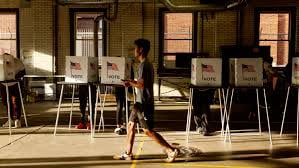
People vote during the 2024 presidential election in Detroit. Mr. Trump and his allies have claimed for the past decade that elections are riddled with illegal votes cast by undocumented immigrants.
It was a common refrain for Donald J. Trump and his allies during the 2024 campaign: The Biden administration was purposely encouraging mass numbers of immigrants to cross the border in order to vote illegally.
As president, Mr. Trump has pushed his administration to address the alleged crimes, including prompting many states to upload tens of millions of voter records through a federal immigration verification tool run out of the Department of Homeland Security.
But with the review underway, the results so far indicate there is no evidence of widespread fraud, according to interviews with government officials and documents reviewed by The New York Times.
Out of 49.5 million voter registrations that have been checked, the department referred around 10,000 cases to Homeland Security Investigations for further investigation of noncitizenship, or roughly .02 percent of the names processed, according to Matthew Tragesser, a spokesman for U.S. Citizenship and Immigration Services, the D.H.S. agency that oversees the program. A Justice Department spokeswoman also said the administration believed around 10,000 registered noncitizen voters had been found.
They did not specify how many of those people had voted.
Even that number could be inflated. The verification tool has mistakenly flagged some people who appear to actually be citizens, according to some local election officials.
In Charlotte County, Fla., for instance, the elections supervisor Leah Valenti, an appointee of Ron DeSantis, the Republican governor, said she found that just 15 out of 176,000 names she uploaded to D.H.S. came back as noncitizens. Of those, she found that three were people mistakenly added to the rolls who never intended to register to vote; they have since been removed. Two others already sent in documentation to prove their naturalized citizenship, she said.
“We didn’t get a mass onslaught of people,” said Ms. Valenti, who is a proponent of using the D.H.S. system to verify voters’ eligibility. “We have clean voter rolls.”
Mr. Tragesser said the program was “doing exactly what it is supposed to do — providing states with an easy-to-use tool to stop aliens from hijacking our elections.”
While the findings affirm that noncitizens do sometimes wind up on the voter rolls, the small numbers so far puncture the claims that Mr. Trump and his allies have made for the past decade that elections are riddled with illegal votes cast by undocumented immigrants. Studies consistently show little if any evidence for such crimes on a large scale.
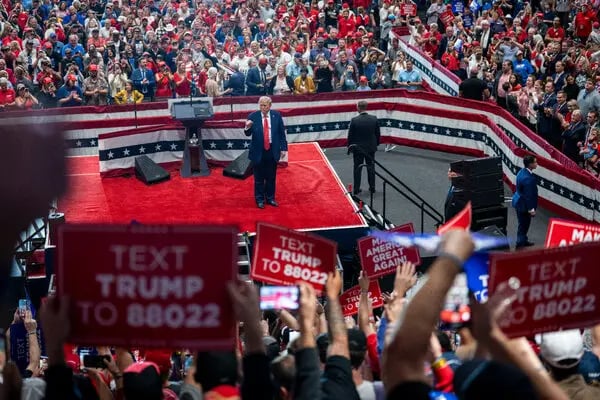
President Trump frequently claimed during the 2024 campaign that large numbers of noncitizens would be voting for president.
(To read the complete article, click on the link in blue above, New York Times.)
Enjoy this truth-telling while you can.
Don’t expect the Times to keep this up. Soon they will be back, perpetuating Trump’s lies again.
Can we take back the Senate in 2026?
Schumer thinks these 4 states will deliver for Dems in November.
Senate Minority Leader Chuck Schumer, along with a Democratic Senatorial Campaign Committee memo shared with POLITICO, laid out their strategy for Democrats’ path back to the majority.
Senate Minority Leader Chuck Schumer believes Democrats have a “real good chance” of flipping the Senate in November — bullish optimism for a party swept out of power in 2024 and still facing several contested primary battles.
In an interview, the New York Democrat called North Carolina, Maine, Ohio, and Alaska “the four states we have to pick up to win back the Senate.” Two other offensive targets, Iowa and Texas, didn’t make Schumer’s core list, but they’re “very possible” pickups, he said. To retake the Senate, Democrats must also defend states they currently hold, including Sen. Jon Ossoff (D-Ga.), and open races to replace retiring senators in Michigan and New Hampshire.
“We have a clear and strong path to winning back the Senate,” Schumer said at the DSCC headquarters in Washington, D.C. “A year ago, no one thought that.”
Schumer, along with a Democratic Senatorial Campaign Committee memo shared with POLITICO, laid out their strategy for Democrats’ path back to the majority — candidate recruiting victories in key races, falling job approval ratings for President Donald Trump and messaging focused on affordability. Former Rep. Mary Peltola jumped into the Alaska Senate race on Monday, the latest recruiting victory for Schumer. But their confidence, boosted by a string of off-year victories, largely ignores their own contentious and expensive primary season ahead, particularly in Maine, Michigan, and Iowa.
“We’ve always had primaries, and some of them always look difficult,” Schumer said. “You work your way through. … Our north star is winning the Senate. That’s what motivates what we do in each thing.”
Beyond Democrats’ intraparty fights, a straight sweep of those four states is a steep hill for Democrats, laden with obstacles. Trump won Ohio and Alaska by double-digits in 2024. Democrats haven’t won a Senate race in North Carolina since 2008. Sen. Susan Collins (R-Me.) beat her last Democratic opponent by nearly 9 percentage points in 2020, even as then-President Joe Biden won the state.
Nonetheless, Schumer compared the 2026 midterms to 2006, when Democrats flipped the House and Senate by running against the Iraq War. “An overseas adventure was bothering the American people” in 2006 and 2026, Schumer said, “Why is [George W. Bush] so focused on Iraq? Why is Trump so focused on Venezuela?”
In contrast, Schumer said, Democrats will be relentlessly focused on cost-of-living concerns.
“All of our candidates, primary or not, have latched onto the cost issue as the most important issue facing America,” he said. “The fact that Trump hasn’t paid attention to that really bothers [voters]. It’s not just what he’s talking about, it’s that he’s busy focusing … on Venezuela, and on Greenland, and now Iran.”
Trump’s allies acknowledged that the operations in Venezuela could complicate the White House’s midterm messaging. And Trump himself told POLITICO that “prices” will be central to the 2026 midterms.
In a statement, the National Republican Senatorial Committee pushed back on Schumer.
“Democrats’ battleground map is littered with failed career politicians no longer aligned with the values of their states and messy, nasty primaries that will leave Schumer with a majority of candidates that have all pledged to vote him out,” Joanna Rodriguez, NRSC spokeswoman, said. “After four years of Democrat failure, Republican Senators are fulfilling their promise of safer communities, more money in voters’ pockets, and more opportunities for working families.”
Schumer and the DSCC have faced pushback from Democrats, both inside Washington and beyond, for their handling of various crowded primaries this cycle. Some accuse the DSCC of not intervening heavily enough, like in Texas, when Rep. Colin Allred abruptly dropped out and Rep. Jasmine Crockett, an anti-Trump firebrand, jumped in. Others vented against Washington putting its thumb on the scale.
In Maine, Schumer heavily recruited Gov. Janet Mills to run, but he failed to keep out Graham Platner, a progressive oyster fisherman who gained national attention for both his viral videos and various scandals. Even so, Platner raised more than $5 million for his bid, and he’s picked up fans in the Senate.
A group of senators, calling themselves the “Fight Club,” have also started weighing in on the open primaries in Maine, Minnesota, and Michigan, often backing candidates not seen as Washington’s preferred choice. When asked about this resistance, Schumer insisted, “we’ve always had primaries, and we have to be guided by how to win the election.”
Schumer said “there’s no one formula” for the kind of Democrat who can win statewide. “We don’t have a preference, old versus young, more progressive versus a little less progressive,” Schumer said. “It’s who can do best in their state. There’s a lot of factors that go into that.”
In Texas, which will hold its primary on March 3, Schumer said Democrats have a “better chance than people think,” but it’s a contingent on the Republican primary, he said. Sen. John Cornyn (R-Texas) is facing stiff challenges from Attorney General Ken Paxton and Rep. Wesley Hunt (R-Texas), which could force a one-on-one runoff in May.
“The people who turn out in the runoff are the Paxton types, so he could win the primary, and then we have a real good chance,” he said.(Politico)
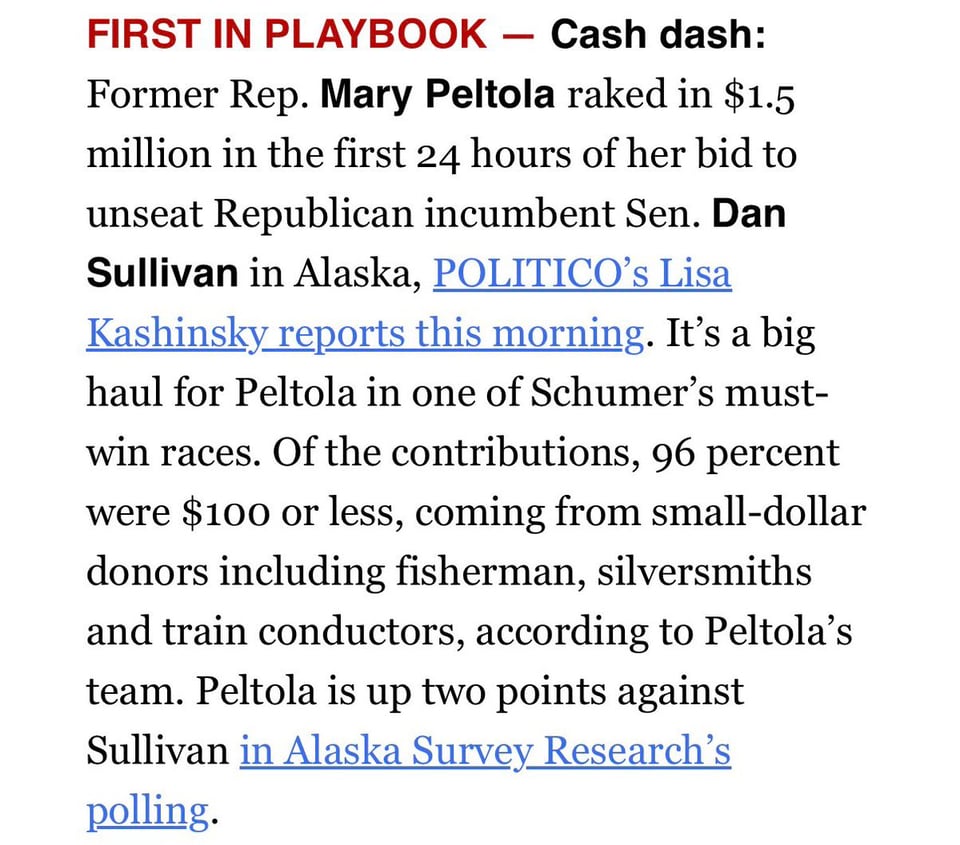
Democrat Mary Peltola’s first financial haul suggests she can muster the support to go all the way to the Senate
The Numbers in the House narrow further.
# [Republican Rep. LaMalfa dies, further narrowing GOP’s House majority .][https://www.washingtonpost.com/politics/2026/01/06/lamalfa-death-house-republicans/)
The death of the seven-term congressman, coupled with Rep. Marjorie Taylor Greene vacating her seat Tuesday, means Republicans are likely to face trouble advancing partisan legislation.
With LaMalfa’s absence, after Rep. Marjorie Taylor Greene (R-Georgia) officially vacates her seat Tuesday, the GOP majority will shrink to 218. That means Republicans can lose only two votes to pass partisan bills if all Democrats are present and voting. Democrats hold 213 seats.(To read the complete article, click on the link in blue above, The Washington Post).
One more thing.
We likely can stop Trump in the House in the runup to the midterms, but then we can surely take back the House. Democrats need to add just five to win control.
Pennsylvania may well give us 4 seats and then this is happening too.👇
Virginia
🚨BREAKING🚨
— The Political HQ (@ThePoliticalHQ) January 14, 2026
Virginia’s Democratic-led House of Delegates has voted 62-33 to advance a constitutional amendment that allows the legislature to redraw congressional districts.
California
#BreakingNews: A federal three-judge panel on Wednesday allowed California to use a new voter-approved U.S. House map that is designed to boost Democrats in the 2026 midterms.
— ABC7 Eyewitness News (@ABC7) January 14, 2026
Read more at https://t.co/jCU1L4KE1o pic.twitter.com/ld4AFDvRJD
More to come
Remember that vote in the Senate last Thursday when a few Republicans showed some backbone and voted to stop further Trump actions against Venezuela without Congressional approval?
Well, they undid it yesterday. Really.
Senate GOP succeeds in last-minute move to block Venezuela vote.
Senate Republicans successfully thwarted a final vote Wednesday on a war powers resolution seeking to restrict future military action in Venezuela.
Why it matters: It's a big win for President Trump and Senate GOP leaders, who mounted a last-minute pressure campaign to avoid another rebuke of the administration's actions in Venezuela.
The procedural vote passed 51-50, with Republican Sens. Rand Paul (Ky.), Lisa Murkowski (Alaska) and Susan Collins (Maine) voting against it with Democrats.
Vice President Vance cast the tie-breaking vote.
Zoom in: It came down to Sens. Josh Hawley (R-Mo.) and Todd Young (R-Ind.) who ultimately decided to support the procedural move to block the vote— despite voting in favor of the resolution last week.
Young was promised that Secretary of State Marco Rubio would appear before the Foreign Relations Committee in a public hearing after next week's recess and assured that the administration will come to Congress first if U.S. military forces are needed in Venezuela, he said.
He cited his talks with Rubio as influential in his decision. "To have the secretary of state be at my disposal — really, I mean, countless phone conversations and text exchanges — was very reassuring to me," he told reporters.
Republicans have argued the fast-track voting process — which would have likely triggered a final vote Wednesday — does not apply because there are no U.S. troops on the ground in Venezuela.
Catch up quick: Rubio emphasized that there are no troops on the ground in a letter sent to Foreign Relations Chair James Risch (R-Idaho) on Wednesday morning, Punchbowl News first reported.
It echoed arguments made by Majority Leader John Thune (R-S.D.) and GOP Whip John Barrasso (R-Wyo.), and appeared successful in swaying Hawley and Young who had also been hearing from Trump, Senate leadership and top administration officials on the issue.
Democrats used a similar tactic in 2024 to avoid a vote on Sen. Ted Cruz's (R-Tex.) war powers resolution focused on the U.S.'s humanitarian pier in Gaza.
!John Thune leads the GOP in the Senate
(Axios)
If this is any consolation, as the AP wrote, the legislation, even if it had cleared the Senate, had virtually no chance of becoming law because it would eventually need to be signed by Trump himself. But it represented both a test of GOP loyalty to the president and a marker for how much leeway the Republican-controlled Senate is willing to give Trump to use the military abroad. Republican angst over his recent foreign policy moves — especially threats of using military force to seize Greenland from a NATO ally — is still running high in Congress.” Stay tuned.
What does it mean to be a Republican?
It turns out Republicans always see the world divided into their team and ours. Here is an example.
New: House Democrats DEFEAT a Republican bill to let employers deny overtime pay or minimum wage to workers if they classify time worked as "job training" or "education."
— Rep. Don Beyer (@RepDonBeyer) January 13, 2026
6 Republicans joined us and the vote failed; GOP leaders then cancelled votes on two more anti-labor bills. pic.twitter.com/oqfNPXKq6X
In this case, they conceive of a policy that they imagine is pro-business, when, in fact, it is anti-worker. Being anti-half your organization is not being pro anything.
Good policies should serve all stakeholders - management, workers, the organization as a whole, the community as a whole.
Would providing a business with money for worker education and support meet those criteria? Possibly.
Here’s how.
The workers benefit from increased knowledge that is portable, no matter where they go. The company benefits, maybe immediately from workers with a new or increased knowledge base and commitment to a company that shows it cares about them. More hires may happen, to provide the education. The community benefits by having more money circulating as well as having happier people.
But that is not how Republicans think. They prefer to divide us.
Republicans embrace a Marxist view of the world. For them, good policy means helping the ruling class (the bourgeoisie), who own the means of production, exploit the working class. For them, the important fight is the Ruling Class - the owners and managers of capitalism - v. Workers.
Our candidates should point this out as well as craft policies which serve us all.
Don’t seek “bi-Partisan” support. Seek support for policies for all.
UniteNotDivide.#UniteNotDivideDemocrats
A Great Man was born today.
THe Holiday is Monday but today is his real Birthday.