Thursday, December 18, 2025. Annette’s Roundup for Democracy.
Two Views of Trump. Neither is admirable.
Part 2. The Vanity Fair Interview with Trump Chief of Staff, Susie Wiles.
Susie Wiles Talks Epstein Files, Pete Hegseth’s War Tactics, Retribution, and More (Part 2 of 2)
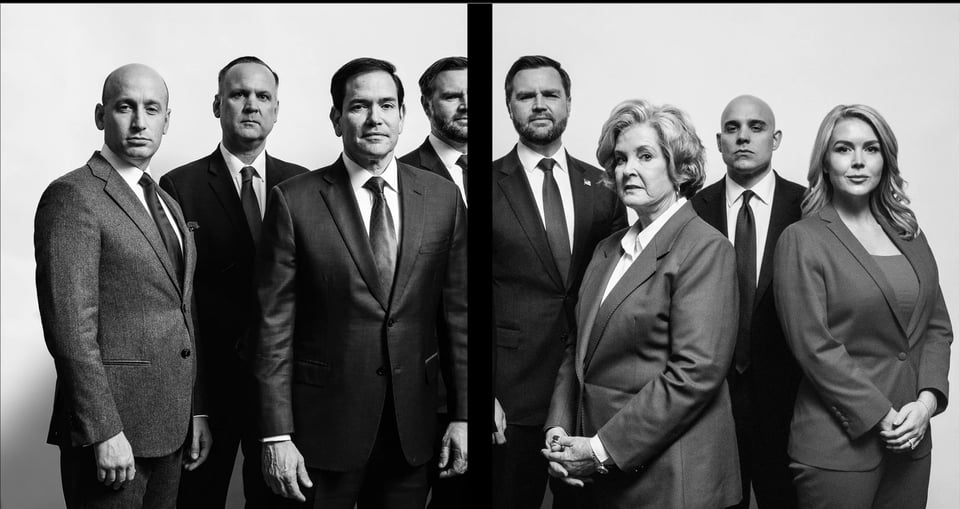
Trump’s chief reveals her thoughts on the first year, and on the team she’s built with JD Vance, Karoline Leavitt, Marco Rubio, and 3 more key players. Vanity Fair writer Chris Whipple reports.
DAY 289
November 4, 2025
The day I met Wiles at the White House was a watershed for Trump: Voters would choose governors in New Jersey and Virginia and a new mayor in New York City; they would also vote on Proposition 50, California governor Gavin Newsom’s proposal to counter a brazen Republican gerrymander in Texas. Collectively, the contests were a referendum on Trump’s second presidency.
Over lunch in her West Wing corner office, Wiles recounted the morning. Escorting Trump from the White House residence to the Oval Office, she gave the president her election predictions: “I’m on the hook because he thinks I’m a clairvoyant.” Wiles thought the GOP had a chance of electing the governor in New Jersey, but she knew they were in for a tough night. (It would prove to be a Republican disaster, with Democrats running the table on the marquee races, passing Proposition 50, and winning downballot elections in Pennsylvania, Georgia, and Mississippi.)
Given voters’ anxiety about the cost of living, Wiles told me she thought Trump should pivot more often from world affairs to kitchen-table issues. “More talks about the domestic economy and less about Saudi Arabia is probably called for,” said Wiles. “They like peace in the world. But that’s not why he was elected.”
Not far from where we sat was a gaping hole where the East Wing had been until just days before. I asked her about the fierce criticism that followed its demolition to make way for Trump’s 90,000-square-foot ballroom. “Were you surprised by it?”
“No,” Wiles replied. “Oh, no. And I think you’ll have to judge it by its totality because you only know a little bit of what he’s planning.”
Was she saying that Trump was planning more, as yet undisclosed renovations?
“I’m not telling.”
T-MINUS 232 DAYS
June 2, 2024
“Would you declassify the Epstein files?” —Fox News’s Rachel Campos-Duffy
“Yeah....I think I would.” —Trump
For many of Trump’s followers, it’s an article of faith that the US government has long been run by an elite cabal of pedophiles. Less conspiratorially but no less seriously, others question whether politicians and powerful people either participated in or knew about Jeffrey Epstein’s sex trafficking of young women, from his posh Manhattan town house to his private Caribbean islands. Perhaps most critical to Trump followers, though, is the fact that Trump indicated a willingness to release the files—and didn’t. As this article went to press, grand jury material from the Epstein records was due to be released in December.
Wiles told me she underestimated the potency of the scandal: “Whether he was an American CIA asset, a Mossad asset, whether all these rich, important men went to that nasty island and did unforgivable things to young girls,” she said, “I mean, I kind of knew it, but it’s never anything I paid a bit of attention to.”
In February, Bondi gave binders labeled “The Epstein Files: Phase 1” to a group of conservative social media influencers who were visiting the White House, including Liz Wheeler, Jessica Reed Kraus, Rogan O’Handley, and Chaya Raichik. The binders turned out to contain nothing but old information. “I think she completely whiffed on appreciating that that was the very targeted group that cared about this,” Wiles said of Bondi. “First she gave them binders full of nothingness. And then she said that the witness list, or the client list, was on her desk. There is no client list, and it sure as hell wasn’t on her desk.”
As Noah Shachtman reported in Vanity Fair, “dozens and dozens” of FBI agents at the New York field office were tasked with combing through the Epstein files. Many observers assumed they were looking for (and possibly redacting) Trump’s name. “I don’t know how many agents looked through things, but it was a lot,” said Wiles. “They were looking for 25 things, not one thing.”
Wiles told me she’d read what she calls “the Epstein file.” And, she said, “[Trump] is in the file. And we know he’s in the file. And he’s not in the file doing anything awful.” Wiles said that Trump “was on [Epstein’s] plane…he’s on the manifest. They were, you know, sort of young, single, whatever—I know it’s a passé word but sort of young, single playboys together.” (Trump started dating Melania Knauss, whom he married in 2005, sometime in 1998. Virginia Giuffre, Epstein’s most prominent accuser, who died by suicide earlier this year, first met Epstein while she was a Mar-a-Lago spa worker in 2000. Trump and Epstein reportedly had a falling out in 2004.)
Trump has claimed, without evidence, that Bill Clinton visited Epstein’s infamous private island, Little St. James, “supposedly 28 times.” “There is no evidence” those visits happened, according to Wiles; as for whether there was anything incriminating about Clinton in the files, “The president was wrong about that.”
The people that really appreciated what a big deal this is are Kash [Patel] and [FBI deputy director] Dan Bongino,” she said. “Because they lived in that world. And the vice president, who’s been a conspiracy theorist for a decade…. For years, Kash has been saying, ‘Got to release the files, got to release the files.’ And he’s been saying that with a view of what he thought was in these files that turns out not to be right.”
In July, Todd Blanche, the deputy attorney general and Trump’s former lawyer, traveled to a Tallahassee, Florida, courthouse to interview Epstein’s longtime associate, Ghislaine Maxwell. Convicted on sex trafficking charges in 2021, she received a 20-year prison sentence. “It’s not typical, is it,” I asked Wiles, “to send the number two guy in the DOJ and the president’s former defense lawyer to interview a convicted sex trafficker?” According to Wiles, “It was [Blanche’s] suggestion.”
Wiles said that neither she nor Trump had been consulted about Maxwell’s transfer to a less restrictive facility after Blanche’s visit. “The president was ticked,” according to Wiles. “The president was mighty unhappy. I don’t know why they moved her. Neither does the president.” But, she said, “if that’s an important point, I can find out.” (At press time, Wiles said she still had not found out.)
What about the birthday greeting featuring a sketch of a nude woman, which, according to The Wall Street Journal, bore Trump’s name and was sent to Epstein for his 50th birthday? “That letter is not his,” Wiles said. “And nothing about it rings true to me, nor does it to people that have known the president a lot longer than I have. I can’t explain The Wall Street Journal, but we’re going to get some discovery because we sued them. So we’re going to find out.” Trump’s lawyers filed a $20 billion defamation lawsuit against Dow Jones & Company, publisher of The Wall Street Journal, which the defendants have asked a federal judge in Florida to dismiss.
So will the president sit for a deposition in that process?
“I mean, if he had to,” she said.
The Epstein files debacle poses a dire political threat to Trump and the future of the GOP. “The people that are inordinately interested in Epstein are the new members of the Trump coalition, the people that I think about all the time—because I want to make sure that they are not Trump voters, they’re Republican voters,” Wiles said. “It’s the Joe Rogan listeners. It’s the people that are sort of new to our world. It’s not the MAGA base.”
A senior White House official described the mindset of an overlapping bloc of voters who are angered by both Trump’s handling of the Epstein files and the war in Gaza. It’s as much as 5 percent of the vote and includes “union members, the podcast crowd, the young people, the young Black males. They are interested in Epstein. And they are the people that are disturbed that we are as cozy with Israel as we are.”
Vance keeps his eye on the voters. “It’s Epstein, Gaza, and the coziness with Israel,” said this White House source. “If you dive deeply into the internet, you’ll find things that say, ‘Well, why don’t we just put Bibi at the Resolute Desk?’ ” the source said, referring to Israeli prime minister Benjamin Netanyahu.
Across our year of conversations, Wiles wanted to put an end to what she believes is a persistent myth, that Trump is a warmonger. To the contrary, Wiles says, the president genuinely cares about ending wars and saving human lives. “I cannot overstate how much his ongoing motivation is to stop the killing, which is not, I don’t think, where he was in his last term,” she said. “Not that he wanted to kill people necessarily, but stopping the killing wasn’t his first thought. It’s his first and last thought now.” Whether that thought is genuine or driven by his desire for a Nobel Peace Prize is, of course, open to debate.
DAY 213
August 20, 2025
“Israel says it has taken first steps of military operation in Gaza City.” —Reuters
In early October, Trump announced that his envoys had brokered a deal with mediators from Qatar, Egypt, and Turkey to end two years of bloodshed in Gaza. The 20-point plan, calling for the disarmament of Hamas and the administering of Gaza by a multinational force, was far from a sure thing. But the ceasefire and the release of almost all the hostages (the remains of one are still missing) was a considerable achievement. During his triumphant appearance at Israel’s Knesset, Trump struck a bellicose tone, praising Netanyahu and the Israeli armed forces with no mention of the Palestinian civilian casualties. Trump had previously lauded Bibi’s efforts in another action by calling him a “war hero”—a remark partially aimed at Israelis. Talking about it then, Wiles winced. “I’m not sure he fully realizes,” she said, “that there’s an audience here that doesn’t love it.”
When I asked her last fall what she thought Trump’s greatest achievement had been in 2025, Wiles was upbeat: “I think the country is beginning to see that he’s proud to be an agent of peace. I think that surprises people. Doesn’t surprise me, but it doesn’t fit with the Donald Trump people think they know. I think this legislation [the so-called One Big Beautiful Bill], which funded the entire domestic agenda, is a huge accomplishment. And even though it isn’t popular in total, the component parts of it are. And that will be a very big deal in the midterms.”
DAY 287
November 2, 2025
“Three killed in latest US strike on alleged drug boat in Caribbean.” —BBC News
During my first visit with Wiles at the White House in November, Trump’s revenge tour against his domestic enemies was in full swing. So was his lethal campaign against Venezuelan president Nicolás Maduro, who, Trump was convinced, headed a powerful drug cartel. Over lunch, Wiles told me about Trump’s Venezuela strategy: “He wants to keep on blowing boats up until Maduro cries uncle. And people way smarter than me on that say that he will.” (Wiles’s statement appears to contradict the administration’s official stance that blowing up boats is about drug interdiction, not regime change.)
I’d already pressed Wiles on Trump’s practice of blowing boats out of the water. The casualties almost certainly include unsuspecting fishermen. In 2016, Trump had famously mused that he could shoot someone on Fifth Avenue and not lose any supporters. Now he seemed to be testing that idea on the global stage. When a critic on X denounced these killings as “war crimes,” Vance posted: “I don’t give a shit what you call it.” Pressed at an October press conference on why he didn’t just ask Congress for a declaration of war, Trump swatted the question away: “I think we’re just going to kill people that are bringing drugs into
our country. Okay?” I asked Wiles: “What do you say to people who ask, doesn’t anybody in this administration have a heart?”
Wiles didn’t mince words: “The president believes in harsh penalties for drug dealers, as he’s said many, many times…. These are not fishing boats, as some would like to allege.” The boats, she argued, carried drugs; eliminating them saves lives. “The president says 25,000. I don’t know what the number is. But he views those as lives saved, not people killed.”
As of this article’s publication, at least 87 people had been killed in US strikes on boats in the Caribbean and eastern Pacific. The Washington Post reported that Hegseth had directed the US military to “kill everybody” in a strike on a boat; this was followed by a second strike that killed two survivors—a possible war crime. Hegseth said an admiral was responsible for the second strike. Congressional Democrats and even some Republicans were talking about calling hearings to investigate the matter.
“Drug smuggling,” I pointed out to Wiles, “is not a death penalty offense, even if the president wishes it were.”

Wiles’s office bookshelf featuring a replica FIFA trophy and some unsubtle Wicked Witch imagery.
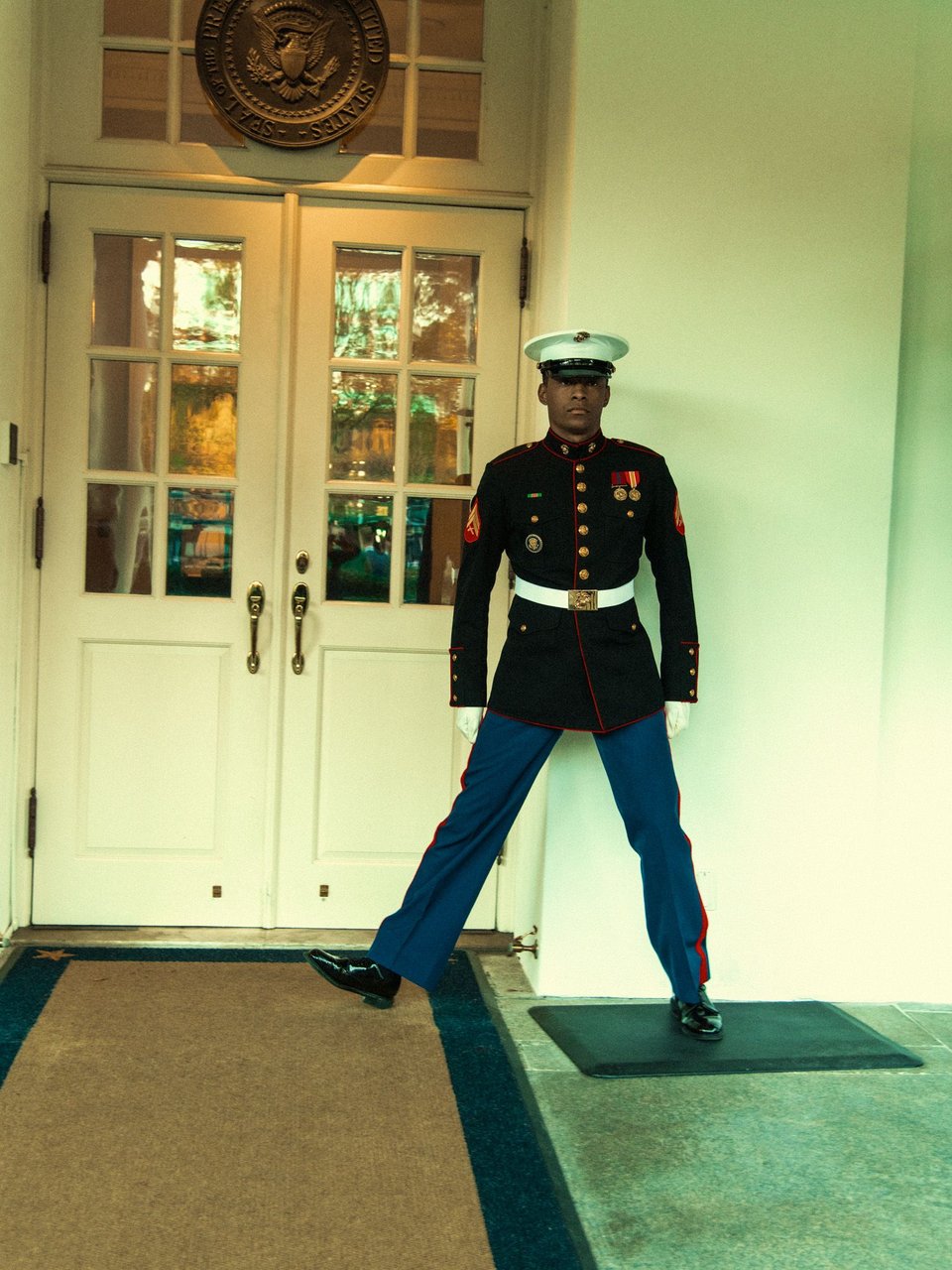
A Marine stands sentry.

The flag from JD Vance’s inauguration ceremony.
“No, it’s not. I’m not saying that it is. I’m saying that this is a war on drugs. [It’s] unlike another one that we’ve seen. But that’s what this is.”
“Obviously it’s a war declared only by the president and without any congressional approval,” I said.
“Don’t need it yet,” Wiles replied.
“We’re very sure we know who we’re blowing up,” she’d told me during lunch in November. “One of the great untold stories of the US government is the talents of the CIA. And there may be an interest in going inside territorial waters, which we have permission [to do] because they’re skirting the coastline to avoid getting [caught].” But Wiles conceded that attacking targets on Venezuela’s mainland would force Trump to get congressional approval. “If he were to authorize some activity on land, then it’s war, then [we’d need] Congress. But Marco and JD, to some extent, are up on the Hill every day, briefing.”
In October I asked Rubio what legal authority the administration had to conduct its lethal strikes. “Obviously, that’s a DOD [Department of Defense] operation,” he replied. “So I’m not in any way disavowing it. I agree with it 100 percent. I think we’re on very strong, firm footing, but I don’t want to be giving legal answers on behalf of the White House or the Department of War.” The secretary of state was unequivocal about the targets of the US strikes. “These are not alleged drug dealers,” he said. “These are drug dealers. Where are the YouTube videos of the family saying my poor innocent fisherman son, you know, was killed?”
DAY 40
February 28, 2025
“Trump, Vance and Zelenskyy get into heated exchange during Oval Office meeting.” —Face the Nation
I asked Wiles what she makes of the president’s affinity for Russian president Vladimir Putin, who seems to have cast a spell over Trump since he first ran for president. In 2018 the leaders met in Finland, where Trump appeared to side with Putin when asked whether he believed him about Moscow’s noninterference in the 2016 election. “Watching it at a distance in Helsinki,” she recalled, “I thought there was a real sort of friendship there, or at least an admiration. But on the phone calls that we’ve had with Putin, it’s been very mixed. Some of them have been friendly and some of them not.”
Vance, Rubio, and Steve Witkoff, Trump’s all-purpose special envoy, and Trump’s son-in-law, Jared Kushner, an informal adviser, have been running Trump’s foreign policy since the departure of National Security Advisor Mike Waltz, who was moved to UN ambassador after Signalgate. “I’m not horrified by it,” Wiles said of the infamous unsecured chat about US attack plans against the Houthis to which The Atlantic editor Jeffrey Goldberg was mistakenly admitted. She noted, with an edge, “The burden’s on us to make sure that [national security] conversations are preserved. In this case, Jeff Goldberg did it for us.”
Wiles said she saw trouble brewing before Trump’s infamous Oval Office scrum with Volodymyr Zelenskyy last February, when the president and Vance berated Ukraine’s leader on worldwide television. “If we had it to do over,” Wiles said, “I wouldn’t have cameras, because it was going to end that way.”
Wiles claims the ugly spectacle was the culmination of churlish behind-the-scenes behavior by Zelenskyy and his entourage. It began with Zelenskyy failing to show up for a meeting with Treasury Secretary Scott Bessent when he visited Kyiv to make a deal on mineral rights—and escalated. “It just was a bad sort of sentiment all the way around. And I wouldn’t say JD snapped, because he’s too controlled for that. But I think he’d just had enough.”
The Trump-Putin relationship has zigged and zagged. In the walk-up to the August summit with Putin in Alaska, Trump had publicly sought a ceasefire in Ukraine. It seemed he was finally getting tough with Putin. But in fact, Trump gave up on a ceasefire before the Anchorage meeting began.

Trump’s team was divided on whether Putin’s goal was anything less than a complete Russian takeover of Ukraine. “The experts think that if he could get the rest of Donetsk, then he would be happy,” Wiles told me in August. But privately, Trump wasn’t buying it—he didn’t believe Putin wanted peace. “Donald Trump thinks he wants the whole country,” Wiles told me.
In October I asked Rubio if that was true. “There are offers on the table right now to basically stop this war at its current lines of contact, okay?” he said. “Which include substantial parts of Ukrainian territory, including Crimea, which they’ve controlled since 2014. And the Russians continue to turn it down. And so…you do start to wonder, well, maybe what this guy wants is the entire country.” (In Wiles’s office is a photograph of Trump and Putin standing together, signed by Trump: “TO SUSIE YOU ARE THE GREATEST! DONALD.”)
I asked Wiles about the remarkable 180-degree conversion of the secretary of state and the vice president from fierce Trump critics to high-ranking acolytes—and heirs apparent. Trump has floated a Vance-Rubio GOP presidential ticket in 2028. Rubio’s transformation was ideological and principled, she said: “Marco was not the sort of person that would violate his principles. He just won’t. And so he had to get there.” By contrast, she suggested, Vance had other motivations. “His conversion came when he was running for the Senate. And I think his conversion was a little bit more, sort of political.” During another visit to the White House on November 13, when I asked Vance about his conversion to Trump loyalist, he said: “I realized that I actually liked him, I thought he was doing a lot of good things.
And I thought that he was fundamentally the right person to save the country.”
Will Rubio challenge Vance for the top spot on the 2028 GOP presidential ticket? His answer: “If JD Vance runs for president, he’s going to be our nominee, and I’ll be one of the first people to support him.”
Wiles is known for having an open-door policy. Trump sometimes comes in unannounced (“he apparently never did in the first administration”). During lunch, no one interrupted us, and Wiles checked her phone only once. She was enjoying a rare moment of downtime. “They don’t know what I’m doing,” she said, motioning toward the Oval, and laughed out loud. After an hour, as I got up to go, I told her about how President Barack Obama’s chief Rahm Emanuel used to complain to visitors about how thankless his job was: “This is nice,” he said, pointing to the wood-burning fireplace, “and this is nice,” gesturing toward the outdoor patio. “And everything in between sucks.” Wiles replied: “I don’t feel that way at all.”
To the left of the fireplace was a freestanding video monitor: a live feed of Trump’s Truth Social posts.
The average tenure for a modern White House chief of staff is a year and a half. George W. Bush’s Andrew Card holds the record at five years and three months. Wiles may yet eclipse Trump’s so-far longest-lasting chief, John Kelly, at 17 months. If she chose to quit, Wiles could make a fortune running the campaign of any number of would-be GOP nominees; though Wiles says she earned around $350,000 for her role managing Trump’s 2024 campaign, she was reported to have made millions more through her consulting firm (Wiles had not replied when asked about this by the time this article went to print). When reports emerged that Biden aide Mike Donilon stood to make $8 million if his boss had stayed in the race and won, Wiles said her co–campaign chair Chris LaCivita sent her a note that said, “Boy, am I stupid. Why was [I] so cheap?
Wiles says she’d originally planned to serve as chief for six months. “I have not had a day I would describe as overwhelming, though there’s plenty of frustration here. But you go to bed at night, you say your prayers, and you get up and do it again.” I asked her about her health and the president’s. “Mine is good,” she said. “His is great. My kids are grown. I’m divorced. This is what I do if I stay four years.”
In December, when asked about Trump falling asleep in Cabinet meetings, Wiles said, “He’s not asleep. He’s got his eyes closed and his head leaned back…and, you know, he’s fine.”
What about Trump’s increasingly frequent verbal attacks on women, as when, in November, he snapped “Quiet, Piggy!” at a female reporter from Bloomberg? Wiles replied: “He’s a counterpuncher. And increasingly, in our society, the punchers are women.”
Is Wiles really irreplaceable, as Rubio said? “Not patting myself on the back, but just recognizing the reality of this president at this time,” she said, “I’m just not [sure] who else could do this.”
In August I’d asked her if she felt she would outlast her Trump predecessors. “As long as I still feel honored to do it, and I feel like things are going well, we’re moving the country forward positively,” she’d said. “It’s two steps forward, one step back. I get that. But it’s two steps nobody else could make.”
“Will the president run for a third term?” I asked in November.
“No,” she said and then added, “But he sure is having fun with it.” Wiles said he knows it’s “driving people crazy.”
“So that’s why he talks about it,” I said.
“Yeah, 100 percent.”
“Would you say categorically no, and that the 22nd Amendment rules out [a third term]?”
“I do. Yeah. And I’m not a lawyer, but based on my reading of it, it’s pretty unequivocal.”
“And has he told you that in so many words?”
“Yes. Oh, a couple times, yeah.”
And then she went on. “Sometimes he laments, ‘You know, gosh, I feel like we’re doing really well. I wish I could run again.’ And then he immediately says, ‘Not really. I will have served two terms and I will have gotten done what I need to get done, and it’s time to give somebody else a chance.’ So, you know, any given day, right? But he knows he can’t run again.”
Months earlier she’d mused on the future of the party and the need for it to turn Trump voters into Republican voters. “Donald Trump will be an ex-president,” she said, looking ahead. And “I’ll be gone to do whatever I do next, which hopefully will be nothing.”
The 2026 midterm elections may determine the fate of Trump’s presidency. Vance told me that he hopes to minimize GOP losses in 2026. “I think a good midterm election for an incumbent presidency would be to lose a dozen seats in Congress and two or three seats in the Senate,” he said. “I think it will be better than that.” I asked Wiles for her prediction. “We’re going to win the midterms,” she said crisply.
DAY 15
February 3, 2025
A couple weeks into his presidency, Trump found himself taking stock. “How is it that you’re doing this so well?” he asked Wiles. “Sir,” Wiles replied, “remember that I am the chief of staff, not the chief of you.” She was paraphrasing one of James Baker’s favorite maxims.
But executing the president’s agenda requires telling him the truth. This is especially important when the president is surrounded by acolytes reading almost entirely from the same playbook. An effective chief steers the president clear of land mines. An ineffective one, by ducking tough conversations, lets him blunder into harm’s way. Four years into Reagan’s presidency, Baker, who understood the job, was replaced as White House chief by Treasury Secretary Donald Regan, who didn’t. Soon after, an ill-fated scheme to trade arms to Iran for hostages was born. Richard Nixon overreacted to the leak of the Pentagon Papers by authorizing a special investigative unit in the White House nicknamed the “plumbers”; the result was the Watergate scandal.
Bill Daley, Obama’s former chief of staff, believes Trump and his team could fall victim to overreach. “There’s no doubt the Charlie Kirk assassination gives them an opportunity to put the left on its heels,” he told me. “They believe they are in an incredibly strong position to do whatever the hell they want,” said Daley. “And usually that’s when [people] make mistakes. They go too far.”
DAY 309
November 24, 2025
“US judge throws out criminal cases against James Comey and Letitia James.” —The Guardian
In late September, in a message to “Pam,” his attorney general, Trump wrote (apparently inadvertently) on Truth Social that he’d been seeing posts online saying “same old story as last time, all talk, no action. Nothing is being done. What about Comey, Adam ‘Shifty’ Schiff, Leticia [sic]??? They’re all guilty as hell, but nothing is going to be done.” He told her, “We can’t delay any longer, it’s killing our reputation and credibility.”
Five days later, a federal grand jury indicted James Comey, the ex-FBI director, for making a false statement and obstructing a congressional investigation. Then, on October 9, 2025, a Virginia grand jury indicted Letitia James, the New York attorney general, on one count of bank fraud and one count of making false statements to a financial institution.
Back in March, on the 56th day of Trump’s presidency, I’d asked Wiles: “Do you ever go in to Trump and say, ‘Look, this is not supposed to be a retribution tour? ’”
“Yes, I do,” she’d replied. “We have a loose agreement that the score settling will end before the first 90 days are over.”
In late August, I asked Wiles: “Remember when you said to me months ago that Trump promised to end the revenge and retribution tour after 90 days?”
“I don’t think he’s on a retribution tour,” she said. “A governing principle for him is, ‘I don’t want what happened to me to happen to somebody else.’ And so people that have done bad things need to get out of the government. In some cases, it may look like retribution. And there may be an element of that from time to time. Who would blame him? Not me.”
“So all of this talk,” I said, “about accusing Letitia James of mortgage fraud….”
“Well, that might be the one retribution,” Wiles replied.
“So you haven’t called him [out] on that, or said, ‘Hey, wait a minute.’ ”
“No, no, not on her,” Wiles said. “Not on her. She had a half a billion dollars of his money!” Wiles laughed. (The massive civil fraud penalty won by the New York attorney general’s office in a case against Trump had just been thrown out by an appeals court.)
“ Do you really think that Merrick Garland went after the president, persecuted him?” I’d asked her in March, referring to Biden’s buttoned-down, by-the-book attorney general.
“I do,” she replied, “and I think history will prove it to be so.”
In November, it was Comey’s turn in the dock. “So tell me why the Comey prosecution doesn’t just look like the fix is in,” I asked her.
“I mean, people could think it does look vindictive. I can’t tell you why you shouldn’t think that.” Wiles said of Trump: “I don’t think he wakes up thinking about retribution. But when there’s an opportunity, he will go for it.”
On November 24, a federal judge dismissed the Comey and James indictments, finding that prosecutor Lindsey Halligan had been appointed unlawfully. Bondi vowed to appeal both decisions—in the Comey case, the statute of limitations may prevent it. Still, Trump’s retribution campaign continued.
Leon Panetta, Bill Clinton’s formidable White House chief, has never met Wiles but observes, “A good chief of staff is willing to stand up and look the president in the eye and say no,” Panetta told me. “I’m not sure whether she’s an enabler,” he said, “or whether she’s somebody who’s a disciplinarian and wants to try to make sure that he does the right thing.”
Wiles told me in March that she had difficult conversations with Trump every day. “They’re over little things, not big,” she said. “I hear stories from my predecessors about these seminal moments where you have to go in and tell the president what he wants to do is unconstitutional or will cost lives. I don’t have that.”
Wiles said Trump has been clear-eyed about what he wanted to do, “having not been there for four years and [having] had time to think about it.” And therefore she can pick her battles.
“So no, I’m not an enabler. I’m also not a bitch. I try to be thoughtful about what I even engage in. I guess time will tell whether I’ve been effective.”
As the 2026 midterm elections approach, the stakes for Trump and his chief of staff couldn’t be higher. Trump’s second term has been more consequential than his first. He could leave office as a transformational president who sealed the southern border, passed major tax cuts, brought peace to Gaza, and re-created the GOP in his image. Or he could pursue reckless vendettas, shred democratic guardrails, and end up in the crosshairs of Democrat-led investigations. Either way, Wiles may be the thin line between the president and disaster. As one former GOP chief put it, “She may be more consequential than any of us.”
“I think what he meant by that,” I told Wiles, “is that we’ve never had a president who governs so much by whim and who depends so much on one person: you.”
“Oh, good Lord,” Wiles said. “Trump doesn’t depend on anybody.” (Vanity Fair)
Another view of Trump.
The Man Who Rules the Country Presides Over Nothing
The White House Is a Lost Cause.
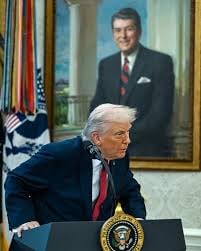
There is a presidency at work in Washington, but it is not clear that there is a president at work in the Oval Office.
Ask Donald Trump about the goings on of his administration, and there is a good chance he’ll defer to a deputy rather than answer the question. “I don’t know her,” he said when asked about his nominee for surgeon general, Casey Means, this year. “I listened to the recommendation of Bobby,” he said, pointing to Robert F. Kennedy Jr., the secretary of health and human services.
Ask Trump for insight into why his administration made a choice or to explain a particular decision, and he’ll be at a loss for words. Ask him to comment on a scandal? He’ll plead ignorance. “I know nothing about it,” Trump said last week, when asked about the latest tranche of photographs released from the estate of Jeffrey Epstein.
None of this on its own means the president isn’t working or paying attention to the duties of his office. But consider the rest of the evidence. He is, by most accounts, isolated from the outside world. He does not travel the country and rarely meets with ordinary Americans outside the White House. He is shuttled from one Trump resort to another to play golf and hold court with donors, supporters and hangers-on.
Ronald Reagan took regular meetings with congressional leaders to discuss his legislative agenda; George H.W. Bush spearheaded negotiations with the nation’s allies and led the United States to war in Iraq; and George W. Bush was, for better or worse, “the decider” who performed leadership for the cameras as much as he tried to exercise it from the Oval Office. Trump is a ubiquitous cultural presence, but there is no outward sign that he is an active participant in running the national government. He was mostly absent during discussions of his signature legislation — the One Big, Beautiful Bill Act — and practically AWOL during the monthlong government shutdown.
It is difficult for any president to get a clear read on the state of the nation; it takes work and discipline to clear the distance between the office and the people. But Trump, in his second term, does not seem to care about the disconnect. Abraham Lincoln once remarked that it would “never do for a president to have guards with drawn sabers at his door, as if he fancied he were, or were trying to be, or were assuming to be, an emperor.” A president has to be engaged — attentive to both the government and the public he was elected to serve.
Trump is neither. He is uninterested in anyone except his most devoted fans, and would rather collect gifts from foreign businessmen than take the reins of his administration. “The president doesn’t know and never will,” Susie Wiles, the White House chief of staff, said in an interview with Vanity Fair, commenting on the work of Elon Musk in the first months of the year. “He doesn’t know the details of these smallish agencies.”
Instead, the work of the White House has been delegated to a handful of high-level advisers. Russell Vought, the director of the Office of Management and Budget, is the de facto shadow president for domestic affairs. As one senior government official told ProPublica, “It feels like we work for Russ Vought. He has centralized decision-making power to an extent that he is the commander in chief.” It was Vought who orchestrated the administration’s assault on the federal bureaucracy, including the wholesale destruction of U.S.A.I.D. It was Vought who either froze or canceled hundreds of billions of dollars in funding for anti-poverty programs, H.I.V. reduction initiatives and research into science, medicine and technology. And it is Vought who has been pushing the boundaries of executive power as he attempts to turn the federal government into little more than an extension of the personal will of the president — as channeled through himself, of course.
If Vought is the nation’s shadow president for domestic policy, then Stephen Miller is its shadow president for internal security. Miller, Trump’s top domestic policy adviser, is using the president’s authority to try to transform the ethnic mix of the country — to make America white again, or at least whiter than it is now. He is the primary force behind the expansion of Immigration and Customs Enforcement and Customs and Border Protection into a roving deportation force. He has pushed both agencies to step up their enforcement operations, targeting schools, restaurants, farms and other work sites and detaining anyone agents can get their hands on, regardless of citizenship or legal status. It is Miller who is behind the militarization of ICE, the use of the National Guard to occupy Democrat-led cities and assist deportation efforts, and the plan to blanket the United States with a network of detention camps for unauthorized immigrants and anyone else caught in his dragnet.
Traditionally, presidents have had a mostly free hand in the conduct of American foreign policy. But here as well Trump has handed the power of the presidency over to a set of figures — inside and outside of government — who are not so much acting on his behalf as they are acting in his stead. Marco Rubio, the secretary of state, and Pete Hegseth, the secretary of defense, are orchestrating a war — and possibly regime change — in Venezuela, while Steve Witkoff, a real estate developer, and Jared Kushner, the president’s son-in-law, are busy pushing a so-called peace deal that would give large parts of Ukraine to Russia, rewarding Vladimir Putin for his decision to wage a war of conquest.
In his foreword to Theodore Sorensen’s 1963 book, “Decision-Making in the White House,” President John F. Kennedy wrote that the “heart of the presidency is therefore informed, prudent and resolute choice” and that the “secret of the presidential enterprise is to be found in an examination of the way presidential choices are made.”
What do we make of a president who chooses not to make these choices?
For Chief Justice John Roberts and the conservative majority on the Supreme Court, the answer is to deliver that president an expansive grant of executive power. In a series of decisions on the court’s so-called shadow docket, Roberts and his allies have backed Trump’s repeated claims to virtually uncontested authority over the entire executive branch. The court has allowed the president to fire officials otherwise shielded by for-cause protections created by Congress, and has signaled quite clearly that it intends to overturn a New Deal-era decision that affirmed the power of Congress to create agencies that are independent of the president’s direct control.
The theoretical basis for the court’s expansion of executive power is the unitary executive theory. Devised by lawyers in the Reagan administration, themselves frustrated by the many legislative obstacles to presidential ambition, the theory holds that the Constitution’s executive vesting clause — “the executive power shall be vested in a president of the United States of America” — is a broad grant of inherent authority. This inherent authority — drawn as well from Article II’s command that the president “take care that the laws are faithfully executed” — includes the power to dismiss executive branch officials at will.
This sounds reasonable until you realize that legislative limits on removal are one of the key ways that Congress holds the president accountable. A nonpartisan official tasked with carrying out the public good or investigating executive branch malfeasance cannot do her job if the president can dismiss her at will for any reason under the sun — or for no reason at all. Imagine a member of a regulatory body, fired because she might threaten the interests of a favored donor, or an inspector general pushed out because he uncovered wrongdoing.
Proponents of the unitary executive theory call it necessary for presidential accountability. This is backward. The theory works instead to shield the president from legislative scrutiny — to render him unaccountable except for a single, quadrennial election. This runs against the structure of the Constitution, which imagines not separation of powers but separated institutions sharing powers. The idea that Congress cannot insulate officials from direct presidential control would shock those members of Congress, among them delegates to the Constitutional Convention, who voted to do exactly that in the 1790s, when the ink had barely dried on the Constitution. Or perhaps they were mistaken and it is Roberts — and the conservative legal community — who understands the true scope of presidential power.
Whether or not the unitary executive theory is historically or intellectually grounded, it is undoubtedly true that in the hands of a president such as Trump, greater executive power is less a means to make the government more accountable than it is a license for presidential dictatorship. It puts something like sovereign power in the hands of one man to use as he sees fit, with few opportunities for real accountability until the next election. Think Bonapartism with an American twist.
But there is something ironic at work in this effort to concentrate executive power in the name of constitutional fidelity. It is being done on behalf of a president who is mostly missing from the business of government. The unitary executive lacks an executive. And the president we have isn’t unitary. He has given his newfound power away to a small set of virtually unaccountable advisers, insulated from public outcry and indifferent to public opinion.
There is a strong argument that far from a grant of presidential power, the executive vesting clause was a simple statement of structure: There shall be one magistrate and not a council of magistrates. This was the subject of real debate during the Philadelphia Convention, and the vesting clause exists to make this clear. Alexander Hamilton’s disquisition on “energy” in the executive branch — found in Federalist No. 70 — is a response to critics who thought republican government needed a plural executive, not a brief for unlimited presidential authority.
The modern presidency is very different from the one the framers envisioned. But one important aspect of the overlapping systems of accountability and control that emerged over the course of two centuries — in response to real and difficult problems of governance — is that they affirmed and reaffirmed the principle of presidential responsibility that drove the decision to create a single executive. A government with independent and nonpartisan officials is a government that can make clear to the people’s representatives in Congress if the president is honoring the public’s trust.
The purpose of the presidency is to carry out the aims of Congress and help govern the nation on behalf of its people — not, as this Supreme Court would have it, to carry out the political will of the president. It makes sense that, from time to time, Congress would put some institutional distance between its goals and the president’s agenda. This doesn’t diminish accountability — it enhances it. Put another way, independence can provide voters a clear view while direct political control can be used to obscure, occlude and obstruct.
In fact, we can see quite clearly that the concentration of presidential power in this administration has done more to make the government unaccountable than it has opened it up to public input or made it more responsive to public discontent.
The embrace of the unitary executive theory by both the president and the court has given us the worst of all worlds: an ultrapowerful presidency without an actual president at the helm. A figurehead whose viziers exercise unitary authority on his behalf, running roughshod over both the law and common decency in pursuit of their own narrow agendas.
The White House is a lost cause, but one might hope that the Supreme Court would be attentive enough to the conditions of the real world to think twice about continued pursuit of its ideological project. But these are principled conservatives. They believe in their theories. And they intend to see them through, no matter the cost to the Constitution or the damage done to American democracy. (New York Times columnist, JAMELLE BOUIE).
Jack Smith spoke the truth in the Congress today and the GOP had nothing to say.
‘Facts and the Law’: Jack Smith Defends Trump Prosecution In Closed Congressional Testimony.
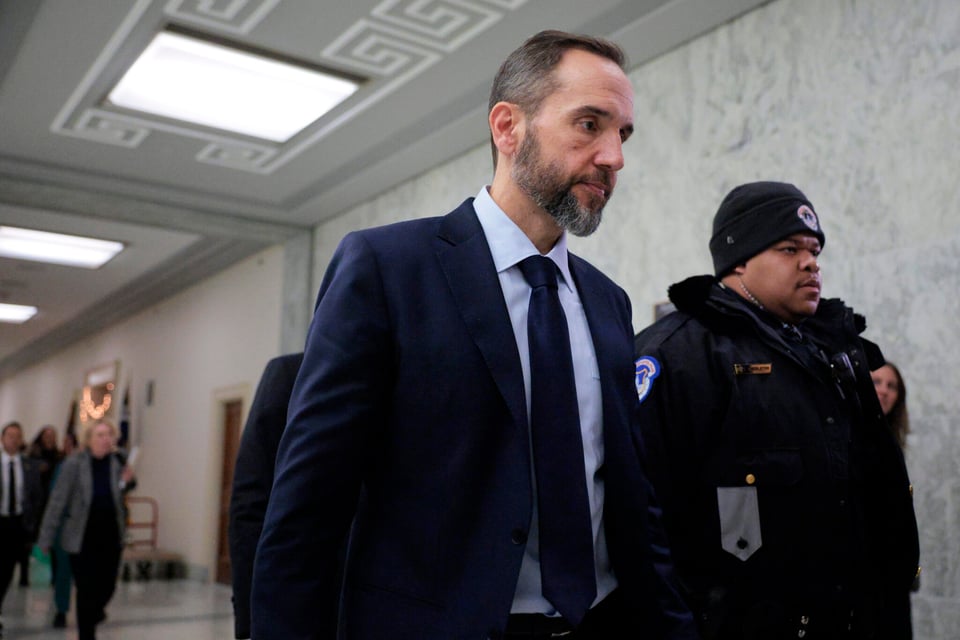
Former Special Counsel Jack Smith returns from a break to testify during a closed-door deposition before the House Judiciary Committee in the Rayburn House Office Building on Capitol Hill on December 17, 2025. Smith was appointed independent special counsel by Attorney General Merrick Garland in 2022 to oversee two criminal investigations into former President Donald Trump’s role in the January 6, 2021 attack on the U.S. Capitol and mishandling of classified documents.
Jack Smith, the former special counsel for the U.S. Department of Justice, forcefully defended his federal prosecution of President Donald Trump in a closed-door hearing Wednesday before the House Judiciary Committee.
During his remarks, Smith pushed back on GOP efforts to discredit the prosecution as unfairly political, arguing that his work was governed by facts and sound prosecutorial ethics.
“Our investigation developed proof beyond a reasonable doubt that President Trump engaged in a criminal scheme to overturn the results of the 2020 presidential election and to prevent the lawful transfer of power,” Smith said in his opening remarks, according to excerpts obtained by Democracy Docket.
The panel subpoenaed Smith earlier this month amid escalating Republican attacks on Smith’s independent investigation into Trump’s election subversion efforts and mishandling of classified documents.
In October, with Attorney General Pam Bondi looking on, Trump called Smith a “criminal,” during an Oval Office press conference, urging the Department of Justice (DOJ) to “look into” him. Earlier this month, Deputy Attorney General Todd Blanche, who was Trump’s criminal defense lawyer in the case, alleged that Smith had improperly withheld evidence.
Smith requested to testify publicly, but House Judiciary Chairman Jim Jordan (R-Ohio) refused.
In his statement, Smith asserted that Trump was charged despite — not because of — the politics involved.
“I made my decisions in the investigation without regard to President Trump’s political association, activities, beliefs, or candidacy in the 2024 presidential election,” he said. “We took actions based on what the facts and the law required — the very lesson I learned early in my career as a prosecutor.”
While Smith said the decision to charge Trump was his alone, “the basis for those charges rests entirely with President Trump and his actions, as alleged in the indictments returned by grand juries in two different districts.”
“If asked whether to prosecute a former President based on the same facts today, I would do so regardless of whether the President was a Republican or Democrat,” he added.
Republicans were incensed after news broke earlier this year that Smith’s investigation obtained phone records of nine GOP lawmakers who were closely involved in Trump’s attempt to block the electoral vote count on January 6, 2021.
“[Phone] records were lawfully subpoenaed and were relevant to complete a comprehensive investigation. January 6 was an attack on the structure of our democracy in which over 100 heroic law enforcement officers were assaulted,” Smith said Wednesday. “Over 160 individuals later pled guilty to assaulting police officers that day. Exploiting that violence, President Trump and his associates tried to call Members of Congress in furtherance of their criminal scheme, urging them to further delay certification of the 2020 election. I didn’t choose those Members; President Trump did.”
Smith also defended the raid on Trump’s Mar-a-Lago residence, which revealed the president had been improperly storing classified materials.
“Our investigation also developed powerful evidence that showed President Trump willfully retained highly classified documents after he left office in January 2021, storing them at his social club, including in a bathroom and a ballroom where events and gatherings took place,” Smith said. “He then repeatedly tried to obstruct justice to conceal his continued retention of those documents.”
Smith dropped the prosecution shortly after Trump won the presidential election in 2024. (Democracy Docket)
Who can resist this late night news.
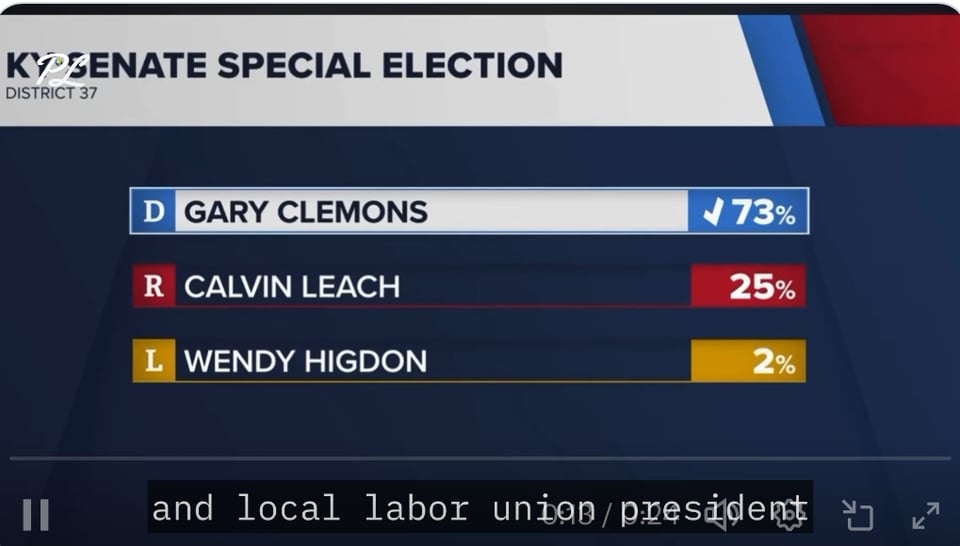
WOW! Kentucky just turned blue in a district Trump won by 30—special election.
— Popular Liberal 🇺🇸 (@PopularLiberal) December 17, 2025
Democrat Gary Clemons—union steelworker, Army vet—flipped a ruby-red state Senate seat the GOP held for 25 years.
No amount of Trump rallies, dark money, or “rigged” screams could stop the exodus.… pic.twitter.com/I11KvtzkRd